

On this page
How to play Daifugo
To win a hand of Daifugo, play all your cards before the other three players do, one play at a time, each play stronger than the one before it.
The deal and the order of the cards
The game uses one 52-card deck and one Joker, 53 cards in all, and all of them are dealt, so each player gets 13 or 14 cards. In the first hand you get the odd card, and later hands give it to the Beggar, the player who finished last. From weakest to strongest the cards go 3, 4, 5, 6, 7, 8, 9, 10, Jack, Queen, King, Ace, 2, and the Joker is stronger than the 2. Wikipedia and pagat give the same order, and it is why the 2 is the card everyone wants and the 3 is the one nobody does.
The player who holds the 3 of diamonds leads the first hand. Wikipedia ja's basic rules start with the 3 of spades and say the 3 of diamonds is used in some regions, and the Federation lets the spades seat start; Play5s uses the 3 of diamonds, as the UECda rules do. The leader may play any card or set, not only the 3 of diamonds, because the sources only say that some groups require the first play to include it. Every hand after the first is led by the Beggar.
What you can play
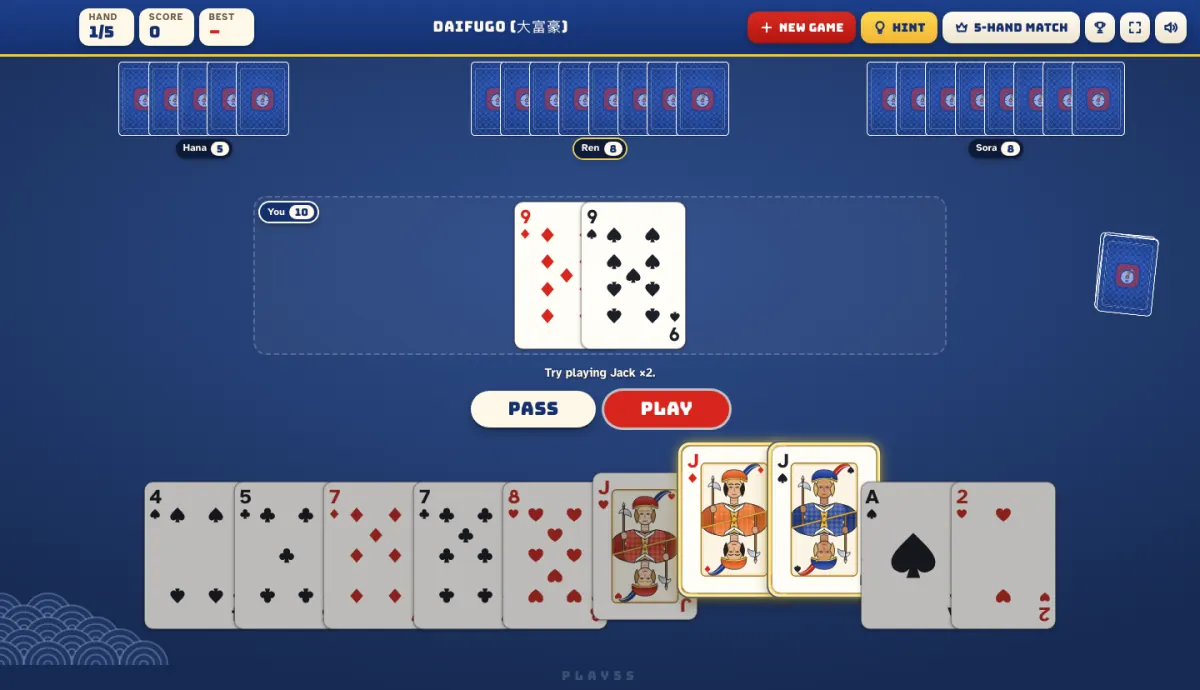
A play is a single card, or a set of two, three or four cards of the same rank. The Joker is wild inside a set: a 9 and the Joker count as a pair of 9s. A single Joker is the strongest card of all. Once a play is on the table, everyone after you must play the same number of cards, and the rank must be higher, or pass.
Passing does not shut you out. You may pass now and play on your next turn in the same round, as pagat describes (the Federation's tournament rules are stricter: after a pass you may not play until the table is cleared), and you are never forced to play a card just because you can. In the Play5s version you tap the cards you want, and the cards that cannot take part in any legal play are dimmed. When you are following a play, the moment your picked cards make a legal play of the right size it is played; when you are leading, tap Play yourself.
| Play | Example | What beats it |
|---|---|---|
| Single card | 7♣ | One higher card, and the Joker beats everything |
| Pair | 9♦ 9♠ | A higher pair |
| Three of a kind | Q♥ Q♣ Q♠ | A higher three |
| Four of a kind | 5♦ 5♣ 5♥ 5♠ | A higher four, and it starts a revolution |
| With the Joker | 8♦ + Joker | Counts as a pair of 8s |
 Zoom in
Passing and clearing the table
When every other player passes, the table is cleared and the player who made the last play leads again with any card or set. You cannot pass when you lead, because there is nothing to pass on. If the player who made the last play has gone out, the next player in clockwise order who still has cards leads.
Going out
A player who plays their last card is out for the rest of the hand, and the others can still beat that last play. If nobody does, the next player leads. The hand goes on until only one player has cards left, and the order in which the players went out is their finishing order: Tycoon, Rich, Poor and Beggar.
Ranks and the card exchange in Daifugo
At the end of a hand the players are ranked Tycoon (大富豪), Rich (富豪), Poor (貧民) and Beggar (大貧民) in the order they went out, and from the second hand on those ranks decide who gives cards to whom.
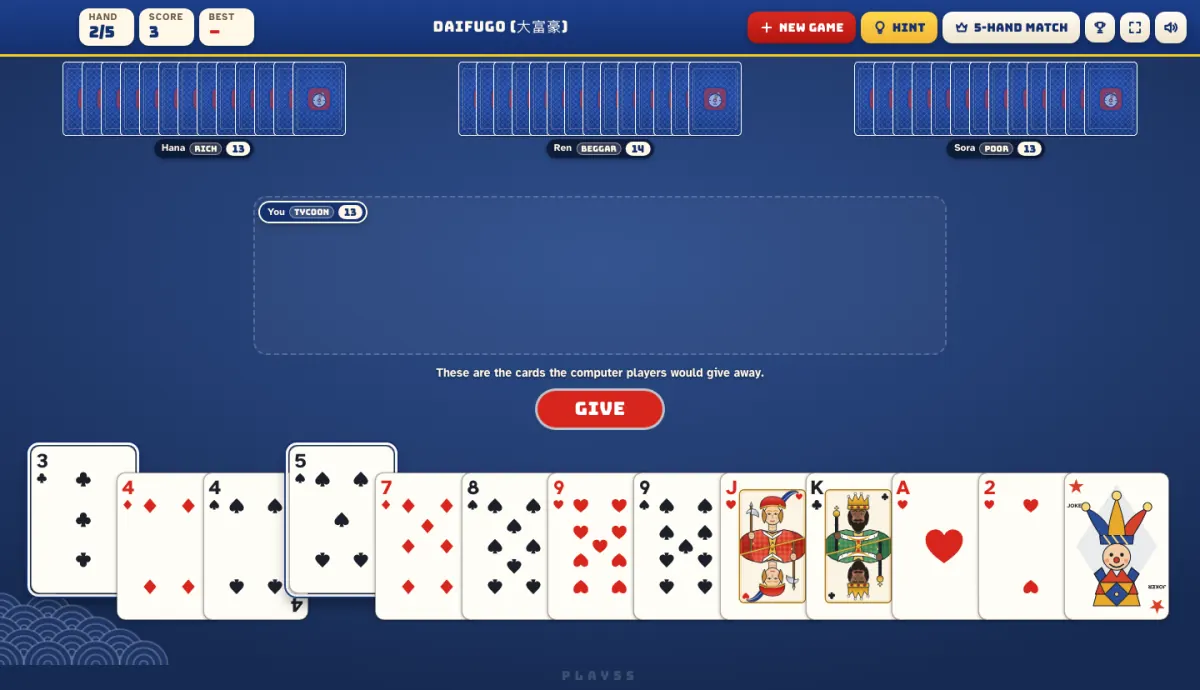
With four players there are four titles and no commoner. English Wikipedia calls the exchange zeikin, "taxation": before the first play of every hand after the first, the Beggar hands their two strongest cards to the Tycoon and the Poor player hands their strongest card to the Rich player. The Tycoon and the Rich player then give back any cards they do not want, two and one. In Play5s the Beggar and the Poor player's cards are taken for you, strongest first, so a Joker or a 2 goes first, and when you are the Tycoon or the Rich player you pick what to give by tapping cards and tapping Give. You choose before you see what you receive.
The Beggar leads the hand, and the rank of every player is shown next to their name on the table. Every hand starts with the strength order back to normal.
| Place | Title | In the exchange | Leads? |
|---|---|---|---|
| 1st | Tycoon (大富豪) | Receives the Beggar's 2 strongest cards, gives back any 2 | No |
| 2nd | Rich (富豪) | Receives the Poor player's strongest card, gives back any 1 | No |
| 3rd | Poor (貧民) | Gives the strongest card | No |
| 4th | Beggar (大貧民) | Gives the 2 strongest cards | Yes |
 Zoom in
The five Daifugo rules the ranked game uses
The ranked game uses five widely played rules: revolution, 8-cut, suit lock, ♠3 return and fall from grace, the five that Wikipedia ja lists as the official rules of the Japan Daifugo Federation.
Daifugo has dozens of local rules, and Wikipedia says players from different regions should agree on them before they start. Play5s turns on the Federation's five and leaves the rest as options, so the standard game is the one most Japanese players will know. Every one of the five can be switched off on the start screen, and then the game is practice. Play5s follows the Federation on the five rules, but not on everything in its rulebook: the Federation bars a player who has passed from playing again until the table is cleared, starts with the spades seat and counts a forbidden finish as official, while Play5s lets you play after a pass, starts with the 3 of diamonds and keeps the forbidden finish as an option.
Revolution (革命)
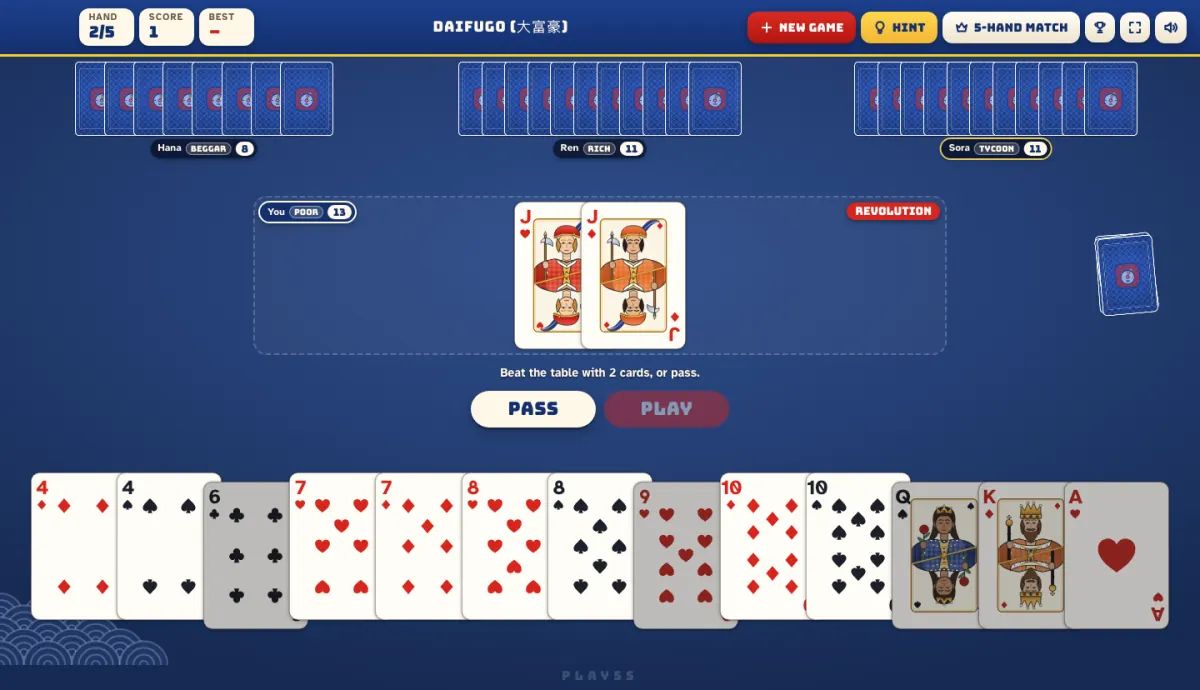
Four cards of the same rank, or three plus the Joker, start a revolution: the order of the cards is reversed, so the 3 is the strongest card and the 2 the weakest, and the Joker stays the strongest of all. It lasts until another set of four is played, which is a counter-revolution (革命返し) and turns the order back. In Play5s the new order applies at once, so four 3s beat four 5s during a revolution. The sources differ on this point: pagat says the new order starts when the table is next cleared, and Wikipedia says that groups read it both ways.
 Zoom in
8-cut (8切り)
Any play of an 8, alone or in a set, clears the table at once and the player who played it leads again. An 8 and the Joker make a pair of 8s, so that clears too, but a lone Joker does not. In Play5s a run that includes an 8 does not cut. If the 8 was the player's last card, the next player in leads.
Suit lock (マーク縛り)
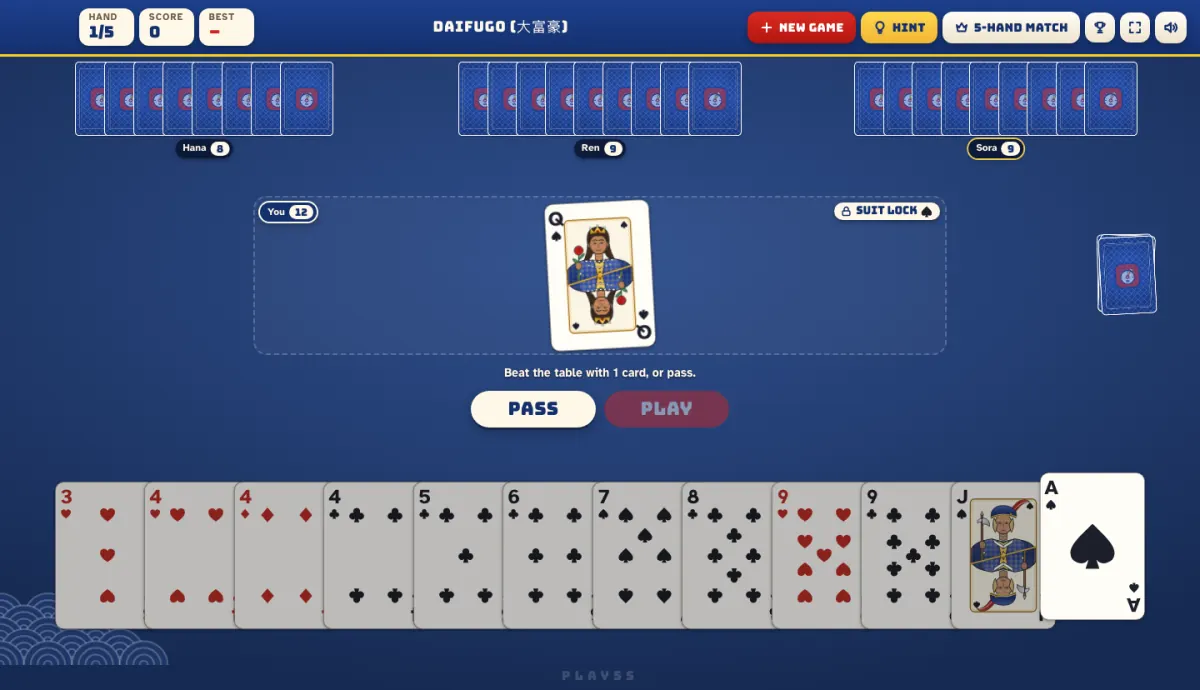
When two plays in a row have the same suit, the suit is locked: from then on only that suit can be played until the table is cleared. A lock works for pairs and threes too, with the same two or three suits. A play with the Joker neither makes a lock nor continues one, as the Federation's rules say, but a Joker may still be played under a lock and takes the locked suit; in a pair or a three the other cards must match the locked suits. This is the shibari rule that pagat describes. Play5s uses the full lock, not the partial lock (片縛り) where one shared suit is enough, which pagat and Wikipedia list as a variant. A badge at the top right of the table shows the locked suit.
 Zoom in
♠3 return (スペ3返し)
A single 3 of spades beats a single Joker and clears the table, so the player who played it leads. It works during a revolution too. Wikipedia describes this version, where the ♠3 clears the table, and pagat describes a milder one where the 3 only beats the Joker and can be beaten by any higher card after that.
Fall from grace (都落ち)
If someone other than last hand's Tycoon goes out first, the Tycoon lays the whole hand down at once and finishes last, with 0 points for that hand, and becomes the Beggar in the next hand while everyone else moves up one place. That is how the Federation's rules put it. A forbidden finish does not make the Tycoon fall, and nothing happens when the Tycoon goes out first. Pagat and Wikipedia describe a milder reading in which the Tycoon only becomes the Beggar next hand and plays on, and Wikipedia says that groups differ. The Japanese name Miyako-ochi means falling from the capital, and the table shows the fall as it happens.
Optional rules: 11-back, runs and forbidden finish
Three more rules can be switched on at the start screen, and a match that uses them is practice and is not ranked.
11-back (11バック)
A Jack played alone or in a set reverses the order of the cards until the table is cleared, and during a revolution it turns the order back to normal. Wikipedia and pagat describe it. In Play5s the badge on the table shows it, and the 11-back ends when the table is cleared.
Runs (階段)
Three or more cards of one suit in a row can be played as a run, such as 4♥ 5♥ 6♥, and only a higher run of the same length beats it. K, A, 2 is a run, and A, 2, 3 is not, because the 2 and the 3 are the two ends of the order. The Joker can fill a gap, and at the end of a run it can be read two ways: when you lead Play5s takes the stronger reading, and when you follow it takes the weakest one that still beats the table. A run does not start a revolution, an 11-back or an 8-cut.
Forbidden finish (禁止上がり)
Going out with the Joker, with a 2 (a 3 during a revolution), with a set of 8s when 8-cut is on or with a lone ♠3 when the ♠3 return is on is a penalty: the player is placed last and becomes the Beggar. Wikipedia ja and pagat list the Joker and the 2, and the Federation's rules add the 8 and the ♠3 with the wording used here: a ♠3 inside a pair, or a run that holds an 8, is fine. The player who is left with cards moves up one place.
Scoring a hand and a match in Daifugo
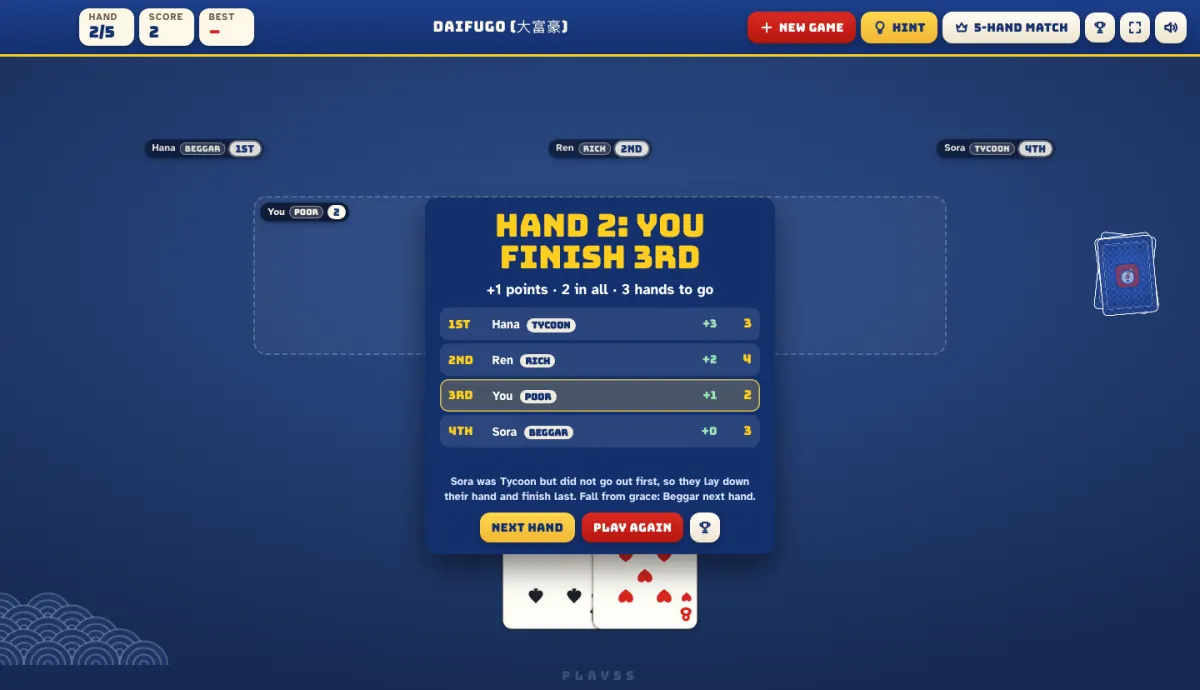
Every hand pays 3 points for 1st, 2 for 2nd, 1 for 3rd and 0 for 4th, and the ranked match adds up five hands.
Traditional Daifugo is played without scores, as pagat says, and the aim is simply to be as rich as possible as often as possible. When a score is wanted, pagat suggests 2 points for the Tycoon and 1 for the Rich player, and the Federation's tournament rules give 6, 4, 2 and 0 points for a game and play twelve games. Play5s halves the Federation's points to 3, 2, 1 and 0 so that every place counts, and plays five hands, which makes 6 points a hand and 30 points a match, shared by the four players.
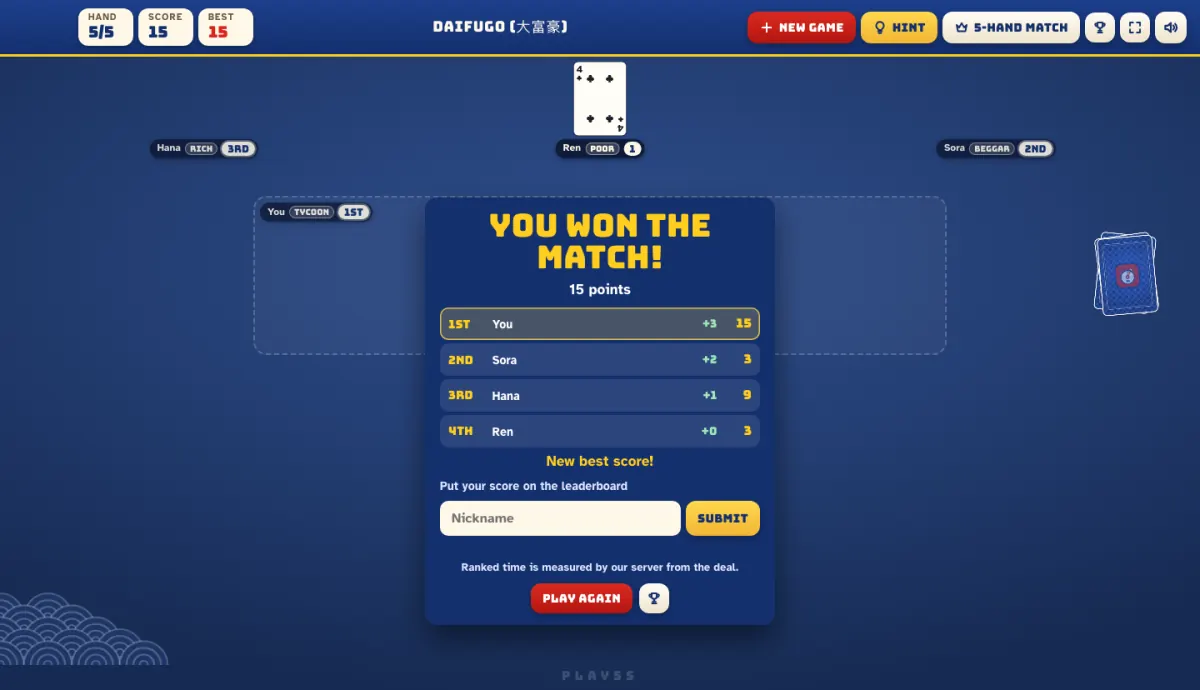
You win the match when you finish with more points than each computer player. Finishing 1st, 2nd, 4th, 3rd and 1st, for instance, scores 3 + 2 + 0 + 1 + 3 = 9. The best possible match is 15 points, and a tie at the top is not a win. The panel after each hand shows the place and the points of every player, and the one after hand five shows who won.
 Zoom in
A single hand is also on the start screen: it has no exchange and no match, and it is practice.
 Zoom in
Match, single hand and easy opponents
The start screen lets you choose a 5-hand match or a single hand, normal or easy computer players, and which rules are on.
A 5-hand match with the five official rules on, the three optional rules off and normal opponents is the ranked game, and the start screen says "ranked" when that is what is selected and "practice" when anything else is. Easy opponents play badly on purpose: about half the time, an easy computer player plays a random legal play or passes instead of its usual choice. The start screen remembers your choice with the game in progress.
How the computer players play
The computer players only use what a player at their seat could see: their own hand, the table, the order of the cards and how many cards everyone holds.
A computer player tries to empty its hand in as few leads as possible. It counts the groups of equal cards it holds and the cards that win the table: Aces, 2s, the Joker and the 8s while 8-cut is on, or the lowest cards during a revolution. It plays the play that leaves the best hand, passes rather than spend a winning card for little, and plays more freely when someone has four cards or fewer. When someone is down to two cards it plays whenever it can. It never looks at your hand.
Its moves depend only on the deal and on what you have done, so a ranked match can be replayed on our server from your moves alone, with the computer players' moves worked out again.
In a Play5s test on 23 November 2026, 400 simulated matches, a player who always followed the Hint button won 20.5% of them, which is close to an even share of 25%, because the Hint plays like a computer player. A player who picked random legal plays won none of them, and a player who followed the Hint against easy computer players won 70%.
Tips for winning Daifugo
The basic strategy of Daifugo is to play your weak cards first and keep your strong cards for the end, as English Wikipedia says too.
- Lead with your low singles and pairs. Every time you win the table you may lead anything, so one weak card can wait until the end if you have a strong card to take the lead back.
- Keep the 2s, the Aces, the Joker and the 8s as your winners. Do not spend a 2 on a low play unless somebody is about to go out.
- An 8 is a free lead: it clears the table and you lead again, so play your weak cards, then use an 8 to get the lead back.
- Pass when the only play you have would use a winner for little. A pass does not stop you playing next time round.
- When one player is down to one or two cards, stop passing. Beat their plays with strong cards, and lead sets so that a single card cannot go out.
- Think before four of a kind. A revolution makes your low cards strong and your 2s weak, which is good for a hand full of 3s and 4s and bad if you hold 2s and Aces.
- Watch the suit lock. After two plays in a row of the same suit, count how many cards of that suit you have, because every other card is stuck until the table is cleared.
- A lone Joker can be beaten by the ♠3, so do not count on it as your last card when that rule is on.
- As the Tycoon you must go out first. If you cannot, you fall from grace, so spend your winners early in that hand.
- Use the Hint button when you are unsure. It plays the way the computer players do, using only your own hand and the table. In a ranked match or the Daily Deal it asks first, because using it makes that match practice.
Daily Deal and leaderboards
The Daily Deal is one 5-hand match that every player gets on the same day, and the leaderboards rank the points you scored over the match.
The leaderboards count 5-hand matches with the five official rules on and normal opponents. There is one all-time board, and the Daily Deal has its own board. Only a match that you win goes on a board, a win meaning more points than each computer player, and the boards are ranked by your points, so a higher number is better. If two players have the same points, the one with fewer seconds wins, and then whoever posted first.
The Daily Deal is the same match for everyone, the day changes at midnight New York time, and the match is chosen from a list in which every deal has a winning line that our solver found. The solver plays like the computer players with a few varied choices, and a line that is only the Hint's choices does not count. The Daily Deal needs a connection because our server hands out the deal. Each connection gets one ranked Daily Deal result per day, and after that the Daily Deal is practice.
Using the Hint in a ranked match or the Daily Deal makes that match practice: the game asks before it opens the Hint, and the server refuses a match that was played with it. The time is measured by our server, from the moment the server dealt the match. The nickname is 2 to 12 characters, offensive names are refused, and you do not need an account. When you submit, your moves and nickname are sent to our server, which replays the match with its own copy of the rules and the computer players to work out the points.
Controls and saving
You play by tapping or clicking cards to pick them and tapping Play or Pass, and the keyboard works for everything.
- Tap or click a card to pick it, and tap it again to put it back. A card that is dimmed has no play right now, and a message tells you why when you tap it.
- Following a play, the picked cards are played as soon as they make a legal play of the right size. Leading, tap Play (key P) when the cards you picked are the play you want.
- Pass is the other button (key S). Leading, you cannot pass.
- The Hint (key H) picks cards for you. In a ranked match or the Daily Deal the game asks first, because using the Hint makes that match practice.
- As the Tycoon or the Rich player, pick the cards to give away and tap Give.
- Keyboard: Tab goes into your hand, the left and right arrows move along it, Enter or Space picks a card, Escape puts the picked cards back, N starts a new game, F switches full screen and M switches the sound.
- The start screen has the format, the opponents and the eight rule switches. It remembers your choice.
- There is no Undo in Daifugo, because taking back a play after the computer players have answered would show you their cards.
- Your game in progress, your options and your best match are saved in this browser on this device. Clearing your browser data removes them.
What Daifugo is and what it is related to
Daifugo is a Japanese climbing card game, a shedding game in which the first player to get rid of all their cards wins, and it is a close relative of President and Big Two.
The name 大富豪 means "grand millionaire", and the game is also called 大貧民, Daihinmin, "grand pauper", and Wikipedia ja mentions a theory that people in the Kanto area tend to say 大貧民 and people in the Kansai area 大富豪. Pagat says the game seems to have come from China in the 1970s, became popular across Japan in the 1980s and 1990s, and gathered many extra rules in those years. It also says that an early form of Daihinmin is likely the direct ancestor of President.
English Wikipedia lists the Hong Kong game Big Two, the Chinese Zheng Shangyou, the Vietnamese Tien Len and the Western President and The Great Dalmuti as similar games, and Wikipedia ja adds the Chinese Dou Dizhu and others. If you like shedding games with a different feel, try Crazy Eights, where you match the top card, or the trick-taking Hearts and Spades.
Daifugo terms
Daifugo has its own words, and most of them are Japanese.
- 大富豪 (daifugō, Tycoon) and 大貧民 (daihinmin, Beggar): the winner and the loser of a hand. 富豪 (fugō, Rich) and 貧民 (hinmin, Poor) are the two in between.
- 革命 (kakumei, revolution): four of a kind, which reverses the order of the cards.
- 8切り (hachigiri, 8-cut): an 8 that clears the table.
- マーク縛り (shibari, suit lock): two plays in a row in the same suit that lock the table to that suit.
- スペ3返し (supe-san-gaeshi, ♠3 return): the 3 of spades beating the Joker.
- 都落ち (miyako-ochi, fall from grace): the Tycoon who does not win again and falls to Beggar.
- 階段 (kaidan, run): three or more cards of one suit in a row.
- Table (場, ba): the play on the table that you have to beat. Clearing it (場を流す) lets the next leader start a new one.
Where the rules come from
The rules on this page come from sources that were read on 23 November 2026, and every choice that is specific to Play5s is listed here.
- Wikipedia: 大富豪: the basic rules, the ranks for four players, the exchange, the odd card, the local rules and, in its section on the rules of the Japan Daifugo Federation, the Federation's five official rules with its rulings on the suit lock (no lock from a play with the Joker), fall from grace (the Tycoon lays the hand down), the forbidden finish and the scores.
- Wikipedia: Daifugō: the titles, the exchange (zeikin), the order of the cards and the basic strategy.
- pagat (John McLeod, Dai Fugō / Dai Hinmin): the plays, passing, going out, the exchange, the scores and the variations, among them the milder reading of fall from grace and of the ♠3 return.
- A Japanese rules guide (KrK, 大富豪ローカルルールざっと, updated 14 November 2026): a list of local rules that marks the same five as the Federation's official rules. It was used for the list only, the rulings come from Wikipedia ja.
- The UECda standard rules of the Computer Daihinmin Contest, as written in an MIT-licensed program (Hironsan/TatsujinDaifugo): the 3 of diamonds start and runs of three or more. Play5s did not copy its code. Two other open-source projects were read for edge cases (wand125/daifugo, MIT; tsukushibito/Daifugo, Apache-2.0), and a GPL one only for the rules.
- The first lead: the holder of the 3 of diamonds leads and may play anything, which is how the UECda rules and the MIT-licensed wand125/daifugo document put it. The Federation starts with the spades seat, and Wikipedia ja's basic rules with the 3 of spades.
- Passing: Play5s lets you play after a pass, as pagat describes. The Federation does not.
- The exchange: the rich players choose what to give back without seeing what they get, which is the Federation's way and one of the two that Wikipedia ja lists.
- The scoring: 3, 2, 1 and 0 points for every place and five hands to a match is Play5s's own choice, half of the Federation's 6, 4, 2 and 0 points for a game, with pagat and Wikipedia en for the 2 and 1 points.
- The options (11-back, runs, forbidden finish): Wikipedia ja and pagat, with the Federation's wording for the forbidden finish. Anything the sources leave open is named in the sections above.
Daifugo questions
What is Daifugo?
Daifugo (大富豪) is a Japanese card game for four players here, in which you try to be the first to get rid of all your cards by playing stronger cards or sets than the player before. It is also called Daihinmin, and President and Big Two are close relatives.
How many cards do you get in Daifugo?
All 53 cards (52 plus a Joker) are dealt, so each player gets 13 or 14. In the first hand you get the odd card and in later hands the Beggar gets it.
What is the order of the cards in Daifugo?
From weakest to strongest: 3, 4, 5, 6, 7, 8, 9, 10, Jack, Queen, King, Ace, 2, and then the Joker. A revolution reverses the order of everything except the Joker.
What does the Joker do in Daifugo?
In a set it is wild, so a 9 and the Joker count as a pair of 9s. Alone it is the strongest card, and with the ♠3 return rule on, only a single 3 of spades beats it. A play with the Joker never starts a suit lock.
What is a revolution in Daifugo?
Four cards of the same rank, or three plus the Joker, reverse the order of the cards until another set of four is played. The 3 becomes the strongest card and the 2 the weakest.
What is 8-cut?
Any play with an 8 clears the table at once and the player of the 8 leads again. A run with an 8 in it does not clear it in this version.
What is the suit lock in Daifugo?
When two plays in a row have the same suit, only that suit can be played until the table is cleared. A play with the Joker makes no lock, and a Joker can still be played under one.
What happens at the start of the second hand?
The Beggar gives the Tycoon their two strongest cards and the Poor player gives the Rich player their strongest card. The Tycoon and the Rich player give back two and one cards of their choice, and the Beggar leads.
What is fall from grace (都落ち)?
If someone other than last hand's Tycoon goes out first, the Tycoon lays the whole hand down and finishes last, then becomes the Beggar in the next hand while everyone else moves up.
How is Daifugo scored?
In Play5s a hand gives 3 points for 1st, 2 for 2nd, 1 for 3rd and 0 for 4th, and a ranked match is five hands. The most points over five hands wins, and a best match is 15.
Can you play Daifugo with fewer than four players?
Not here: the game is always you and three computer players. Wikipedia ja says that four to six players is usual and pagat says three to six, and other numbers work with other rules.
Why do local rules differ so much?
Daifugo became popular across Japan in the 1980s and 1990s, and pagat says many extra rules were added in those years, so regions play it differently. Play5s turns on the Federation's five, and you can switch the rest on or off at the start screen.
Can the computer players see my cards?
No. They use their own hand, the table, the order of the cards and the number of cards everybody holds. They never look at your hand.
Is there a Daifugo leaderboard and a Daily Deal?
Yes: a Daily Deal that is the same 5-hand match for everyone on a given day, and an all-time board. Boards rank the points you scored in a match with the five official rules, and you only need a nickname. A match in which you used the Hint is practice.
Does the game save my progress?
Yes. Your current match, your options and your best match are saved in this browser on this device. Clearing your browser data removes them. Only matches you choose to submit to a leaderboard are sent to our server, with your nickname.
About this version
This Daifugo was built by Play5s to run in any modern web browser. It shuffles a new deal for every match, and the computer players follow fixed rules that are described on this page. The cards, including the Jacks, Queens, Kings and the Joker, are drawn by Play5s.
There is nothing to install and no account to create. Your game in progress and your best match are kept in your browser on this device. Starting a ranked match or the Daily Deal asks our server for a deal and a ticket; your moves and nickname are sent only when you submit a match to a leaderboard.
The page gives the rules as Wikipedia, pagat and the Japan Daifugo Federation's rules (as Wikipedia ja writes them) describe them, and the choices that are specific to this version are listed in the section on where the rules come from.
Read more about Play5s, or see all of our free card games.