

On this page
How to play Hearts
To win Hearts, take fewer points than the other three players: a game is a series of hands, each hand is 13 tricks, and the hearts and the queen of spades are the cards that cost you points.
The goal and the setup
Hearts is played with a standard 52-card deck by four players, as most sources describe it; three to six can play, but four is the usual number. Aces rank high, there is no trump suit, and each player is dealt 13 cards. You sit at the bottom of the table, and the three computer players sit West, North and East. Play goes clockwise, from you to West, North and East.
You never want to win points: a heart is 1 point, the queen of spades is 13, and every other card is worth nothing. That makes 26 points in every hand, and the game ends after a hand in which someone reaches 100 points. The player with the lowest total then wins.
Passing three cards
Before the first trick you pick three cards from your hand and pass them to another player, and you receive three cards from someone else. The direction follows a cycle of four hands: left on the first hand, right on the second, across on the third and no passing on the fourth, and then it repeats. Wikipedia and pagat describe the same cycle for the Black Lady game that most apps call Hearts.
Passing is where you shape your hand. You can pass the cards most likely to cost you points, such as the queen of spades and high hearts, or cards that leave you with few cards in one suit. In this version you tap a card to choose it, tap it again to take it back, and press Pass once three are chosen. Hint chooses the three cards the computer would pass.
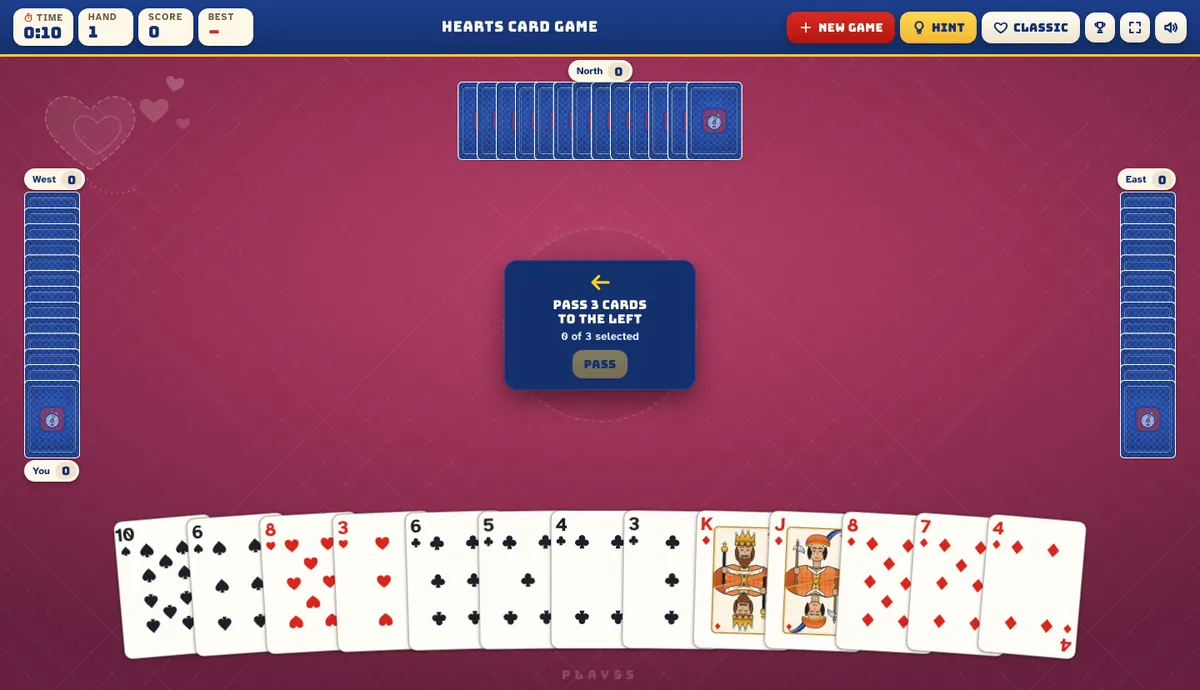 Zoom in
After the pass, the cards you received are mixed into your hand. The player who holds the 2 of clubs starts the hand, which can be you or one of the computer players.
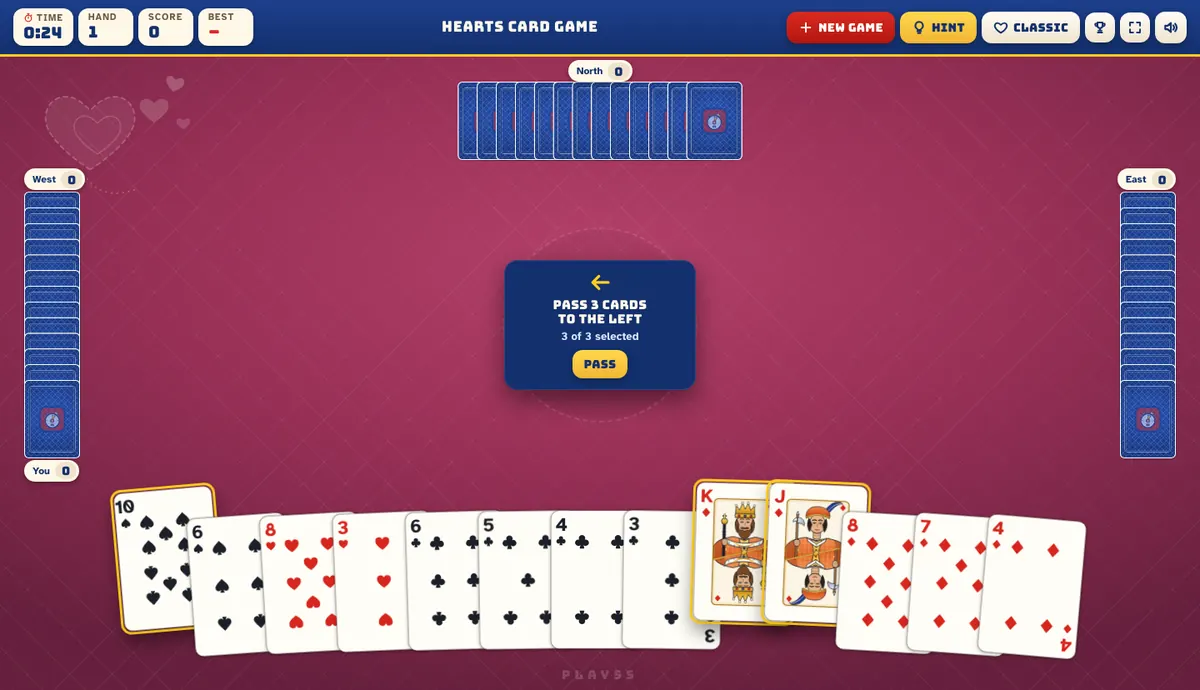 Zoom in
Playing a trick
A trick is four cards, one from each player. The player who starts it, called the leader, plays any card the rules allow, and everyone else must play a card of the same suit if they have one. If you cannot follow suit you may play any card, which is the moment to get rid of a heart or the queen of spades. The highest card of the suit that was led wins the trick, and its winner takes the four cards and leads the next trick.
The 2 of clubs starts the first trick, and nobody may play a heart or the queen of spades on it unless every card in their hand is a point card. This version dims the cards you cannot play, and if you tap one anyway it tells you why: follow the suit that was led, no hearts on the first trick, or the 2 of clubs opens the hand.
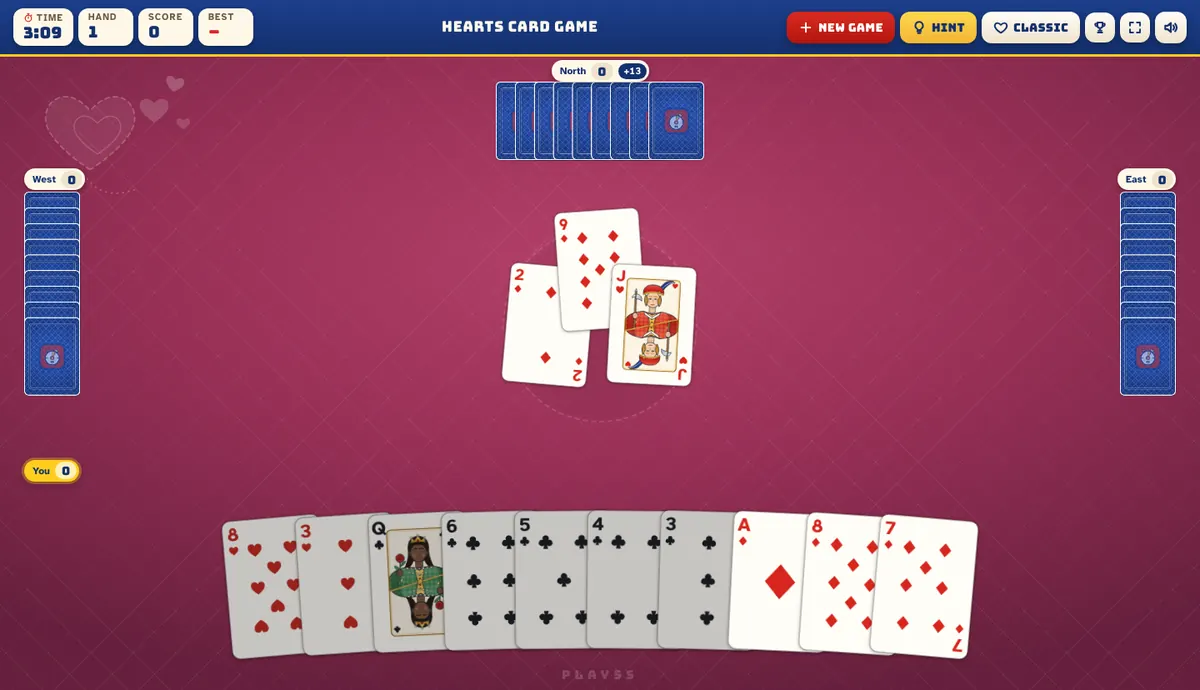 Zoom in
Leading and breaking hearts
You may not lead a heart until hearts have been "broken", which means a heart has been played on an earlier trick, usually thrown on a trick of another suit by a player who could not follow. The exception is a hand with nothing but hearts, which may lead one. In this version the queen of spades does not break hearts, the same choice cardgames.io makes; some sources, such as pagat, list it as a variation. The small heart in the middle ring of the table turns red and cracks when hearts are broken.
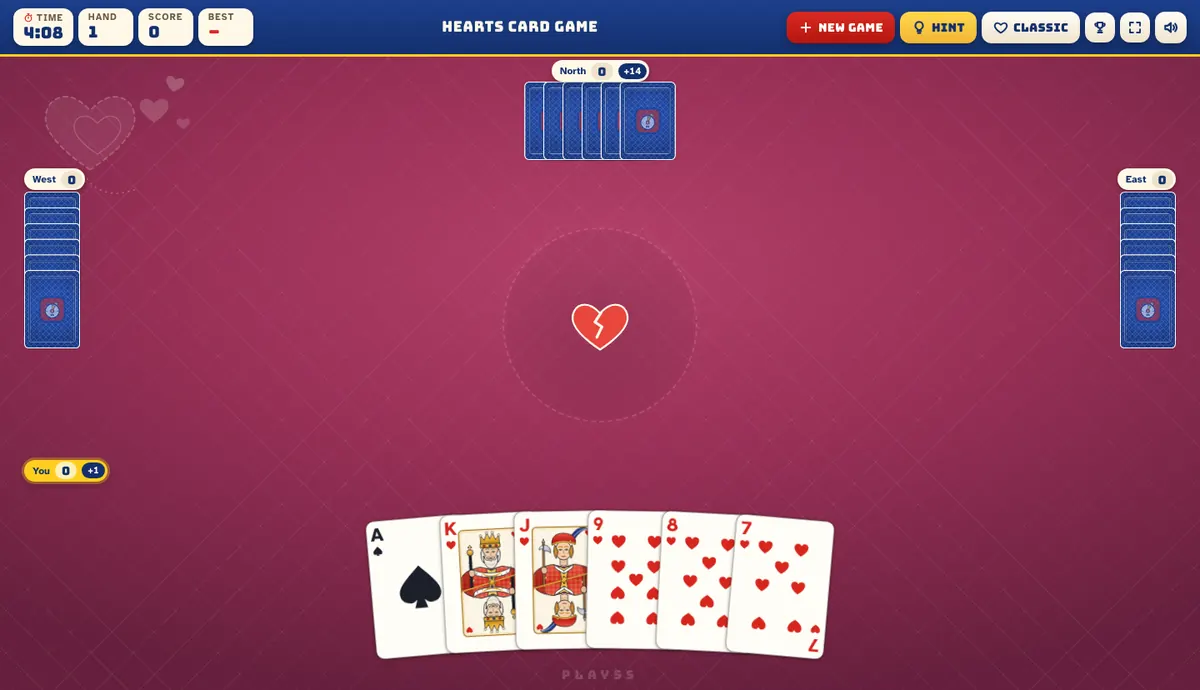 Zoom in
Ending a hand and a game
After the 13th trick each player counts the hearts and the queen of spades in the tricks they won, and the totals are added to the running scores. The next hand is dealt and the passing direction moves on. When a hand ends with at least one player on 100 or more, the game is over and the lowest total wins; if two players share the lowest total, more hands are played until one is alone in front. Microsoft Hearts games, according to Wikipedia, typically run between six and ten hands.
Hearts scoring: points, shooting the moon and the final total
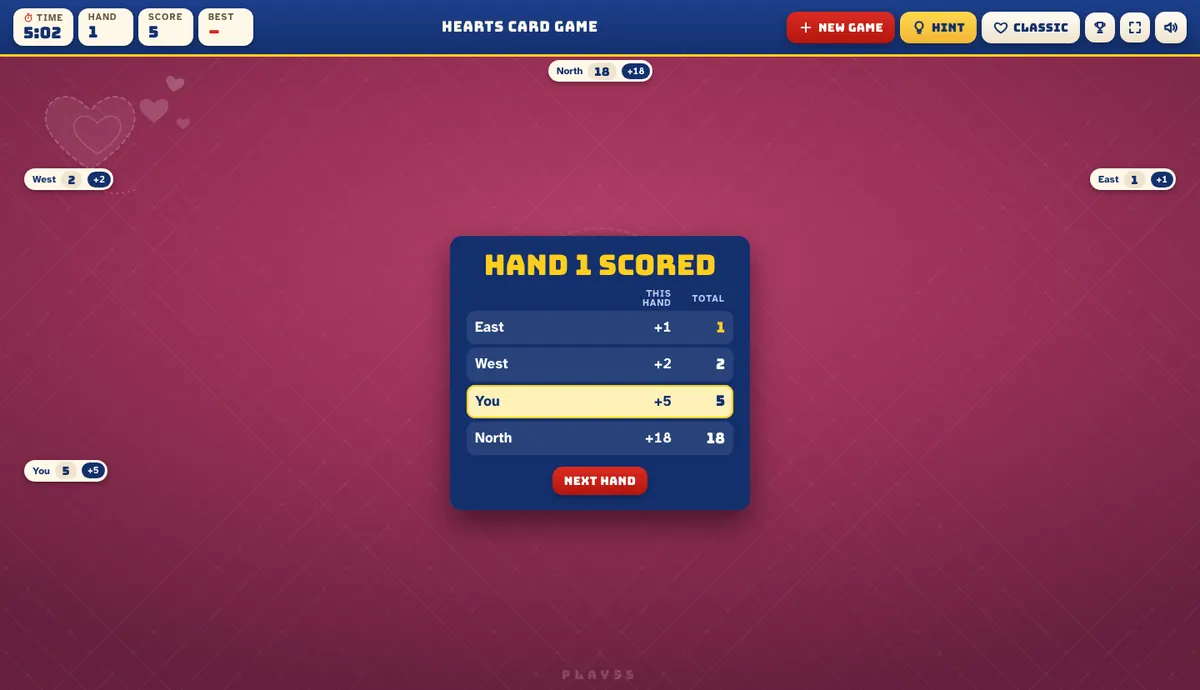
In Hearts, every heart you win is 1 point and the queen of spades is 13, so there are 26 points in a hand, and the lowest total wins.
What each card is worth
The ace through the 2 of hearts are worth 1 point each, 13 points in all, and the queen of spades is worth 13. No other card has a value in the Classic rules. Points are counted per player, not per trick: a trick holding the queen of spades and three hearts costs the player who wins it 16 points.
 Zoom in
Shooting the moon
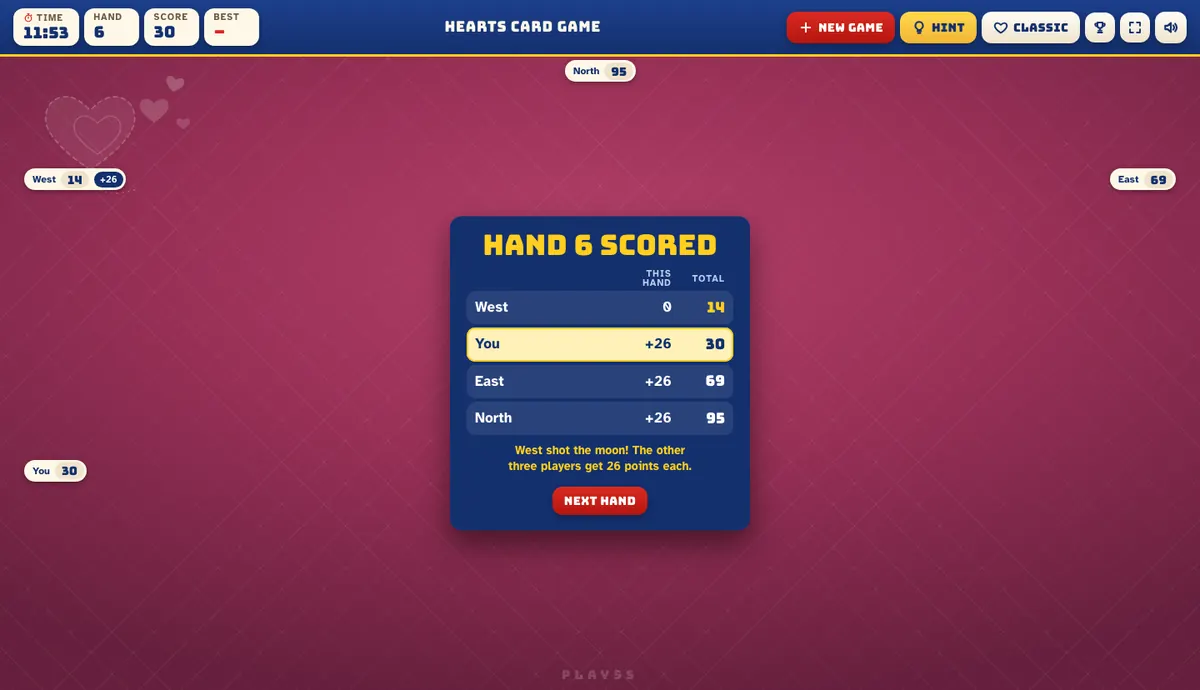
If one player wins every point card in a hand, all 13 hearts and the queen of spades, they have "shot the moon". In this version that player scores 0 for the hand and each of the other three players scores 26. Wikipedia and cardgames.io describe it this way, and the player who shoots is not asked to choose; some sources let the shooter subtract 26 instead, and this version does not.
It is hard to pull off, because every other player is trying to take at least one heart or the queen of spades. The computer players know this: when one player has taken every point so far in a hand, they try to win a trick with a heart in it to stop the run.
 Zoom in
Winning the game
Your final score is your running total after the last hand, and lower is better. The Best box in the bar above the table shows the lowest total you have reached in a game you won, for the rule set you are playing. The Score box shows your current total.
Which Hearts rules does this version use?
This version uses the most common US rules: four players, a three-card pass in a four-hand cycle, the 2 of clubs to lead, no points on the first trick, and 100 as the end of the game.
Hearts has many house rules, so these are the choices Play5s made. They match Wikipedia's description of Microsoft Hearts and the rules on cardgames.io, and where a source differs the difference is named.
- Players and deal: you and three computer players, 13 cards each. The game never uses a three- or five-player layout.
- Passing: three cards, left, right, across, then no pass, repeating. You choose yours; the computer players choose theirs at the same moment.
- First lead: the holder of the 2 of clubs leads it. Older rules, which pagat mentions, let the player to the dealer's left lead any card.
- First trick: no heart and no queen of spades unless every card in the hand is a point card.
- Breaking hearts: a heart may not lead until a heart has been played. The queen of spades does not break hearts.
- Points: 1 per heart and 13 for the queen of spades in Classic. Omnibus also gives the jack of diamonds −10.
- Shooting the moon: the shooter scores 0 and everyone else 26. It needs all 13 hearts and the queen of spades, in both modes.
- End of the game: after a hand in which someone reaches 100, the lowest total wins, and a tie for the lowest total means more hands.
- No Undo: the computer players answer straight away, so taking a card back would let you see how each play is answered. The real game has no take-backs either.
Classic or Omnibus rules?
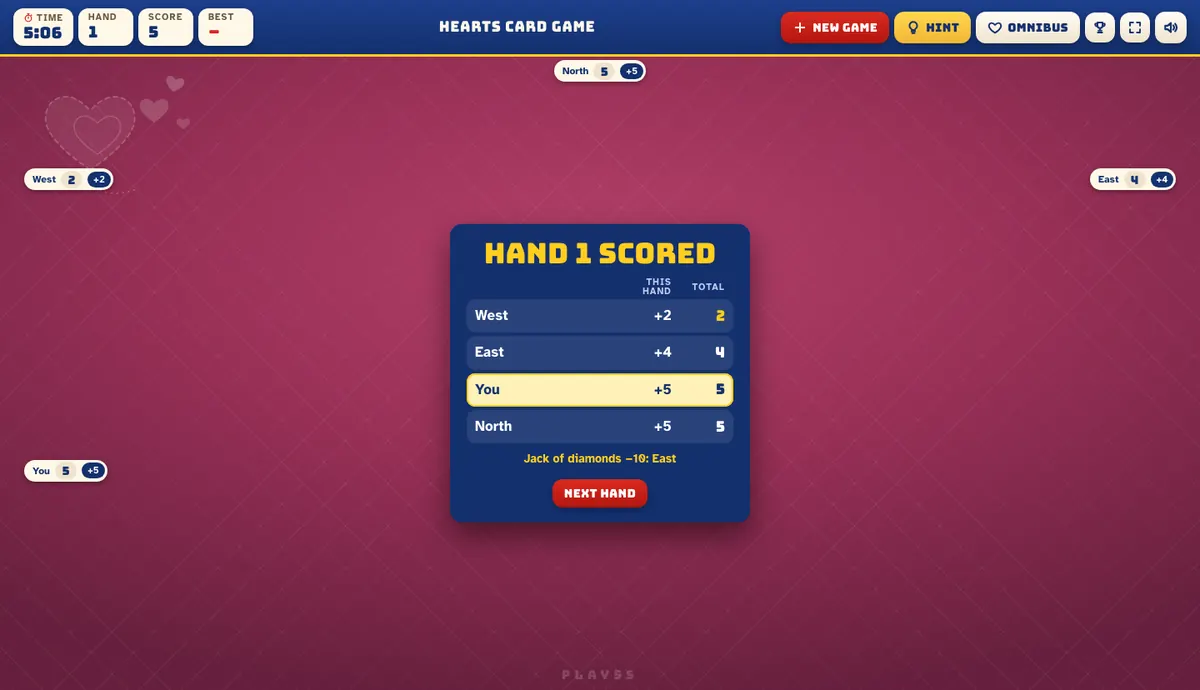
In the Play5s version, Classic is the usual Hearts scoring, and Omnibus adds one bonus card: the jack of diamonds is worth −10 points to the player who wins it.
Omnibus is the name Wikipedia and pagat give to Black Lady with the jack of diamonds as a bonus card; some players use the 10 of diamonds instead, and this version uses the jack. The jack is worth minus 10 to whoever wins it, so players want it, and it can pull a total below zero. In Omnibus shooting the moon still needs the 13 hearts and the queen of spades, and the jack's −10 is applied on top for whoever took it. Because the jack takes 10 off the points handed out in a hand (16 instead of 26 when it is won), an Omnibus game usually lasts more hands.
Many other variations exist and are not part of this version: Black Maria adds the ace and king of spades as penalty cards, Spot Hearts scores each heart by its rank, Cancellation Hearts is for larger groups with two decks, and partnership versions pair the players across the table. The mode button above the table switches between Classic and Omnibus and starts a new game, and your Best score and the leaderboard are kept separately for each.
 Zoom in
Hearts strategy: how to take fewer points
The most useful habit in Hearts is to play to lose tricks that carry points, which means keeping low cards for the right moment and getting rid of high ones early.
- Pass the cards that can hurt you. The queen of spades is the biggest danger, and the ace and king of spades are risky when you hold few spades, because other players can lead low spades to force the queen out. High hearts are also worth passing, because they win tricks you do not want.
- Build a void when you can. If you hold two or three cards of a suit, passing them leaves you with none, and the next time that suit is led you may throw a high card or the queen of spades. Wikipedia lists being "void" as a strong position.
- Duck under the winning card. If someone has played a 9 and you hold a 7 and a king of the same suit, play the 7: you stay under the card that wins the trick and keep the king for a trick you cannot lose. Wikipedia calls this undershooting.
- Keep a few low hearts. Late in a hand, a low heart lets you lose the lead on a trick that carries points, when it matters most, so many strong players keep them rather than leading them early.
- Count the queen of spades. Leading a low spade makes whoever holds the queen play her when they must follow suit. If you hold the queen yourself, a long spade suit of five or more cards guards her, and with fewer it is usually better to pass her.
- When you are last to play on a trick with no points, you can safely win it with a high card you want to get rid of, such as a king or an ace, as the computer players do, but remember that you have to lead next.
- Watch for a run at the moon. If one player has taken every point so far, taking one heart yourself is worth the points because a shot at the moon costs the other three players 26 each.
- Lead low when you have to lead. A low card in a suit where higher cards are still out is likely to lose the trick, and it passes the lead on to someone else.
How the computer players play
The computer players in this version decide from their own hand and the cards already played, with no hidden information and no random numbers.
A computer player does not see anyone else's hand. It looks at its own cards, the cards on the table and the cards that have already been played in the hand. Because no random numbers are involved, the same game played with the same moves always plays out the same way, which is what lets the server replay a ranked game and check your score.
When passing, a computer player gives away the queen of spades unless it holds five or more spades to guard her, passes the ace and king of spades when it holds four or fewer spades, and passes high hearts. When leading, it chooses the card least likely to win a trick that carries points, such as a low card in a suit where many higher cards are still out. When following, it plays the highest card that still loses the trick, throws the queen of spades onto a trick won by a higher spade as soon as it can, and when it cannot follow suit it discards the queen of spades, then the highest hearts. Hint uses the same rules for your hand.
Daily Deal and leaderboards
The Daily Deal is one Classic game that every player gets on the same day, with the same hands in the same order for everyone; each Daily Deal was checked in advance by a test player using the computer's own choices, so it can be won.
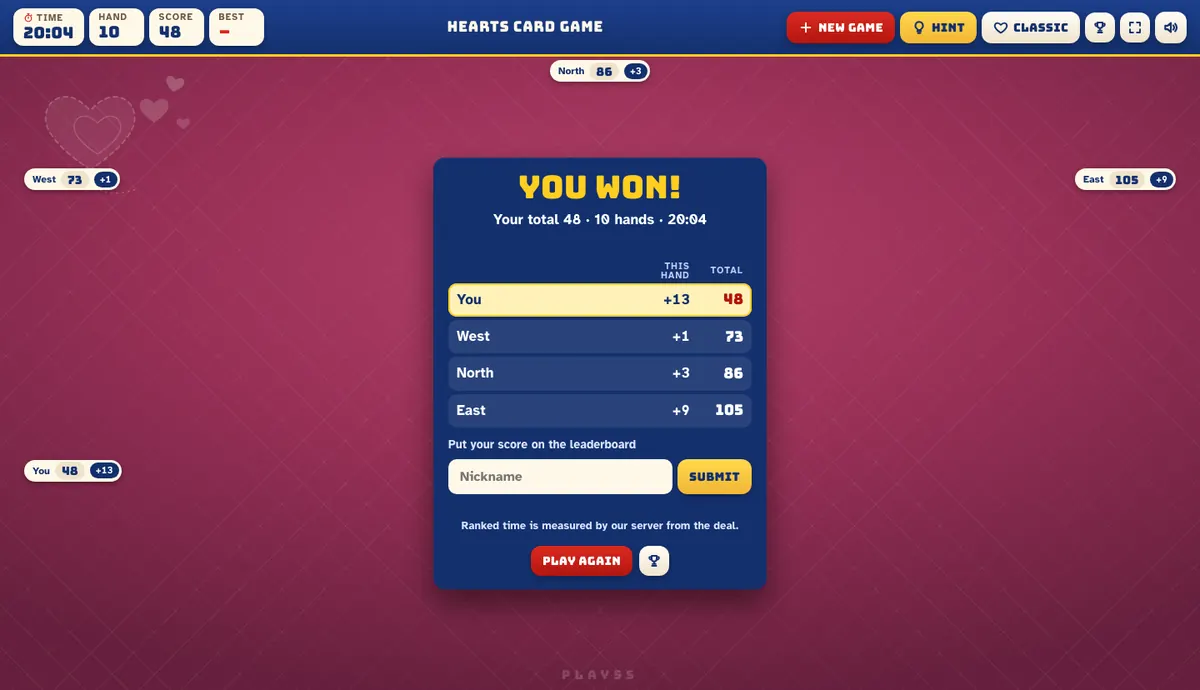
Only games you win go on a board, and players are ranked by their final total, lowest first. If two totals are the same, the faster time ranks higher, and then whoever posted first. The Daily Deal board starts fresh every day at midnight New York time, and there is an all-time board for Classic and for Omnibus. After you win you can put your total on a board with a nickname of 2 to 12 letters or numbers; offensive nicknames are refused, and you do not need an account.
Starting a regular game or the Daily Deal asks our server for a deal and a ticket, so the Daily Deal needs an internet connection. The ranked time is measured by our server from the moment it hands out the deal. Each connection gets one ranked result per Daily Deal day; after that, playing the Daily Deal again is practice. When you submit, the server replays the cards you passed and played, works out the computer players' moves itself, and posts the total it gets, so a forged score is refused.
 Zoom in
Hearts controls: tap, click or keyboard
Tap a card to play it, or to choose it when you are passing; press Enter or Space on a card if you are using the keyboard.
Cards you cannot play right now are dimmed, and a tap on one gives a small shake and a short message that says why. The cards of your hand overlap, so tap the visible edge of the card you want. While the computer players take their turns, taps on your cards are ignored.
Buttons and saving
Hint chooses three cards to pass, or the card to play. New game and the mode button start a new game, and while a game is in progress they ask first (Esc keeps it). When a hand ends, a scoreboard shows the points of that hand and the totals, and the next hand is dealt when you press Next hand. The full screen button hides everything except the table. The gear (Settings) button opens a panel with two switches: sound effects for passing, playing and winning, with a low thud for the queen of spades (on at first), and a quiet background music loop (off until you turn it on); both choices are remembered for every Play5s game. The same panel lets you pick the language of the game’s own words, and the M key mutes or unmutes the sound effects.
The bar above the table shows your time, the hand number, your total and your best total, and the cup button opens the leaderboards. Your current game is saved in this browser on this device, so you can leave and pick up where you stopped, in the middle of a trick if you like.
Keyboard shortcuts
On a computer you can play without the mouse. Tab moves to your hand, the left and right arrow keys move along it, and Enter or Space plays the card or chooses it for the pass.
- Left and right arrows, Home, End: move along your hand
- Enter or Space: play the card, or choose it to pass
- P: pass the three chosen cards
- H: show a hint
- N: start a new game
- F: full screen on or off, Esc to leave it
- M: sound effects on or off
Hearts terms
Hearts has a small set of words of its own, and most of them are shared with other trick-taking games.
- Trick: one round of play in which every player puts down one card; the highest card of the suit that was led takes it.
- Hand: one deal, from the pass to the 13th trick. A game is several hands.
- Lead: to play the first card of a trick. The 2 of clubs is the first lead of every hand.
- Follow suit: to play a card of the suit that was led. It is required whenever you have one.
- Void: having no cards in a suit. A void lets you throw a card of another suit when that suit is led.
- Slough: to throw an unwanted card, such as a heart or the queen of spades, on a trick you cannot win.
- Breaking hearts: playing the first heart of the hand, which opens hearts for leading.
- Point card: a heart or, in Classic, the queen of spades, the cards that carry points.
- Shooting the moon: winning all the point cards in a hand. Some sources also call it a slam or running.
- Black Lady: the queen of spades, and the name used in books for the game most apps simply call Hearts.
- Duck or undershoot: to play a card just under the card that is winning the trick.
Where Hearts comes from
Hearts is a trick-avoidance card game first recorded in the United States in the 1880s, according to Wikipedia, and it probably grew out of Reversis, a Spanish game that became popular around 1750.
The Standard Hoyle of 1887 described Hearts as a no-trump game for four players where the aim was to avoid hearts, and said it had been played in the United States for about five years and was "probably of German origin". The queen of spades was added as the highest penalty card in 1909, in a variant called Discard Hearts or Black Lady, and that version is the one most people mean today. The jack of diamonds variation followed in the 1920s, and shooting the moon is first recorded in Britain in 1939.
Microsoft included Hearts in Windows from 1992 until Windows 7, and Wikipedia notes that the game it shipped follows the Black Lady rules. That is why the rules that most players know as Hearts include the queen of spades and the three-card pass.
Sources for the Hearts rules
The rules on this page come from sources that were read on 22 November 2026, and every choice that is specific to Play5s is labeled as such.
- Wikipedia: Hearts (card game) (opens in a new tab)
- Wikipedia: Microsoft Hearts (opens in a new tab)
- pagat: Hearts rules and variations
- cardgames.io: Hearts rules page
- Open-source rule engines, for edge cases: zmcx16/OpenAI-Gym-Hearts and Rescator7/Hearts (both MIT licensed)
Hearts questions
How do you play Hearts?
Four players each get 13 cards and pass three of them. The holder of the 2 of clubs leads, everyone follows suit if they can, and the highest card of the suit wins the trick. Hearts are 1 point each and the queen of spades is 13, and the lowest total wins when someone reaches 100.
How many points is the queen of spades worth?
13 points, as much as all the hearts together. It is the single most expensive card, which is why it is often called the Black Lady.
How many hearts are in a deck of cards?
There are 13 hearts in a 52-card deck, one for each rank from the ace to the king. It is also the answer to the riddle "what has 13 hearts but no organs?": a deck of cards.
What does shooting the moon mean in Hearts?
It means winning all 13 hearts and the queen of spades in one hand. In this version the shooter scores 0 for the hand and each of the other three players scores 26.
Who goes first in Hearts?
The player who holds the 2 of clubs leads it to the first trick. It can be you or one of the computer players, and the game plays the card for them.
When can you lead a heart?
Only after a heart has been played on an earlier trick, which is called breaking hearts, unless your hand holds nothing but hearts. In this version the queen of spades does not break hearts.
Can you play a heart on the first trick?
No, unless every card in your hand is a heart or the queen of spades. Otherwise a player who cannot follow suit has to throw some other card.
How many players can play Hearts?
Four is the usual number, and three to six are possible with small changes to the deck, according to Wikipedia. This version is always you against three computer players.
What happens if two players tie for the lowest score at 100?
More hands are played until one player is alone with the lowest total. This follows the rule pagat and cardgames.io give.
Does the queen of spades break hearts?
Not in this version. Some house rules do count it, and pagat lists that as a variation, but the usual rule is that only a heart breaks hearts.
What is the difference between Hearts, Black Lady and Omnibus?
Black Lady is the name books use for the game most apps call Hearts, with the queen of spades worth 13. Omnibus is Black Lady with the jack of diamonds worth −10. This version has Classic (the usual rules) and Omnibus.
Can I take a move back?
No. The computer players answer straight away, so a take-back would show you how each play is answered, and there is no Undo in real Hearts either. Hint can tell you which card to pass or play.
How do the passing directions work?
The first hand passes left, the second right, the third across the table and the fourth passes nothing, and then the cycle repeats.
Does the game save my progress?
Yes. Your current game, including the hand number, the cards and the time, is saved in this browser on this device. Clearing your browser data removes it and your best totals. Only games you choose to submit to a leaderboard are sent to our server, with the nickname you type.
Is there a Hearts leaderboard and a Daily Deal?
Yes: a Daily Deal that is the same Classic game for everyone on a given day, and an all-time board for Classic and for Omnibus. Boards are ranked by your final total, lower is better, and only games you win can go on one.
Is Hearts free to play here?
Yes. It runs in your browser with nothing to install and no account to create.
About this version
This Hearts was built by Play5s to run in any modern web browser. It deals a new shuffled hand for every hand of a game, lets you play Classic or Omnibus rules, and plays three computer players that decide from their own hand and the cards already played. The cards, including the Jacks, Queens and Kings, are drawn by Play5s.
There is nothing to install and no account to create. Your game in progress and your best totals are kept in your browser on this device. Starting a regular game or the Daily Deal asks our server for a deal and a ticket; your cards and nickname are sent only when you submit a score to a leaderboard.
Read more about Play5s, or see all of our free card games.