

On this page
How to play Spades
In Spades, four players in two teams each bid how many tricks they expect to win in a hand, and a team scores by winning at least as many tricks as its two bids add up to.
The teams and the cards
Spades uses one 52-card deck, with Ace high and Two low in every suit. You sit at the bottom with the computer as your partner across the table (North), and the two computer opponents sit to your left (West) and right (East). Play goes clockwise, and each player gets 13 cards.
The dealer changes every hand, passing to the left. The player on the dealer’s left bids first and also plays the first card of the hand.
Bidding
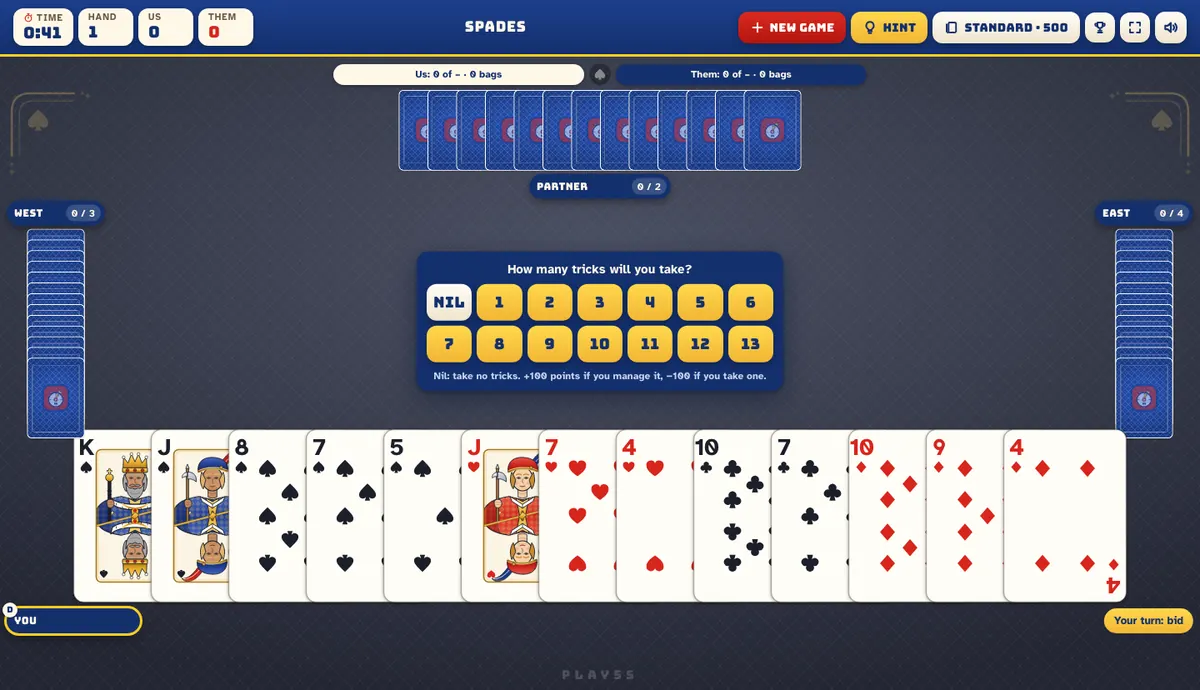
Everyone bids once, in turn, with no passing. A bid is the number of tricks you expect to win with your own cards, from 1 up to 13, or Nil, which is a promise to win no tricks at all. A team’s bid is the two partners’ bids added together, and a Nil counts as zero in that total.
Bids cannot be changed. You see the bids of the players who bid before you, so a partner’s high bid tells you how much help they expect to need.
 Zoom in
Playing a trick
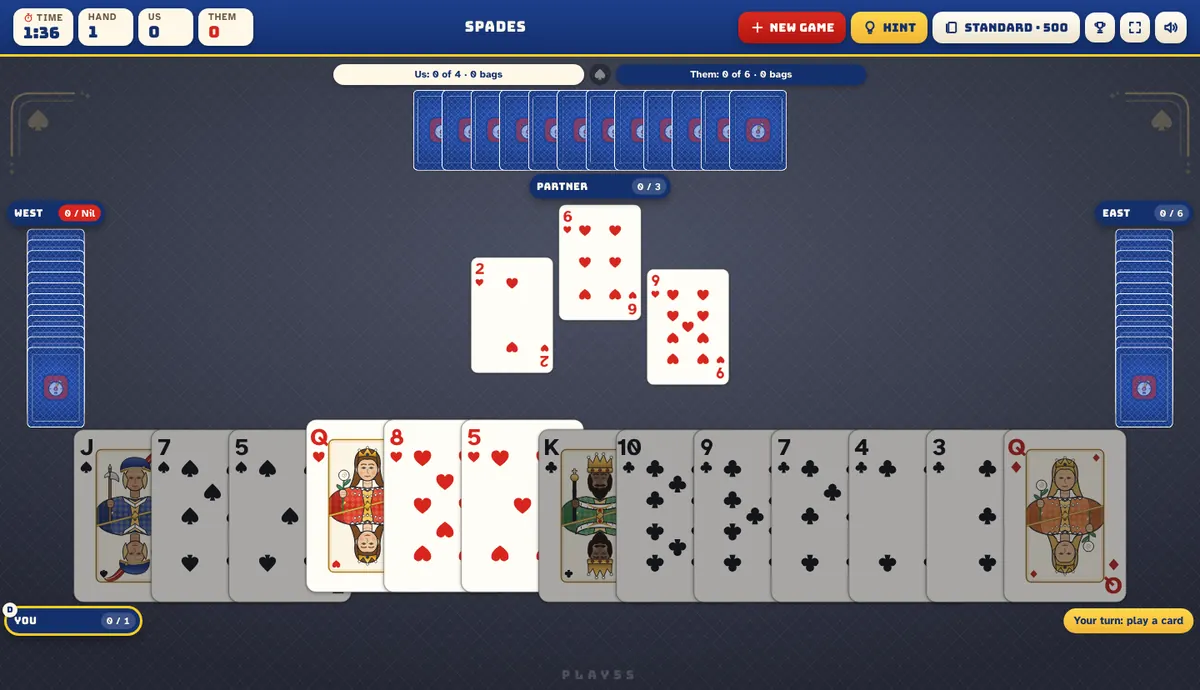
A hand is thirteen tricks. The first player puts any card down, and the others each play one card in turn. You must follow the suit that was led if you have a card of it. If you have none, you may play any card, including a spade. The trick goes to the highest spade in it, or, when nobody played a spade, to the highest card of the suit that was led. The winner leads the next trick.
Cards you cannot legally play are dimmed, and the ones you can play rise a little. If you tap one that is not allowed, the game tells you why.
 Zoom in
Breaking spades
Spades cannot be led until a spade has been played in an earlier trick, usually by someone who had no card of the suit that was led. That first spade “breaks” spades. The only exception is a player who holds nothing but spades. The small spade at the top of the table turns yellow once spades are broken.
How a hand and a game end
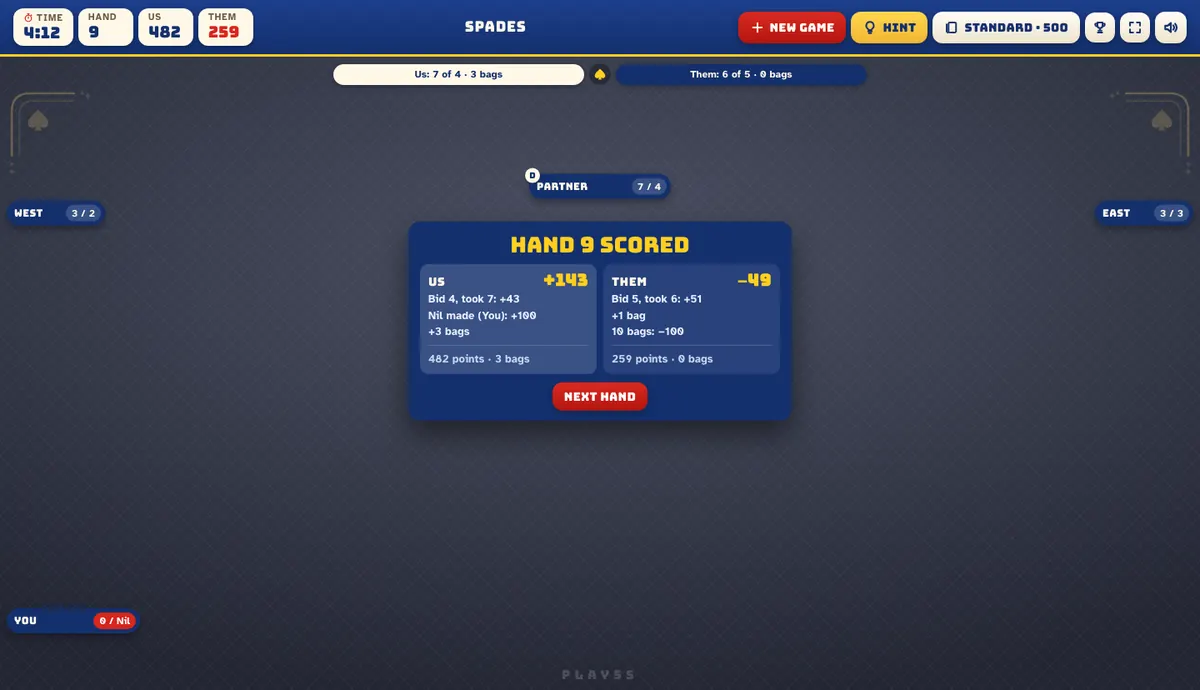
After the thirteenth trick the hand is scored, and a score screen shows what each team won and lost. The game goes on, hand after hand, until a team reaches the target score. Scoring is explained next.
How scoring works in Spades
In Spades on Play5s, a team that wins at least its bid scores 10 points for every trick it bid, plus 1 point for each extra trick, and a team that falls short loses 10 points for every trick it bid.
Making and missing a bid
The team’s bid is the two bids added. If the team bids 3 and 2 and wins five tricks, it scores 50. If it wins fewer than five, it is “set” and loses 50 points, whatever the number it fell short by. A Nil bid does not add to this total: with a Nil and a bid of 5, the team needs five tricks from the partner who did not bid Nil.
What a bag is
A bag, also called a sandbag or an overtrick, is a trick won beyond the team’s bid. Each bag scores 1 point, so bids of 3 and 2 with eight tricks won scores 50 plus 3 for three bags, or 53. Bags also count up from hand to hand. In the Standard game, every 10 bags cost 100 points, and in the Short game every 5 bags cost 50 points. The team’s bag count is shown at the top of the table, and the count starts again after a penalty.
Nil
A Nil bidder promises to win no tricks. If that holds to the end of the hand, the team gets 100 points. If the Nil bidder wins even one trick, the team loses 100 points. This is separate from the team’s bid: the partner’s own bid is scored as usual. A trick won by a Nil bidder who fails does not count toward the partner’s bid, but it does count as a bag. Both players on a team can bid Nil, and each Nil is scored on its own.
 Zoom in
Winning the game
In the Standard game the first team to reach 500 points wins; in the Short game the target is 250. If both teams pass the target in the same hand, the higher score wins, and a tie means one more hand. A team that falls to −200 points or lower loses at once. If a game is still undecided after thirty hands, the team with the higher score wins.
Standard 500 or Short 250?
Standard goes to 500 points and in our tests took about eight hands on average; Short goes to 250 points and took about four.
Both modes use the same rules of bidding and play. They differ in two numbers: the target score, and how many bags cost a penalty (10 bags for 100 points in Standard, 5 bags for 50 points in Short). The −200 loss limit is the same in both.
Standard is the usual way to play Spades, and it is the mode of the Daily Deal. Short is for a quick game. Each mode has its own all-time leaderboard.
How the computer plays
The computer plays your partner and both opponents with a fixed set of rules, and it only uses what a real player at its seat could know: its own cards, the bids, and the cards already played.
To bid, the computer counts roughly a trick for each Ace outside spades, most of a trick for the King and Queen of spades when it has enough spades to protect them, and about one trick for every spade beyond its third. It adds a little for short suits it can trump, and it lowers its bid when the team total would get too high. It bids Nil only on a hand with few spades and few high cards.
In play, it has four styles. It wins the tricks its team still needs, then tries to lose the rest so as not to collect bags. It plays low to protect its own Nil. When its partner bid Nil, it takes tricks with high cards to cover them. When an opponent bid Nil, it tries to leave that player holding the trick. The computer remembers which cards have gone and which players ran out of a suit.
The Hint button asks the same player what it would do in your seat: it marks a bid, or the card to play. The computer never looks at your hand, and it never plays randomly: the same game always plays out the same way for the same bids and cards, which is also how the server can check a ranked game.
Daily Deal and leaderboards
The Daily Deal is one Standard game that every player gets on the same day: the same shuffles, hand after hand, with a new set starting at midnight New York time.
Because everyone gets the same cards, the Daily Deal leaderboard compares players on one set of deals. Spades is not a game you can solve in advance, so a Daily Deal is not checked to be winnable: whether you win depends on how you and the computer play it. Our server hands out the Daily Deal, so it needs an internet connection, and each connection gets one ranked result per day: after that you can still replay it, but only as practice.
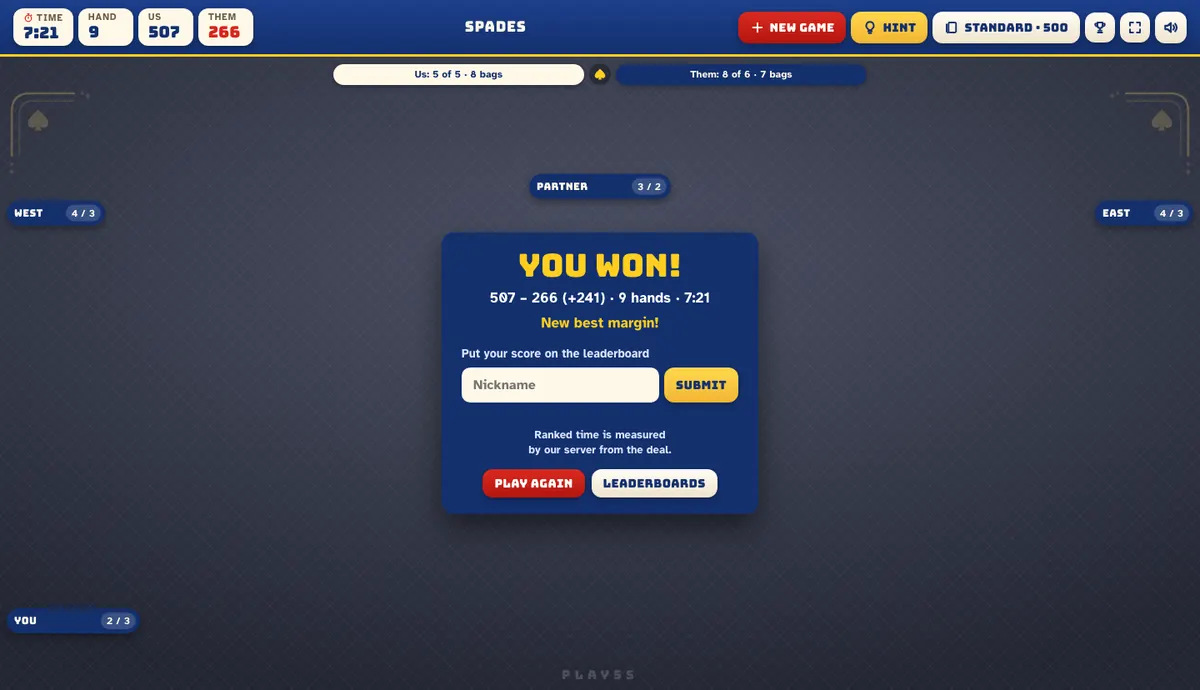
The leaderboards rank winning games only, by the winning margin: your team’s final score minus the other team’s. A bigger margin ranks higher, and a tie goes to the faster game and then to whoever posted first. There is a board for each day’s Daily Deal and an all-time board for Standard and for Short. After a win, type a nickname of 2 to 12 characters and press Submit; offensive names are refused and there is no sign-up.
The server replays every submitted game from your bids and cards, works out the computer’s moves and the score itself, and measures the time from its own clock, from the moment it handed out the deal. A typed-in score or an impossible game is turned away. For regular games the server also picks the shuffles, so nobody can choose an easy set in advance.
 Zoom in
Spades strategy for beginners
The most useful habit in Spades is to bid what you expect to win, not what you hope for, because a missed bid costs 10 points a trick while an extra trick only costs a bag.
- Count your sure tricks before you bid: Aces outside spades, the Ace and King of spades, and every spade beyond your third.
- If both teams’ bids add up to more than 13, at least one team cannot make its bid. A high bid from your partner is a reason to bid your own hand honestly, not to add more.
- Lead your Aces early, before an opponent runs out of that suit and can trump them with a spade.
- Do not waste high spades early. Keep them to win tricks later, and use low spades to trump when you have no card of the suit that was led.
- When your partner is already winning a trick, play your lowest card instead of beating them.
- Watch your bags. With nine bags, an extra trick costs 100 points, so once your team has its bid, let the other team have tricks.
- Bid Nil only with a hand of low cards: no Ace, no high spades, and few spades overall. A Nil that fails costs 100 points.
- If your partner bid Nil, win tricks with high cards so that they do not have to. If an opponent bid Nil, lead low cards in suits where they may hold only high ones.
- Keep track of the spades. There are 13, and once you know how many are gone you know when your own are safe.
- Use Hint to see what the computer would do, and ask why: the rules above explain most of its choices.
Spades controls: tap, click or keyboard
To bid, press a number on the bid panel; to play, tap or click one of the cards that rise above your hand.
The cards you can play are raised and the others are dimmed. Tapping a card that is not allowed makes it shake and shows the reason, such as “You have to follow suit”. Your hand is fanned, so tap the part of a card that shows. The computer plays at a pace you can follow, and each finished trick stays in the middle for a moment before it is swept to its winner.
Buttons and the table
The bar above the table shows your time, the hand number, and the score for your team (Us) and the other team (Them). On the table, each name plate shows the tricks that player has won out of the bid, and the strip at the top shows each team’s bid, tricks and bags. New game deals a fresh game and asks first when one is in progress. The mode button switches between Standard and Short and starts a new game. The full screen button shows only the table. The cup opens the leaderboards, and the gear (Settings) button holds two switches: sound effects (on at first) and quiet background music (off at first). The same panel lets you pick the language of the game’s own words, and the M key mutes or unmutes the sound effects. There is no Undo in Spades: the computer’s answers would show you what each card does before you chose it.
Keyboard
On a computer you can play without the mouse. While the bid panel is open, press 0 for Nil or 1 to 9 for that bid, or tab to the buttons for 10 to 13. When you play, Tab moves to your playable cards (one stop), the arrow keys step along them, and Enter or Space plays the card.
- 0–9: bid (0 is Nil)
- H: show a hint
- N: start a new game
- F: full screen on or off
- M: sound effects on or off
Spades terms
Spades has a short vocabulary, and most of it comes from trick-taking games in general.
- Bid: the number of tricks a player promises to win with their own cards.
- Contract: the team’s bid, the two partners’ bids added together.
- Trick: one round of four cards, one from each player, won by one player.
- Trump: the suit that beats the others. In Spades it is always spades.
- Follow suit: play a card of the suit that was led, if you have one.
- Lead: play the first card of a trick.
- Break spades: play the first spade of the hand, after which spades can be led.
- Nil: a bid of zero, a promise to win no tricks. It scores 100 points, or loses 100.
- Bag (sandbag, overtrick): a trick won beyond the team’s bid. It scores 1 point and counts toward a penalty.
- Set: failing to win the bid. The team loses 10 points for each trick it bid.
- Void: having no cards of a suit. A void player can trump with a spade.
Other ways to play Spades
Spades has many house rules, and this version uses the most common ones: four players in two partnerships, Nil, bags, and spades that cannot be led until broken.
Some groups add blind Nil (a Nil bid before looking at your cards, worth more), passing cards to a partner, jokers, a minimum bid for the team, or bids that must match the number of spades in the hand. Spades can also be played by two, three or six players, or with every player for themselves. None of these are in this version, which has four players only. Several of them are listed on the Spades (opens in a new tab) page of Wikipedia.
Where Spades comes from
Spades was devised in the United States in the late 1930s, and the bridge writer George Coffin traced it to Cincinnati between 1937 and 1939.
Spades descends from whist and is closely related to bridge, pinochle and euchre. It differs in that the trump suit is always spades instead of being chosen by an auction or at random. It became popular during the Second World War, when soldiers spread it around the world, and veterans brought it back home afterward.
The history and the full list of rule variations are covered in Spades (card game) (opens in a new tab) on Wikipedia, and its relatives are covered in Whist (opens in a new tab) and Contract bridge (opens in a new tab).
Where these rules come from
These rules follow three published descriptions of Spades, and where they differ this version takes the most common American rule and says so.
- The basics (four players in two partnerships, one bid each, spades always trump, following suit, 10 points a trick and 1 per bag) are the same in Wikipedia, pagat and Bicycle’s rules.
- A missed bid costs 10 points a trick, as in Wikipedia and pagat. Bicycle’s rules score a missed bid as zero, which is the choice not taken here.
- Ten bags cost 100 points (Wikipedia and pagat). The Short game follows Wikipedia: 250 points and 50 points for every 5 bags. Bicycle’s rules suggest 200 for a short game.
- A failed Nil’s tricks do not count toward the partner’s bid but count as bags, which pagat calls the usual rule. The open-source mreishus/spades project (MIT license) counts them toward the partner’s bid instead.
- Spades cannot lead until broken: a common rule in Wikipedia, standard in pagat and in Bicycle’s rules.
- A game ends at the target score or when the other team reaches −200 (Wikipedia). If both teams pass the target in the same hand, the higher score wins (pagat).
- The computer players are our own code. The four styles of play (win tricks, play Nil, cover a Nil partner, stop an opponent’s Nil) also appear in the open-source spades-bot (opens in a new tab) project (MIT license).
Spades questions
How many players are in Spades?
Four, in two teams of two, sitting opposite their partner. Here you play with the computer as your partner and as both opponents. Spades can also be played with two, three or six players, but those versions are not in this game.
How many cards does each player get in Spades?
Thirteen. The whole 52-card deck is dealt, so every player gets 13 cards and a hand has 13 tricks.
How do you keep score in Spades?
A team that wins at least its bid scores 10 points for every trick it bid plus 1 for each extra trick (a bag). A team that falls short loses 10 points for every trick it bid. Every 10 bags cost 100 points, and a Nil is worth plus or minus 100.
What does Nil mean in Spades?
Nil is a bid of zero: the player promises to win no tricks in the hand. If they manage it, their team gets 100 points; if they win a trick, the team loses 100 points.
What is a bag in Spades?
A bag, also called a sandbag or overtrick, is a trick your team wins beyond its bid. Each bag scores 1 point, but collecting 10 bags costs the team 100 points (5 bags cost 50 in the Short game).
What is “breaking spades”?
Spades cannot be led until a spade has been played in an earlier trick. The first spade played, usually by a player who had none of the suit that was led, breaks spades.
What happens if both teams reach 500 in the same hand?
The team with the higher score wins. If the scores are tied, one more hand is played.
Can I play Spades with two or three people?
Not in this game, which is for four players: you, a computer partner and two computer opponents. Other player counts exist as variations of Spades, but this version does not include them.
Is there an Undo button?
No. The computer answers each card you play, so taking one back would show you the result of a card before you chose it. Hint shows what the computer would do in your seat.
What is the Daily Deal in Spades?
A Standard game that is the same for every player on a given day: the same shuffles, hand after hand. It needs an internet connection, and each connection gets one ranked result per day. A new one starts at midnight New York time.
How are the Spades leaderboards ranked?
By the winning margin, your team’s final score minus the other team’s, and only for games your team wins. A bigger margin ranks higher, and a tie goes to the faster game. There is a board for each Daily Deal and an all-time board for Standard and for Short.
Does the game save my progress?
Yes. Your current game, bids and time are saved in this browser on this device, so you can close the page and pick up where you left off. Clearing your browser data removes the saved game.
Can I play Spades on my phone?
Yes. The table fits phone screens held upright: your hand is fanned across the bottom, so tap the part of a card that shows. Turning the phone sideways or using the full screen button gives bigger cards.
Is Spades free on Play5s?
Yes. It is free to play in your browser, with no download and no account.
About this version
This Spades was built by Play5s to run in any modern web browser. It follows the rules described above, shuffles a new set of hands for every game, and lets you choose Standard, Short or the Daily Deal. The cards, including the Jacks, Queens and Kings, are drawn by Play5s, and the computer players are our own code.
There is nothing to install and no account to create. Your game in progress is kept in your browser. Starting a ranked game asks our server for a deal and a ticket; your bids, cards and nickname are sent only when you submit a score.
Read more about Play5s, or see all of our free card games.