

On this page
How to play Durak
To avoid being the fool, get rid of all your cards: Durak is played in bouts of attack and defense, and the last player left holding cards loses.
The deal and the trump
Durak uses a 36-card pack: the cards from 6 up to the Ace in each of the four suits, ranking 6, 7, 8, 9, 10, Jack, Queen, King, Ace from low to high. Each player gets six cards. The bottom card of the stock is turned face up and its suit is the trump suit for the whole game. That card stays in the stock, lying sideways under it, and whoever draws the last card of the stock takes it. In Play5s the trump card lies under the stock and a round plate on the stock always shows the trump suit.
The player who holds the lowest trump attacks first, as pagat and Wikipedia describe it. You do not have to open with that trump; it only decides who goes first. The play goes clockwise: the defender is always the next player after the attacker.
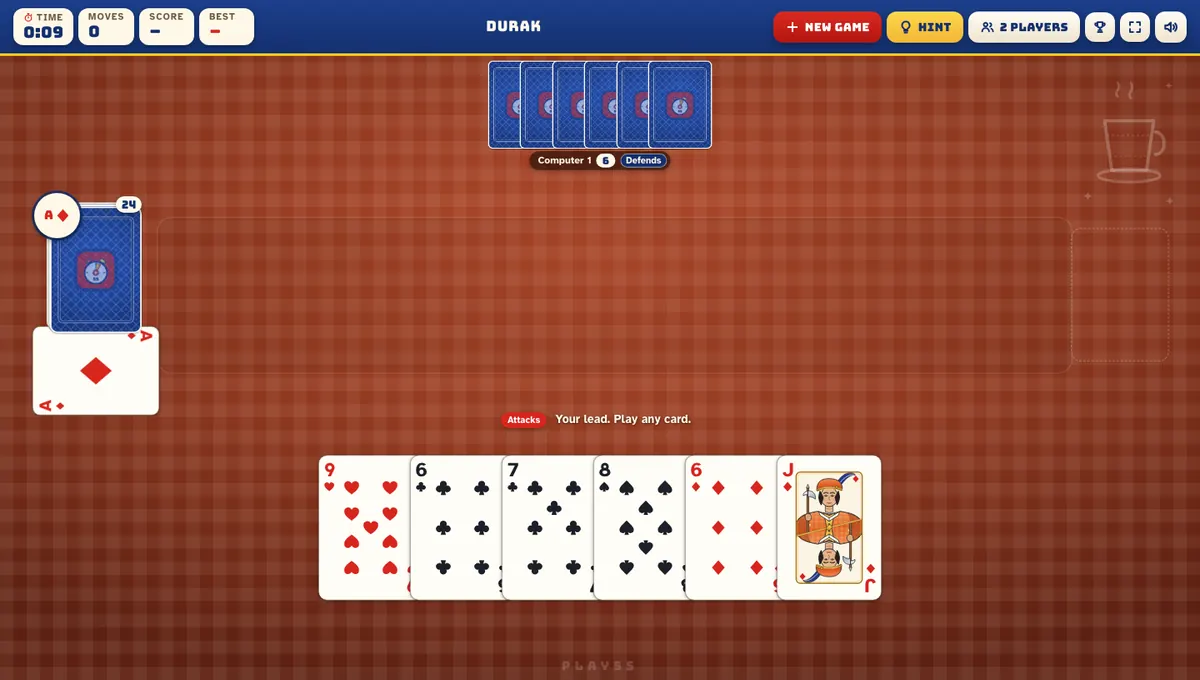 Zoom in
A bout: attack and defense
The attacker puts any card from their hand on the table. The defender must beat it or pick it up. If the defender beats it, other players may add more attack cards, and the defender has to beat those too. When every attack on the table is beaten and nobody adds another card, the defender has won the bout: all the cards on the table go to the discard pile and the defender attacks next. If the defender picks up instead, they take every card on the table and lose the turn to attack.
In Play5s the buttons at the bottom of the table change with your role: Pick up when you are the defender, Beaten when you may add cards and have nothing more to add, and Pass on in Perevodnoy. The small tag next to the message says whether you attack or defend in this bout.
How do you beat a card in Durak?
You beat an attack card with a higher card of the same suit, or with any trump; a trump can only be beaten by a higher trump.
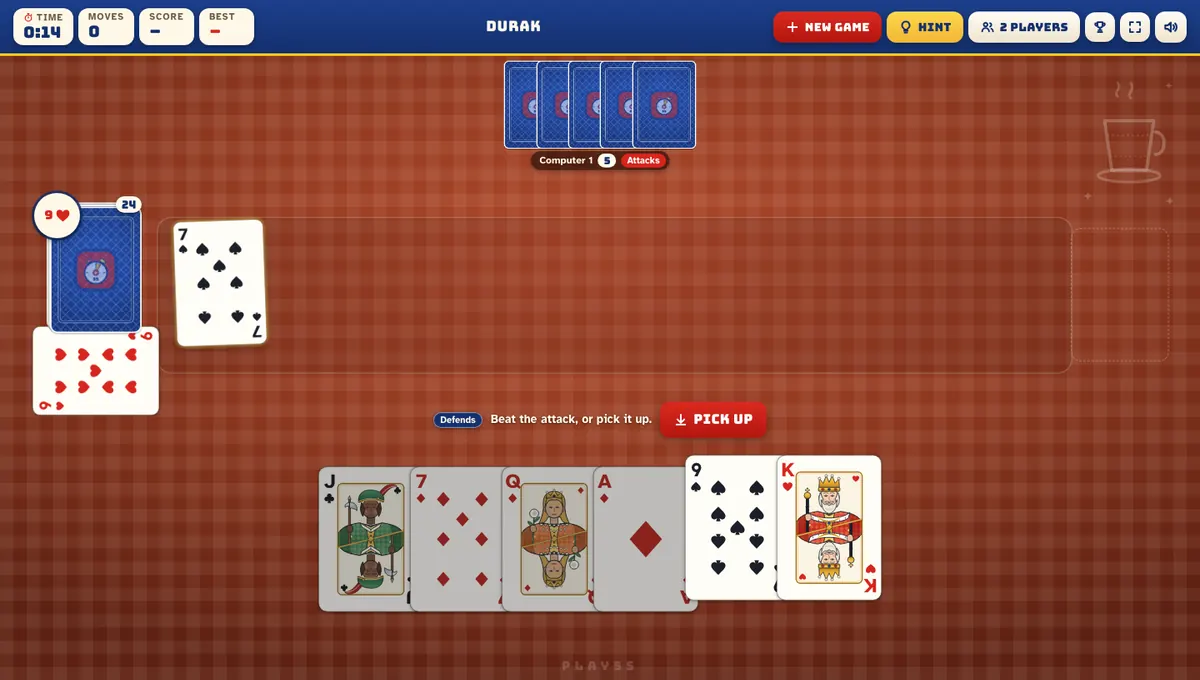
There is no duty to follow suit. A plain card such as the 7 of spades can be beaten by the 9 of spades, but also by the 6 of trumps, even if you hold a higher spade. The ace of trumps cannot be beaten at all, and a plain ace never beats a trump. Both the attack card and the card that beats it stay on the table until the bout ends, so each pair shows which card answers which.
When it is your turn to defend in Play5s, the cards that beat the attack are lifted and the others are dimmed. Tap a lifted card, or drag it onto the attack card it beats; a tap on a card that cannot beat the attack tells you why. If more than one attack is unbeaten, as can happen in Perevodnoy, tap the card first and then the attack it should beat.
 Zoom in
When it is better to pick up
Beating an attack with a trump is allowed, but it costs a card you may need later. Picking up the attack cards gives you more cards now and keeps your trumps. The normal computer players do exactly this while the stock is still big, and they beat anything they can once the stock is empty, because from then on every card in the hand counts.
Throwing in cards, picking up and “Beaten”
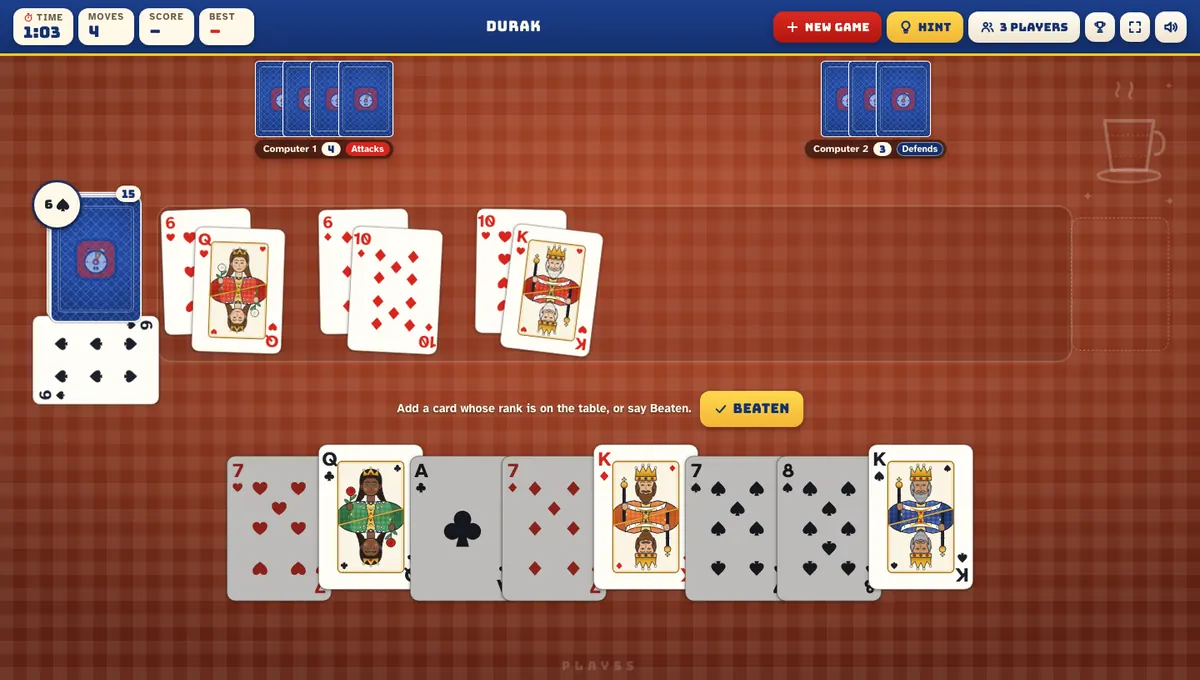
After the first attack card is beaten, any player except the defender may add a card whose rank is already on the table, either as an attack card or as a card that beat one.
Who may add cards, and how many
The attacker is asked first, then the other players clockwise from the defender. In a two-player game only the attacker can add. A bout can never hold more than six attack cards, and the unbeaten attack cards can never outnumber the cards in the defender’s hand: a defender with three cards cannot be attacked with a fourth card at once. Every card is added one at a time in Play5s.
When it is your turn to add and you can, the cards that fit are lifted. Tap one to add it, or tap Beaten to say you have nothing more to add. A player who cannot add anything is skipped, so you are only asked when you have a card that fits.
 Zoom in
Picking up
A defender who cannot or does not want to beat a card says Pick up. The other players may then still add cards of the ranks on the table, within the same limits, and the defender takes every card on the table, the beaten pairs included. Because the defender picked up, they do not get to attack: the next player after the defender attacks, and the player after that defends.
Drawing cards and who is the fool
After every bout, each player with fewer than six cards draws up to six from the stock, the attacker first and the defender last; when the stock is empty, the last player holding cards is the fool.
The order of drawing is the attacker, then the other players clockwise, then the defender. If the stock runs out in the middle of that, the later players draw less or nothing, and the trump card is the very last card to be drawn. Once the stock is gone nobody draws any more, and a player with no cards is out of the game for good.
The game ends at the end of a bout, when only one player still holds cards. That player is the fool, the durak. If the last cards of two players go in the same bout, for example when the defender beats the attacker’s last card with their own last card, nobody is the fool and the game is a draw. Pagat describes the draw; the Russian Wikipedia says that two players with equal hands play on until one of them sheds first, which this version does not do.
Safety net
If sixty bouts in a row end with the defender picking up, the game is closed: the player holding the most cards is the fool, and a tie for the most is a draw. A player who is already out is never the fool. The computer players avoid such a loop themselves, and in 12,000 games played between computer players on 23 November 2026 the longest run of pick-ups was eleven bouts. A player who picks up every single time reaches about thirty pick-ups in a row against one computer player, and the game then ends by itself, because the computer player runs out of cards, so the rule does not come into play there either.
Perevodnoy: passing the attack on
In Perevodnoy (Переводной, “transfer”) the defender may pass the attack on to the next player by adding a card of the same rank as the attack card, instead of beating it or picking it up.
You can only pass an attack on before any card has been beaten, and every attack card on the table must have that same rank. The card you add joins the attack, you become the attacker of the bout, and the next player has to beat all the cards, so that player must hold at least as many cards as there are attack cards, as pagat describes. In a two-player game the attack comes straight back to the player who led it. Several passes in a row are possible, up to four cards, one of each suit. If the attack goes all the way round, drawing starts with the player who began the bout, as pagat says; the Russian Wikipedia has that player draw last.
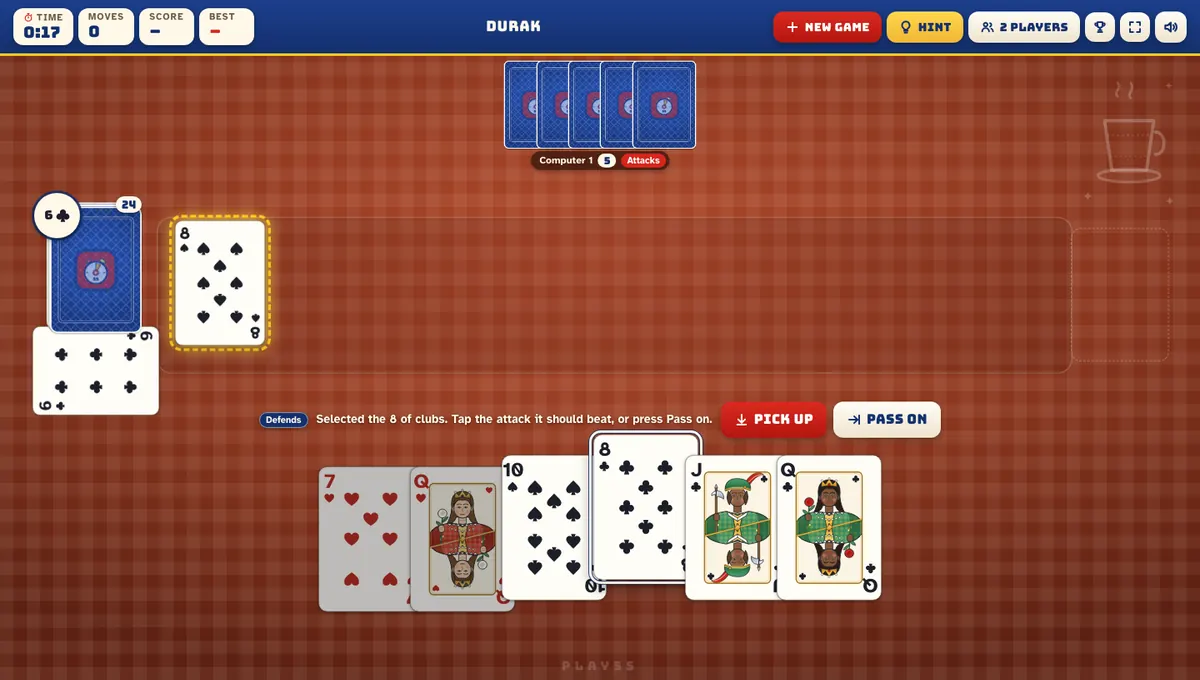
In Play5s, a card that matches the rank of the attack passes it on with one tap. If the same card could also beat the attack, for example a trump of the same rank, it is selected first: the attack it could beat is marked and a Pass on button appears next to Pick up. Perevodnoy is a practice mode in Play5s and is not ranked.
 Zoom in
How do the computer players play?
The computer players use only their own cards and what every player can see: the table, the number of cards left in the stock and in each hand, and the trump suit. They never look at another hand.
There are two levels. The easy level always leads its lowest card, always beats an attack when it can, always passes on an attack when it may, and only adds low cards. The normal level leads its lowest plain card, and prefers the rank it holds most of so it can follow up; late in the game, with the stock almost gone, it opens with pairs, trumps included. It beats with the cheapest card that works, picks up rather than spend a trump while the stock is big, adds cheap plain cards to wear a defense down, unloads plain cards on a defender who is picking up, and passes on an attack with a plain card. When a hand grows large, or when several bouts in a row have ended in a pick-up, it stops being picky and beats whatever it can.
Each choice is a fixed function of the deal and of what is on the table, so the same deal and the same moves always give the same game; this is also how a leaderboard game is checked on our server.
What the computer players do to a human player
On 23 November 2026 we played 3,000 games per row in Podkidnoy against the normal computer players, with the human seat following the Hint button every turn. The human seat ended as the fool in 38.8% of two-player games, 32.0% of three-player games and 24.2% of four-player games, and a two-player game ended in a draw 22.4% of the time (5.3% with three players, 3.7% with four). A seat that played a random legal move every turn was the fool in 97.7%, 91.9% and 85.4% of those games. A seat playing the easy logic was the fool in 47.1%, 60.4% and 53.5%.
These are results for the Hint’s own logic, not a promise about how you will do: a player who thinks ahead and watches the cards can do better than a fixed rule.
Modes, difficulty and controls
You choose the number of players (2, 3 or 4), the rules (Podkidnoy or Perevodnoy) and the computer level (easy or normal) on the start screen.
Podkidnoy (Подкидной, “throw-in”) is the main game and the one most people mean by Durak, as pagat notes. Perevodnoy adds the pass-on. Only Podkidnoy against the normal computer players is ranked; everything else is for practice. Your game in progress is saved in this browser, so you can close the page and continue later, and your tally of how many times you were the fool and how many times you were not is kept on this device too.
Play with a tap on a card, or drag a card onto the attack it beats or onto the table to lead or add. The keyboard works as well: arrow keys and Tab move along your hand, Enter or Space plays the card, B says Beaten or Enough, T picks up, X passes the attack on, H shows a hint, N starts a new game and F goes full screen. There is no undo, because the computer’s cards would be revealed.
Leaderboards and the Daily Deal
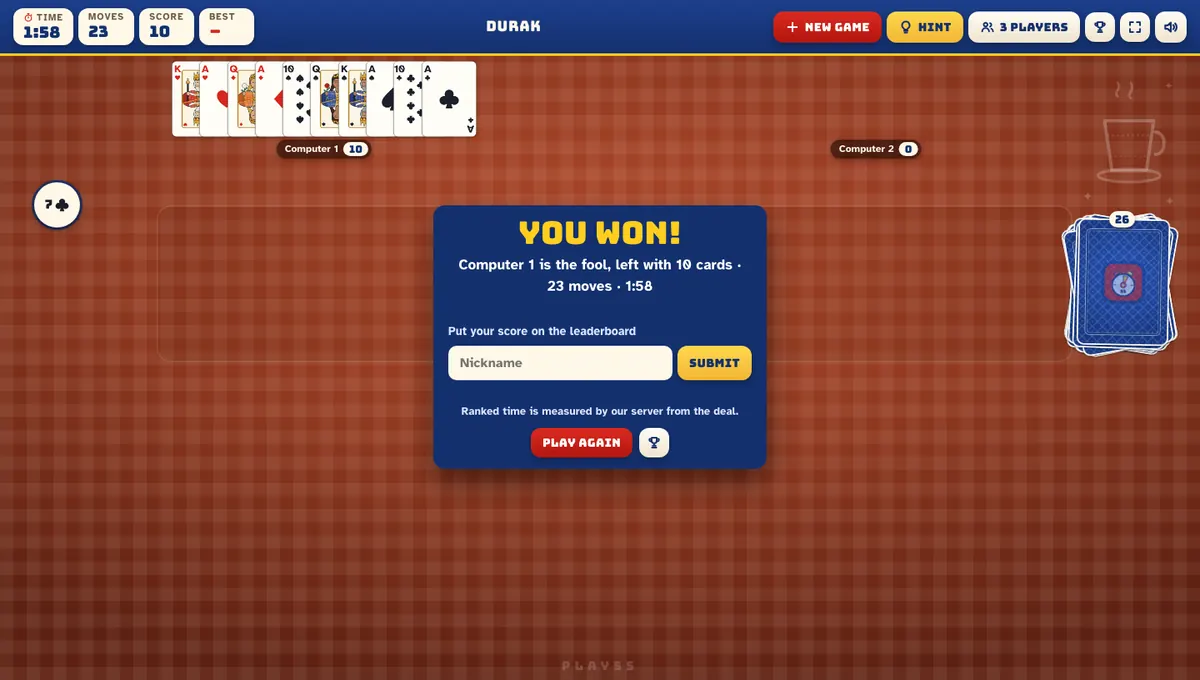
A game goes on a leaderboard when it is over and you are not the fool; it is ranked by the number of cards the fool was left holding, and a higher number is better.
There is one board for each number of players, plus the Daily Deal. A draw does not count as a win, and neither does a loss, and only Podkidnoy against the normal computer players is ranked. If you go out early, your result is already decided, and the rest of the game is played out by the computer players so that the number of cards the fool holds is known. Ties on the board are decided by the fewer seconds, then by who posted first. The time is measured by our server from the moment it dealt the game.
The Daily Deal is the same two-player deal for everyone, and the day changes at midnight New York time. Every deal in our table has a winning line for the human seat, which the engine’s own search found and replayed. Starting a ranked game asks our server for a deal and a ticket, so the Daily Deal needs a connection. Each connection gets one ranked Daily Deal result a day; after that, the deal is practice. A nickname is 2 to 12 characters and offensive names are refused. No account is needed.
 Zoom in
Durak strategy tips
The best habit in Durak is to spend your low plain cards first and keep your trumps for later, while the stock is still large.
These tips describe what the normal computer players do and what the rules reward; none of them is a guarantee.
- Count the trumps. There are nine trumps in the pack. While the stock lasts, one of them is the card under it, so at most eight can be in hands or in the discard pile. After the stock is gone, every trump you have seen go is one less to fear.
- Lead low, plain cards. A low card of a suit that your opponent may not hold forces them to answer with a trump or pick up. Keep the Ace and the King of a plain suit for a bout that really needs them.
- Lead with a rank you hold twice. When you hold two cards of one rank, the second one is a ready-made follow-up as soon as the first is beaten. Near the end, when the stock is nearly gone, the normal computer players open with a pair, trumps included.
- Add cheap cards to a bout. Plain cards of a rank already on the table cost you little, and each one the defender has to beat is a card they no longer hold.
- Pick up sometimes. Taking a low attack and keeping your trump can be better than beating it, as long as the stock is big. When you are already holding many cards, though, it is time to beat whatever you can.
- Pass on with plain cards. In Perevodnoy, use a plain card of the attack’s rank to pass the attack on, and keep a trump of that rank for beating. Check that the next player can hold the extra card first.
Where the rules come from
The rules of this Durak follow pagat’s Podkidnoy and Perevodnoy pages and the English and Russian Wikipedia articles, all read on 23 November 2026; the table shows where they differ and what Play5s chooses.
The sources agree on the pack, the trump, the beating rule and the rule of adding cards. They differ on details, and the table lists the details that matter. Pagat names Podkidnoy Durak as the best-known form in Russia. The English Wikipedia article (opens in a new tab) describes the game as Russia’s most popular card game.
| Rule | What the sources say | Play5s |
|---|---|---|
| Pack and deal | Pagat and Wikipedia: 36 cards, 6 each. Wikipedia (Russian) also lists 24, 52 and 54-card packs. | 36 cards, 6 each |
| Players | Pagat: 2 to 6, teams of 2 are best with 4. Wikipedia: 2 to 6. | 2 to 4, everyone for themselves |
| Who leads | Pagat and Wikipedia: the lowest trump in the first game (pagat: in later games the player to the dealer’s left, and the dealer is the previous loser). Wikipedia (Russian): the player to the loser’s left. | The lowest trump, in every new game |
| Adding cards | Pagat and Wikipedia: ranks already on the table, the attacker first. Pagat: the number of unbeaten cards is limited by the defender’s hand. | As pagat: at most 6, and never more than the defender’s hand |
| After a pick-up | Pagat and Wikipedia: others may still add cards. Wikipedia (Russian): unclear. | Others may add |
| All cards gone together | Pagat: a draw. Wikipedia (Russian): equal hands, the first to shed wins. | A draw |
| Swapping the trump 6 | Pagat: allowed, some groups forbid it. | Not in this version |
| Passing the attack on | Pagat: only before any card is beaten, the next player must hold enough cards. | Perevodnoy, practice mode |
Durak variants that are not in this game
Durak has many local variations; this version plays the two most common ones, Podkidnoy and Perevodnoy, and leaves the rest out.
Pagat lists a few more. Some groups play four players in teams of two, where a partner cannot help the defender. Some let the holder of the trump 6 swap it for the turned-up trump card. In individual games with more than three players, the first defender is often attacked with at most five cards. Perevodnoy has a version where a trump can be shown instead of played to pass the attack on. Durak Severnyi uses two trump suits, and Prostoy Durak (the “simple fool”) starts with five cards each. Wikipedia (Russian) adds jokers, and a shorter pack of 24 cards. Both Wikipedia articles describe “durak with epaulettes” (durak s pogonami in Russian): when the last card an attacker plays is a six and the defender loses, the six is laid on the loser’s shoulder as a joke and the loss counts as more shameful. Play5s does not mark it. None of these is in the Play5s version, so what the page says always matches the game on it.
If you like card games where the aim is to get rid of your cards, try Crazy Eights; for trick-taking games where you play against the computer, Hearts and Spades work the same way on the same table.
Durak questions
What is Durak?
Durak is a Russian card game for 2 to 6 people (2 to 4 in this version) in which nobody wins: the last player left holding cards is the loser, the “durak”, which means fool in Russian. It is played with a 36-card pack in bouts of attack and defense.
How many cards are in a Durak pack?
A standard Durak pack has 36 cards: 6, 7, 8, 9, 10, Jack, Queen, King and Ace in each of the four suits. Each player is dealt six cards at the start, and everybody refills to six from the stock after each bout while it lasts.
What does “durak” mean?
Durak is the Russian word for fool. It names the game and the loser of the game: the player left holding cards when everybody else is out is “the durak”.
What is the trump in Durak?
The trump is a suit chosen by the bottom card of the stock, which is turned face up and lies sideways under the stock. Any trump card beats any card of another suit, and a trump only loses to a higher trump. The trump card itself is the last card drawn from the stock.
Who goes first in Durak?
The player who holds the lowest trump attacks first. They do not have to lead that card. After that, the defender who beat the attack leads the next bout, or, if the defender picked up, the next player after the defender.
How many cards can be played in one attack?
At most six attack cards in a bout, and the unbeaten ones can never outnumber the cards in the defender’s hand. Only cards whose rank is already on the table can be added after the first attack card.
Do you have to follow suit when you beat a card?
No. You beat a card with a higher card of the same suit or with any trump; you may use a trump even if you hold a higher card of the attack’s suit.
What is the difference between Podkidnoy and Perevodnoy Durak?
In Podkidnoy (throw-in) the defender can only beat the cards or pick them up. In Perevodnoy (transfer) the defender may also pass the attack on to the next player by adding a card of the same rank, before any card is beaten, if the next player holds enough cards to beat them all.
What happens if two players run out of cards together?
If the last cards of two players go in the same bout, nobody is the fool and the game is a draw. A draw is not a win on the leaderboards.
Is Durak on Play5s free, and can I play with friends?
It is free, with no download and no account. The game is against one to three computer players; there is no multiplayer with other people.
Does the game save my progress?
Yes. The game in progress, your options, your best results and your tally of fool and not-fool games are saved in this browser on this device. Clearing your browser data removes them. Only games you choose to submit to a leaderboard are sent to our server, with your nickname.
About this version
This version has 2 to 4 players: you and one to three computer players. The pack is 36 cards, each player gets six, the bottom card of the stock is the trump card and is drawn last, and the holder of the lowest trump leads, in every new game (pagat and the Russian Wikipedia let a later game start with the player to the loser’s left). Attack cards are added one at a time, at most six in a bout and never more unbeaten cards than the defender holds. After a pick-up the others may still add cards. Players refill from the stock in the order attacker, other players, defender. There is no swapping of the trump 6, no teams and no jokers.
Podkidnoy is the main game and Perevodnoy (pass the attack on) is a practice mode. The computer players come in two levels, easy and normal, and use only their own cards and what is visible on the table. There is a Hint button, and no undo. If sixty bouts in a row end in a pick-up, the game is closed and the player with the most cards is the fool; the computer players never reached this in tests.
Starting a ranked game or the Daily Deal asks our server for a deal and a ticket; your moves and nickname are sent only when you submit a result. Only Podkidnoy against the normal computer players is ranked, per number of players, plus a two-player Daily Deal that changes at midnight New York time. Your game in progress, your options, your best results and your tally are kept in your browser on this device.
Play5s is a network of free classic games in the browser, with no download. The rules come from pagat and Wikipedia, as listed above, and the interface has its own cards, table and sounds.
Read more about Play5s, or see all of our free card games.