

On this page
How to play Hanafuda Koi-Koi
To play Koi-Koi, capture cards by matching the month of a card from your hand or from the draw pile with a card on the field, and collect the capture sets called yaku before the computer does.
The deck and the deal
A hanafuda deck has 48 cards in 12 months of four cards, and each month is a flower: pine, plum, cherry, wisteria, iris, peony, bush clover, pampas grass, chrysanthemum, maple, willow and paulownia. The cards come in four kinds. There are 5 Brights, 9 Animal cards (called seeds or tane), 10 Ribbons (tanzaku) and 24 Chaff cards (kasu). The point values printed on the cards are not used in Koi-Koi; only the kinds matter for the yaku.
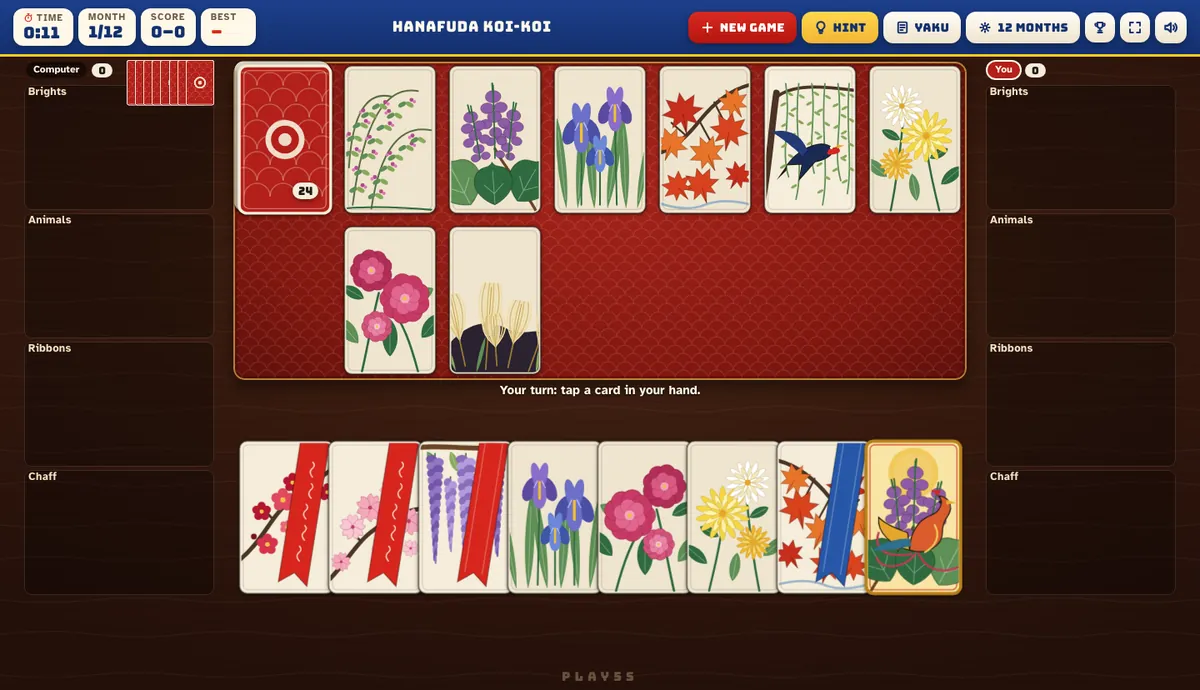
Each player is dealt 8 cards, 8 cards are laid face up on the field and the other 24 form the draw pile. If four cards of one month land on the field, the cards are dealt again. A hand that holds four cards of one month (teshi) or four pairs (kuttsuki) scores 6 points straight away and ends the month. Before the first month each side draws a card and the earlier month deals first, which is the oya, the player who moves first.
 Zoom in
A turn
On your turn you play one card from your hand. If a card of the same month is on the field, you capture both cards and put them in your capture area, which is sorted into Brights, Animals, Ribbons and Chaff. If there is no match, your card stays on the field. Then the top card of the draw pile is turned over and it works the same way: it captures a card of its month, or it stays on the field.
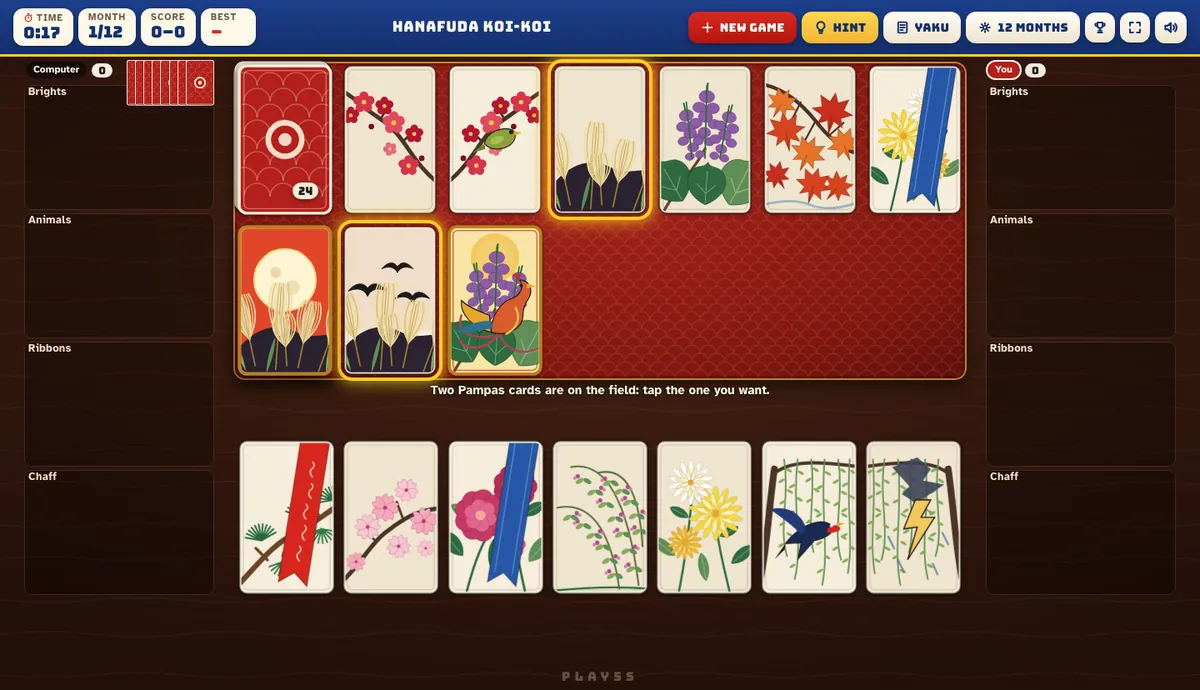
When two cards of the month are on the field, you choose which one to take. When three are on the field and you match the fourth, you capture all four. In the Play5s version the card you are playing waits next to the draw pile while the matching cards glow, and you tap the one you want.
 Zoom in
Who moves first
The oya moves first in every month. In the first month both players draw a card and the player with the earlier month deals, or the better card if the months are the same. After that, the player who won the last month deals the next one. If a month ends in a draw, the deal passes to the other player.
Which sets (yaku) score points in Koi-Koi?
The yaku are the capture sets that score points: five Brights is the biggest at 10 points, and the smallest are the Animal, Ribbon and Chaff sets at 1 point each.
Only the cards you have captured count, and a yaku is made as soon as the last card of the set is in your capture area. Several yaku can score at once. The Bright sets do not stack: only the highest one counts. Red and blue ribbons together score 10 instead of 5 + 5. Boar, Deer, Butterflies and the red, blue and red-and-blue ribbon sets are worth 1 more for each extra Animal or Ribbon card you hold, and they replace the plain Animals or Ribbons set, so the same cards never score twice: Boar, Deer, Butterflies with two more Animal cards is 7 points, and the red ribbons with two more ribbons is 7 as well.
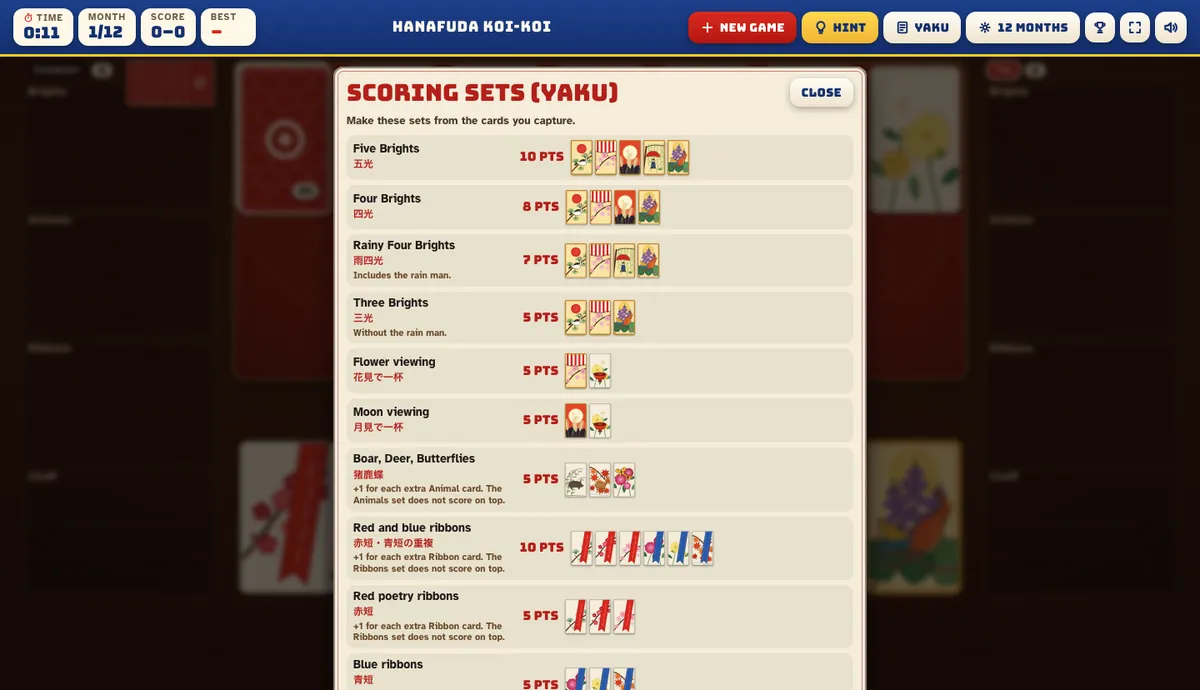
The Yaku button in the toolbar shows every set with its cards, so you do not have to remember them.
| Yaku | Cards | Points |
|---|---|---|
| Five Brights (五光) | All five Brights | 10 |
| Four Brights (四光) | Four Brights without the rain man | 8 |
| Rainy Four Brights (雨四光) | Four Brights including the rain man | 7 |
| Three Brights (三光) | Three Brights without the rain man | 5 |
| Flower viewing (花見で一杯) | Cherry curtain and the sake cup | 5 |
| Moon viewing (月見で一杯) | Full moon and the sake cup | 5 |
| Boar, Deer, Butterflies (猪鹿蝶) | The three animals of July, October and June | 5, +1 for each extra Animal card |
| Red and blue ribbons (赤短・青短の重複) | All three red poetry ribbons and all three blue ribbons | 10, +1 for each extra Ribbon card |
| Red poetry ribbons (赤短) | The three red ribbons with writing: pine, plum, cherry | 5, +1 for each extra Ribbon card |
| Blue ribbons (青短) | The three blue ribbons: peony, chrysanthemum, maple | 5, +1 for each extra Ribbon card |
| Animals (タネ) | Any five of the nine Animal cards, when Boar, Deer, Butterflies is not made | 1, +1 for each extra |
| Ribbons (タン) | Any five of the ten Ribbon cards, when no red or blue ribbon set is made | 1, +1 for each extra |
| Chaff (カス) | Any ten Chaff cards; the sake cup counts as one | 1, +1 for each extra |
 Zoom in
The sake cup
The sake cup (the chrysanthemum Animal card) counts as an Animal card and as a Chaff card at the same time. It is also half of both viewing sets, flower viewing with the cherry curtain and moon viewing with the full moon. The start screen has a switch that turns the two viewing sets off, which makes the game practice only.
What do koi-koi and shobu mean?
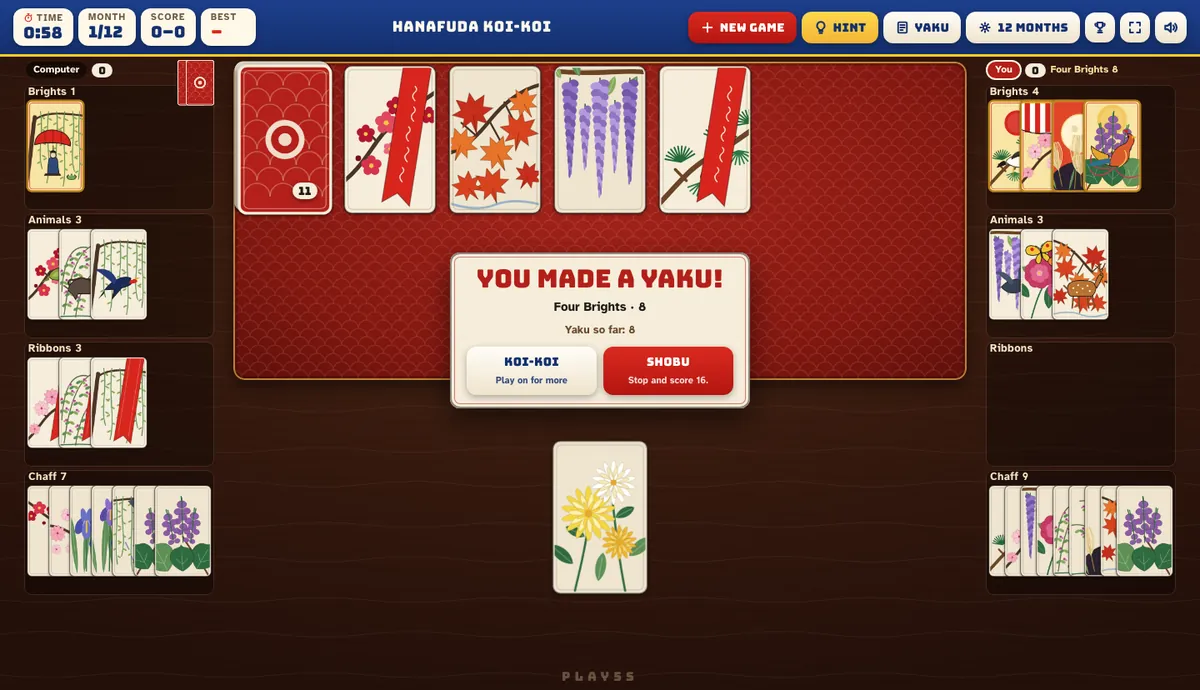
After a turn that makes a yaku you choose koi-koi to keep playing for more points, or shobu to stop the month and score your yaku.
Koi-koi means “come on” in Japanese. If you call it, the month goes on with the points of your yaku still waiting, and you can score more by growing the set or making another one. The risk is that once you have called koi-koi, a yaku made by the other player ends the month at once: they score their yaku doubled and you score nothing.
If you have called koi-koi and a yaku of yours then grows, with a new set or with one more Animal, Ribbon or Chaff card, you are asked again. If you have no card left in your hand after the turn, there is no choice and you score. If both hands run out with no new yaku after a koi-koi, the month is a draw and nobody scores.
The computer decides between koi-koi and shobu with the same information you have: how many points it has, how many cards it holds, and which sets you are close to.
 Zoom in
How is a month scored in Koi-Koi?
A month is scored for the player who stops it, with the points of their yaku added up, doubled when the total is 7 or more, and doubled again when the other player had called koi-koi.
Add the points of every yaku you have. If the total is 7 or more, it is doubled; five Brights is 10 points, which becomes 20. If the other player had called koi-koi before you made your yaku, your score is doubled once more, so a total of 7 or more after a koi-koi is worth four times as much. The loser of the month scores nothing, whatever cards they captured.
A game is 12 months, one for each month of the year, and the shorter game is 6 months. The player with the higher total after the last month wins, and equal totals are a tie. The month winner deals the next month, and a draw passes the deal to the other player.
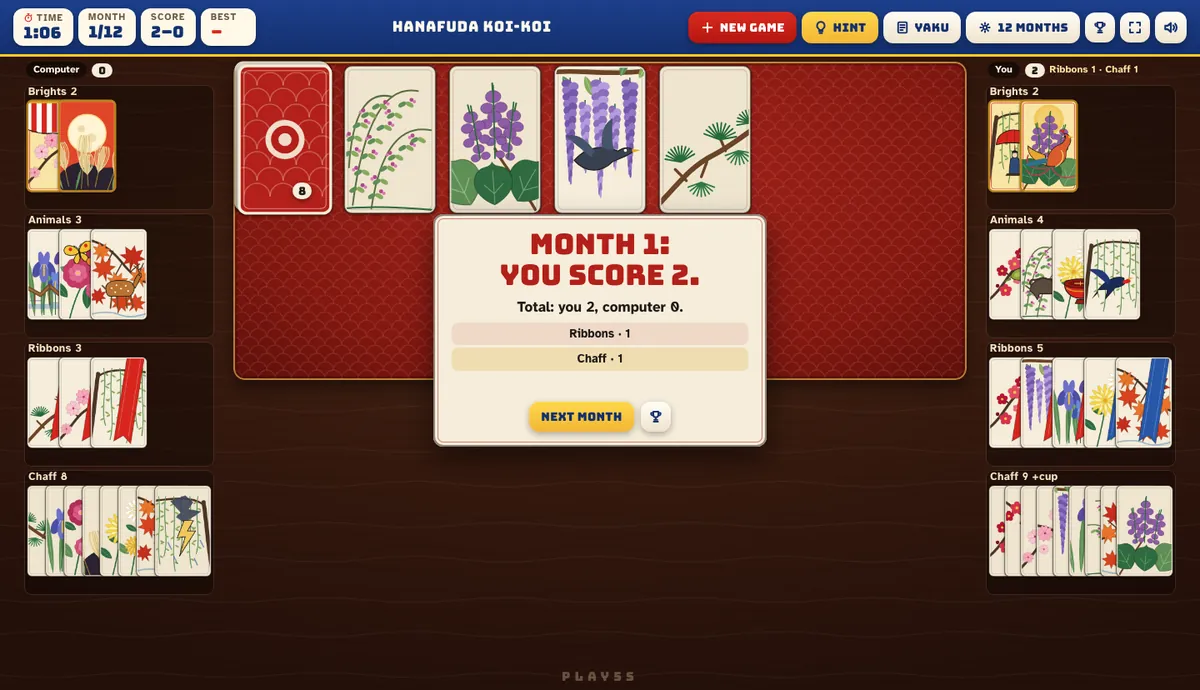
The scores of both players are shown in the toolbar as you–computer, and the panel at the end of every month lists each yaku and each doubling that was used.
 Zoom in
Months, computer level and rule options
You can play 12 months or a quick 6, against a standard or an easy computer, with the two viewing yaku on or off, and only the standard rules go on a leaderboard.
The start screen has three choices: the length (12 or 6 months), the computer (standard or easy) and the viewing yaku. A game with the standard computer and the viewing yaku on is ranked; anything else is practice and the start screen says so.
The standard computer weighs the value of each card, how far each of its sets has come, and which of your sets it can stop by capturing a card you need. It takes cards that it expects you to need and it avoids leaving good cards where you can take them. The easy computer usually takes the highest-value card it can, but about one turn in three it plays a different card; it never calls koi-koi and does not look at what you are collecting.
How the computer plays
The computer plays by fixed rules that use only what a player in its seat can see: its own hand, the field, both capture areas and the number of cards left.
It never looks at your hand or at the draw pile, and the same deal always gives the same moves, so a game can be replayed from its deal and your moves alone. That is how the leaderboard checks a score: the server plays the game again from the deal and your moves and works out the computer’s moves itself.
A fixed set such as Boar, Deer, Butterflies is out of reach for a player once the other player has captured one of its cards. The computer counts this when it picks a card: a card that kills one of your sets is worth more to it, and so is a card that finishes one of its own.
Tips for winning Koi-Koi
Most Koi-Koi games are won by taking the cards that make big sets and the cards the other player needs, and by choosing the right moment to stop.
- Take the Brights first when you can: the five Brights are the only cards in the four Bright sets, and the sets are worth 5 to 10 points.
- Remember that a fixed set is dead for you when the other player has captured one of its cards. Check the other capture area before you chase boar-deer-butterflies or the ribbons.
- Capture a card the other player needs instead of a low-value pair, when you can do both.
- A total of 7 or more is doubled, so a 5-point yaku plus a 2-point yaku can be worth much more than the points that you see.
- Call koi-koi when you have a small yaku, several cards in hand and the other player is far from a set. Call shobu when your yaku is big, your hand is nearly empty or the other player is one card from a set.
- The Hint button shows the card that the standard computer would play in your seat, and it also tells you what it would call when you make a yaku.
Daily Deal and leaderboards
The Daily Deal is one 12-month game that every player gets on the same day, and the leaderboards rank how many points ahead of the computer you finished.
The leaderboards count games with the standard computer and the viewing yaku on. There is one board for the 12-month game and one for the 6-month game, and the Daily Deal has its own board. Only a game that you win goes on a board, and the boards are ranked by the points you finished ahead by, so a higher number is better. If two players have the same margin, the one with fewer seconds wins, and then whoever posted first.
The Daily Deal is the same set of deals for everyone, the day changes at midnight New York time, and it is the 12-month game. It needs a connection because our server hands out the deal. Each connection gets one ranked Daily Deal result per day, and after that the Daily Deal is practice.
The time is measured by our server, from the moment the server dealt the game. The nickname is 2 to 12 characters, offensive names are refused, and you do not need an account. When you submit, your moves and nickname are sent to our server, which replays the game with its own copy of the rules and the computer’s moves to work out the margin.
Controls and saving
You play by tapping a card to select it and tapping it again to play it, and everything can also be done from the keyboard.
- Tap a card in your hand: it lifts and the cards of the same month on the field glow. Tap it again to play it, or tap a glowing card on the field to play your card onto that one.
- When two cards of the month are on the field, tap the one you want to capture.
- Keyboard: Tab to your hand, Left and Right to move along it, Enter or Space to select and then play, K for koi-koi and S for shobu, H for a hint, Y for the yaku sheet, N for a new game, F for full screen, M for sound and Esc to put a selection back.
- The game saves after every move in your browser, so closing the page or reloading it brings you back to the same month. Clearing your browser data removes the saved game and your best margins.
- Turn your phone sideways or use the full-screen button for a larger table.
What hanafuda is and where Koi-Koi comes from
Hanafuda is the Japanese deck of 48 flower cards, and Koi-Koi is the most common game played with it in Japan.
Playing cards reached Japan with Portuguese traders in the mid-16th century, and the Tokugawa shogunate banned the first Japanese decks in 1648. Card makers answered with decks that did not look like the banned ones, and the flower deck took its present shape with 12 months of four cards. The games of the flower deck mostly come from an older game called Mekuri.
Koi-Koi is younger than most of those games. The Japanese Wikipedia gives two dates for its start in Tokyo, 1925 in one book and about 1928 in another, both in the 1920s, and says it became the best-known way to play hanafuda around 1950. Many arcade and video games use Koi-Koi rules for hanafuda.
Hanafuda Koi-Koi terms
Koi-Koi uses Japanese words, and these are the ones you will see in the game.
- Yaku (役): a scoring set of captured cards.
- Koi-koi (こいこい): the call to keep playing after a yaku. Shobu (勝負): the call to stop and score.
- Oya (親): the dealer, who moves first. The other player is the ko (子).
- Hikari (光): the Brights. Tane (種): the Animals. Tanzaku (短冊): the Ribbons. Kasu (カス): the Chaff.
- Teshi (手四) and kuttsuki (くっつき): dealt hands with four cards of one month or four pairs, which score 6 points at once.
Where the rules come from
The rules on this page come from sources that were read on 23 November 2026, and every choice that is specific to Play5s is listed here.
- Wikipedia: Koi-Koi: the deal, the turn, the yaku list and points, the sake cup, teshi and kuttsuki, and the draw rule where the dealer scores a point.
- Wikipedia (Japanese): こいこい: the flow of play, the yaku with the values different rule books use, the doubling rules, koi-bai and the draw variants.
- nintendo (the koi-koi how-to page in Japanese): the 12 months, the points of each yaku, 7 or more doubled, the other player’s yaku after koi-koi doubled, a draw as no game with the deal changing, and the 6-point dealt hands.
- Open-source koi-koi code (hanafuda-js, KoiKoi-AI and hanafuda-koi-koi, all under the MIT license) was read for edge cases and for how computer players weigh cards. No code was copied.
- Boar, Deer, Butterflies and the ribbon sets: the card maker’s yaku table and Fudawiki’s Koi-Koi page give 5 (10 for red and blue together) and 1 more for each extra Animal or Ribbon card, in place of the plain Animals or Ribbons set, and Play5s counts them that way. The Japanese Wikipedia lists the extra-card bonus as a rule some groups use, and Wikipedia (English) adds the plain set on top.
- When both players are dealt a special hand (teshi or kuttsuki), the month is no game and the deal passes to the other player. The sources do not say who deals next, so this is a Play5s choice.
- Three or more of one month: when three cards of a month are on the field and you match the fourth, you capture all four, as the Japanese Wikipedia says.
- The viewing yaku: both Wikipedia pages say some rule sets leave them out, so Play5s turns them on by default and gives a switch.
- Koi-koi: Play5s doubles the other player’s win once and lets the caller call again when a yaku grows. It does not double per call.
- The end of a month with no yaku: Wikipedia (English) gives the dealer 1 point and the others call it no game, so Play5s uses no game, nobody scores and the deal passes to the other player.
Hanafuda questions
What is Koi-Koi?
Koi-Koi is a two-player Japanese card game played with a hanafuda deck of 48 flower cards. You capture cards by matching months and try to collect scoring sets called yaku. When you make one, you call koi-koi to play on or shobu to stop and score.
How many cards are dealt in Koi-Koi?
Eight cards to each player and eight cards face up on the field. The other 24 cards are the draw pile. If four cards of one month are on the field, the cards are dealt again.
What does koi-koi mean?
“Koi-koi” means “come on” in Japanese. You say it after you make a yaku to keep the month going for more points, at the risk of the other player scoring first.
What is the difference between koi-koi and shobu?
Shobu stops the month and scores your yaku now. Koi-koi plays on. If the other player then makes a yaku, they score it doubled and you score nothing.
How many points is each yaku worth?
Five Brights 10, Four Brights 8, Rainy Four Brights 7, Three Brights 5, flower viewing 5, moon viewing 5, Boar-Deer-Butterflies 5 (+1 for each extra Animal card), red ribbons 5 and blue ribbons 5 (+1 for each extra Ribbon card), red and blue ribbons together 10 (+1 for each extra Ribbon card), and 1 point each for five Animals, five Ribbons or ten Chaff, with 1 more for each extra card. The Animals and Ribbons sets do not score on top of the sets above.
When are points doubled?
When the total of your yaku is 7 or more, and again when the other player had called koi-koi before you made your yaku. Both can apply, which makes the score four times as large.
What is the sake cup?
The chrysanthemum Animal card with a sake cup. It counts as an Animal card and as a Chaff card, and it forms the flower viewing and moon viewing sets with the cherry curtain and the full moon.
What happens if neither player makes a yaku?
When both hands are empty with no yaku, the month is a draw: nobody scores and the deal passes to the other player.
How long is a game of Koi-Koi?
A full game is 12 months, one for each month of the year. The Play5s version also has a 6-month game. A month has eight turns each at the most.
What are teshi and kuttsuki?
Two special hands that are scored when the cards are dealt: four cards of one month (teshi) and four pairs of cards (kuttsuki). Each is worth 6 points and ends the month at once.
Can the computer see my cards?
No. It uses its own hand, the field, what both players have captured and the number of cards left. It never looks at your hand or at the draw pile.
Is there a Hanafuda leaderboard and a Daily Deal?
Yes: a Daily Deal that is the same 12-month game for everyone on a given day, and all-time boards for 12 and 6 months. They rank how many points ahead of the computer you finished in a game with the standard computer and the viewing yaku on, and you only need a nickname.
Does the game save my progress?
Yes. Your current game, your options and your best margins are saved in this browser on this device. Clearing your browser data removes them. Only games that you choose to submit to a leaderboard are sent to our server, with your nickname.
About this version
This Hanafuda Koi-Koi was built by Play5s to run in any modern web browser. It deals every month from a shuffled deck, and the computer follows fixed rules that are described on this page. All 48 cards are drawn by Play5s for this game.
There is nothing to install and no account to create. Your game in progress and your best margins are kept in your browser on this device. Starting a ranked game or the Daily Deal asks our server for a deal and a ticket; your moves and nickname are sent only when you submit a game to a leaderboard.
The page gives the common Japanese Koi-Koi rules as the sources in the section on where the rules come from describe them, and the choices that are specific to this version are listed there.
Read more about Play5s, or see all of our free card games.