

On this page
How to play Crazy Eights
To win Crazy Eights, play every card from your hand onto the discard pile before the other players do, one card per turn, each one matching the card on top in suit or in rank.
The deal
The game uses one standard 52-card deck. Each player gets five cards, or seven cards when there are only two players, as Wikipedia and pagat describe it. The rest of the deck is the stock, face down, and the top card of the stock is turned over to start the discard pile. If that first card is an 8, the Play5s version buries it in the middle of the stock and turns the next card, as Bicycle Cards describes it.
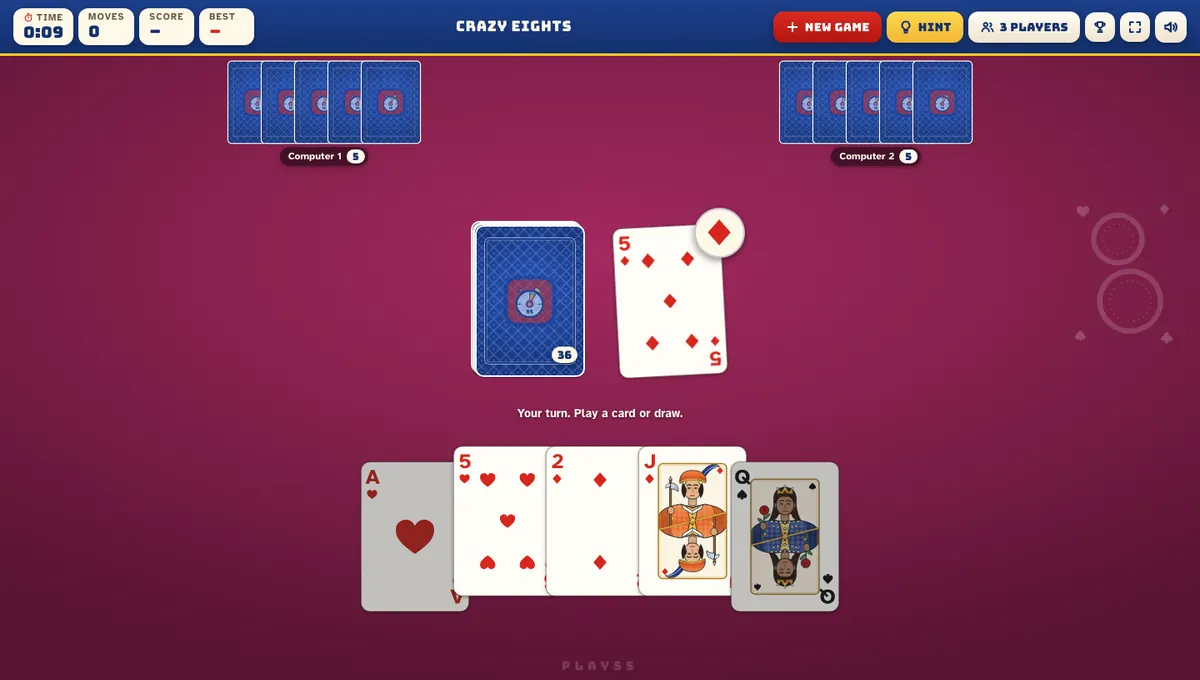
You sit first at the bottom of the table and play first in a quick round. The computer players sit at the top and play after you in turn, clockwise.
 Zoom in
Playing a card
On your turn you play one card that has the same suit or the same rank as the top card of the discard pile. If the top card is the 6 of clubs, you can play any club or any 6. In the Play5s version the cards you can play are lifted and the others are dimmed, so you can see your options at a glance.
The card you play becomes the new top card, and the turn passes to the next player. The small round plate on the corner of the discard pile always shows the suit that the next card has to follow.
The eights are wild
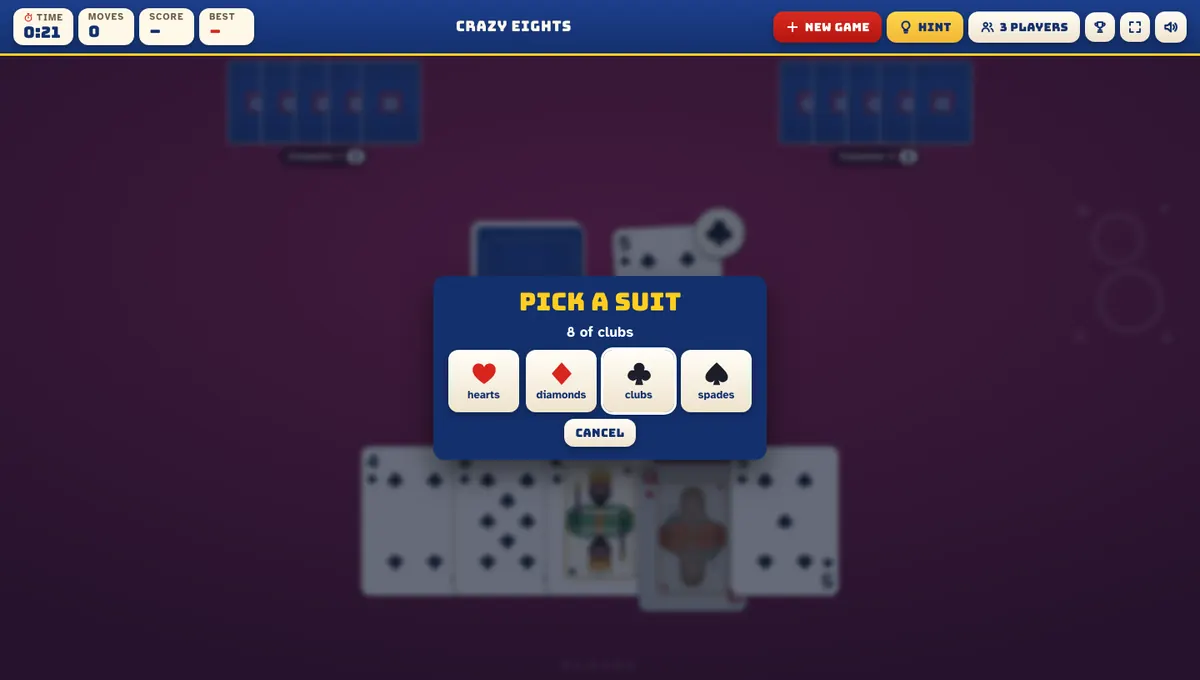
An 8 can be played on any card at any time, and when you play one you choose the suit that the next player must follow. The next player has to play a card of that suit, or another 8. After the 8 is played, its own suit and rank do not matter: only the suit that was named does.
In the Play5s version, tapping an 8 opens a small box with the four suits. The suit you hold most of is highlighted and has the focus, and Escape or Cancel puts the 8 back in your hand. Keyboard players can press H, D, C or S.
 Zoom in
Drawing from the stock
If you cannot play, you draw cards from the stock until you can play. You are also allowed to draw when you could play. Wikipedia and Bicycle Cards say so, and pagat calls it the normal game, noting that some groups let you draw only when you are stuck. In the Play5s version you tap the stock for each card, and the stock pulses when it is your only move.
When the stock runs out, the discard pile below the top card is shuffled into a new stock. A round can use up to eight of these reshuffles. If a player still cannot play and there is nothing to draw, the turn passes.
How a round ends
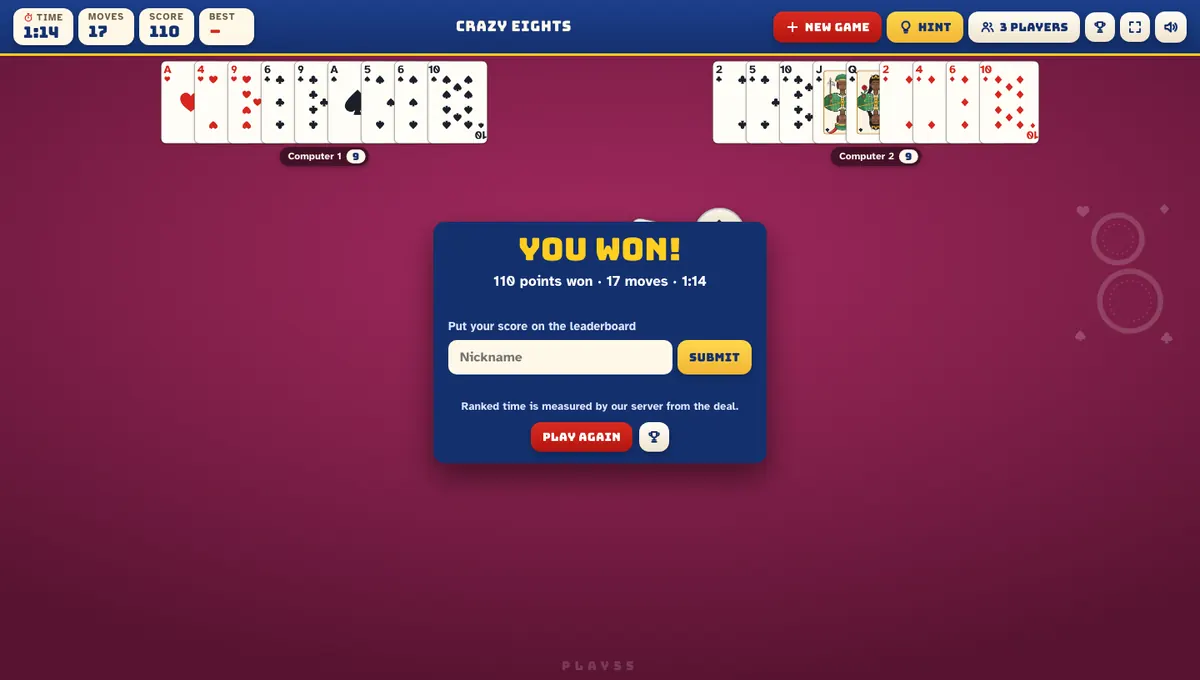
The round ends the moment a player plays their last card. That player wins, and the others pay the points left in their hands. A round can also be blocked: if nobody can play and nothing is left to draw, the hand with the fewest points wins the difference to each of the other hands, and if the lowest hands are equal, nobody scores.
 Zoom in
How scoring works in Crazy Eights
The player who goes out first scores the penalty points of the cards left in the other hands: 50 for each 8, 10 for each King, Queen, Jack and 10, 1 for each Ace and the face value for the other cards.
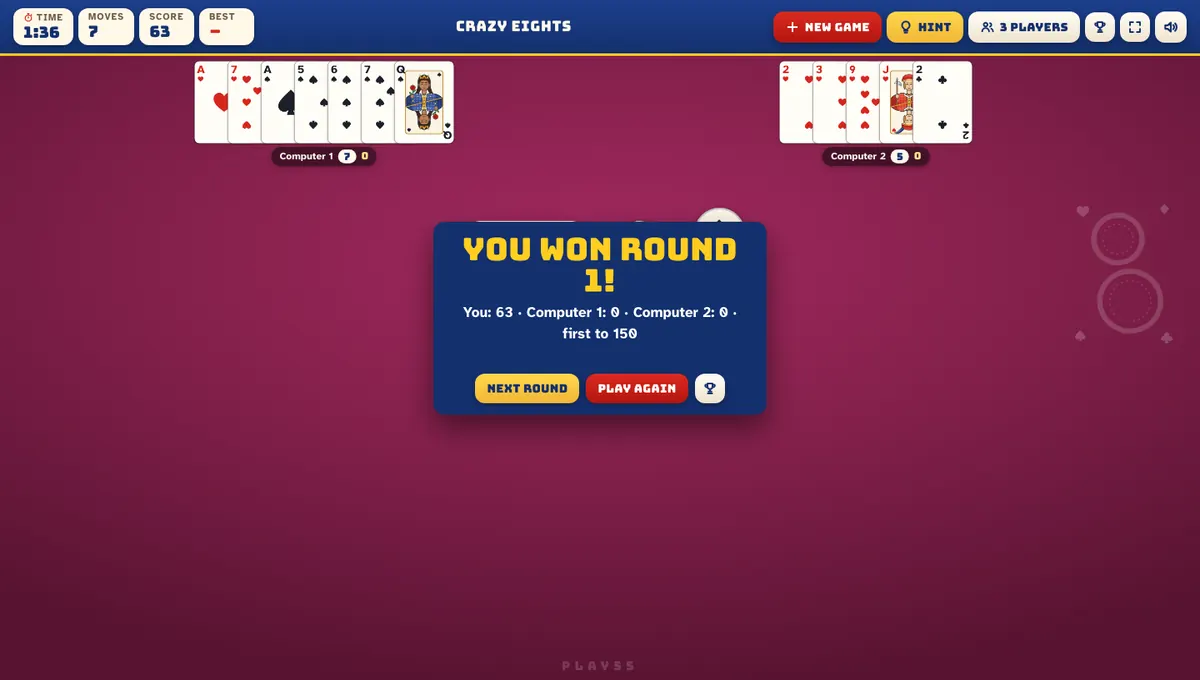
This is the scoring in Wikipedia, pagat and Bicycle Cards alike. If a computer player is left holding an 8, a King and a 3, you collect 50 + 10 + 3 = 63 points from that hand.
In a match the points of every round are added up, and the first player to reach 50 points for each player at the table wins: 100 points with two players, 150 with three and 200 with four. That target comes from Wikipedia. Some sites play with a lowest total instead, where every player adds the points in their own hand and the match ends when someone reaches 100, so check which scoring a table is using before you compare scores.
In a quick round the points you win are your score. Time and the number of moves do not change the score, and they only break ties on the leaderboard.
 Zoom in
Quick round, match and rule options
In the Play5s version you can choose the number of players, play a single quick round or a match, and switch on two rule options; the standard rules are the default.
Two, three or four players
You always sit at the bottom, and the other seats are computer players: one, two or three of them. Two players get seven cards each, and three or four get five. The Daily Deal is a three-player round.
Quick round or match
A quick round is one deal, and it is what the leaderboards use. A match is a series of rounds played to 50 points for each player at the table, with the dealer moving one seat after every round, and the panel after each round shows the points of every player. A match is played for fun and is not ranked.
Draw up to 3 and Action cards
Draw up to 3 changes how drawing works: you draw at most three cards in a turn, and if none of them can be played the turn passes. Wikipedia mentions this as one of the limits that some groups put on drawing.
Action cards add the three special cards that Wikipedia and pagat list as the most common house rules. A Queen makes the next player lose a turn. An Ace reverses the direction of play, which does nothing with two players. A Two makes the next player draw two cards, or answer with another Two, and the penalty adds up with each Two. An 8 cannot answer a Two, and a special card that goes out has no effect. A special card turned up as the starter works as if the dealer had just played it.
These two options and the match are practice rules. The leaderboards only take quick rounds with the standard rules, and the start screen says so before you begin.
Mau-Mau and Makao: two more games at the same table
Besides Crazy Eights, the start screen offers Mau-Mau, the German classic with 32 cards, and Makao, the Polish classic with 52 cards. The table and the computer players stay the same, but no 8 is wild: each game has its own special cards, you draw one card at a time, and you call “Mau” or “Makao” when you are down to one card.
Choosing a game
The start screen has a Game choice with Crazy Eights, Mau-Mau and Makao, and it remembers your pick. The German page opens on Mau-Mau and the Polish page on Makao, both written in their own language; every other page opens on Crazy Eights, unless you chose a game before. The number of players, from two to four, and the Hint button work the same in all three games.
Each game has its own rules, not just other special cards: the deck, the drawing, the calls and the scoring change too, as the table shows.
| Rule | Crazy Eights | Mau-Mau | Makao |
|---|---|---|---|
| Cards | Standard 52 | 32, from 7 to Ace | 52, no jokers |
| Deal | 5 each, 7 with two players | 5 each | 5 each |
| Special cards | Every 8 is wild | 7: next player draws 2, and 7s stack. 8: next player misses a turn. Jack: wild, names a suit | 2 and 3: next player draws 2 or 3. 4: miss a turn. Jack: demands a rank from 5 to 10. Queen and Ace: wild, and the Ace names a suit. K♥: next player draws 5. K♠: previous player draws 5 |
| Drawing | Until you can play, or at any time | One card: play it or keep it | One card: play it or keep it |
| Call | None | “Mau” when you are down to one card, “Mau-Mau” with the last | “Makao” when you are down to one card |
| Card values | 8 = 50, K Q J 10 = 10, A = 1, others face value | A 11, J 20, K Q 10, 7 to 10 face value | K♥ 150, A 50, 3 = 30, 2 = 20, 10 J Q and the other Kings 10, 4 to 9 = 5 |
| Match to | 50 points per player | 50 points per player | 500 points |
Mau-Mau in short
In Mau-Mau the card turned up at the start has no effect, so a 7, an 8 or a Jack on top is just a card to follow. A 7 can be answered with another 7, and the penalty grows to 4, 6 and so on until a player does not answer with a 7 and takes them all. A Jack goes on any card except a 7 that is waiting for an answer, but a Jack on a Jack is not allowed unless you switch on the Jack on Jack option, which is for practice. If you forget “Mau” you take one card, and if you forget “Mau-Mau” with your last card you take two and have not won yet.
Makao in short
In Makao a 2, a 3, the king of hearts and the king of spades can be answered with another of them that fits the top card in suit or rank, and the penalties add up; the Free stacking option drops the matching and is for practice. A player who misses a turn because of a 4 is skipped: attacks go past them, so with two players an attack played on the opponent comes back to you. A Jack demands its rank for one full round, you included, and a Queen or an Ace cannot be played while an attack or a rank demand is open, and after an Ace only the named suit or another Ace goes on. Forget “Makao” and you take five cards; the last card needs no call.
Calling and keeping a card
The call button sits on the right of the discard pile. Tap it before you play the card that leaves you with one card (key C; M stays the sound switch). If you forget, the game takes the penalty cards for you, and the computer players always call. After you draw a card that fits, you can play it or tap Keep (key K) to end the turn with it in your hand.
Leaderboards for each game
Each game has its own leaderboards for two, three and four players, nine in all, and only quick rounds with the default rules go on them. A match, Jack on Jack and Free stacking are practice. The Daily Deal stays a three-player Crazy Eights round, and when Mau-Mau or Makao is selected, its button says so.
How the computer players play
The computer players only use what a player at their seat could see: their own hand, the discard pile, how many cards the others hold, and which suits the others have shown they lack.
A computer player cannot see your hand or the stock. When someone has to draw, it learns that this player had nothing in the suit in play, and it uses that. Its choices are fixed rules and not guesses: it keeps its 8s for later because a last 8 always goes, unless nothing else fits or somebody is about to go out; among the other cards it plays the one that leaves the most cards in its hand that can follow it; it prefers a suit that the next player is known to lack; and when two cards are equal it plays the one with more penalty points. When it plays an 8 it names the suit it holds most of. In Mau-Mau and Makao they keep their attack cards and the cards that go on anything for the right moment, and they always call “Mau” or “Makao” on time.
Its moves depend only on the deal and on what you have done, so a ranked round can be replayed on our server from your moves alone, with the computer players' moves worked out again.
In a Play5s test on 22 November 2026, 1,500 simulated three-player rounds, a player who always followed the Hint button won 35% of them, and a player who picked a random playable card won 24%, against the same computer players. With an even share, a third of the rounds would go to each player.
Tips for winning Crazy Eights
The best habit in Crazy Eights is to keep your 8s until you need them, because an 8 is the one card that can always be played.
- Hold an 8 as long as you have other plays. If your last card is an 8, you can always go out.
- Play the cards of the suit you hold least of first, and keep the suit you hold most of for later. An 8 that names that suit then clears several cards in a row.
- Watch the hand sizes. When another player is down to one or two cards, play an 8 and name a suit they have not been able to follow.
- Get rid of high cards early. A King or a 10 costs 10 points if you lose, and a Queen or a Jack costs the same.
- Remember which suits the other players had to draw on. A player who drew when clubs were in play has no clubs.
- Use the Hint button when you are unsure. It shows the card the computer players' own rules would pick for your hand, and it never reveals another hand.
Daily Deal and leaderboards
The Daily Deal is one three-player quick round that every player gets on the same day, and the leaderboards rank the points you won.
The leaderboards count quick rounds with the standard rules. Each of the three games (Crazy Eights, Mau-Mau and Makao) has one board for two, three and four players, nine in all, and the Daily Deal has its own board. Only a round that you win goes on a board, and the boards are ranked by the points you won, so a higher number is better. If two players have the same points, the one with fewer seconds wins, and then whoever posted first.
The Daily Deal is the same deal for everyone, the day changes at midnight New York time, and the deal is chosen from a list in which every deal had a winning line found by our solver. It needs a connection because our server hands out the deal. Each connection gets one ranked Daily Deal result per day, and after that the Daily Deal is practice.
The time is measured by our server, from the moment the server dealt the round. The nickname is 2 to 12 characters, offensive names are refused, and you do not need an account. When you submit, your moves and nickname are sent to our server, which replays the round with its own copy of the rules and the computer players to work out the points.
Controls and saving
You play by tapping or clicking a card to play it and the stock to draw, and the keyboard works for everything.
- Tap or click a card that is lifted to play it. A card that does not fit shakes and a message tells you what would fit.
- Tap an 8, then pick a suit in the box.
- In Mau-Mau a Jack, and in Makao an Ace, opens the same suit box (keys H, D, C, S); a Makao Jack opens a box of ranks 5 to 10 (keys 5 to 9, and 0 for 10).
- Tap the stock to draw a card (key D). The Hint button (key H) points at a card to play, or at the stock.
- Keyboard: Tab goes into your hand, the left and right arrows move along it, Enter or Space plays a card. N starts a new game, F switches full screen and M switches the sound.
- The start screen has the game (Crazy Eights, Mau-Mau or Makao), the number of players, the format and the rule options. It remembers your choice.
- In Mau-Mau and Makao the call button (key C) goes with the next card you play, and Keep (key K) ends your turn with the card you drew. The button is labeled Mau!, Mau-Mau! or Makao!.
- There is no Undo in Crazy Eights, because taking back a move after the computer players have answered would show you their hands.
- Your game in progress, your options and your best rounds are saved in this browser on this device. Clearing your browser data removes them.
What Crazy Eights is and what it is related to
Crazy Eights is a shedding card game, the best known American member of the family of eights games, and the first player to get rid of all their cards wins.
According to Wikipedia the game first appeared as Eights in the 1930s, and the name Crazy Eights dates from the 1940s. It may come from the German Mau-Mau. The family includes Switch, Mau-Mau and Uno, and many countries have their own name for a game of the same kind: pagat lists Mau-Mau in Germany, Tschausepp in Switzerland and Pesten in the Netherlands. Mau-Mau and Makao have their own special cards, so the rules on this page are the Crazy Eights rules, where the eight is wild; both of the other games are described in the section on Mau-Mau and Makao.
The game is also called Crates, Switch, Swedish Rummy, Last One or Rockaway, and David Parlett describes it as less a game than a basic pattern of play on which a wide variety of changes can be rung.
Crazy Eights terms
Crazy Eights uses a handful of words, and most are shared with other card games.
- Stock: the face-down pile that you draw from. The discard pile is the face-up pile that you play onto.
- Starter: the first card of the discard pile, turned over from the stock when the round begins.
- Wild card: a card that can be played on anything, here every 8.
- Going out: playing your last card, which ends the round.
- Penalty points: the value of the cards left in a hand, which the winner collects.
- Blocked round: a round where nobody can play and nothing is left to draw.
Where the rules come from
The Crazy Eights rules on this page come from three sources that were read on 22 November 2026, the Mau-Mau and Makao rules from sources read on 25 November 2026, and every choice that is specific to Play5s is listed here.
- Wikipedia: Crazy Eights (opens in a new tab): the deal, wild eights, drawing, the stock running out, scoring, the match target of 50 points for each player and the three common special cards.
- pagat (John McLeod, Crazy Eights): the starter card that is an 8, the last card call, the three special cards and the end of the stock.
- Bicycle Cards (How to play Crazy Eights): the deal, the buried 8, drawing at any time and the scoring.
- The starter 8: pagat has the dealer name the suit and Bicycle Cards buries it, so Play5s buries it.
- The end of the stock: Wikipedia and pagat shuffle the discard pile into a new stock and Bicycle Cards has the player pass, so Play5s shuffles it (up to eight times a round) and then passes.
- The last card call from pagat is not used in Play5s Crazy Eights, because many groups skip it; Mau-Mau and Makao have their own calls, described above.
- Wikipedia: Mau-Mau (Kartenspiel) (opens in a new tab) (German) and spielregeln.de (Mau Mau): the Mau-Mau rules, which are 32 cards, the 7, the 8 and the Jack, the calls “Mau” and “Mau-Mau”, and the card values.
- Wikipedia: Makao (opens in a new tab) (Polish) and pl.wikibooks (Makao): the Makao rules, which are the function cards, the call and the penalty of five cards. The card values are the Tel Aviv table that pl.wikipedia gives for a variant of the game, the only table of points in those sources.
Crazy Eights questions
How many cards do you get in Crazy Eights?
Five cards each, or seven each when only two people play. The rest of the deck is the stock and its top card starts the discard pile. This is the deal in the Play5s version too.
What does an 8 do in Crazy Eights?
An 8 is wild. You can play it on any card at any time and you name the suit that the next player has to follow, or play another 8.
Can you play Crazy Eights with 2 players?
Yes. With two players each gets seven cards. In the Play5s version you can choose two, three or four players at the start screen.
Can you draw a card when you have a card to play?
Yes. Wikipedia, pagat and Bicycle Cards all describe drawing as allowed even when you could play, and some groups only allow it when you are stuck. The Play5s version lets you draw whenever the stock has cards.
What happens when the stock runs out?
The discard pile, except for the top card, is shuffled into a new stock. If there is still nothing to draw and you cannot play, your turn passes. If nobody can play, the round is blocked and the lowest hand wins the difference.
How is Crazy Eights scored?
The player who goes out first collects the points left in the other hands: 50 for an 8, 10 for a King, Queen, Jack or 10, 1 for an Ace and face value for the rest. A match goes to 50 points for each player at the table.
Do Queens, Aces and Twos do anything?
Not in the standard Crazy Eights rules, although in Makao a 2 does make the next player draw and a Queen and an Ace go on any card unless an attack or a rank demand is open. The Action cards option makes a Queen skip a player, an Ace reverse the direction and a Two make the next player draw two cards. That option is for practice and is not ranked.
Why is it called Crazy Eights?
The eights are the wild cards that change the suit. According to Wikipedia the name Crazy Eights dates from the 1940s, and the game was called Eights before that.
Is Crazy Eights the same as Uno or Mau-Mau?
They are in the same family. In all of them you match the top card and the first to empty their hand wins, but Uno uses its own deck, and Mau-Mau has different special cards: a 7 makes the next player draw two, an 8 skips a player and a Jack is wild. You can play Mau-Mau, and its Polish relative Makao, from the start screen of this game.
Can I play Mau-Mau or Makao here?
Yes. Pick Mau-Mau or Makao in the Game choice on the start screen. Mau-Mau is the German game with 32 cards and Makao the Polish game with 52 cards, and each has its own leaderboards.
How do you win Crazy Eights?
Be the first to play all your cards. Keep your 8s for the end, watch how many cards the others hold, and use the Hint button when you are stuck.
Can the computer players see my cards?
No. They use their own hand, the discard pile, the number of cards in each hand and the suits the others have shown they lack. They never look at your hand or at the stock.
Is there a Crazy Eights leaderboard and a Daily Deal?
Yes: a Daily Deal that is the same three-player round for everyone on a given day, and an all-time board for two, three and four players in each of the three games. Boards rank the points you won in a quick round with the standard rules, and you only need a nickname.
Does the game save my progress?
Yes. Your current round or match, your options and your best rounds are saved in this browser on this device. Clearing your browser data removes them. Only rounds you choose to submit to a leaderboard are sent to our server, with your nickname.
About this version
This Crazy Eights was built by Play5s to run in any modern web browser. It deals a new shuffled hand every round, and the computer players follow fixed rules that are described on this page. The cards, including the Jacks, Queens and Kings, are drawn by Play5s.
There is nothing to install and no account to create. Your game in progress and your best rounds are kept in your browser on this device. Starting a quick round or the Daily Deal asks our server for a deal and a ticket; your moves and nickname are sent only when you submit a round to a leaderboard.
The page gives the Crazy Eights rules as Wikipedia, pagat and Bicycle Cards describe them, and the Mau-Mau and Makao rules as the German and Polish Wikipedia, spielregeln.de and pl.wikibooks describe them; the choices that are specific to this version are listed in the section on where the rules come from.
Read more about Play5s, or see all of our free card games.