
On this page
How to play Whist
In whist, four players in two fixed partnerships play thirteen tricks with one 52-card deck, and the trump suit is set by the last card the dealer deals.
The partnerships and the cards
Whist uses one standard deck, with the Ace high and the Two low in every suit. You sit at the bottom and the computer partner sits across from you (North); the two computer opponents sit on your left (West) and right (East). Play goes clockwise, and every player gets thirteen cards.
Partners never see each other’s cards and there is no bidding, so the only way to tell your partner anything is the cards you play.
The deal and the turned-up trump
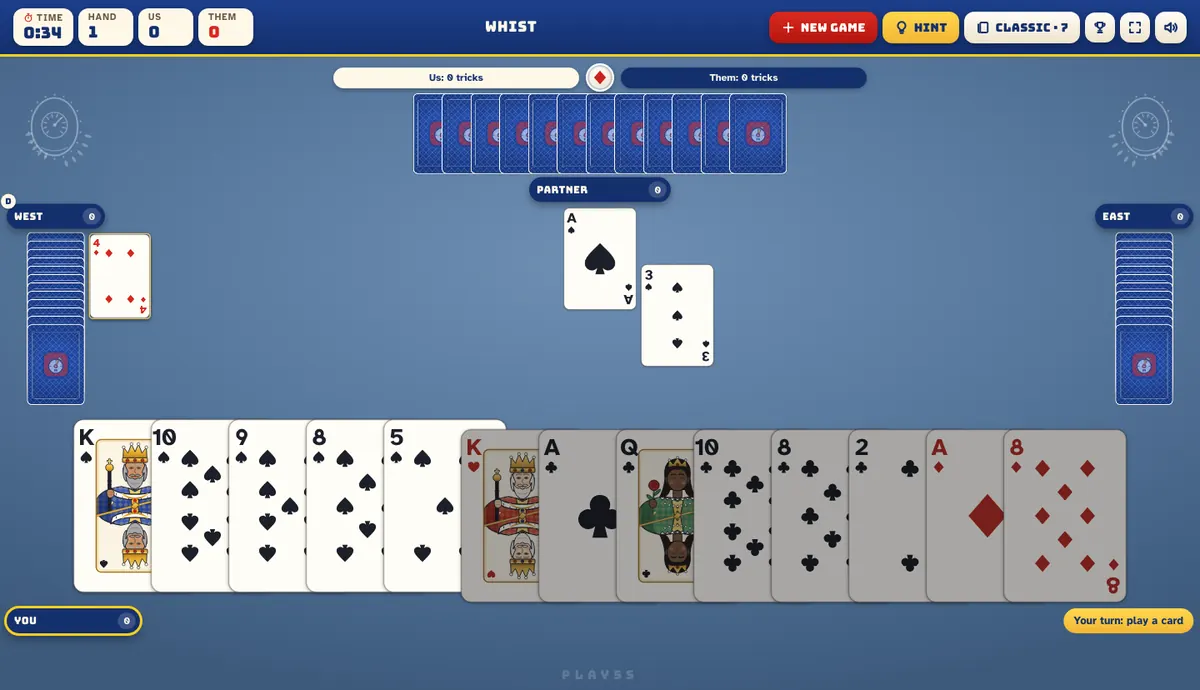
The dealer deals all 52 cards one at a time, starting with the player on their left. The last card, which belongs to the dealer, is turned face up, and its suit is trumps for the whole hand. That card stays on the table, in front of the dealer, until the dealer plays to the first trick; then it goes back into the dealer’s hand. On the table it has a gold edge, and the round medallion at the top of the table always shows the trump suit. The deal passes to the left after every hand.
 Zoom in
Playing a trick
The player on the dealer’s left leads the first trick with any card, and the others each play one card in turn. You must follow suit, playing a card of the suit that was led, whenever you have one. If you have none, you may play any card: a trump, to try to win the trick, or a card of another suit, which cannot win. The highest trump in the trick wins it; when nobody played a trump, the highest card of the suit led wins. The winner leads the next trick.
Trumps can be led at any time; there is no rule about trumps being “broken” as in Spades. The cards you can play rise above your hand and the others are dimmed; tapping one that is not allowed makes it shake and tells you why.
How a hand and a game end
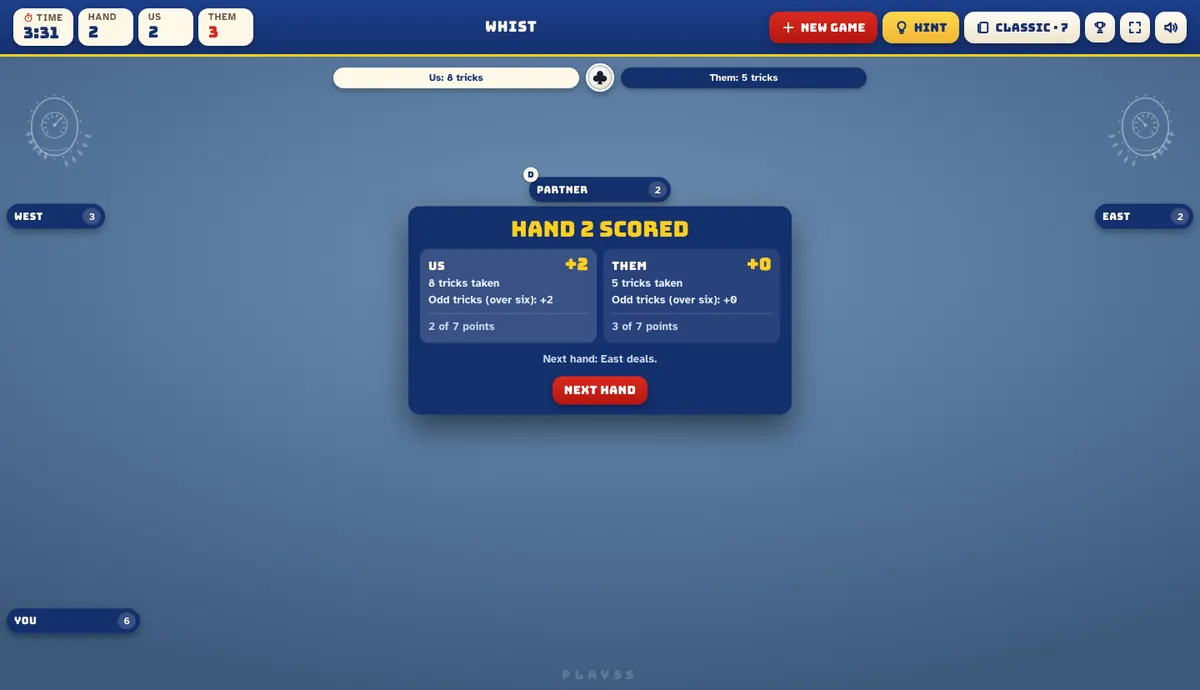
When all thirteen tricks have been played, the hand is scored and a score panel shows what each side took. Hands are dealt one after another until one side reaches the target score.
How scoring works in Whist
In whist, the side that wins more tricks scores 1 point for every trick it took beyond six, and the other side scores nothing for that hand.
Odd tricks
The first six tricks a side wins are called the book and score nothing. Every trick after them is an odd trick, worth 1 point. With 13 tricks in a hand, one side always takes at least seven, so every hand scores at least 1 point for someone.
| Tricks your side took | Points for your side | Points for the other side |
|---|---|---|
| 13 | 7 | 0 |
| 10 | 4 | 0 |
| 8 | 2 | 0 |
| 7 | 1 | 0 |
| 6 | 0 | 1 |
| 4 | 0 | 3 |
| 0 | 0 | 7 |
Winning the game
In the Classic game, the first side to reach 7 points wins; in the Short game, the first to 5 points. A side that takes all thirteen tricks scores 7 points in one hand, which wins a Classic game at once. In 3,000 games the computer played against itself, a game to 7 took 4.8 hands on average and a game to 5 took 3.4. About two hands in three scored 1 or 2 points, and all thirteen tricks went to one side in about 1 hand in 1,000.
 Zoom in
Honours (house rule)
Older whist also scored honours: the Ace, King, Queen and Jack of trumps. A side that was dealt all four honours between its two hands scores 4 points, and a side dealt three of them scores 2. Tricks are counted first, so a side that reaches the target on tricks wins even if the other side held honours, and a side that is one point short of game cannot score honours at all. Honours are off unless you switch them on in the house rules on the start screen; many players today leave them out because they add luck.
Classic 7, Short 5 or Knock-out Whist?
Classic goes to 7 points, as American players and most whist sites play it; Short goes to 5 points, the British short game; Knock-out is a different game for four players each on their own.
Classic and Short use exactly the same rules of play and scoring and differ only in the target, so Short is the quicker game. Classic is the mode of the Daily Deal. Each mode has its own all-time leaderboard.
Two house rules can be switched on for Classic and Short on the start screen: Honours, described above, and Trumps in turn, which replaces the turned-up card with the fixed order pagat gives for whist drives: hearts, diamonds, spades, clubs, then a hand with no trumps, and round again. Not every source agrees on the order: Wikipedia gives hearts, clubs, diamonds, spades. With either house rule on, a game is practice and is not ranked. Your choice is remembered on this device.
How to play Knock-out Whist
Knock-out Whist is a game of seven deals, from seven cards each down to one, in which a player who takes no trick in a deal is out, and the winner is the last player left or the winner of the single trick of the last deal.
Deals and trumps
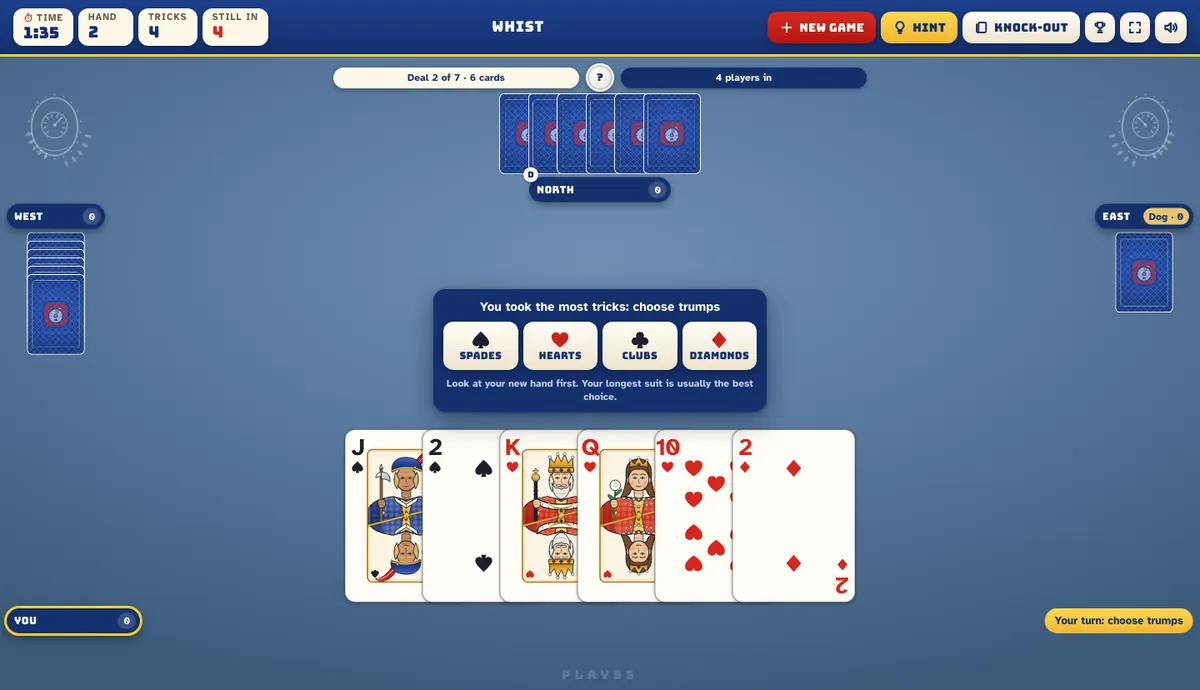
In this mode the four players play for themselves; North is an opponent, not a partner. The first deal is seven cards each, and the next card of the deck is turned up to set trumps; it belongs to nobody. Each later deal has one card fewer. The player who took the most tricks in the deal before chooses trumps after looking at their new cards, and a tie is settled by a cut. The usual advice is to choose your longest suit.
Play follows the same rules as Classic: follow suit if you can, and the highest trump or the highest card of the suit led wins.
 Zoom in
Knocked out, and the dog’s life
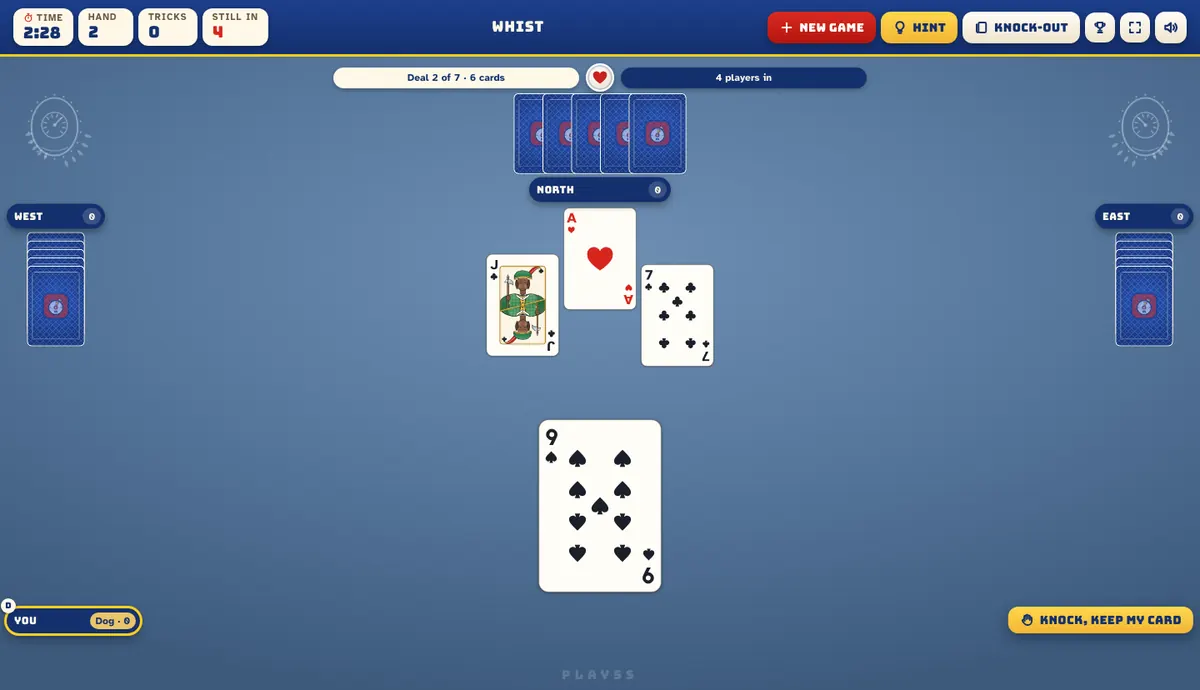
A player who takes no trick in a deal is knocked out. The first time this happens in a game, that player gets the dog’s life instead: one card in the next deal, which they may hold back by knocking on any trick except the last of the deal. If two or more players take no trick in that same deal, each gets a dog’s life; after that, nobody gets one again. A dog who wins a trick with that one card is back in, with a full hand in the next deal, and the player on the dog’s left leads after it; a dog who loses is out.
In this game, the game ends for you when you are knocked out. The Knock button appears next to your plate whenever you may knock.
 Zoom in
Winning Knock-out Whist
The game is won by the last player left in, or, if more than one player reaches the seventh deal, by the winner of its one trick. On the leaderboard, a won Knock-out game ranks by the number of tricks you took over the whole game.
How the computer plays
The computer plays your partner and the opponents with a fixed set of rules taken from classic whist advice, and it only uses what a player in its seat could know: its own cards, the turned-up trump and the cards already played.
When it leads, it opens its longest suit, leading the top card of a run of honours such as Ace–King or King–Queen, and otherwise a low card from the suit. It leads trumps when it holds five or more, or four headed by the best trump left; it returns the suit its partner led first, and it plays a suit its partner can trump. It cashes a card no one can beat as long as no opponent has shown that they are out of the suit.
When it follows, it plays low as the second player unless an honour was led and it can cover it, or it can take the trick with a sure winner from a short suit; it plays high as the third player, and wins as cheaply as it can as the last player. It never trumps a trick its partner is already sure to win, and when it is out of the suit led it trumps only when that wins the trick, otherwise throwing away its least useful card. It remembers every card played and which players have run out of a suit.
Hint asks the same player what it would do in your seat. The computer never looks at your cards and never plays at random, so the same deal and the same cards always play out the same way; that is also how our server checks a ranked game. In 2,000 Classic games with the computer playing your seat and your partner’s, your side won about three games in four against two simple opponents that only play their lowest winning card. Knock-out depends far more on the cards: in 3,000 games, the computer in one seat won about one game in four, close to an even share among four players, whether the other three played the same rules or only their lowest winning card.
Daily Deal and leaderboards
The Daily Deal is one Classic game to 7 points that every player gets on the same day: the same shuffles, hand after hand, with a new set at midnight New York time.
Every Daily Deal was checked before it went into the table: the computer playing your seat won it, so each one can be won. Our server hands out the Daily Deal, so it needs an internet connection, and each connection gets one ranked result per day; after that you can replay it as practice.
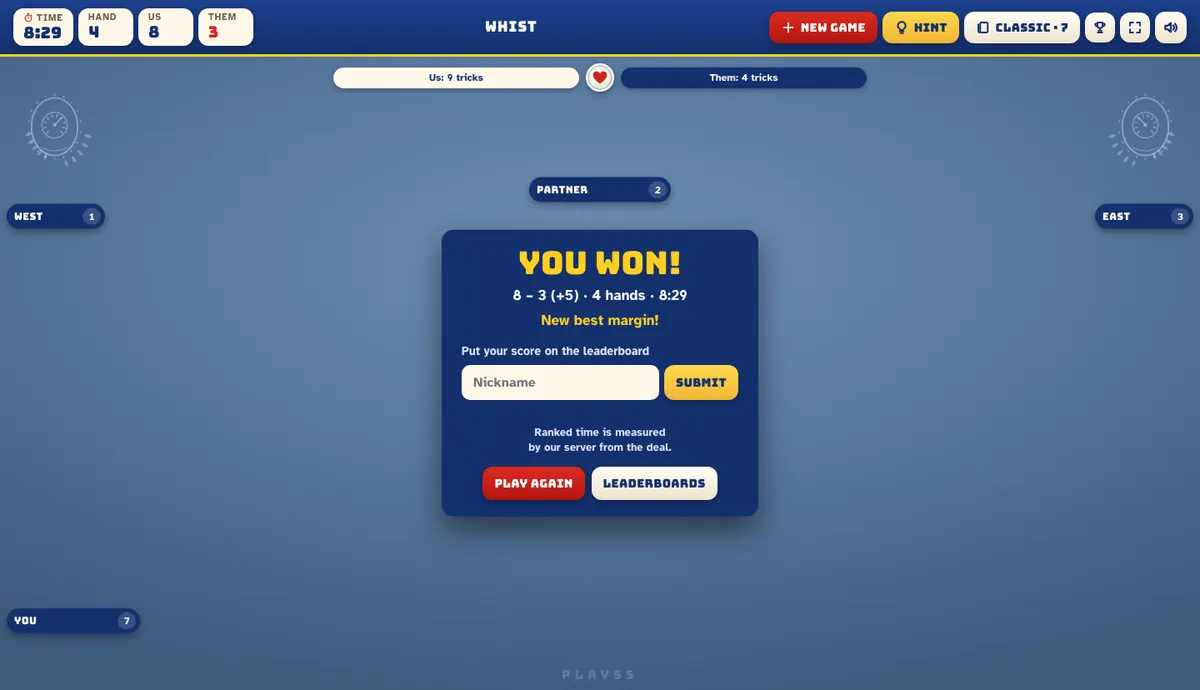
The leaderboards rank won games only. Classic and Short rank by the winning margin, your side’s final points minus the other side’s; Knock-out ranks by the tricks you took over the game. A higher number ranks higher, and a tie goes to the faster game, then to whoever posted first. There is a board for each day’s Daily Deal and an all-time board for each mode. After a win, type a nickname of 2 to 12 characters and press Submit; offensive names are refused and there is no sign-up.
The server replays every submitted game from your cards and choices, works out the computer’s moves and the score itself, and measures the time with its own clock from the moment it handed out the deal. Games with a house rule switched on are practice and cannot be submitted.
 Zoom in
Whist strategy for beginners
The most useful habit in whist is counting: keep track of the trumps and the high cards that have gone, because by the last few tricks you can often work out who holds the rest.
- Lead from your longest suit at the start of a hand. Once its high cards are gone, its low cards can win tricks too.
- With five or more trumps, lead trumps early to draw the opponents’ trumps, so your other long suit can run later.
- Second to play, play low; third to play, play high. Your partner still has a chance to win the trick after a low card from you in second seat.
- Cover an honour with an honour: if an opponent leads a Queen and you hold the King, playing it forces out their Ace or wins the trick.
- Do not trump a trick your partner is already winning. Keep your trumps for tricks the other side would take.
- Return your partner’s suit. The suit your partner led first is usually their strongest.
- Watch the turned-up card: everyone knows the dealer holds it until the first trick, so a dealer with a low trump showing may still hold high ones.
- When a player fails to follow suit, remember it. That player can trump that suit from now on, and the rest of that suit is in the other three hands, so their partner may well hold several of it.
- In Knock-out, one trick is what keeps you in the game. With a short hand, keep a sure winner for the trick you need rather than spending it early.
- Use Hint to see what the computer would play, then ask why: the rules in the section above explain most of its choices.
Whist controls: tap, click or keyboard
To play, tap or click one of the cards that rise above your hand; in Knock-out, choose trumps with the four suit buttons and use the Knock button to hold back a dog’s-life card.
Your hand is fanned, so tap the part of a card that shows. The computer plays at a pace you can follow, and each finished trick stays in the middle for a moment before it is swept to its winner. The bar above the table shows your time, the hand number and the score of your side (Us) and the other side (Them); in Knock-out it shows the tricks you have taken in the game and how many players are still in. Name plates show each player’s tricks in the current hand, and the strip at the top shows each side’s tricks with the trump medallion between them.
New game deals a fresh game and asks first when one is in progress. The mode button switches from Classic to Short to Knock-out and starts a new game. The full screen button shows only the table, the cup opens the leaderboards, and the gear (Settings) button holds two switches: sound effects (on at first) and quiet background music (off at first). The same panel lets you pick the language of the game’s own words, and the M key mutes or unmutes the sound effects. There is no Undo: the computer’s answers would show you what a card does before you chose it.
Keyboard
On a computer you can play without the mouse. When your turn comes, the focus moves to your playable cards: the arrow keys step along them, and Enter or Space plays the card. When you choose trumps or may knock in Knock-out, it moves to the suit buttons or the Knock button instead. In Knock-out, keys 1 to 4 choose trumps in the order the buttons show (spades, hearts, clubs, diamonds), and K knocks.
- H: show a hint
- N: start a new game
- F: full screen on or off
- M: sound effects on or off
- K: knock (Knock-out, dog’s life)
- 1–4: choose trumps (Knock-out)
Whist terms
Whist gave many card-game words their meaning, and most of them are still used in bridge.
- Trick: one round of four cards, one from each player, won by one player.
- Trumps: the suit that beats every other suit for the hand, set by the turned-up card.
- Turn-up: the dealer’s last card, dealt face up to show trumps.
- Follow suit: play a card of the suit that was led, if you have one.
- Ruff: play a trump on a trick of another suit when you cannot follow.
- Book: the first six tricks a side takes, which score nothing.
- Odd trick: each trick beyond the book; each one is worth 1 point.
- Honours: the Ace, King, Queen and Jack of trumps (a house rule here).
- Grand slam: all thirteen tricks to one side.
- Void: having no cards of a suit.
- Dog’s life: in Knock-out, a last chance with one card for the first player who takes no trick.
Other ways to play Whist
Many games carry the name whist, and this version has three of them: Classic, Short and Knock-out, with honours and trumps in turn as house rules.
British players of the 19th century played a rubber, the best of three games to 5, and older long whist went to 10 points. Many games add bidding to the classic play: Solo Whist, where one player can bid to take 5, 9 or all 13 tricks or to lose every trick; Bid Whist, a partnership game played in the United States; and Contract Whist or Oh Hell, where players predict exactly how many tricks they will take. German Whist is a two-player game in which the first thirteen tricks are played to win cards from the stock. Knock-out Whist also has house rules this version does not include, such as no dog’s life at all, or a “rainbow” of four suits winning the four-card deal. These games are described on the Whist and Knock-out whist pages of Wikipedia.
Two related trick-taking games are also on Play5s: Spades, a descendant of whist in which spades are always trumps and partners bid their tricks, and Euchre, a five-card partnership game in which the players choose trumps.
Where Whist comes from
Whist is an English game of the 17th and 18th centuries, and it became the leading card game for serious players after Edmond Hoyle published A Short Treatise on the Game of Whist in 1742.
Whist grew out of an older game called Ruff and Honours. The name comes from an old English word meaning “quiet” or “attentive”. Hoyle’s book, which can be read in its 1743 edition at the Internet Archive, was the standard text on the rules for about a century; in 1862 Henry Jones, writing as “Cavendish”, published the book that set out the conventions of play. The short game of 5 points became the British standard, while American players adopted a game of 7.
In the 1890s bridge, which adds bidding, replaced whist in clubs. Whist lived on as a social game, notably at whist drives, evenings where pairs move from table to table and trumps follow a fixed order. Its full history is on the Whist page of Wikipedia.
Where these rules come from
These rules follow three published descriptions of whist, pagat, Wikipedia and Bicycle’s rules, and where they differ this version says which one it follows.
- Four players in two partnerships, the whole deck dealt one card at a time, the dealer’s last card turned up for trumps and picked up at the dealer’s first play, following suit, and 1 point per trick over six are the same in all three.
- The target is 7 points in Classic, as in American whist and Wikipedia; 5 points in Short, as in pagat’s main rules and British short whist. Bicycle’s rules give no fixed target.
- Honours score 4 for all four and 2 for three, counted after tricks and not for a side one point short of game, as in pagat and in Wikipedia’s modern short whist. Older rules counted them as one or two tricks instead; they are a house rule here.
- Trumps in turn (hearts, diamonds, spades, clubs, no trumps) follow pagat’s description of fixed trump suits, the method it says whist drives use. Wikipedia’s description of whist drives gives another order, hearts, clubs, diamonds, spades.
- Knock-out Whist follows pagat: seven deals from seven cards to one, the first trumps turned up, then chosen by the player with most tricks after seeing their cards, a tie settled by a cut, the dog’s life for the first player with no trick, and a knocked-out player on the dealer’s left still dealing the next hand.
- The computer players are our own code. No open-source whist engine was copied.
Whist questions
How many players are in Whist?
Four, in two partnerships, with partners sitting opposite each other. Here you play with the computer as your partner and as both opponents. Knock-out Whist also has four players here, each playing for themselves.
How many cards does each player get in Whist?
Thirteen. The whole 52-card deck is dealt, so a hand has 13 tricks. In Knock-out Whist the first deal is 7 cards each and each later deal has one card fewer.
How is the trump suit decided in Whist?
The dealer’s last card is turned face up, and its suit is trumps for the hand. The card stays on the table until the dealer plays to the first trick. With the Trumps in turn house rule, trumps follow a fixed order instead: hearts, diamonds, spades, clubs, then no trumps.
Who leads first in Whist?
The player on the dealer’s left leads the first trick. After that, the winner of each trick leads the next.
How do you score Whist?
After 13 tricks, the side that took more tricks scores 1 point for each trick over six. Taking 8 tricks scores 2 points, and taking all 13 scores 7.
How many points is a game of Whist?
Seven in the Classic game, the American target, and five in the Short game, the British one. The first side to reach the target wins.
Can you lead trumps in Whist?
Yes. Any card may be led at any time, trumps included; whist has no rule about breaking trumps.
What are honours in Whist?
The Ace, King, Queen and Jack of trumps. With the Honours house rule on, a side dealt all four scores 4 points and a side dealt three scores 2, unless it is one point short of game.
What is the dog’s life in Knock-out Whist?
The first player who takes no trick gets one card in the next deal instead of being knocked out. They may knock to hold it back for a later trick, and if it wins a trick they are back in the game.
Is there an Undo button?
No. The computer answers each card you play, so taking one back would show you its result before you chose it. Hint shows what the computer would play in your seat.
What is the Daily Deal in Whist?
A Classic game to 7 that is the same for every player on a given day. It needs an internet connection, and each connection gets one ranked result per day. A new one starts at midnight New York time.
Does the game save my progress?
Yes. Your current game, its time and your house rules are saved in this browser on this device, so you can close the page and continue later. Clearing your browser data removes them.
Is Whist free on Play5s?
Yes. It is free to play in your browser on a phone, tablet or computer, with no download and no account.
About this version
This Whist was built by Play5s to run in any modern web browser. It follows the rules described above, shuffles a new deal for every game, and offers Classic, Short, Knock-out and the Daily Deal. The table, the cards, including the Jacks, Queens and Kings, and the cameo with the whist marker dial are drawn by Play5s, and the computer players are our own code.
There is nothing to install and no account to create. Your game in progress and your house rules are kept in your browser. Starting a ranked game asks our server for a deal and a ticket; your cards, choices and nickname are sent only when you submit a score.
Read more about Play5s, or see all of our free card games.