

On this page
How to play Pinochle
To win Pinochle, your team must be the first to reach 150 points, by making the bids you win, showing meld and taking aces, 10s and kings in the tricks.
The deck and the table
Pinochle uses a 48-card deck: two copies of the ace, 10, king, queen, jack and 9 in each of the four suits. Four players sit at the table in two teams, and partners sit across from each other. Here you are at the bottom, your partner is at the top, and the computer plays West and East. Every deal gives each player 12 cards.
The auction
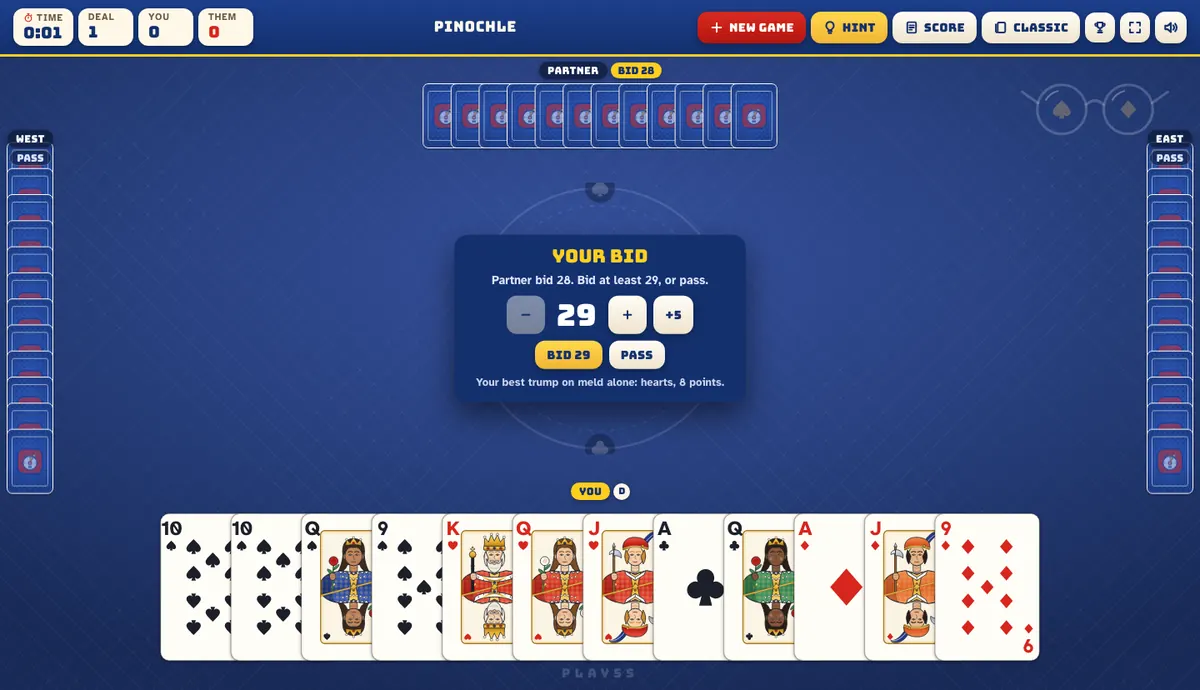
Each deal starts with an auction. The player to the dealer’s left bids first, and play goes around the table: you can raise the bid or pass, and a pass is final for that deal. The last player left wins the bid, names the trump suit and leads the first trick. A bid is a promise: your team will score at least that many points from meld and tricks together.
 Zoom in
Passing four cards
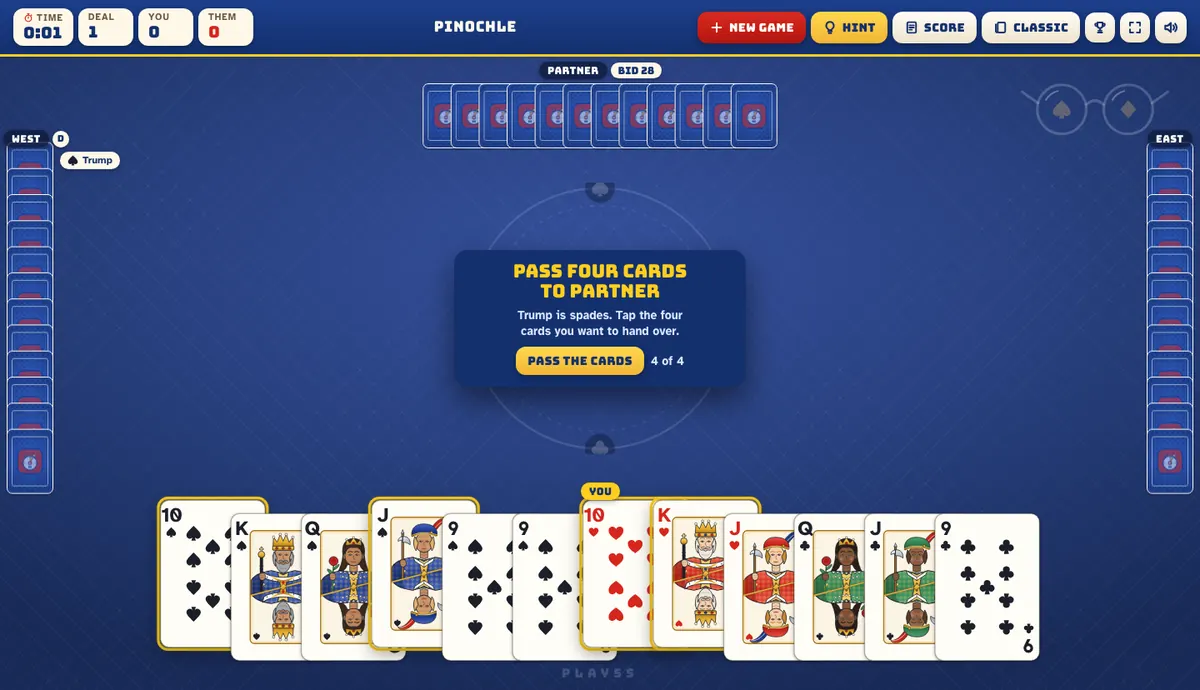
Once trump is named, the bid winner’s partner passes four cards across the table, and the bid winner passes four back (they may be the same cards). Only the team that won the auction exchanges cards. When your partner wins the bid, you choose the four cards to hand over; when you win it, you get your partner’s four first and then decide which four to give back.
 Zoom in
Showing meld
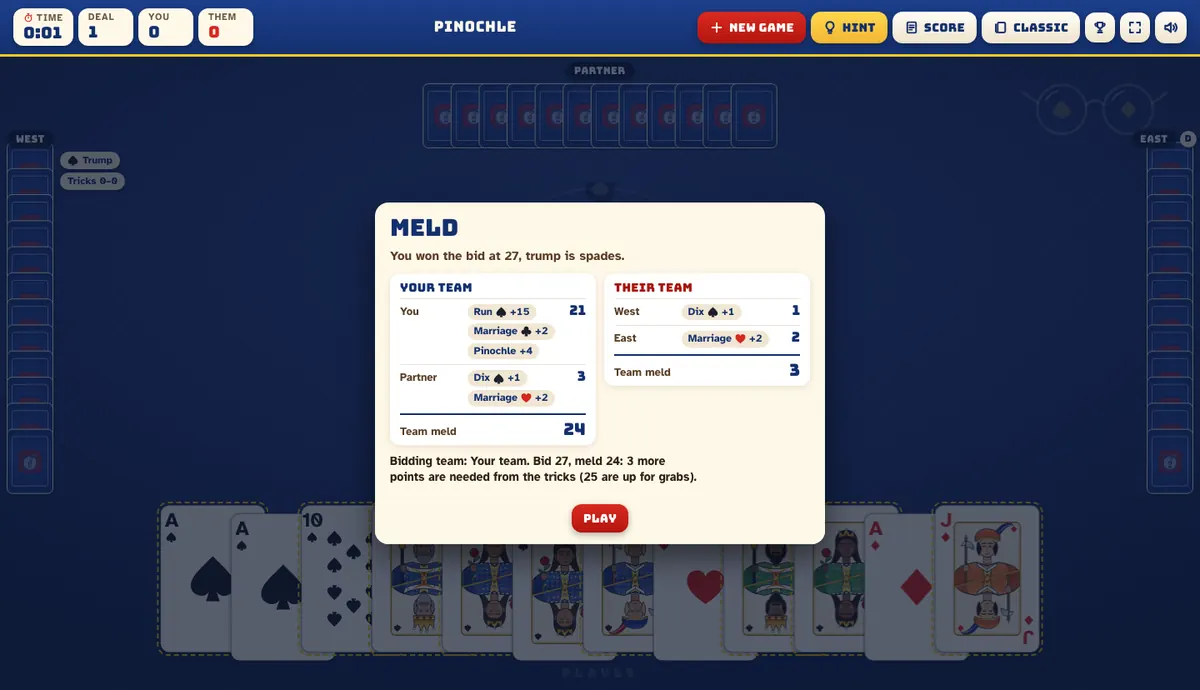
After the exchange all four players show their meld: scoring combinations such as a marriage (king and queen of one suit), a run (ace, 10, king, queen, jack of trump) or the pinochle itself (queen of spades with jack of diamonds). Each player’s meld counts for the team. If the bidding team’s meld cannot reach the bid even with every point of the tricks, the hand is thrown in at once; if it can, the bid winner decides whether to play the hand or throw it in.
 Zoom in
Taking tricks
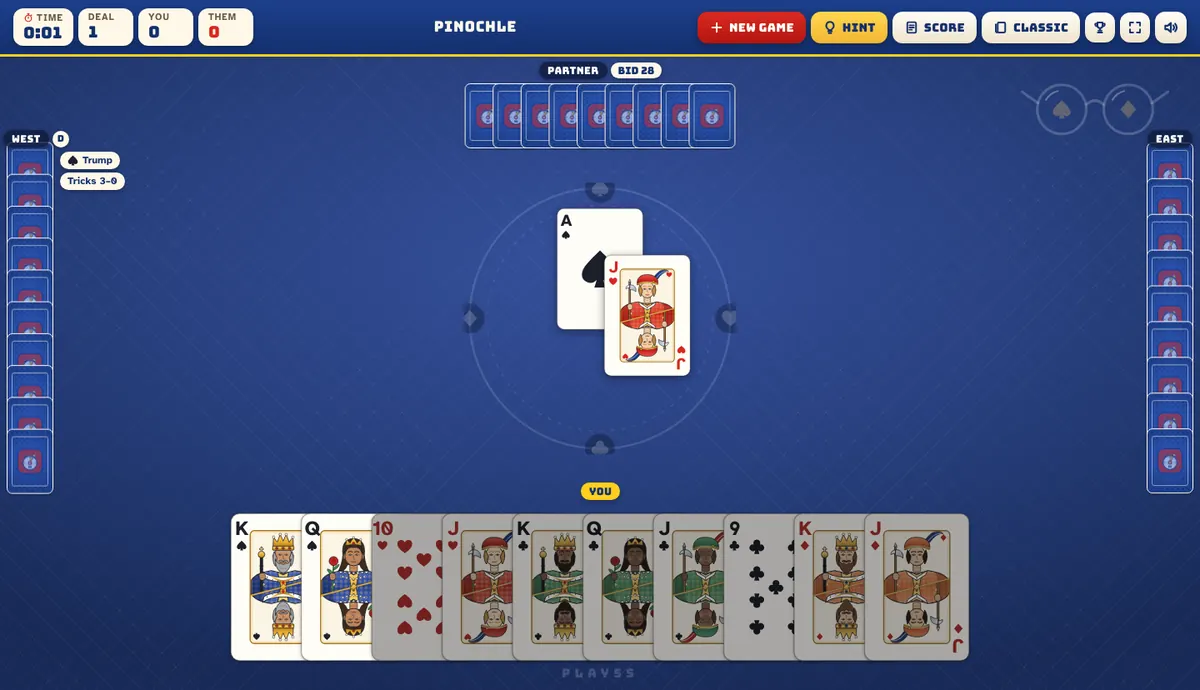
The bid winner leads the first trick and the winner of each trick leads the next, for 12 tricks. You must follow suit, you must beat the best card on the table if you can, and if you have no card of the suit led you must play a trump. A trump beats every card of another suit, and of two identical cards the first one played wins.
 Zoom in
Counting the deal and winning
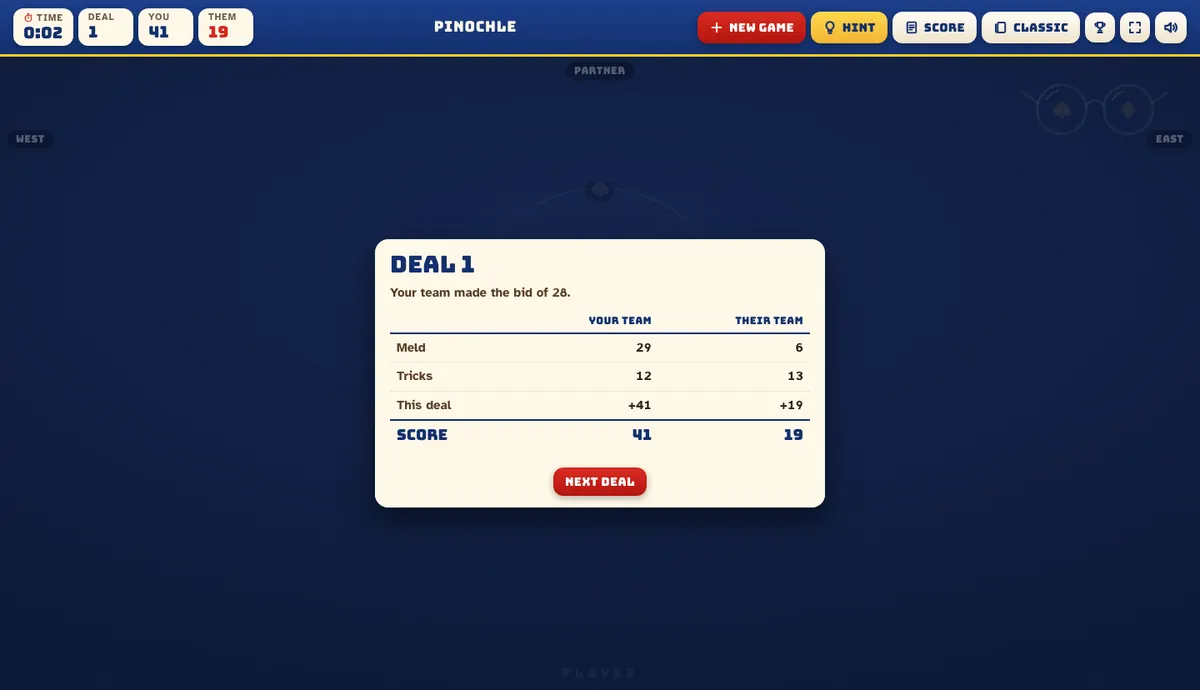
When the 12 tricks are played, each team adds its meld to the points it took in the tricks. The bidding team keeps its points only if the total reaches the bid; if not, the bid is taken off its score. Play deal after deal until a team reaches 150 points.
 Zoom in
The Pinochle deck and card ranking
A Pinochle deck has 48 cards: the 9, jack, queen, king, 10 and ace of each of the four suits, two of each card.
The ranking is unusual: from high to low it is ace, 10, king, queen, jack, 9, so a 10 beats a king. Aces, 10s and kings are the “counters”, the cards that score in the tricks; queens, jacks and 9s are worth nothing in the tricks, but they win tricks, build meld and the 9 of trump is itself meld.
Because every card exists twice, tracking what has been played matters more than in a 52-card game: once both copies of the cards above yours are gone, yours is the best card left in its suit. The deck is dealt out completely, 12 cards to each player, so nobody’s hand is a secret from you except by what you can work out.
Pinochle bidding rules
In Pinochle you bid the number of points your team expects to score in a deal, and the lowest bid is 25 points.
The player to the dealer’s left bids first. Each bid must be higher than the one before, bids go up one point at a time here, and you can pass instead of bidding. A pass is final: you are out of the auction for that deal. The auction ends when only one player has not passed, or at once when someone bids 100, since nobody can top it. If the first three players pass, the dealer is “under”: the dealer takes the bid at 25.
The player who wins the bid has three rights: to name the trump suit, to receive four cards from their partner and to lead the first trick. A bid counts for the whole team: your own meld, your partner’s meld and the points the team takes in the tricks all go toward it. The bid is not a bet on your own hand, so bid what the team can make, not what you can make alone.
Many tables, and many online games, use a bigger scale where everything is ten times larger: the lowest bid is 250, a pinochle is worth 40 and the game is played to 1,500. It is the same game with a zero added; this page and this game use the smaller scale, so 25 here means 250 there.
Pinochle meld values
Meld is a set of scoring card combinations: a run in trump is worth 15 points, a marriage 2 to 4, a pinochle 4 and four aces 10.
Every player shows meld after the cards have been passed, and the points count for the team. The combinations come in three kinds. A card can be used in more than one combination of different kinds (a queen can be in a marriage and in “queens around”), but only once in each kind. Scores below are on the scale used here; multiply by 10 for the larger scale.
| Meld | Cards | Points |
|---|---|---|
| Run (also called a flush or family) | Ace, 10, king, queen and jack of the trump suit | 15 |
| Run with a second marriage | Ace, 10, king, king, queen, queen, jack of trump | 19 |
| Double run | Both aces, 10s, kings, queens and jacks of trump | 150 |
| Royal marriage | King and queen of the trump suit | 4 |
| Double royal marriage | Both kings and both queens of trump | 8 |
| Marriage | King and queen of any other suit | 2 |
| Double marriage | Both kings and both queens of another suit | 4 |
| Dix (say “deece”) | Each 9 of the trump suit | 1 |
| Pinochle | Queen of spades and jack of diamonds | 4 |
| Double pinochle | Both queens of spades and both jacks of diamonds | 30 |
| Aces around | One ace of each suit | 10 |
| Kings around | One king of each suit | 8 |
| Queens around | One queen of each suit | 6 |
| Jacks around | One jack of each suit | 4 |
| Aces, kings, queens or jacks “abound” | All eight cards of that rank | 100 · 80 · 60 · 40 |
A few details trip people up. The run counts only in the trump suit, and the trump suit decides which marriage is royal. A single extra king or queen next to a run adds nothing in this game; a second king and a second queen make a second marriage and take the run from 15 to 19. A marriage in every suit with clubs as trump comes to 24 points: 4 for the royal marriage, 2 each for the other three, 8 for kings around and 6 for queens around.
Not every table scores the run and its extra cards the same way. Some score a run with one extra king or queen as 19 and with a full extra marriage as 23. We follow the rule that pagat calls the more usual one and that other open-source game code uses.
Pinochle trick rules: follow suit, beat, trump
In the trick-taking part of Pinochle you must follow suit, you must play a higher card if you can, and if you have no card of the suit led you must play a trump.
The leader may play any card. After that, every player must obey the same order of duties. If you have a card of the suit led, you must play one, and if you have one that beats the best card in the trick so far you must play it, even when your partner is the one winning. If you have none of the suit led but you do have a trump, you must play a trump, and if the trick has been trumped already you must play a higher trump when you can. Only a player with no card of the suit and no trump may throw anything. Of two identical cards the first one played wins.
Classic and Relaxed rules
This game has two rule sets for the tricks, because Pinochle is played both ways. Classic is the rule set above: you must beat the best card whenever you can, which is the older rule and the one most online games use. Relaxed follows the rules in most books since 1945: only a trump lead has to be beaten, and when you follow a plain suit you may play any card of it; you must still follow suit and still trump when you are out of the suit, but you need not play a higher trump than the one already in the trick. According to Wikipedia, pinochle clubs and tournaments play the later rules about half of the time. Each rule set has its own all-time leaderboard.
How scoring works in Pinochle
Each ace, 10 and king you take in the tricks is worth 1 point, and the last trick is worth 1 more, so every deal has 25 points in the tricks.
Making the bid or going set
The bidding team adds its meld to the points it took in the tricks. If the total is at least the bid, the team scores all of it. If it falls short, the team “goes set”: the bid is subtracted from its score, and it scores nothing else for that deal, neither meld nor trick points, so a team can go below zero. A bid of 30 with 12 points of meld needs 18 of the 25 trick points.
Saving your meld as a defender
The other team scores the points it took in the tricks, but its meld counts only if it took at least one point in the tricks (an ace, a 10, a king or the last trick). A team that wins no counters loses its meld, with one exception: the 9s of trump count either way.
Throwing in the hand
The tricks are worth only 25 points. If the bidding team’s meld is so thin that the bid is more than 25 points above it, the bid cannot be made: the team is not “on the board” and the hand ends right after the meld is shown. It loses the bid, the other team scores its meld, and the cards are not played. A team that is on the board but still needs points from the tricks may give up the same way: after the meld, the bid winner chooses Play the hand or Throw in. Throwing in costs exactly the bid and keeps the other team from scoring the tricks, so it is the better choice when the tricks still needed are out of reach. When the meld alone covers the bid there is nothing to decide and the hand is played. The computer throws in only when the trick points still needed are well beyond what its own cards and trump can expect to take.
Winning the game
The first team to reach 150 points wins. If both teams pass 150 in the same deal, the team that held the bid wins, even with the lower total (this is often called “bidder out”). To keep a game from running on, this game stops after 20 deals, and the higher score wins; computer games have never come close, with an average of six or seven deals.
 Zoom in
Daily Deal and leaderboards
The Daily Deal is one Classic game that every player gets on the same day, with the same chain of deals, and its leaderboard ranks the winners by winning margin.
A new Daily Deal starts at midnight New York time. Everyone plays the same shuffles, in the same order, against computer players that decide the same way, so the board compares what players did with identical cards. Each Daily Deal was tested before it was scheduled: a computer player sitting in your seat wins it in 5 to 11 of 16 test games, so it is neither a lost cause nor a gift. Our server hands out the Daily Deal, so it needs an internet connection, and each connection gets one ranked result per day; after that you can replay it as practice.
Boards rank winning games only, by the winning margin: your team’s final score minus the other team’s, higher is better. If two players have the same margin, the faster time ranks higher, then whoever submitted first. Time is measured by our server from the moment the deal is handed out. Classic and Relaxed each have an all-time board, and the Daily Deal has its own for each day. After a win, type a nickname of 2 to 12 characters (offensive names are refused) and press Submit; no sign-up is needed.
Pinochle strategy and tips
The most useful habit in Pinochle is to count your meld before you bid, because meld is the part of your score you can know in advance.
- Count meld for each suit as trump before bidding: a run, a royal marriage and a pair of aces around are worth far more than they look.
- Bid for the team, not for your own hand: your partner’s four passed cards and their meld count toward the bid too.
- Do not bid points you cannot count. A missed bid costs the whole bid and cancels the meld you showed.
- When your partner wins the bid, pass trump first, then aces. Extra trumps give the bidder control of the deal, and an ace wins a trick in any suit.
- Keep the cards that complete your own meld. A king and a queen of one suit are worth more at home than in your partner’s hand.
- Lead your aces early and, if you hold the highest trumps, lead trump to pull the opponents’ trumps out of their hands.
- Track what has been played. Every card exists twice, so once both copies above yours are gone, yours is the master card of its suit.
- When your partner is winning a trick, play a 10 or a king onto it: it is a free point for your team (in Classic you must still beat the trick if you can).
- Hold a high trump for the end if you can: the last trick is worth a point, and every deal is 25 points.
- On defense, take at least one ace, 10 or king: without a trick point your meld is lost.
Pinochle terms
Pinochle has its own words, most of them for scoring combinations and for what happens to a bid.
- Auction: the bidding at the start of a deal; the winner names trump.
- Counters: aces, 10s and kings, the cards that score points in the tricks.
- Meld: scoring card combinations shown before the tricks are played.
- Marriage: a king and a queen of the same suit; royal when the suit is trump.
- Run (or flush, family): ace, 10, king, queen and jack of trump.
- Dix: the 9 of trump, worth 1 point as meld.
- Pinochle: the queen of spades with the jack of diamonds, 4 points.
- Around: one card of the same rank in each suit; abound: all eight cards of that rank.
- Going set: failing to make the bid, which costs the bid and the deal’s other points.
- Throwing in: giving up a hand after the meld, without playing the cards: the bidding team loses the bid and the other team scores its meld. A team whose meld cannot reach the bid must throw in.
- Saving meld: taking at least one point in the tricks so that the meld counts.
- Bidder out: when both teams pass the target in one deal, the bidding team wins.
Other kinds of Pinochle
Four-player partnership auction pinochle is the standard game today, but Pinochle is also played by two or three people, and with a bigger deck.
Wikipedia’s Pinochle article describes the others. Two-handed pinochle is the original game, closest to its ancestor bezique, where melds are shown after winning tricks and cards are drawn from a stock. Three-handed pinochle deals 15 cards to each player and three to a widow, and every player plays alone. “Cutthroat” deals out the whole deck, 16 cards each. Double-deck pinochle uses two decks without the 9s, 80 cards in all, deals 20 cards each and starts bidding at 500 on the larger scale. This game is the four-player single-deck version only. More trick-taking and card games are on the Play5s card games page.
Where Pinochle comes from
Pinochle is a descendant of bezique that became one of the best-known card games in the United States.
It is thought to be either a cousin of Binokel, the Swiss and South German game, or a descendant of it, and both come from bezique. The name may come from the French word “binocle”, meaning eyeglasses or “two eyes”: a legend says the queen of spades and jack of diamonds, the two cards of the pinochle meld, were once drawn in profile with one eye each. The game spread in the United States in the early 1900s, when boxed decks made for it, with each card twice and nothing below the 9, went on sale. The table in this game carries a faint pair of spectacles in its corner as a nod to that story.
The standard game today is partnership auction pinochle. Variants with a different number of players, extra decks, a card kitty or different meld tables are all played. The rules on this page were compared with Wikipedia, pagat’s single-deck partnership rules and the rule pages of several online games, and where they differ we took the table rule that is most common in the United States and said so.
Pinochle controls: tap, click or keyboard
Tap or click a card in your hand to play it, and use the panel in the middle of the table to bid, name trump, pass cards and choose whether to play the hand or throw it in.
On your turn the cards you may play are bright and the rest are dimmed; tapping a dimmed card tells you why it is not allowed. Bidding has a stepper (minus, plus and a plus 5 button) and a Pass button. To pass or give back four cards, tap each card you want to send, and the button lights up at four. The computer players act one at a time so you can follow every bid and card, and tapping the table after a trick moves on. Hint suggests a bid, a trump suit, four cards or a card to play, using the same logic as the computer players. Score opens the score sheet with every deal so far.
- Tab and Shift+Tab: move between cards and buttons
- Left and right arrow keys: move along your hand
- Enter or Space: play or pick the focused card
- H: show a hint
- S: open or close the score sheet
- N: start a new game
- F: full screen on or off
- M: sound effects on or off
Pinochle questions
How many cards are in a Pinochle deck?
A Pinochle deck has 48 cards: two copies of the 9, jack, queen, king, 10 and ace in each of the four suits.
What is Pinochle?
Pinochle is a trick-taking and melding card game, most often played by four players in two teams. Players bid for the right to name trump, show scoring combinations called meld and then take tricks; ace, 10 and king are the scoring cards.
How do you play Pinochle with four players?
Partners sit across from each other and each player gets 12 cards. After an auction the bid winner names trump and swaps four cards with their partner, all four players show meld, and 12 tricks are played. The first team to 150 points wins.
Can you play Pinochle with two players?
Yes. Two-handed pinochle is the original game, but it is played differently, with a draw pile and meld shown after tricks. This game is the four-player version: you and a partner against two computer players.
How do you spell Pinochle?
Pinochle is the common spelling. Pinocle and penuchle are spellings you will also see, and it is pronounced “PEE-nuk-ul”.
What is the lowest bid in Pinochle?
In this game the lowest bid is 25 points. That is the “small scale” of the same game that other places score with 250.
Can you throw in a hand in Pinochle?
Yes. After the meld, a bid winner whose team still needs points from the tricks may throw the hand in instead of playing it: the team loses the bid, the other team scores its meld, and the cards are not played. A team whose meld is more than 25 points short of the bid cannot make it at all, so its hand is thrown in automatically.
What does going set mean?
The bidding team goes set when its meld and trick points do not reach the bid. It loses the amount of the bid and scores nothing else for that deal.
What is a dix?
The dix (pronounced “deece”) is the 9 of the trump suit. Each one is worth 1 point as meld, and it still counts for a team that takes no points in the tricks.
Can a card be used in more than one meld?
Yes, but only in melds of different kinds. A queen of spades can count in a marriage with a king of spades and in a pinochle with a jack of diamonds, but it cannot be in two marriages.
What is a run, flush or family in Pinochle?
They are all names for the ace, 10, king, queen and jack of the trump suit, which is worth 15 points here.
Is a 10 higher than a king in Pinochle?
Yes. The order is ace, 10, king, queen, jack, 9, so a 10 beats a king.
Do I have to beat my partner’s card?
In Classic, yes, if you can: you must play a higher card than the best one in the trick even when your partner is winning. In Relaxed you do not have to when a plain suit is led, but you must follow suit and trump when you cannot.
Is Pinochle like Spades?
They are cousins: both are partnership trick-taking games with a bid at the start of each deal. In Spades every player bids how many tricks they will take and spades are always trump. In Pinochle the players bid points, the highest bidder names trump and leads, the deck has 48 cards with the order ace, 10, king, queen, jack, 9, and meld adds points before the tricks.
Who invented Pinochle?
Nobody knows. It developed from bezique by way of the German game Binokel, and it became popular in the United States in the early 1900s.
Is Pinochle hard to learn?
The cards and the order of duties take a game or two to remember, and the meld table is the longest thing to learn. The deal sheet and the meld sheet in this game show every point, and the Hint button suggests the next step.
How do the computer players decide?
The computer players follow fixed rules and see only their own cards and what is on the table, the same as you: bids from the meld and strength of their hand, trump chosen by the best total, and the cheapest card that wins a trick. They never look at your hand.
Is there a Pinochle leaderboard?
Yes: one for each Daily Deal and all-time boards for Classic and Relaxed, ranked by winning margin. Only games your team wins are listed. The time is measured by our server from the moment the deal is handed out.
Does the game save my progress?
Yes. Your current game is saved in this browser on this device, so you can close the page and pick up where you left off. Clearing your browser data removes it.
Is Pinochle free on Play5s?
Yes. It is free to play in your browser, with no download and no account.
About this version
This Pinochle was built by Play5s to run in any modern web browser: single-deck partnership auction pinochle for four players, you and a partner against two computer players, with the Classic and Relaxed trick rules and a Daily Deal. The cards, including the jacks, queens and kings, are drawn by Play5s. The meld values, the trick rules and the scoring are checked by an automated test suite and by 600 games played by computer players only, in which every deal adds up to 25 trick points and every saved game replays to the same score.
Where tables differ we chose the common United States rule and said so on this page: a single extra king or queen next to a run adds nothing, bids go up one point at a time and a bid of 100 ends the auction, and a game stops after 20 deals. There is nothing to install and no account to create. Your game in progress is kept in your browser. Starting a ranked game asks our server for a deal and a ticket; your moves and nickname are sent only when you submit a score.
Read more about Play5s, or see all of our free card games.