
On this page
How to play bridge
Bridge is played in two parts: an auction, in which the four players bid for the right to name the trump suit, and the play, in which the side that won the auction tries to take the number of tricks it bid.
The players and the cards
Bridge uses one 52-card deck, with Ace high and Two low in every suit. Four players sit around the table as North, East, South and West, and the two players facing each other are partners. You sit South, your computer partner is North, and the computer opponents are West on your left and East on your right. Play goes clockwise, and every player gets 13 cards.
A deal from start to finish
Each deal has the same steps. The cards are shuffled and dealt, 13 to each player. The dealer starts the auction, and the players call in turn until three passes in a row end it. The last bid becomes the contract: a number of tricks and a trump suit, or no trump. One player of the side that bid it becomes the declarer, and their partner becomes the dummy. The player on the declarer’s left leads the first card, the dummy’s hand is laid face up, and thirteen tricks are played. The deal is then scored and the next one begins, with the deal passing to the left.
What a contract means
A bid has a level from 1 to 7 and a denomination: clubs, diamonds, hearts, spades or no trump. The level counts tricks above six, so a bid of 4 spades is a promise to take 10 of the 13 tricks with spades as trumps, and 1 no trump promises 7 tricks with no trump suit. The declarer’s side scores if it takes at least that many tricks; otherwise the defenders score for every trick it falls short.
The bidding: how the auction works
In the auction each player in turn makes a bid higher than the last one, passes, or doubles or redoubles, and the auction ends when three players pass in a row after a bid.
Higher bids
The denominations rank, from lowest to highest, clubs, diamonds, hearts, spades and no trump. A new bid must be higher than the last: the same level in a higher denomination (1♥ over 1♦) or any higher level (2♣ over 1♠). The lowest bid is 1♣ and the highest is 7NT. The dealer calls first, then the player on the dealer’s left, and so on clockwise.
Pass, double and redouble
A pass does not end your part in the auction: you may bid later if it comes round again. Double is allowed only on the last bid, only if an opponent made it, and only while it is not doubled yet; it raises the score of the contract and of the penalty if it fails. Redouble is allowed only after an opponent has doubled your side’s bid, and raises them again. A new bid by anyone cancels an earlier double or redouble.
The end of the auction
Three passes in a row after a bid end the auction, and the last bid is the contract. If all four players pass at their first turn, the deal is passed out: nobody plays it. The declarer is the player of the winning side who first named the denomination of the contract, even if their partner made the final bid. If your partner North becomes declarer, you are the dummy, and you play North’s cards as declarer.
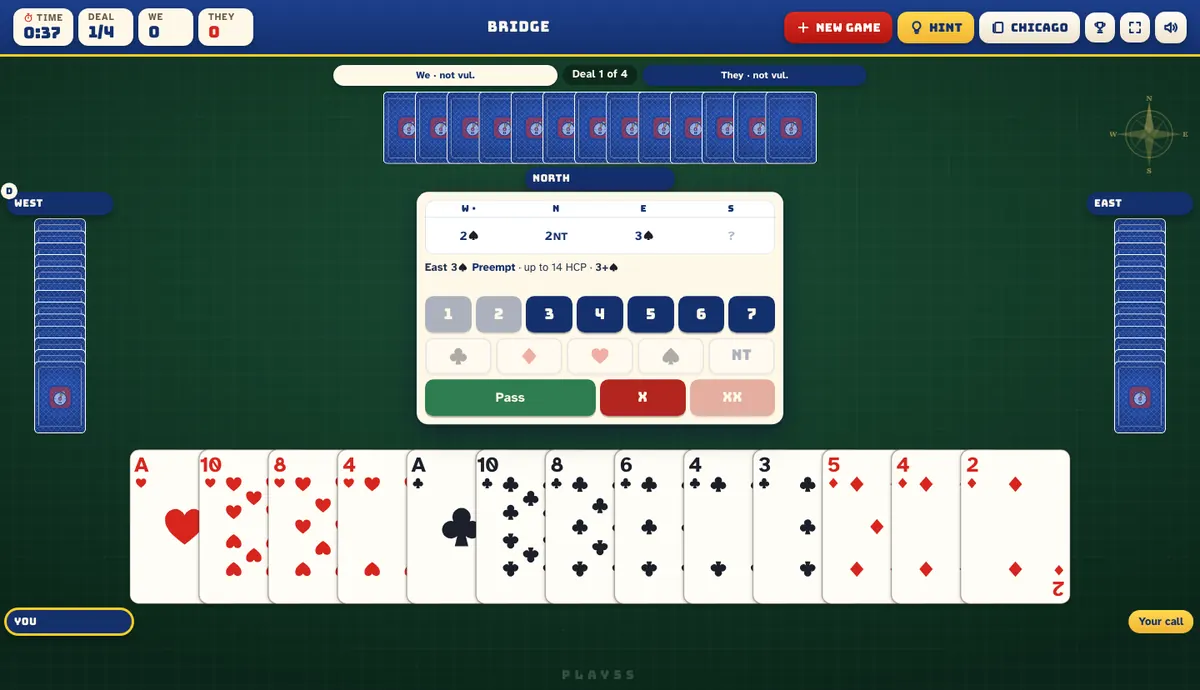
The bidding box under the auction table works in two taps: choose a level from 1 to 7, then a suit or NT. Levels and suits that would not be a higher bid are greyed out, and the double and redouble keys only light up when the laws allow them.
 Zoom in
Playing the hand: tricks, trumps and the dummy
The player on the declarer’s left leads to the first trick, the dummy then lays its 13 cards face up, and the declarer plays both their own hand and the dummy’s for all 13 tricks.
Following suit
Each player in turn plays one card to the trick, clockwise. You must follow the suit that was led if you have a card of it. If you have none, you may play any card, including a trump. A trick is won by the highest trump in it or, if no trump was played, by the highest card of the suit that was led. The winner of a trick leads to the next one. Playing a trump is never compulsory.
The dummy
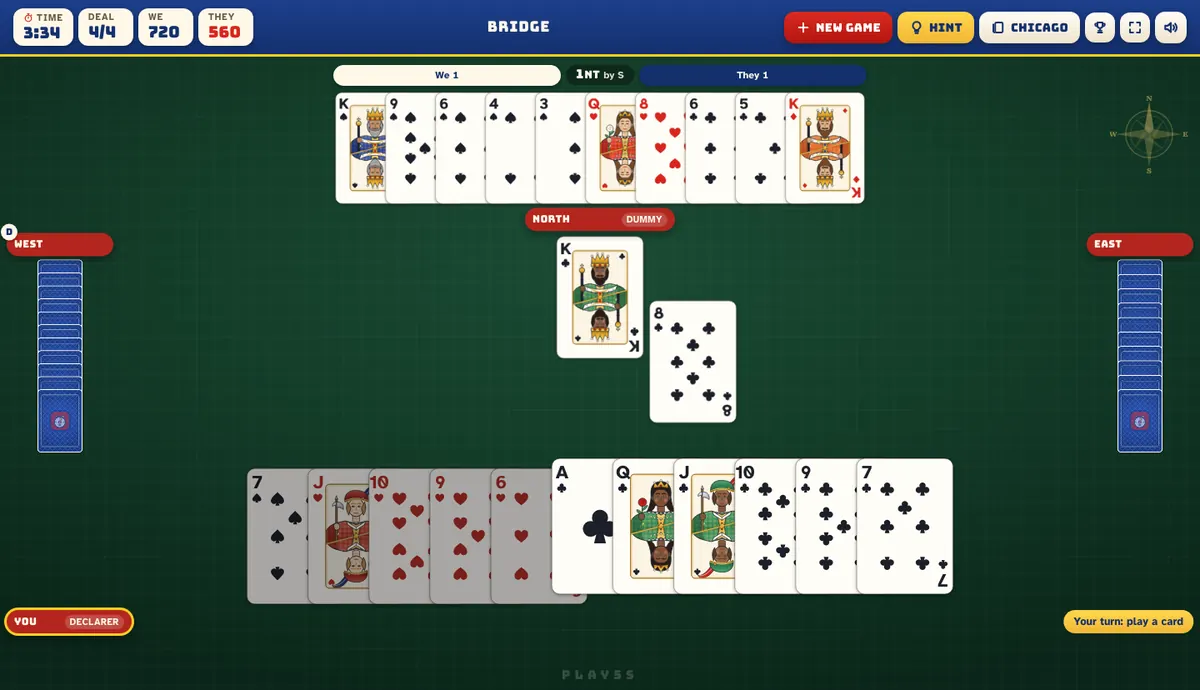
Right after the opening lead, the dummy’s cards are spread face up for everyone to see, and from then on the declarer chooses every card the dummy plays. Here the dummy’s cards appear in their seat: across the table for North, or down the side for West or East, sorted by suit. When your side declares, the cards you may play rise in whichever hand is on turn, yours or North’s, and the plate of each seat shows who is declarer and who is dummy.
 Zoom in
Defending
When East or West declares, you and your partner defend. You see your own hand and the dummy, and the defenders aim to take enough tricks to defeat the contract: with a contract of 4♠, that is four tricks.
How scoring works in bridge
A made contract scores trick points for each trick bid above six (20 in clubs or diamonds, 30 in hearts or spades, 40 for the first and 30 for the rest in no trump), and a contract worth 100 trick points or more is a game.
Trick points count toward game; everything else is a bonus. A side that takes more tricks than it bid scores overtricks, and a side that falls short gives the defenders undertricks. Doubling multiplies the trick points by two (redoubling by four) and makes overtricks and undertricks dearer. A side is vulnerable when it has won a game in a rubber, or when the deal number says so in Chicago, which raises its bonuses and its penalties.
| Contract | Not doubled | Doubled | Redoubled |
|---|---|---|---|
| Clubs or diamonds | 20 | 40 | 80 |
| Hearts or spades | 30 | 60 | 120 |
| No trump, first trick | 40 | 80 | 160 |
| No trump, each later trick | 30 | 60 | 120 |
Game, slams and other bonuses
Starting from nothing, the lowest contracts that make a game in one deal are 3NT, 4♥, 4♠, 5♣ and 5♦. Part scores below 100 add up from deal to deal until a side reaches 100, and then both sides start again from zero. Bidding and making 12 tricks is a small slam and all 13 a grand slam.
| Bonus | Not vulnerable | Vulnerable |
|---|---|---|
| Each overtrick, not doubled | trick value | trick value |
| Each overtrick, doubled / redoubled | 100 / 200 | 200 / 400 |
| Making a doubled / redoubled contract | 50 / 100 | 50 / 100 |
| Small slam (6-level) / grand slam (7-level) | 500 / 1000 | 750 / 1500 |
| Game in Chicago, scored on the deal | 300 | 500 |
| Rubber won 2–0 / 2–1 | 700 / 500 | — |
Undertricks and honours
When the contract fails, the defenders score for each trick short. Doubled undertricks grow quickly, so one down doubled is 100 points but three down doubled is 500 when not vulnerable. Honours are scored too, by whichever side holds them, made or not: four of the five top trumps (A K Q J 10) in one hand are worth 100, all five 150, and the four Aces in one hand at no trump 150. This game counts honours for you from the hands as dealt.
| Tricks short | Not vulnerable: plain / doubled | Vulnerable: plain / doubled |
|---|---|---|
| 1 | 50 / 100 | 100 / 200 |
| 2 | 100 / 300 | 200 / 500 |
| 3 | 150 / 500 | 300 / 800 |
| 4 | 200 / 800 | 400 / 1100 |
| Each one after | +50 / +300 | +100 / +300 |
 Zoom in
Chicago or rubber: the two ways to play
Chicago is a fixed game of four deals with vulnerability set in advance, and a rubber goes on until one side has won two games; this game offers both, and the Daily Deal is a Chicago.
Both modes use the same rules of bidding, play and scoring; they differ in how long a game lasts and how vulnerability is decided. In our tests with the computer in every seat (300 games of each, November 2026), a Chicago took 4.03 deals on average, counting the rare passed-out deal that is dealt again, and a rubber took 8.7 deals.
| Chicago | Rubber | |
|---|---|---|
| Length | Four deals | Until a side wins two games |
| Vulnerability | Deal 1 neither side, deals 2 and 3 the dealer’s side, deal 4 both | A side with one game is vulnerable |
| Game bonus | 300, or 500 when vulnerable on that deal | Rubber bonus at the end: 700 (2–0) or 500 (2–1) |
| Part scores | Carried over; a part score on deal 4 that does not make game scores 100 | Carried over within each game |
| A deal passed out | Redealt by the same dealer, not counted | The deal passes to the left |
| Leaderboard | Chicago board and Daily Deal | Rubber board |
The Chicago vulnerability follows Appendix 4 of the Laws of Rubber Bridge, where deals 2 and 3 make the dealer’s side vulnerable; pagat describes the reverse order as a modern variant, and the Laws also allow it by agreement. A rubber still open after 24 deals ends unfinished: a side with the only game scores 300, and a side with the only part score in the unfinished game scores 100.
How the computer bids and plays
The computer bids with Standard American Yellow Card (SAYC), the American Contract Bridge League’s standard system, and plays its cards by rules that use only what a real player in its seat could know.
Its bidding system
At the Normal level, your partner and the opponents open the bidding with five-card majors, 1NT with 15 to 17 high-card points and a balanced hand, 2NT with 20 to 21, and an artificial 2♣ with 22 or more. With no five-card major they open the longer minor (1♦ with four cards in each minor, 1♣ with three in each). Weak twos in diamonds, hearts and spades show a six-card suit and 5 to 11 points, and three-level openings are preempts with a seven-card suit.
Partner understands and uses Stayman and Jacoby transfers over 1NT, Jacoby 2NT, limit raises, two-over-one responses (forcing for one round), negative and takeout doubles, overcalls and weak jump overcalls, Michaels and the Unusual 2NT, Blackwood (and Gerber over no trump), fourth suit forcing and reopening doubles. You can bid in your own style, but partner reads your calls the SAYC way.
Every call has an explanation: tap a call in the auction table to read what it showed, such as “Stayman: asks for a four-card major” or “Natural · 11–21 HCP · 5+ hearts”, and point at a suit key to see what that bid would mean before you make it.
Its card play
As declarer it counts sure tricks, draws trumps when that is safe, ruffs losers in the shorter trump hand, leads toward honours and takes finesses, and holds up a single stopper at no trump. As a defender it leads partner’s suit or the top of a sequence, fourth best against no trump, plays second hand low and third hand high, covers an honour with an honour and returns partner’s suit. It never looks at a hidden hand, and nothing it does depends on chance outside the game’s own seed, so the server can replay every ranked game exactly.
| Test | Result |
|---|---|
| Bidding: 610 test positions of the open-source saycbridge project | 322 matched (52.8%) |
| Declarer play compared with a double-dummy solver, 400 deals | 0.43 tricks fewer on average |
| Contracts the double-dummy solver says can be made | 69.3% made by the computer declarer |
| Contracts the computer bid that can be made double dummy | 63.5% |
Easy, Normal and Hard opponents
Easy, Normal and Hard change the two computer opponents, East and West; your partner always plays at Normal. Normal is the level described above, and the only one that the Daily Deal and the leaderboards use. Easy keeps the same SAYC table but never starts a convention (no Stayman, transfers, Blackwood, Michaels or negative doubles), and plays by plain textbook rules: second hand low, third hand high, ruff when void, cash an ace. It does not count the cards played, take finesses or hold up a stopper. Hard bids like Normal and plays by simulation: before each card it deals the unseen cards at random 60 times, keeping the suits each player has already failed to follow and what the auction showed, plays every candidate card to the end of the deal with the Normal rules, and chooses the card that took the most tricks on average. It never sees a hidden hand, and its imagined deals come from the game’s seed and the cards played, so the same game always plays out the same way.
Games against Easy or Hard opponents are practice: they do not go on a leaderboard and do not change your best margin. Pick the level on the start screen, or open it again with the mode button in the bar; the choice is kept in this browser with your saved game.
| Computer against computer | Games won | Average margin per Chicago |
|---|---|---|
| Easy against Normal (300 sets of deals, seats swapped) | Easy 39% | Easy 209 points behind (±42) |
| Hard against Normal (300 sets of deals, seats swapped) | Hard 76% | Hard 487 points ahead (±37) |
| Easy against Hard (300 sets of deals, seats swapped) | Easy 24% | Easy 495 points behind (±42) |
| Normal against Normal (600 games) | North-South 49% | 4 points (±58) |
| Easy against Easy (600 games) | North-South 48% | −24 points (±50) |
| Hard against Hard (300 games) | North-South 50% | −2 points (±91) |
Each row replays the same deals with the pairs swapped, so luck of the cards cancels out; the ± is a 95% interval, and a result inside it is not a difference. The same-level rows show how far chance alone moves the result. Easy’s missing conventions on their own made no measurable difference (1 point behind, ±22): its weakness comes from the card play. These are computer-against-computer measurements, not a prediction of your own results.
The test positions come from saycbridge (BSD license) and include conventions this game does not play, such as defences to 1NT; the double-dummy solver is macroxue/bridge-solver (Apache 2.0), which sees all four hands, so a real declarer is expected to fall below it. These are measurements of this game, not a rating.
Daily Deal and leaderboards
The Daily Deal is one Chicago that every player gets on the same day: the same four deals, with a new set at midnight New York time.
Because everyone plays the same cards, the Daily Deal board compares players on one set of deals. A set of bridge deals has no “winnable” check: the result depends on how you and the computer bid and play it. Our server hands out the Daily Deal, so it needs an internet connection, and each connection gets one ranked Daily Deal result per day; after that, playing it again is practice.
Only games against Normal opponents that your side wins go on a leaderboard, ranked by the winning margin: your side’s points minus the opponents’ at the end. A tie goes to the faster game, then to whoever posted first. Time is measured by our server from the deal. There is a board for each day’s Daily Deal and an all-time board for Chicago and for Rubber. You choose a nickname of 2 to 12 characters when you submit, offensive names are refused, and no account is needed.
Starting a ranked game asks our server for a deal and a ticket; your calls, cards and nickname are sent only when you submit a score. Using Hint in a ranked game or the Daily Deal turns it into practice after a question, so that game does not reach the board.
Bridge tips for beginners
The most useful habit for a new bridge player is to count: high-card points before you bid, and sure tricks before you play the first card from the dummy.
- Count your high-card points: Ace 4, King 3, Queen 2, Jack 1. The deck holds 40, so an average hand has 10. Partner opens with about 12 or more.
- Look for an eight-card fit in a major. Together 25 points or so usually make a game: 4♥ or 4♠ with a fit, 3NT without one.
- With a balanced hand of 15 to 17 points, open 1NT. Partner then knows your hand within three points and can place the contract.
- Do not bid the same values twice. If you have shown your strength, let partner decide.
- As declarer, count your sure winners and your losers before you play from dummy, then make a plan: draw trumps, ruff losers, or set up a long suit.
- Draw trumps early unless you need them for ruffing in the dummy.
- Lead toward your honours: with the Ace and Queen in the dummy, lead low from your hand and play the Queen if the King has not appeared.
- On defence, lead your partner’s suit if they bid one, and return it when you win a trick.
- Double the opponents’ contract only when your trumps or your side’s strength should beat it: if they make it doubled, they score twice the trick points and a bonus.
- Use the explanations in the auction table to learn the system: they show what each of the computer’s calls promised.
Bridge controls: tap, click or keyboard
To bid, tap a level and then a suit or NT in the bidding box; to play, tap or click one of the raised cards in the hand that is on turn.
Cards you can play rise and the others are dimmed. Tapping a card that is not allowed makes it shake and shows the reason, such as “Follow suit”. The computer plays at a pace you can follow, and each finished trick stays in the middle for a moment before it goes to the side that won it. The bar above the table shows the time, the deal number and the score of your side (We) and theirs (They). The strip on the table shows the contract and the tricks each side has taken, or the vulnerability during the auction, and a seat plate turns red when that seat’s side is vulnerable.
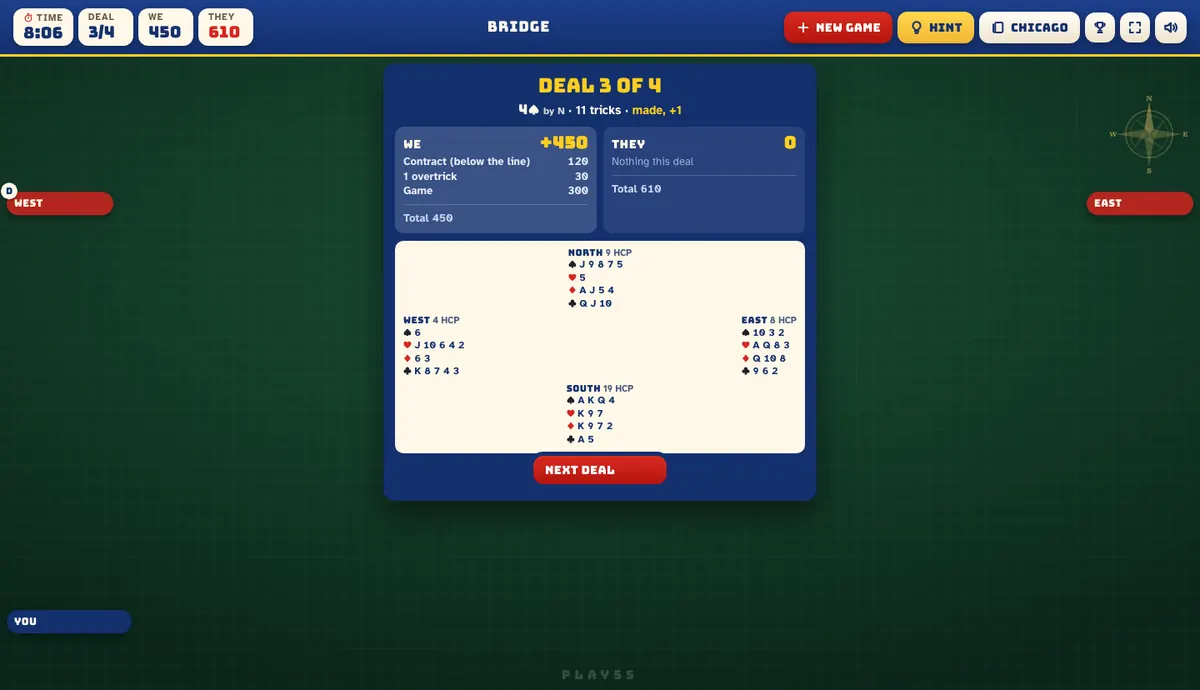
After each deal a score panel shows what each side scored and why, with the four hands as dealt. Your game is saved in this browser, so you can close the page and continue later.
Keyboard
During the auction, press a number from 1 to 7 to pick a level, then C, D, H, S or N for clubs, diamonds, hearts, spades or no trump. P passes, X doubles, R redoubles and Esc clears the level. During the play, Tab reaches the playable cards, the arrow keys move along them, and Enter or Space plays the card.
- 1–7, then C D H S N: bid
- P: pass · X: double · R: redouble
- H: show a hint
- N: start a new game
- F: full screen on or off
- M: sound effects on or off
Bridge terms
Bridge has its own vocabulary, and these are the words used on this page and in the game.
- Auction (bidding): the calls that decide the contract.
- Contract: the final bid, a number of tricks above six and a trump suit or no trump.
- Declarer: the player who plays the contract, the first of the winning side to name its suit.
- Dummy: the declarer’s partner, whose cards are laid face up and played by the declarer.
- Trick: four cards, one from each player, won by one of them.
- Trump: the suit named in the contract, which beats every other suit.
- No trump (NT): a contract with no trump suit.
- Double / redouble (X / XX): calls that raise the score of the contract and of its penalty.
- Vulnerable: in a rubber, a side that has won a game; in Chicago, set by the deal number. Bonuses and penalties are bigger.
- Part score: a made contract worth less than 100 trick points.
- Game: 100 trick points or more, in one deal or added up.
- Small slam / grand slam: a contract for 12 / 13 tricks.
- Overtrick / undertrick: a trick above the contract / a trick short of it.
- Honours: the A K Q J 10 of trumps, or the four Aces at no trump.
- High-card points (HCP): Ace 4, King 3, Queen 2, Jack 1.
- Rubber: a set of games won by the first side to win two.
Where bridge comes from
Contract bridge comes from whist through biritch and auction bridge, and its modern scoring was set out by Harold Stirling Vanderbilt in 1925.
The first known rule book of the game, “Biritch, or Russian Whist”, was published in 1886, and it already had a dummy, no trump and doubling. Auction bridge followed at the start of the 20th century. Vanderbilt’s change was to score below the line only the tricks a side had contracted for, and to add vulnerability; within a few years “bridge” meant contract bridge. The first officially recognized world championship was held in Budapest in 1937, and the World Bridge Federation was founded in 1958. It revises the Laws about every ten years (see Contract bridge on Wikipedia).
Where these rules come from
The auction and the play follow the World Bridge Federation’s Laws, and the scoring follows the Laws of Rubber Bridge, checked against pagat and Wikipedia.
- Bids, doubles and redoubles, the end of the auction, the declarer, the opening lead, the dummy and following suit: the Laws of Duplicate Bridge 2017 of the World Bridge Federation, Laws 18, 19, 22, 41 and 44.
- Trick points, overtricks, undertricks, slams, honours, the rubber bonus and the unfinished rubber: the Laws of Rubber Bridge (2014), Laws 72 to 81. Pagat gives the same tables.
- Chicago: Appendix 4 of the Laws of Rubber Bridge (four deals, vulnerability, 300 / 500 game bonus, 100 for a part score on deal 4, a passed-out deal redealt by the same dealer). Pagat lists the 2–3 vulnerability the other way round; this game follows the Laws.
- A deal passed out in a rubber passes to the next dealer, as in pagat.
- The bidding system is SAYC as summarized on Standard American on Wikipedia; the computer’s bidding and play are our own code.
- Not included: duplicate scoring (IMPs and matchpoints), claims, Undo, and games for other numbers of players.
Bridge questions
How many players are in bridge?
Four, in two partnerships, sitting opposite their partner. Here you play South with the computer as your partner North and as East and West.
How many cards does each player get in bridge?
Thirteen. The whole 52-card deck is dealt, so every player gets 13 cards and each deal has 13 tricks.
What does a bid of 4 spades mean?
It is a promise to take at least 10 tricks, six plus the level of four, with spades as trumps. Made, it scores 120 trick points, enough for a game.
Who is the declarer in bridge?
The player of the side that won the auction who first named the suit of the contract, or no trump. Their partner is the dummy.
Can I play the dummy’s cards?
Yes, when your side declares. You play both your hand and North’s, whichever of you is declarer, as the laws say the declarer plays the dummy.
What happens if everyone passes?
The deal is passed out and nobody scores. In Chicago the same dealer deals again and the deal does not count as one of the four; in a rubber the deal passes to the left.
How does bridge scoring work?
A made contract scores 20 or 30 trick points for each trick bid above six (40 for the first in no trump), plus bonuses for overtricks, games, slams and making it doubled. A failed contract gives the defenders 50 or more for each trick short.
What is vulnerable in bridge?
A vulnerable side has bigger bonuses and bigger penalties. In a rubber a side becomes vulnerable once it has won a game; in Chicago vulnerability is set by the deal number instead.
What is the difference between Chicago and rubber bridge?
Chicago is four deals with a game bonus paid straight away (300 or 500 by the deal’s vulnerability), while a rubber runs until one side has won two games and ends with a rubber bonus of 700 or 500. Both use the same bidding, play and trick scoring.
What bidding system does the computer use?
Standard American Yellow Card (SAYC): five-card majors, 1NT with 15 to 17 points, a strong 2♣, weak twos, Stayman, Jacoby transfers and Blackwood; the Easy level leaves the conventions out. Tap any call in the auction to see its meaning.
Does the bridge computer have difficulty levels?
Yes: Easy, Normal and Hard opponents, chosen on the start screen. In our computer-against-computer tests Easy won 39% of its games against Normal and Hard won 76%. Your partner always plays at Normal, and only games against Normal opponents reach a leaderboard.
Is there an Undo button?
No. The computer answers each call and card, so taking one back would show you its answer before you chose. Hint shows what the computer would do in your seat.
What is the Daily Deal in bridge?
A Chicago of four deals, against Normal opponents, that is the same for every player on a given day. It needs an internet connection, each connection gets one ranked result per day, and a new set starts at midnight New York time.
How are the bridge leaderboards ranked?
By the winning margin, your side’s points minus theirs, for games against Normal opponents that your side wins. A tie goes to the faster game. There is a board for each Daily Deal and all-time boards for Chicago and Rubber.
Does the game save my progress?
Yes. Your game, the auction and your time are saved in this browser on this device. Clearing your browser data removes the saved game.
Is bridge free on Play5s?
Yes. It is free to play in your browser on a phone, tablet or computer, with no download and no account.
About this version
This bridge game was built by Play5s to run in any modern web browser. It follows the laws described above, shuffles new deals for every game, and offers Chicago, Rubber and the Daily Deal. The cards, the table and the bidding box are drawn by Play5s, and the computer’s bidding and play are our own code.
There is nothing to install and no account to create. Your game in progress is kept in your browser. Starting a ranked game asks our server for a deal and a ticket; your calls, cards and nickname are sent only when you submit a score.
Read more about Play5s, or see all of our free card games.