

On this page
How to play Euchre
In Euchre, two teams of two take turns winning tricks, and the team that names the trump suit must win at least three of the five tricks in a hand to score; the first team to reach 10 points wins the game.
The pack and the deal
Euchre uses a 24-card pack: the 9, 10, Jack, Queen, King and Ace of each of the four suits. Four players sit in two teams, with partners across from each other. In Play5s you are at the bottom, your partner is at the top, and the two opponents sit on your left and right; the computer plays the other three seats.
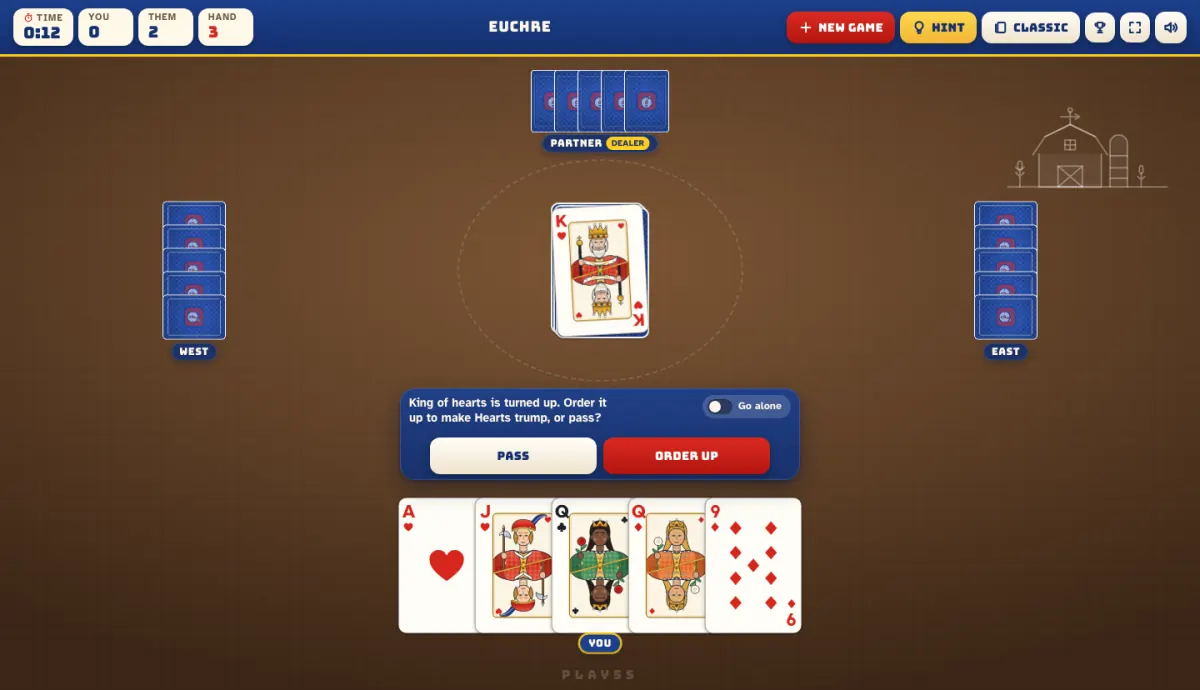
Each player gets five cards. The next card is turned face up, and the remaining three cards stay face down and are not used in that hand. The suit of the turned-up card is the first suit that can become trump. The deal passes to the left after every hand, and the player to the dealer’s left speaks first.
Calling trump: order up, pass, or name a suit
In the first round, each player in turn, starting on the dealer’s left, either orders it up or passes. Ordering it up makes the suit of the turned-up card trump and ends the bidding. The dealer then picks up the turned-up card and discards one card from their hand. The team that called trump is the makers; the other team is the defenders. In the version played in the United States, the dealer’s partner may order the card up and play alongside the dealer.
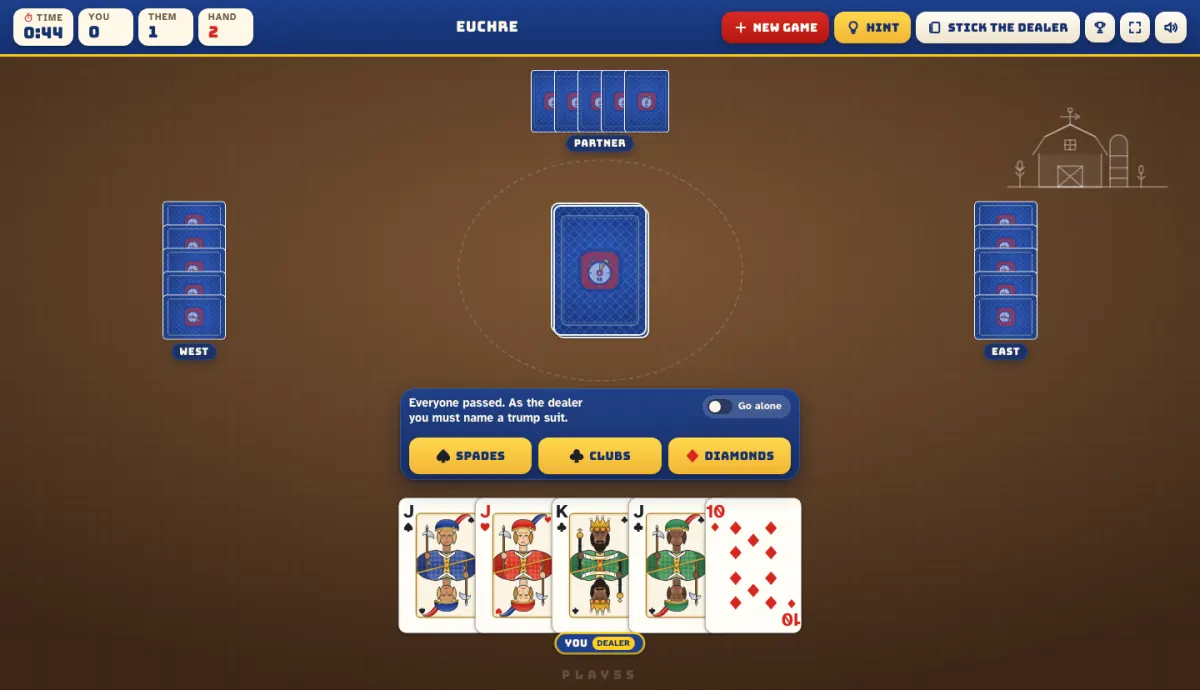
If all four players pass, the turned-up card is turned down and a second round begins. Starting on the dealer’s left again, each player may name any suit except the one that was turned down, or pass. The dealer does not pick anything up in this round. If everyone passes again, the rules split in two. In Classic, the hand is thrown in and the next player deals. In Stick the Dealer, the dealer may not pass and must name a suit.
 Zoom in
The bowers: the two strongest cards
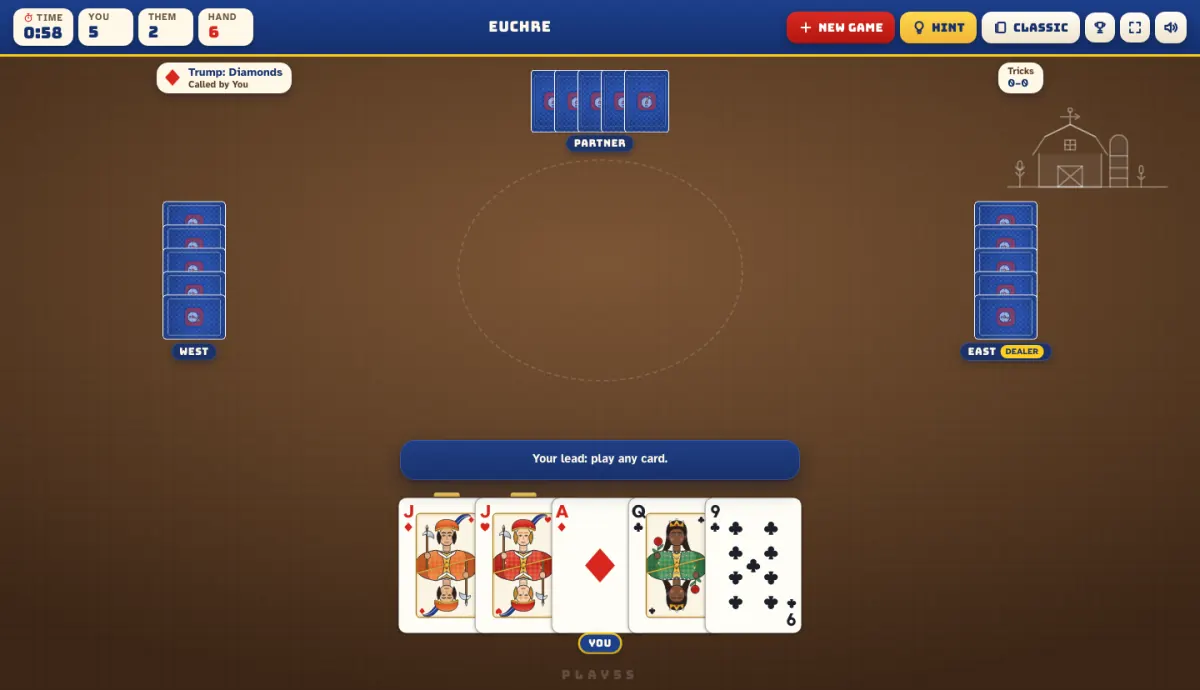
The trump suit beats every other suit, and it has its own order. The jack of the trump suit is the right bower, the highest card in the game. The jack of the other suit of the same colour is the left bower, the second highest. After them come the Ace, King, Queen, 10 and 9 of trump. With hearts as trump, the order from high to low is: Jack of hearts, Jack of diamonds, Ace, King, Queen, 10 and 9 of hearts.
The left bower counts as a trump card for everything during that hand, so the jack of diamonds is a heart, not a diamond, when hearts are trump. If a heart is led you must follow with it, and if a diamond is led it does not count as a diamond. The suits of the same colour are hearts and diamonds, and clubs and spades. The Play5s table puts a small gold tab on both bowers in your hand once trump is named.
 Zoom in
Going alone
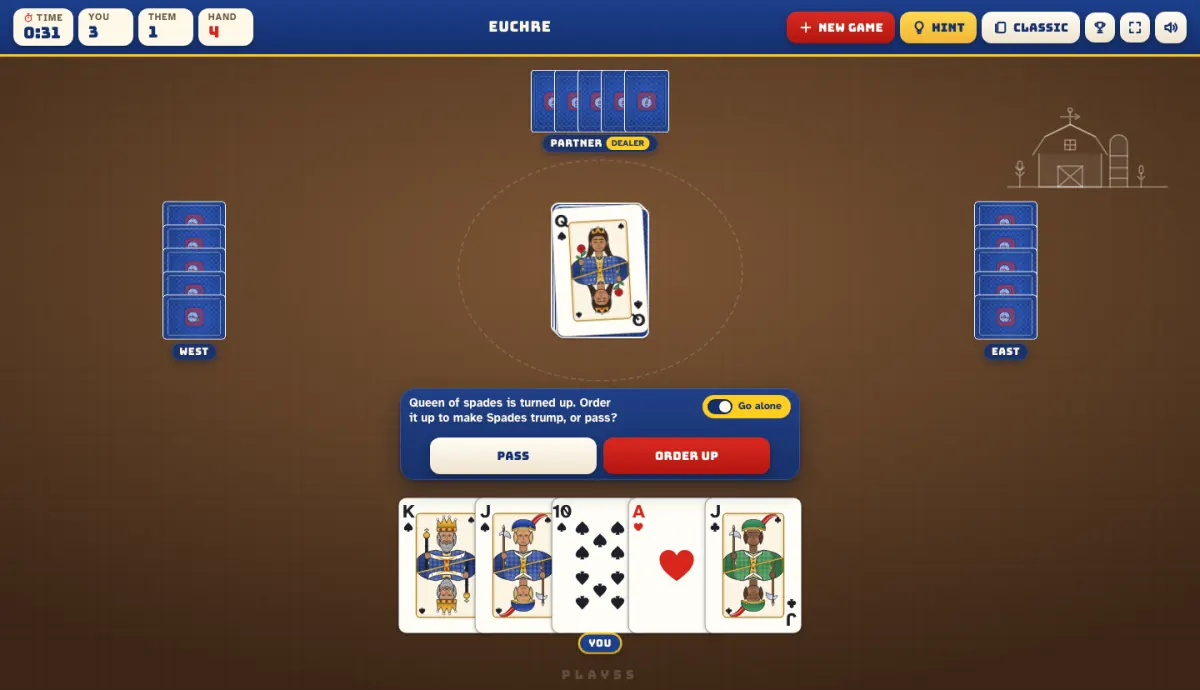
The player who orders up trump, or names it, may announce that they are going alone. Their partner puts the cards down and sits out the hand, so one player faces two opponents. Going alone has to be announced when the trump is called, before the first trick. A lone player who takes all five tricks scores 4 points instead of 2, while taking only three or four tricks still scores the normal 1 point. Being euchred still gives the other team 2 points. In Play5s you turn on the Go alone switch above the bid buttons before you tap Order up or a suit.
Some tables also let a defender go alone against the makers. Play5s follows the more common rule that only the player who calls trump may go alone, which is also how Wikipedia describes the North American game.
 Zoom in
Playing the five tricks
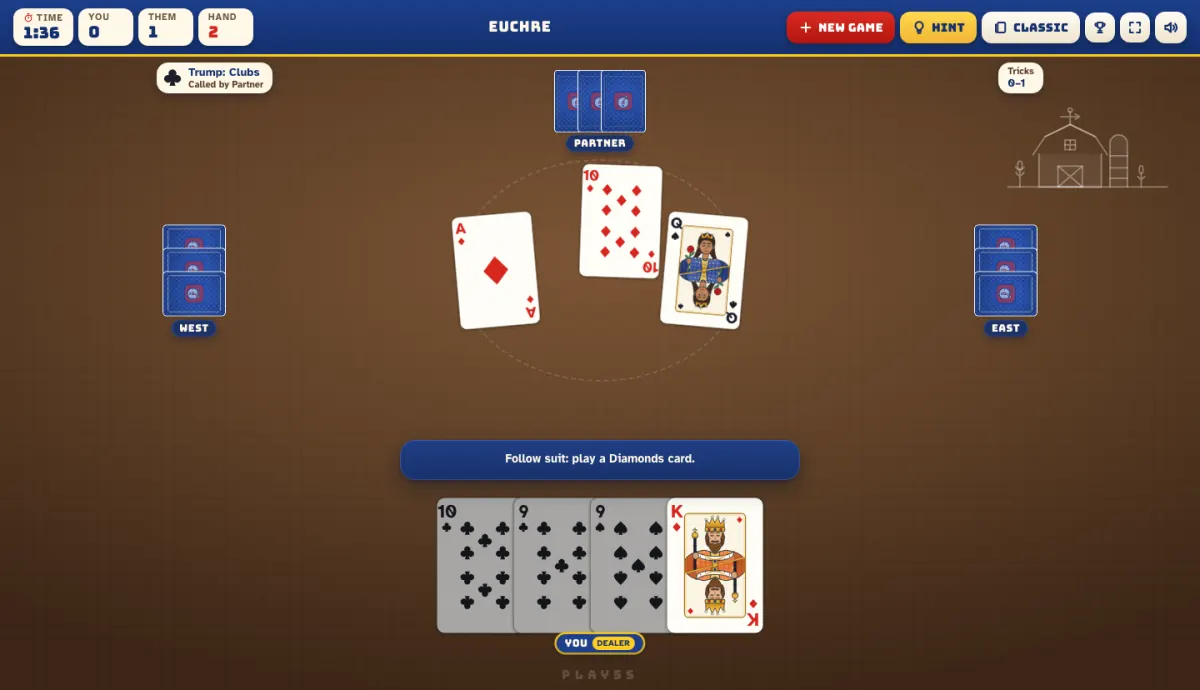
The player on the dealer’s left leads to the first trick and may play any card. If that player is sitting out because their partner is going alone, the next player in turn leads. Play goes clockwise, and each player must follow suit if they can; a player with no card of the suit that was led may play anything, including trump.
The highest trump wins the trick. If nobody plays trump, the highest card of the suit that was led wins. The winner of a trick leads the next one, and the hand ends after five tricks. The Play5s table dims the cards you may not play and tells you which suit to follow.
 Zoom in
How scoring works in Euchre
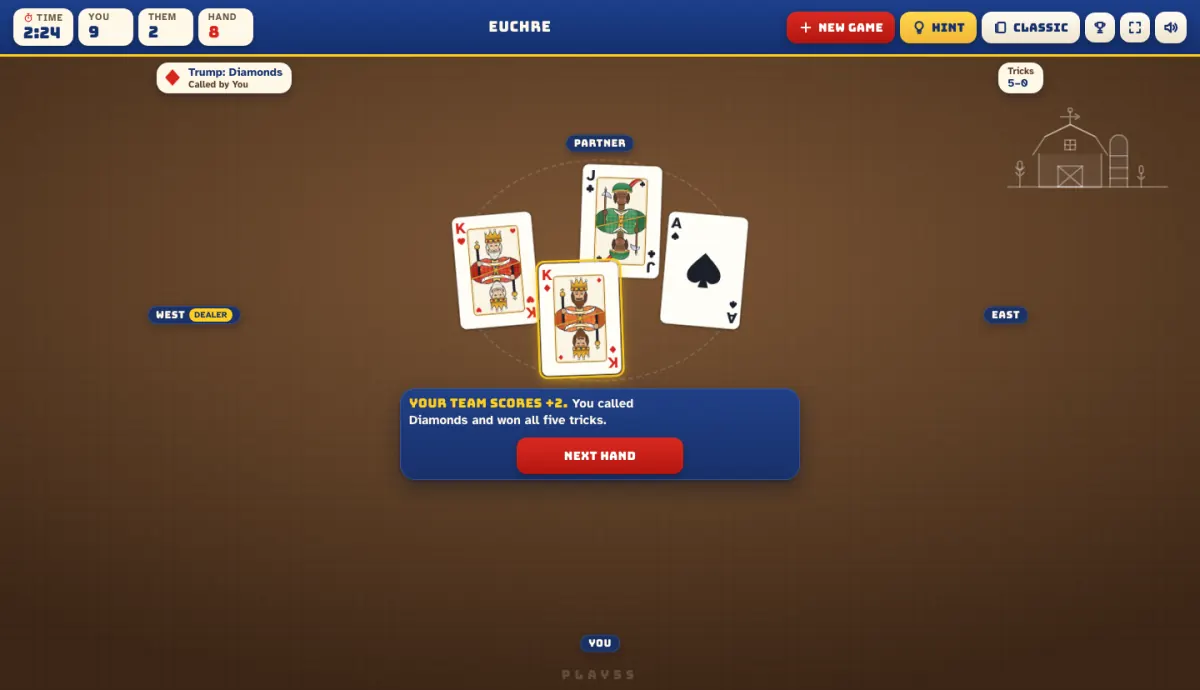
The team that called trump scores 1 point for taking three or four tricks, 2 points for taking all five (a march), and 4 points if the player who called it went alone and took all five; if the makers take fewer than three tricks they are euchred and the other team scores 2.
Only one team scores in each hand, so a game ends as soon as a team gets to 10 or more; a euchre can take a team from 9 to 11. In Play5s the score tiles show you and them, the hand number and the time, and the table shows the tricks each team has won in the current hand.
 Zoom in
- Makers take 3 or 4 tricks: makers score 1 point.
- Makers take all 5 tricks (a march): makers score 2 points.
- A lone maker takes all 5 tricks: 4 points. A lone maker who takes 3 or 4 tricks still scores 1 point.
- Makers take fewer than 3 tricks (euchred or “set”): the defenders score 2 points, whether or not the maker went alone.
- The first team to reach 10 points wins. In Britain, Australia and New Zealand the usual target is 11.
Classic or Stick the Dealer?
Classic and Stick the Dealer differ in one situation: when all four players pass in both rounds of calling trump, Classic throws the hand in and the next player deals, while Stick the Dealer forces the dealer to name a trump suit.
Wikipedia and pagat describe throwing the hand in as the usual North American rule and list Stick the Dealer, also called Screw the Dealer, as a variation. pagat adds that it is often played when time is short, because it removes the hands that nobody plays. Online, some sites make Stick the Dealer the only rule or the default: cardgames.io added it in April 2020, and World of Card Games says it is the default there. The World Euchre Federation’s beginner guide describes the throw-in.
Because the sources split, Play5s lets you choose. Classic is the default and is the mode of the Daily Deal. Stick the Dealer is one tap away from the mode button or the start screen, and it has its own leaderboard. Everything else is the same in both modes.
 Zoom in
Euchre strategy and the odds of the deal
The best way to improve at Euchre is to call trump with a hand that is worth it, count the bowers and trump cards as they fall, and lead trump when your team called it.
Calling trump
A hand is worth ordering up when it holds a few trump, especially a bower or the Ace. World of Card Games advises not to accept a suit unless you hold at least two cards of it, and to remember that the turned-up card goes to the dealer: ordering it up helps the dealer’s team. Your own side gets the extra trump when your partner or you are the dealer, and your opponents get it when they are. Do not wait for a perfect hand: if nobody calls, the second round gives everybody another chance.
Going alone pays 4 points, but a failed call hands the other team 2. A lone hand is strongest with both bowers and the Ace of trump, and a card or two to win the other tricks.
Playing the hand
If your team called trump, leading a high trump early is usually right, because it draws the trump out of the opponents’ hands. World of Card Games gives the same advice when your partner called. Keep track of which cards are out, above all the two bowers, as the World Euchre Federation’s tips suggest, and save a plain-suit Ace for after trump has been cleared, when an opponent can no longer trump it.
When you cannot win a trick, play your lowest card and keep your strength for a trick you can win. When your partner is already winning, play low and let them have it.
The odds of the deal
Counted from the 24-card pack (Play5s, 22 November 2026): there are 42,504 different five-card hands, and about 125 trillion different deals when you count which four cards stay in the kitty. Any particular card is in your hand 5 times in 24, or 20.8%. For a trump suit named afterwards, you hold at least one of its two bowers in 38.0% of hands and both in 3.6%. You hold three or more of the seven trump cards (the six of the suit plus the left bower) in 12.6% of hands. A hand with only 9s and 10s, a “farmer’s hand” in some regions, comes up 0.13% of the time, about once in 760 deals.
How the computer players decide
The three computer players use only what a real player could see: their own five cards, the turned-up card, the bids and the cards played so far; they never look at anyone’s hidden hand, and they use no random numbers.
To bid, each computer player adds up what its hand would be worth with each possible trump: the bowers and the Ace count most, plain-suit Aces and a short suit that can trump later count a little, and it allows for who the dealer is, since the turned-up card goes to the dealer. It orders up or names a suit when the total is high enough, and goes alone only with a hand far stronger than that. As dealer it discards the card that leaves the best five.
To play, it follows suit, wins a trick with the cheapest card that does the job, plays low when its partner is already winning, leads its top trump when that is the highest card left, and counts the cards that have been played. The same deal and the same choices by you always lead to the same game, which is how the leaderboard server can replay a game from your moves alone. The Hint button shows what the computer would do in your seat; it is a suggestion, not a rule.
Controls and saving
Tap or click a card to play it, use the buttons in the panel above your hand to bid, and use the keyboard if you prefer: the arrow keys move between your cards and Enter or Space plays one.
- Bidding: the panel above your hand asks the question and shows Pass and Order up, or the suits you may name. Turn on Go alone first for a lone hand. The keys P (pass) and A (go alone) work too.
- Discard: when you are the dealer and pick up the turned-up card, tap the card you want to drop, then tap Discard.
- Playing: cards you may not play are dimmed. A tap on one tells you which suit you must follow.
- Hint (H) shows what the computer would do. New game (N) starts again after a question, and Full screen (F) gives the table the whole screen. M turns sound on or off.
- There is no Undo: a hand has hidden cards, so a move cannot be taken back.
- Your game is saved in this browser as you play, with your best winning margin for each mode. Clearing your browser data removes them.
Daily Deal and leaderboards
The Daily Deal is one Classic game that every player starts with the same shuffles on the same day; the day changes at midnight New York time, and the leaderboards rank won games by how many points you win by.
Every hand of a game is shuffled from a number the server hands out, so in the Daily Deal everyone gets the same cards and the same dealer for each hand. Your bids and plays are your own, so the games soon go their own way. Play5s does not claim the Daily Deal is easy or winnable: it is a game against the computer, and some days you lose.
Only games you win go on a leaderboard. The ranking is your winning margin, your final points minus theirs, so a 10–3 win is +7. Ties go to the faster game, measured by our server from the deal, then to whoever posted first. There is one board for Classic, one for Stick the Dealer and one for the Daily Deal. Each connection gets one ranked Daily Deal result a day; after that, playing again is practice.
Your nickname has 2 to 12 characters and offensive names are refused. You do not need an account. Starting a ranked game asks our server for a deal and a ticket; your moves and your nickname are sent only when you submit a score, and the server plays the computer seats itself to check the game. The Daily Deal needs a connection because the server picks the day’s shuffles. If it cannot be reached, a regular game still plays but is not ranked.
Euchre terms
Euchre has its own vocabulary: a euchre, a march, bowers, makers and a loner are the words you will meet most.
- Trick: one round of play in which each player puts down one card.
- Trump: the suit that beats all the others for one hand.
- Right bower and left bower: the jack of the trump suit and the other jack of the same colour, the two highest cards.
- Turned-up card (up-card): the card turned face up after the deal; its suit is the first possible trump.
- Kitty: the cards left over after the deal, three of them once the turned-up card is taken.
- Order up: to accept the turned-up card’s suit as trump, which also gives the card to the dealer.
- Makers and defenders: the team that called trump, and the other team.
- Euchre or euchred: the makers failing to take three tricks. The defenders score 2 points. Also called a set.
- March: taking all five tricks. Worth 2 points for the makers.
- Loner or going alone: playing without your partner. 4 points for a march.
- Throw in: giving up the hand when everyone has passed twice. In Stick the Dealer the dealer must name trump instead.
- Follow suit: playing a card of the suit that was led if you have one.
Where Euchre comes from
Euchre appeared in the United States in the early 19th century, and the most likely source is Jucker, an older Alsatian game.
Euchre is mentioned as early as 1810, and uker was being played with bowers on a steamboat in the American Midwest in 1829, according to Wikipedia. The earliest written rules known today appear in 1844, in Thomas Mathews’s The Whist Player’s Hand-book, and they already give the right and left bower as the two highest cards. The card game historian David Parlett traces the game to the Alsatian Jucker or Juckerspiel; “bower” sounds like the German word Bauer, a farmer, which is also a word for a jack.
The joker was added to the pack in the 1850s for Euchre, as the top trump, and later went on to poker. By the late 19th century Euchre was described as the national card game of the United States. It has since given way to Bridge and Spades in many places, but it is still a favourite social game in the Midwest, in Ontario and in parts of Britain such as Cornwall, and the World Euchre Championship is held each year in New Glarus, Wisconsin.
Sources for the rules
The rules and figures on this page come from these pages, all read on 22 November 2026.
- Wikipedia, “Euchre”: the North American rules, scoring, variations, history.
- pagat.com, “Euchre”: the rules in Britain and North America, Stick the Dealer, terms.
- World Euchre Federation, “How to Play Euchre”: the standard North American rules, the two rounds of calling trump, going alone, scoring.
- World of Card Games, “Euchre”: the rules, Stick the Dealer, strategy advice and the FAQ.
- cardgames.io, “Euchre Rules”: the rules used in one online version, Stick the Dealer, who may go alone.
- The odds of the deal were counted by Play5s from the 24-card pack, 22 November 2026.
Euchre questions
What is a euchre?
A euchre happens when the team that called trump fails to take at least three of the five tricks in a hand. The other team then scores 2 points, and the makers score nothing. It is also called being set.
How many points do you play to in Euchre?
Most North American games are played to 10 points, as in Play5s. In Britain, Australia and New Zealand the usual target is 11, and some groups play to 5, 7 or 15.
How many cards are in a Euchre deck?
A Euchre pack has 24 cards: the 9, 10, Jack, Queen, King and Ace of each suit. Some games add 7s and 8s, or a joker, but Play5s uses the 24-card pack.
What are the bowers in Euchre?
The bowers are the two highest cards. The right bower is the jack of the trump suit, and the left bower is the other jack of the same colour. The left bower counts as a trump card for that hand.
What does going alone mean in Euchre?
The player who calls trump can play without their partner, who sits out the hand. Taking all five tricks alone scores 4 points instead of 2, and taking three or four still scores 1.
What is Stick the Dealer?
Stick the Dealer is a rule that does not let the dealer pass in the second round of calling trump. If the other three players pass, the dealer has to name a trump suit. In Classic, the hand is thrown in instead.
Can you lead trump in Euchre?
Yes. Any card may be led to any trick, trump included. Leading a high trump early is often a good way to draw out the opponents’ trump when your team called it.
Can the dealer’s partner order up the turned-up card?
In the United States, yes: they order it up and play with the dealer as a partner. In Britain, Australia and Canada some tables make them play alone instead. Play5s uses the US rule.
Can I play Euchre against the computer here?
Yes. You play with a computer partner against two computer opponents, free in your browser, with no download and no account. You can start a game from the start screen in one tap.
Can two people play Euchre?
Euchre is a four-player partnership game, so Play5s has you play with a computer partner. Wikipedia lists versions for two to nine players, but they change the rules.
How long does a game of Euchre take?
Each hand is only five tricks, so a game to 10 points is over in a few minutes of play. World of Card Games reports an average game length of 15 minutes on its own site (November 2026). In Play5s your time is on the score tiles and is the leaderboard tie-break.
Do I need an account to put a score on the leaderboard?
No. You win a game, type a nickname of 2 to 12 characters and submit it. The server replays your game from your moves to check it before it goes on the board.
About this version
Play5s Euchre is a game against the computer: you and a computer partner play two computer opponents, to 10 points, with the 24-card pack and no joker.
There are two modes, Classic (a hand nobody calls is thrown in) and Stick the Dealer, and a Daily Deal in Classic. The dealer’s partner may order the card up, only the player who calls trump may go alone, and there is no Undo.
Starting a ranked game asks our server for a deal and a ticket; your moves and your nickname are sent only when you submit a score. Your game, your best winning margin and your nickname are kept in your browser on this device.
Play5s is an independent site and is not connected to any other Euchre site or app.
Read more about Play5s, or see all of our free card games.