

On this page
How to play Gin Rummy
To win Gin Rummy, be the first player to reach 100 points over several hands, and score each hand by ending it with fewer leftover card points than your opponent.
The deal
Gin Rummy uses one standard 52-card deck, with the ranks running from Ace (low) to King. Each player gets ten cards, and the next card is turned face up to start the discard pile. The rest of the deck is the stock. In the Play5s version the computer deals the first hand, so you choose first, and the deal alternates after every hand that is scored, as Wikipedia (opens in a new tab) describes it.
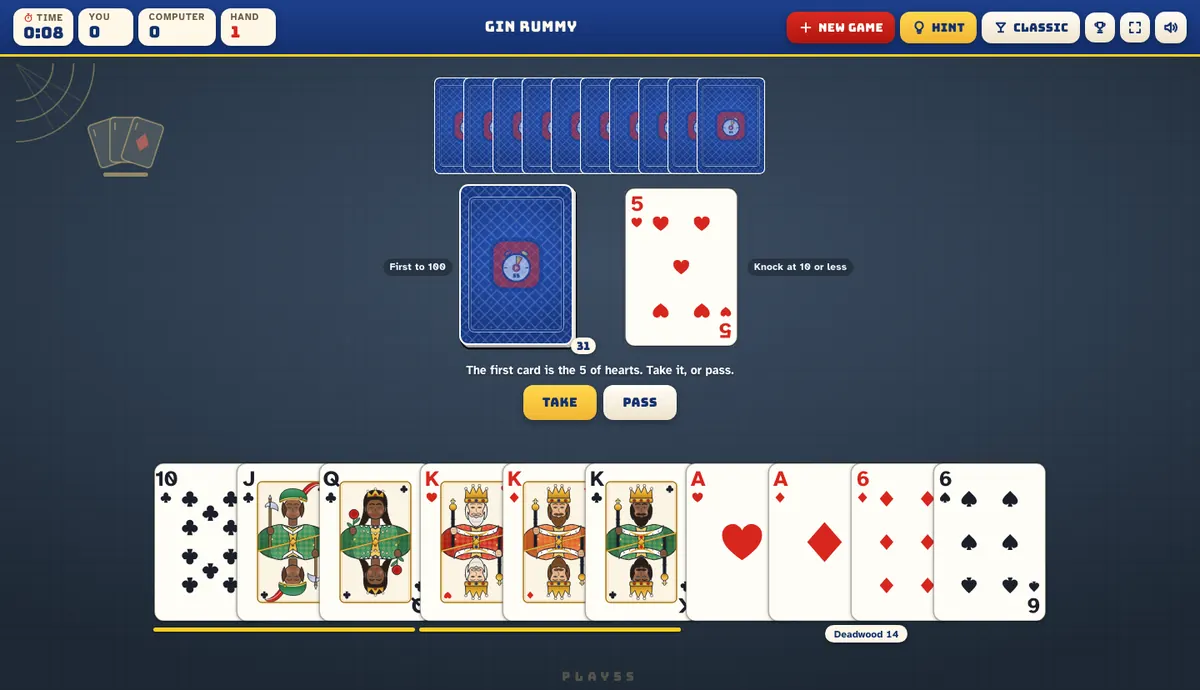
Your ten cards are sorted for you: cards that already make a set or a run sit together under a yellow bar, and the cards that fit nowhere are grouped at the end with a count of their points.
 Zoom in
Your turn: draw, then discard
On every turn you take one card and put one card down. You draw either the top card of the stock, which you cannot see until you take it, or the top card of the discard pile, which everyone can see. Then you discard one card from your hand onto the discard pile, so you always go back to ten cards. If you took the top card of the discard pile, you may not put that same card straight back.
The first turn has a special rule. The player who did not deal may take the upcard or pass. If they pass, the dealer may take it or pass. If both pass, the player who did not deal draws from the stock, and the game goes on as usual.
How a hand ends
A hand ends in one of two ways. A player knocks, which is allowed once their leftover cards add up to 10 points or less, and the two hands are compared (see Knocking, Gin and Big Gin below). Or the stock runs down to two cards and nobody has knocked: then the hand is dead, nobody scores, and the same player deals again. The hand is also over when a player goes Gin or Big Gin.
A match is a series of hands. Points from every hand add up, and the match ends when one player reaches 100 points (150 in Oklahoma).
Melds and deadwood in Gin Rummy
A meld is a set of three or four cards of the same rank, or a run of three or more cards of the same suit in order, and every card that is not in a meld is deadwood.
Sets are cards of one rank, such as the 8 of hearts, the 8 of diamonds and the 8 of spades. A set has three or four cards, and there are never more than four of a rank. Runs are cards of one suit in a row, such as the 3, 4 and 5 of hearts. A run can be longer than three cards, and in Gin Rummy the Ace is always low: A-2-3 is a run, but Q-K-A is not.
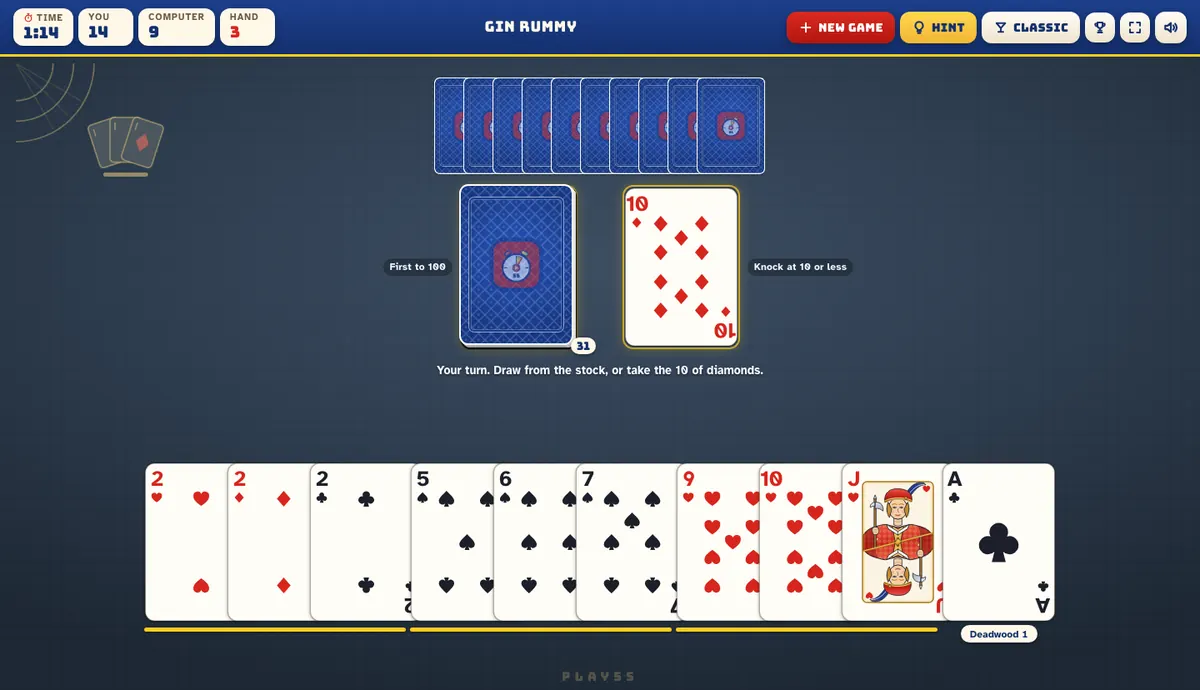
A card can belong to only one meld at a time. With the 7 of clubs, the 7 of spades, the 7 of diamonds, the 8 of diamonds and the 9 of diamonds, the 7 of diamonds can sit in the set or in the run, but not both. The best choice here is the run, because it leaves only two 7s (14 points) instead of the 8 and 9 (17 points).
 Zoom in
What deadwood is worth
Aces count 1 point, the 2 to the 10 count their number, and Jacks, Queens and Kings count 10. Your deadwood count is the total of the cards left outside your melds. Gin Rummy rewards a low count, so the high cards you cannot match are the ones to get rid of first. In this version the count is always shown under your hand, and when you pick a card to discard it shows what the count would be after discarding it.
Knocking, Gin and Big Gin
You can knock at the end of your turn when the cards you keep leave 10 points of deadwood or less, which ends the hand at once and makes both players show their cards.
Knocking
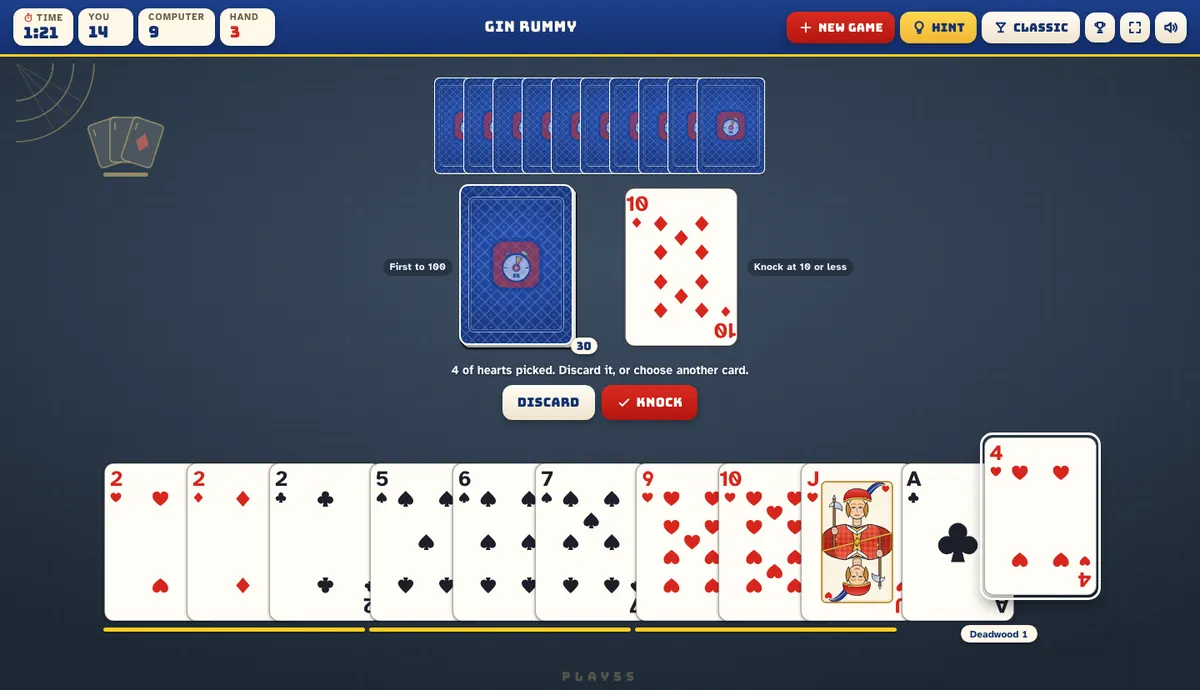
After you draw you hold eleven cards. To knock, you discard one of them face down, and the other ten must have a deadwood count of 10 or less. You can knock on any turn, even the first, and you are never forced to. In this version the Knock button appears when some card in your hand would let you knock, and it works once you have chosen one of those cards.
Once you knock, the other player lays out their hand. The knocker never adds cards to the other player's melds, but the other player may lay off: any of their leftover cards that fit one of your melds (the fourth card of a set, or the next card at either end of a run) are added to it, and no longer count against them. Cards cannot be laid off on your deadwood. In the Play5s version the melds and the lay-offs are worked out for both hands in the way that gives each side the lowest count, and the knocker's melds are arranged, among equal choices, so that the other player is left with the most.
 Zoom in
Gin
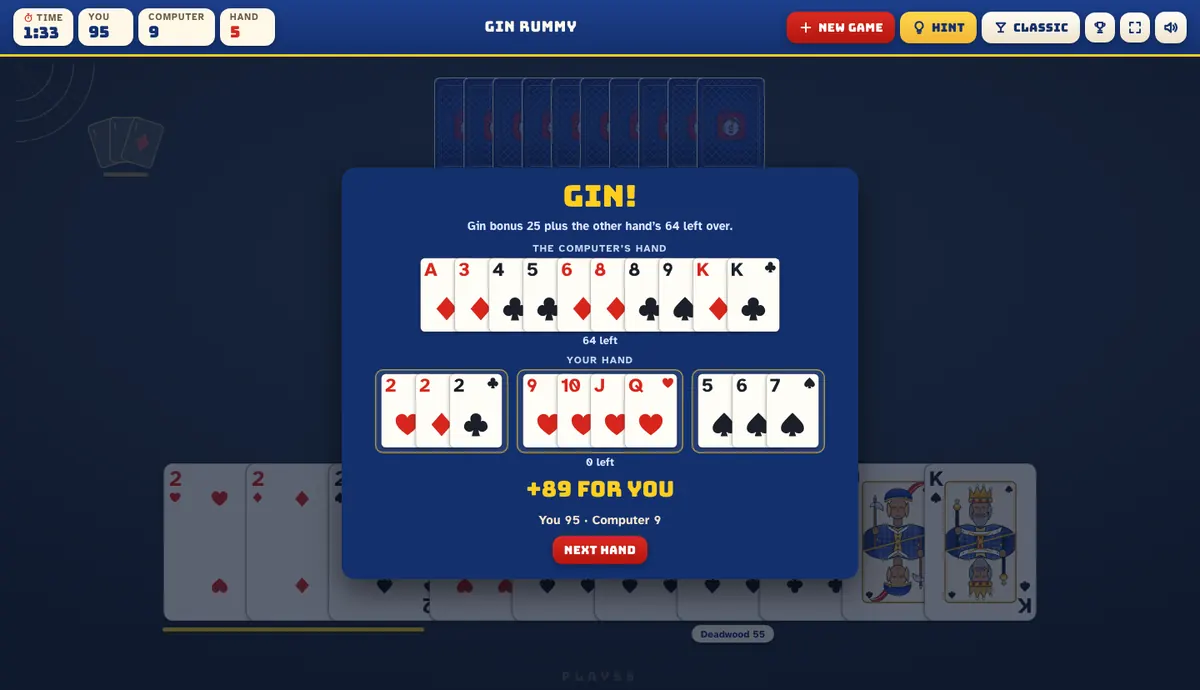
If all ten cards left after your discard are in melds, you have no deadwood and you go Gin. Gin earns a bonus (25 points in the Play5s version) plus the full deadwood count of the other hand, and the other player cannot lay off anything. Most Gin hands are three melds of four, three and three cards, but two runs of five cards also work.
 Zoom in
Big Gin
Big Gin is Gin with eleven cards: after you draw, all eleven of your cards fit into melds, so you have nothing to discard. It scores a bigger bonus (31 points) plus the other hand's deadwood. In this version a Big Gin button appears as soon as your eleven cards are all melded.
Undercut
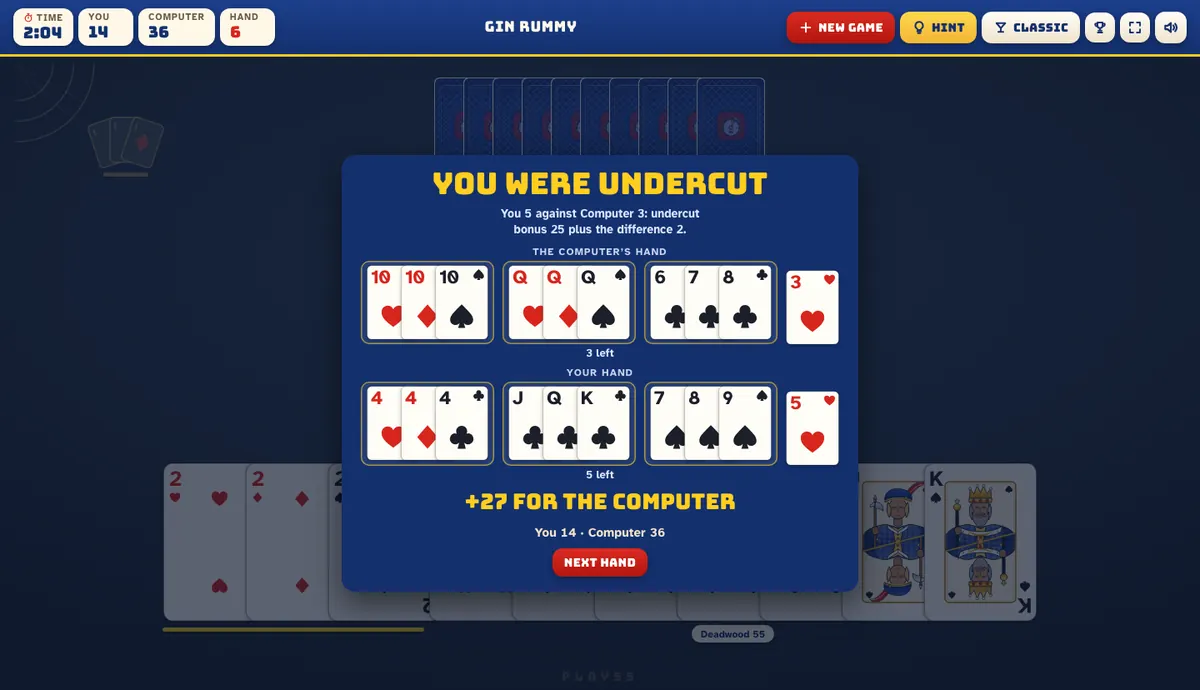
A knock is a risk. If the other player's count is equal to yours or lower, once their lay-offs are done, you have been undercut: they score a bonus of 25 points plus the difference between the counts, and you score nothing. A tie counts as an undercut. A player who goes Gin can never be undercut.
 Zoom in
How scoring works in Gin Rummy
After a knock the player with the lower count scores the difference between the two counts, Gin scores 25 plus the other count, Big Gin 31 plus the other count, and an undercut gives the other player 25 plus the difference.
The scoring for one hand in the Play5s version, which matches the usual American rules in the sources below:
Points in a hand
Say you knock with a count of 6 and the other hand has 15 left after laying off: you score 15 − 6 = 9. Go Gin when the other hand has 22 left, and you score 25 + 22 = 47. Knock with 5 and the other player gets down to 3 with a lay-off, and they score 25 + (5 − 3) = 27 for the undercut.
- Knock, lower count: the difference between the two counts
- Undercut (the other count is equal or lower): 25 plus the difference, for the other player
- Gin: 25 plus the other hand's count, with no lay-off
- Big Gin: 31 plus the other hand's count, with no lay-off
- Dead hand (stock down to two cards): no points
Game bonus and box bonus
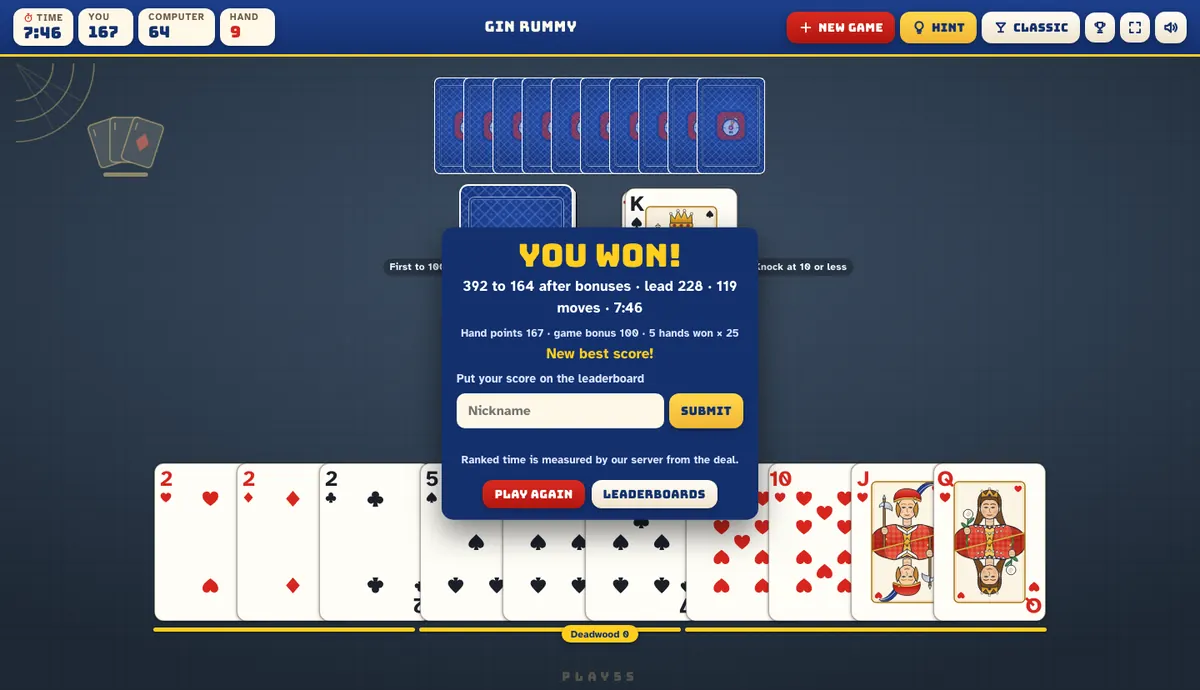
The match ends when a player's hand points reach 100. That player wins the match and gets a game bonus of 100 points, or 200 if the other player never won a hand. Each player also adds 25 points for every hand they won, called the box or line bonus. These extra points do not count toward the 100 needed to win; they only make up the final score.
Here is a full match: you reach 112 points after winning six hands, and the computer has 74 points from four hands. You add 100 for the game and 6 × 25 for your hands, 362 in all; the computer adds 4 × 25 for 174. In the Play5s version your lead is the difference, 188 points, and that is the number the leaderboards rank.
Gin Rummy strategy: how to win more hands
The core of Gin Rummy strategy is to keep your deadwood low while you build melds, and to watch which cards the other player picks up from the discard pile.
- Get rid of high unmatched cards early: a King, Queen, Jack or 10 you cannot meld costs 10 points if the hand ends suddenly.
- Keep cards that can join a meld in more than one way: the 6 and 7 of hearts want a 5 or an 8 of hearts, while a lone 6 and 7 of different suits want nothing.
- Take a card from the discard pile when it completes a meld or lowers your count at once, and draw from the stock otherwise: the discard pile tells the other player what you need.
- Remember what the other player took from the discard pile. A card they took is probably in a set or a run, so keep away from discarding cards of the same rank or next to it in the same suit.
- Count the cards that can still help you. A pair has two cards left that complete the set, but if you have seen one in the discard pile, only one is left.
- Do not rush to knock with a high count when the other player has been taking cards from the discard pile: the more they build, the likelier an undercut.
- Late in a hand, when the stock is nearly gone, knock if you can. A dead hand scores nothing for anyone, and knocking at 10 or less still scores if your count is the lower one.
- Going for Gin pays the biggest bonus, but waiting for a card you may never get costs hands, so knock when your count is low enough that an undercut is unlikely.
Gin Rummy variations: Classic, Oklahoma and more
Play5s offers two rule sets: Classic, the American rules to 100 points, and Oklahoma, where the first card sets the knock limit and the match goes to 150.
Oklahoma Gin
In Oklahoma Gin, the value of the first upcard sets the most deadwood you may knock with in that hand: if it is a 7, you must get your count down to 7 or less before you can knock, and a face card means 10. If the first upcard is a spade, everything scored in that hand is doubled, Gin and undercut bonuses included. The target is higher, 150 points. In the Play5s version an Ace as the first upcard means you may only knock with Gin, which is how the Gin Rummy Association rules and the OpenSpiel code treat it (the page on pagat.com says "some play" it that way). The knock limit and any doubling are shown beside the piles for every hand.
Other versions you may meet
Straight Gin allows no knocking at all: you play until someone goes Gin. Hollywood Gin is a way of keeping score for three games at once, and Tedesco Gin lets Aces run high or round the corner. These are described on Wikipedia (opens in a new tab), but they are not in the Play5s version. Gin Rummy is a two-player game; it is related to the larger family of rummy games (opens in a new tab), with 500 Rum and Rummikub as cousins that play differently.
Where the sources differ
The rule sources agree on how a hand is played, and differ on a few details of scoring: pagat.com gives 20 or 25 points for Gin and 10, 20 or 25 for an undercut, Wikipedia says 25 for both and adds Big Gin at 31, and the tournament rules followed by OpenSpiel let the other player take one last discard at the end of the stock. The Play5s version uses the most common American numbers: 25, 25 and 31, and a hand that is dead when the stock is down to two cards.
How the computer plays
The computer plays from what a person at the table could see: its own hand, the discard pile and the cards you picked up from it, and it never looks at the stock or at your hand.
It takes a discard only when the card helps its melds or lowers its count more than a stock card is likely to, and it avoids throwing away cards that match what you picked up. It knocks when its count is 4 or less, and goes Gin or Big Gin whenever it can. When the stock is down to eight cards or fewer, it knocks at up to the limit of the hand, because a dead hand is near.
Its moves are worked out from the shuffle and from your own moves, never at random, so the same shuffle with the same moves gives the same game. The Hint button asks the same reasoning what it would do in your place: take the card, draw, pass, discard a card, or knock.
Gin Rummy controls: tap, drag or keyboard
Tap the stock or the discard pile to draw, then tap a card to choose it and tap it again, or press Discard, to put it down.
At the start of a hand the buttons under the piles read Take and Pass for the first upcard. After that, tap the stock to draw an unseen card or the top of the discard pile to take it. A chosen card lifts up, and the Deadwood pill shows your count without it. When knocking with that card is allowed, a Knock button appears (it reads Gin when nothing is left over), and when all eleven cards are melded a Big Gin button appears too. You can also drag a card up above your hand to discard it.
There is no Undo in Gin Rummy: a drawn card has shown you something that cannot be taken back. Hint is always there, and the game saves itself after every move, so you can close the page and come back to the same hand.
Keyboard shortcuts
On a computer you can play without the mouse. Press Tab to move to your cards in order, or use the left and right arrow keys between them. Press Enter or Space on a card to choose it, and again to discard it.
- D: draw from the stock
- T: take the top discard (or the first upcard)
- P: pass on the first upcard
- K: knock with the chosen card
- G: declare Big Gin
- H: show a hint
- N: start a new match
- F: full screen on or off
- M: sound effects on or off
Daily Deal and leaderboards
The Daily Deal is a Classic match that every player starts from the same shuffles on the same day.
A new Daily Deal begins at midnight New York time. The cards are the same for everyone at the start, but the computer answers each of your choices, so a match goes its own way as soon as you take different cards. Our server hands out the Daily Deal, so it needs an internet connection, and each connection gets one ranked Daily result per day; after that you can still play it as practice.
Only matches you win go on the leaderboards, and they are ranked by your lead at the end: your final score minus the computer's, after the game bonus and the box bonuses. A tie goes to the shorter time, then to whoever posted first. The time is measured by our server from the moment it hands out the shuffles. After a win, type a nickname of 2 to 12 characters and press Submit; offensive nicknames are refused, and there is no sign-up. There are boards for the Daily Deal, Classic and Oklahoma.
Your own best lead for each mode is kept on this device. The match you are playing is kept there too, and clearing your browser data removes it.
 Zoom in
Gin Rummy terms
Gin Rummy has a small vocabulary of its own, and these are the words you will meet in the rules, in this page and in the game.
- Deadwood: the cards left over outside your melds, counted in points.
- Meld: a set or a run.
- Set: three or four cards of the same rank.
- Run: three or more cards of the same suit in a row, with the Ace low.
- Upcard: the card turned face up to start the discard pile.
- Stock: the face-down pile you draw from.
- Knock: end the hand with 10 points or less of deadwood.
- Gin: knocking with no deadwood at all.
- Big Gin: all eleven cards in melds after a draw.
- Lay off: add a leftover card to the knocker's meld.
- Undercut: the other player's count is equal to or lower than the knocker's.
- Box (line) bonus: 25 points for each hand a player won, added at the end of the match.
- Game bonus: 100 points for winning the match, 200 if the other player won no hand.
Where Gin Rummy comes from
Gin Rummy was created by Elwood T. Baker and his son C. Graham Baker in 1909, according to Wikipedia, and it was a New York game until it became a fad in Hollywood in 1941.
Not every source agrees on the date: the pagat.com page puts the invention around 1911. Wikipedia (opens in a new tab) says it stayed local to New York until the 1941 craze, and cites a 1947 survey by an association of US playing-card makers that found as many people had learned Gin Rummy during World War II as had learned pinochle, cribbage, poker and bridge together.
Card-game historian David Parlett, in his history of Gin Rummy (opens in a new tab), sees the Mexican game Conquian as its forerunner, and calls the theory that it grew out of whiskey poker "highly implausible" in the words Wikipedia quotes from him. The game is a faster, more tactical version of rummy: you can learn the rules in a couple of minutes and spend a lifetime playing them better.
Sources for the rules
The rules on this page were checked against four independent descriptions, read on 22 November 2026.
- Gin rummy on Wikipedia (opens in a new tab): the deal, the turn, knocking, Gin, Big Gin (31), the undercut, the box and game bonuses, the shutout bonus and the variations.
- The Gin Rummy page on pagat.com: the first-turn rule, the lay-off rule, the dead hand at two cards, the 20 or 25 point bonuses and Oklahoma Gin (named, not linked).
- David Parlett's history of Gin Rummy (opens in a new tab): the history, and the family of rummy games.
- OpenSpiel’s Gin Rummy code (opens in a new tab), open source (Apache-2.0), which follows the Gin Rummy Association rules: the last turn at the stock, the Oklahoma Ace and the 25-point bonuses.
- Todd Neller’s Gin Rummy rules for the EAAI student challenge (opens in a new tab): the scoring of a hand as played in computer tournaments, including the tie counting as an undercut.
Gin Rummy questions
How many cards are dealt in Gin Rummy?
Ten cards to each player, one at a time, from a standard 52-card deck. The next card is turned face up to start the discard pile and the remaining 31 cards form the stock.
Can you play Gin Rummy with two players?
Yes, and two is how it is normally played. Gin Rummy is a two-player game, and on Play5s you play against the computer. Variations for three or four players exist, but they are not in this version.
What is deadwood in Gin Rummy?
The cards in your hand that are not part of a set or a run. Their points add up to your deadwood count: Aces are 1, number cards are their number and Jacks, Queens and Kings are 10.
What is the difference between rummy and Gin Rummy?
Gin Rummy is a two-player rummy game with ten cards each where you keep your melds hidden until you knock, and you score the difference in leftover points. In most other rummy games you lay your melds on the table as you go and the first player to get rid of their cards wins.
How do you score in Gin Rummy?
After a knock, the player with the lower deadwood count scores the difference. Gin scores 25 plus the other hand's count, Big Gin 31 plus the count, and an undercut gives the other player 25 plus the difference. A match goes to 100 points, with a 100-point game bonus and 25 points for each hand won.
What is an undercut?
When the player who did not knock ends up with a count equal to or lower than the knocker's, after laying off, they score 25 plus the difference and the knocker scores nothing.
Can you knock on the first turn?
Yes, as soon as you have drawn a card and your other ten cards leave 10 points or less. You are never forced to knock, though, even when you can.
Is the Ace high or low in Gin Rummy?
Always low. A-2-3 is a run, but Q-K-A is not, and a run cannot go round from King to Ace. An Ace is worth 1 point of deadwood.
What happens when the stock runs out?
When only two cards are left in the stock and the player who took the third-last card discards without knocking, the hand is dead. Nobody scores, and the same player deals again.
What is Big Gin?
A Gin with all eleven cards: after drawing, every card in your hand fits into a set or a run, so you have no card to discard. It scores 31 points plus the other hand's count in this version.
Can the computer see my cards?
No. The computer decides from its own hand, the discard pile and the cards you took from it. It does not look at your hand or at the stock.
What is the difference between Classic and Oklahoma?
Classic is the standard American game, knocking at 10 or less, played to 100 points. In Oklahoma the first upcard decides how low your count must be to knock, a spade doubles the hand, and the match is played to 150.
Is there a Hint button?
Yes. It shows what the computer's own reasoning would do in your place: take, draw, pass, discard a card or knock. There is no Undo, because a drawn card cannot be taken back.
Does the game save my progress?
Yes. The match you are playing is saved in this browser on this device after every move, so you can close the page and carry on later. Clearing your browser data removes the saved match.
What is the Daily Deal?
A Classic match that starts from the same shuffles for every player on a given day. A new one begins at midnight New York time, it needs an internet connection, and each connection gets one ranked result per day.
Is there a Gin Rummy leaderboard?
Yes: one for the Daily Deal, and all-time boards for Classic and Oklahoma. Matches you win are ranked by your lead, your final score minus the computer's. After a win, type a nickname and press Submit; no sign-up is needed.
Is Gin Rummy free on Play5s?
Yes. It is free to play in your browser, with no download and no account, on a phone, a tablet or a computer.
About this version
This Gin Rummy was built by Play5s to run in any modern web browser. It follows the standard American rules above, plays you against a computer opponent that decides only from what a player can see, and lets you choose Classic, Oklahoma or the Daily Deal. The cards, including the Jacks, Queens and Kings, are drawn by Play5s.
There is nothing to install and no account to create. Your match in progress is kept in your browser. Starting a ranked match asks our server for a shuffle and a ticket; your moves and nickname are sent only when you submit a score, and our server then replays the whole match to check it.
Read more about Play5s, or see all of our free card games.