

On this page
How to play cribbage
To win cribbage, be the first player to reach 121 points, scored by pegging on the board for card combinations during the play and when the hands are counted.
The deal and the crib
Cribbage uses one 52-card deck. At the start of a game each player cuts a card and the lower card deals first (the ace is lowest); if the two cards have the same rank, there is a new cut. The deal then alternates every hand, and the dealer owns the crib, an extra hand that only the dealer scores. In the Play5s version the cut for first deal is made for you, and the message above your cards tells you who deals.
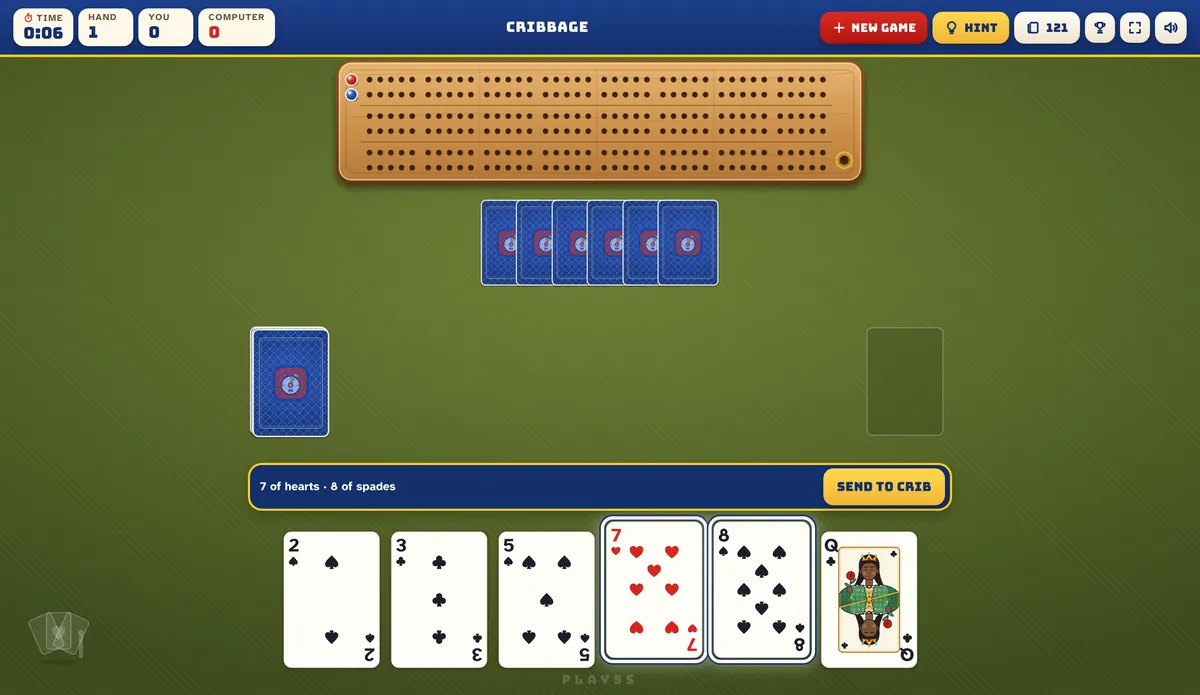
Each player gets six cards and chooses two to put face down into the crib, which leaves a hand of four. When you deal, the crib is yours, so you want to throw cards that work well together. When the computer deals, you want to throw cards that are unlikely to score. On Play5s, tap two cards to lift them, then press Send to crib.
The player who does not deal cuts the rest of the deck and the top card of the lower half, the starter, is turned face up. The starter counts as a fifth card in every hand and in the crib. If the starter is a jack, the dealer scores 2 points at once, called his heels.
 Zoom in
The play (pegging)
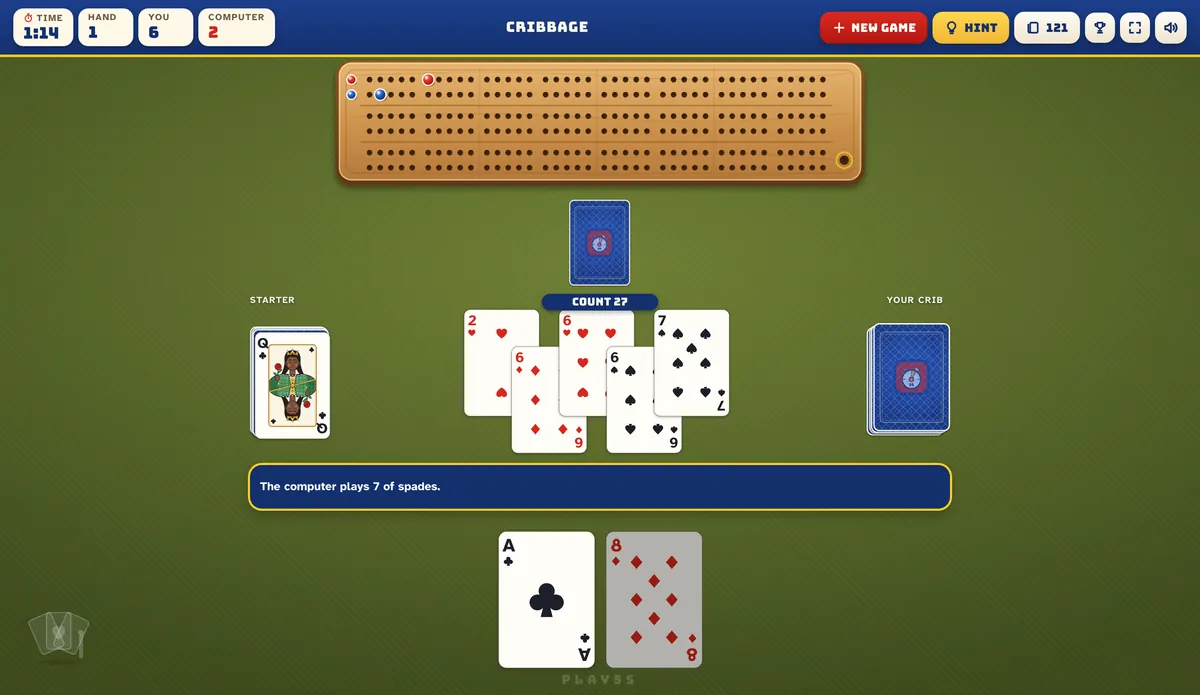
The player who does not deal lays the first card face up, and the players take turns laying one card at a time, keeping a running count. Cards count their face value, aces count 1 and every face card counts 10. The count may never go over 31. A player who cannot lay a card without going over 31 says go, and the other player carries on with any cards they can lay. Whoever lays the last card scores 1 point, or 2 points if the count is exactly 31. Then the count starts again from 0 and the player who did not lay the last card begins.
You score as you play: 2 points for making the count exactly 15, 2 for exactly 31, 2 for a pair (the same rank as the card before), 6 for three of a kind in a row and 12 for four, and 1 point for each card in a run of three or more cards in a row, in any order. A run or a pair only counts cards that were laid one after another in the same count. In the Play5s version the points are pegged for you and the computer's plays show in the message bar.
 Zoom in
The show
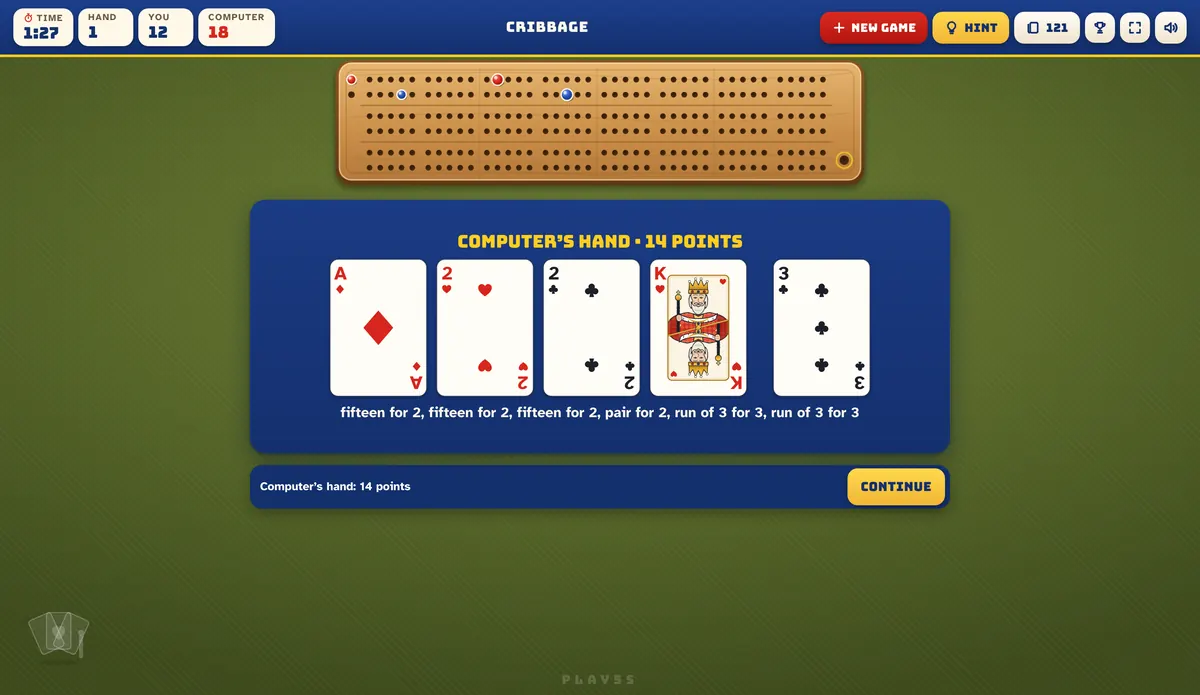
When all eight cards have been played, the hands are counted. The player who did not deal counts first, then the dealer counts their hand, and then the dealer turns over the crib and counts it. Every hand is four cards plus the starter. The points are 2 for each set of cards that adds up to 15, 2 for each pair, 1 for each card in a run of three or more, 4 for a flush of the four hand cards (5 if the starter matches the suit), and 1 for the jack in your hand that has the same suit as the starter, called his nobs. The crib only scores a flush when all five cards match.
 Zoom in
Winning the game
The first player to reach 121 points wins, and that can happen at any moment: in the middle of the play, while a hand is being counted, or even when the dealer scores two for a jack starter. In the Play5s version the game ends the moment a player reaches the target, and the winner is pegged out on exactly 121 (or 61 in the short game).
Cribbage scoring in the play
In the play, you score for making 15 or 31, for pairs and for runs, and 1 point for the last card, and each score is pegged as soon as you lay the card.
- Fifteen: 2 points to the player whose card makes the count exactly 15.
- Thirty-one: 2 points for making the count exactly 31. This replaces the 1 point for the last card.
- Go and last card: 1 point for laying the last card of a count when neither player can go on without passing 31, and for the very last card of the hand.
- Pair: 2 points for laying a card of the same rank as the card before it. A 10 and a queen are not a pair, only the same rank counts.
- Pair royal and double pair royal: 6 points for a third card of the same rank in a row, 12 points for a fourth.
- Run: 1 point for every card in a run of three or more consecutive ranks laid one after another, in any order. 4-2-3 is a run of 3, and adding a 5 makes a run of 4. The ace is low, so queen, king, ace is not a run.
- A pair or a run cannot reach back over a reset: when the count goes back to 0, the cards before it no longer count.
Cribbage scoring in the show
When hands are counted, every different set of cards that adds up to 15 scores 2, every pair 2, every run 1 per card, a flush 4 or 5, and nobs 1.
- Fifteens: 2 points for each different combination of two or more cards that adds up to 15. Face cards count 10 and aces 1, so three 5s and a jack hold four fifteens (8 points), and with the fourth 5 as the starter there are eight (16 points).
- Pairs: 2 points for each pair. Three of a kind is three pairs and scores 6, four of a kind is six pairs and scores 12.
- Runs: 1 point for each card in a run of three or more, and a hand that has a pair inside a run counts the run once for each way to make it. 6-7-7-8 is two runs of 3 (6 points), a pair (2) and two fifteens (4): 12 points.
- Flush: 4 points when all four cards of your hand are the same suit, 5 points when the starter is also that suit. Three cards of a suit and the starter do not count. In the crib only a five-card flush counts.
- His nobs: 1 point for the jack in your hand that is the same suit as the starter. The starter itself is not nobs.
- His heels: the dealer scores 2 when the starter is a jack. This one is scored when the starter is turned, not in the show.
The best hand in cribbage: 29, and how often hands score
The best possible cribbage hand is worth 29 points: three 5s and the jack of the same suit as the fourth 5, which is the starter.
All scores from 0 to 29 can happen except 19, 25, 26 and 27, and a hand that scores nothing is called a nineteen hand. We checked this by counting every one of the 2,598,960 possible sets of five cards, with each of the five cards taken in turn as the starter: 12,994,800 combinations of a four-card hand and a starter, scored with the same code that runs this game. The only scores missing from 0 to 29 are 19, 25, 26 and 27, and 29 happens in 4 of the 12,994,800 combinations, one in about 3.2 million. A 28 happens 76 times.
A hand picked at random scores 4.77 points on average. About 7.8 percent score nothing, 4 points and 2 points are the most common results (about 22 percent each), 12 or more happens about 4 percent of the time, 16 or more about 0.7 percent, and 20 or more about 0.1 percent. A random crib averages 4.73 points. These are averages over all deals, so the hand you keep from six cards, chosen on purpose, scores more.
 Zoom in
The cribbage board, pegs and skunks
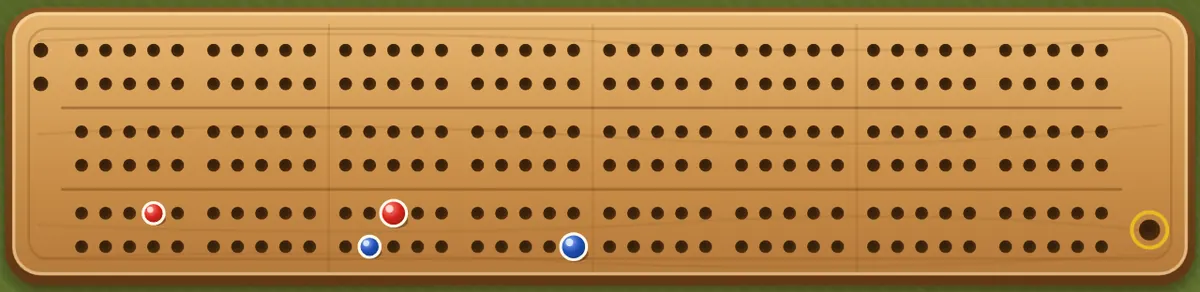
A cribbage board is a scoring track with a row of holes for each player and two pegs each: the front peg shows your score and the back peg the score before it.
When you score, you move the back peg past the front peg by the number of points, so the board always shows both your current score and the last one. A common board has a track of 120 holes for each player and a game hole beyond it, and the first player to peg out wins. The Play5s board has three rows of 40 holes for each player, running left to right, back right to left and left to right again, with the start holes on the left and the game hole at the right-hand end. In the short game to 61 the finish is marked with a gold ring on the second row instead.
A skunk is a win by a wide margin. In the American Cribbage Congress rulebook it means winning by 31 or more points, and other sources put the line at the loser finishing under 91. A double skunk is a loser who finishes under 61. In the Play5s version the result panel tells you when you skunked the computer in a game to 121, and the leaderboards rank wins by how far ahead you finished, which is the target minus the computer's score.
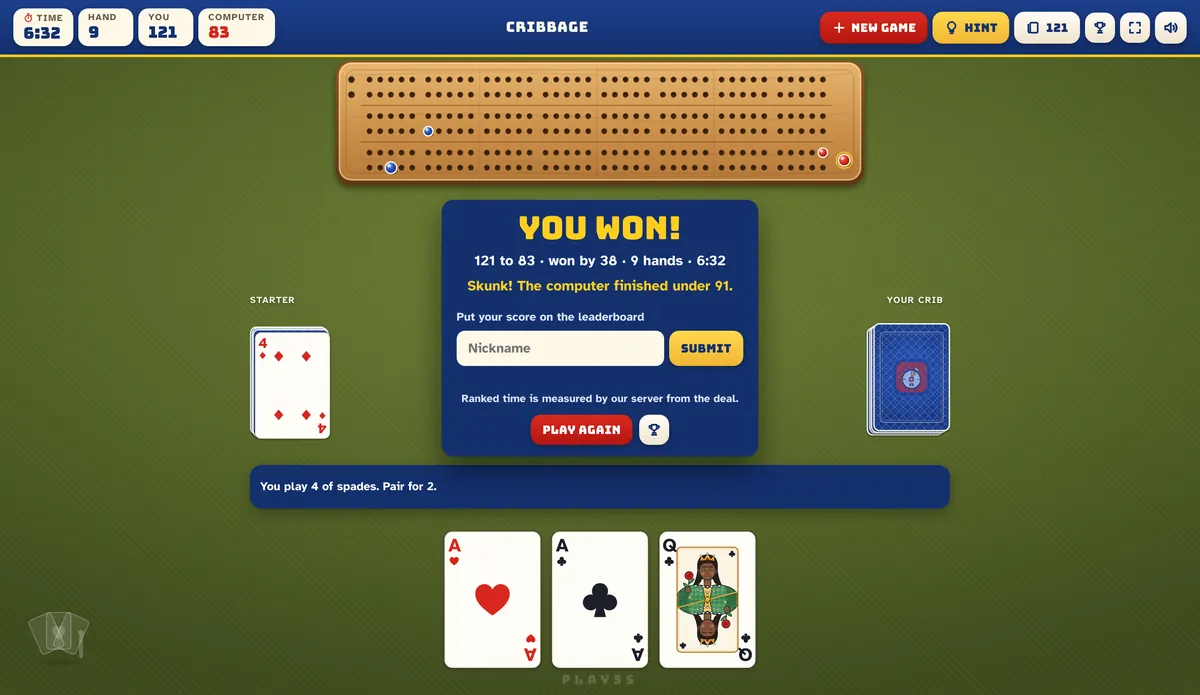 Zoom in
Daily Deal, modes and leaderboards
The Daily Deal is one game to 121 that every player gets on the same day: the same shuffles, the same first dealer and the same computer.
A new Daily Deal starts at midnight New York time. Because the shuffles are the same for everyone, the Daily Deal leaderboard compares players on the same cards, and wins are ranked by how far ahead you finished, then by time. Daily Deals are plain shuffles and are not checked to be winnable: cribbage is decided by how you play your cards, and some games are lost whatever you do. Our server hands out the Daily Deal, so it needs an internet connection, and each connection gets one ranked result per day: after that you can replay the game, but only as practice.
Besides the Daily Deal there are two regular modes, each with its own all-time leaderboard: To 121, the standard game that goes twice round the board, and To 61, a short game of Play5s's own on the same rules, played once round. After a win, type a nickname of 2 to 12 characters and press Submit; offensive names are refused and no account is needed. Only wins go on the boards, and a tie on the margin goes to the faster time. The time is measured by our server from the moment it hands out the deal, and the server replays every submitted game from your moves to check the result before it goes on the board.
Cribbage strategy: what to keep, what to throw, how to play
The most useful cribbage habit is to keep the four cards that score best on average, and to think about whose crib it is before you throw the other two.
We worked out what two cards are worth in a crib by counting, for each pair of ranks (ignoring suits), every possible set of the other two crib cards and every possible starter. A pair of 5s averages 9.0 points. The next best are 5 and jack (7.3), 5 and 6 (7.1), 5 and 10 (7.0), 4 and 5 (7.0), 5 and queen (6.9), 2 and 3 (6.8) and 5 and king (6.8). The cards that give the least are a king with a 10 (3.4), a 9 (3.5), an 8 (3.6) or a 7 (3.6), and a queen with a 9, an 8, a 7 or a 6 (about 3.6 to 3.7). Everything is an average over the cards you cannot see, so any single crib can be far above or below it.
That makes the rule of thumb: when you deal, add the crib's average to the value of the four cards you keep, and throw cards that go together, especially 5s. When you do not deal, subtract it, and keep your 5s, because a 5 and any 10-value card make a 15 for the dealer. The computer picks its discard in just this way: it averages the four kept cards over every starter it has not seen, then adds the crib value if it deals or takes it off if it does not.
- Keep pairs, runs of three and cards that add up to 15 together.
- As non-dealer, do not give the dealer a 5, and avoid throwing two cards that are next to each other or add up to 15.
- Do not lead a 5: any of the sixteen 10-value cards in the deck makes 15 for your opponent. A low card such as a 4 is a safer lead.
- Avoid leaving the count at 21, because a 10-value card then makes 31 for 2.
- Count the cards that have been played. Once most of the 10-value cards are gone, a count of 5 or 21 is far less dangerous.
- Hold a small card back for the end of a count, because the last card scores a point.
- When you are near 121, play for points you can peg now over points that need the show, because the game can end in the middle of the play.
How the computer plays
The computer decides from its own cards, the cards already played and the starter, and it never looks at your hand.
For the crib, it tries every pair of cards from its six, scores the other four with each starter it has not seen, averages the results, and adds the crib's average value when it deals and subtracts it when you do. In the play, it picks the card that scores the most now, minus what you could answer with. That reply is estimated from the cards you may still hold, which are all the cards it cannot see, so it tends to avoid leaving a count of 5 or 21 and takes a pair or a run when it has one. It does not use any randomness except the shuffle: the same game plays out the same way every time, which is how the leaderboard server can replay a game from your moves.
We tested it by playing hundreds of full games. Two copies of the same computer player split the wins about evenly, a plain player who keeps the best average hand, scores greedily in the play and ignores the crib wins about 28 of 100 games to 121, and a player who picks cards at random almost never wins. The Hint button shows the card or the two crib cards the computer would choose in your place.
Cribbage controls: tap, keys or the keyboard
Tap a card to choose it for the crib, and later tap a card to play it.
At the start of a hand, tap two cards and they lift; tap a lifted card to put it back, and a third tap puts the oldest choice back. The Send to crib button turns on when two cards are lifted. During the play, tap a card to lay it. Cards that would take the count over 31 are greyed out, and tapping one gives a small shake and says why. After the last card is played, the counts are shown one at a time, with the cards and what they scored, and you press Continue (or tap the bar) to go on. The Hint button highlights what the computer would do in your place.
Keyboard shortcuts
On a computer you can play without the mouse. Press Tab to move between your cards, the left and right arrow keys to step along them, and Space to choose or play the card. Enter does the same, except that with two cards chosen for the crib Enter sends them. The number keys 1 to 6 choose or play your cards counted from the left. Once the cards are laid, Enter or Space also moves on from a count.
- 1 to 6: choose a card for the crib, or play a card
- Enter: send the two chosen cards to the crib, or move on from a count
- H: show a hint
- N: start a new game
- F: full screen on or off
- M: sound effects on or off
Cribbage terms
Cribbage has a vocabulary of its own, and most of the words name a place on the table or a scoring combination.
- Crib (or box): the four discarded cards that the dealer counts after the hands.
- Starter (or cut, turn-up): the card turned up before the play, which counts in every hand.
- Pone: the player who does not deal. In a two-player game the pone leads first and counts first.
- Pegging: the play of the cards to 31, and also the act of moving pegs. A good play is good pegging.
- Go: what you say when you cannot lay a card without going over 31.
- His heels: the 2 points the dealer scores when the starter is a jack. Also called his nibs.
- His nobs: the 1 point for holding the jack of the starter's suit. Also called nibs.
- Pair royal: three of a kind, worth 6. Double pair royal: four of a kind, worth 12.
- Skunk: a win by a wide margin, and a double skunk is an even bigger one. British players say lurch.
- Muggins: an optional rule that lets the opponent claim points a player forgot to count. It is not used here, because the game counts for you.
- Nineteen hand: a hand that scores nothing, because 19 is a score that cannot happen.
Where cribbage comes from
Cribbage was created in England in the early 17th century, and the poet Sir John Suckling is traditionally given the credit.
According to John Aubrey, Suckling made it up as a variation of the older English card game noddy, and the earliest printed rules are in Cotgrave (1662), Willughby (1672) and Cotton (1674). Cribbage has been called Britain's national card game, and it was popular with prospectors in the American West: the small mining town of Nelson, Montana, still has a sign calling it the "Cribbage Capital of the World". The novelist Charles Dickens helped its fame by showing the game in The Old Curiosity Shop, and American submariners have long played it as a pastime.
The history and the rules are covered in Cribbage and Rules of cribbage on Wikipedia.
Sources for the rules
The rules on this page come from three sources, read on 22 November 2026, and the page says where they differ.
- Rules of cribbage and Cribbage on Wikipedia.
- The six-card cribbage page on pagat.com, which gives worked examples of the play and the show.
- Rules of Cribbage, 2025 rulebook of the American Cribbage Congress, the source for the cut for first deal, his heels and the skunk.
- Where they differ: the cut for first deal goes by rank in the American Cribbage Congress rules and counts all ten-value cards as equal on pagat.com, and Play5s follows the American Cribbage Congress. The short game to 61 is Play5s's own option, a half-length game of the same rules. Five-card cribbage and three or four players are not in this version.
Cribbage questions
How many cards are dealt in cribbage?
In two-player cribbage each player is dealt six cards, and each puts two of them into the crib, so every hand and the crib hold four cards. With three or four players, five cards are dealt each.
How many points do you need to win cribbage?
121 points in the standard game. Play5s also has a short game to 61.
Who deals first in cribbage?
Each player cuts a card and the lower card deals first, with the ace lowest. If the two cards have the same rank, there is another cut. The deal then alternates. In the Play5s version the cut is made for you and the message above your cards says who deals.
Who counts first in cribbage?
The player who does not deal counts first, then the dealer counts their hand and then the crib. That order matters because the game ends the moment someone reaches 121.
What is the crib in cribbage?
The crib, or box, is a hand of four cards made from two cards that each player puts in face down. It belongs to the dealer and is counted after the dealer's own hand.
What does go mean in cribbage?
Go is what you say when you cannot lay a card without taking the count over 31. The other player carries on laying cards, and whoever lays the last card scores 1 point, or 2 points for exactly 31.
What is the best hand in cribbage?
The best hand is 29 points: three 5s in your hand and the jack of the same suit as the starter, which is the fourth 5. Scores of 19, 25, 26 and 27 cannot happen.
How many points is four of a kind in cribbage?
In the show, four of a kind is worth 12 points (six pairs). In the play, laying a fourth card of the same rank in a row also scores 12. Three of a kind scores 6.
How many points is a flush in cribbage?
A flush of the four cards in your hand is 4 points, and 5 points when the starter is the same suit as well. A flush in the crib only counts if all five cards are the same suit, for 5 points.
Is the ace high or low in cribbage?
The ace is low, so it counts 1 and sits before the 2 in a run. Queen, king and ace is not a run.
What is nobs in cribbage?
Nobs, also called nibs, is 1 point for holding the jack of the same suit as the starter card. A jack turned up as the starter is a different score: 2 points for the dealer, called his heels.
What is a skunk in cribbage?
A skunk is a win by a wide margin. In the American Cribbage Congress rulebook it is winning by 31 or more points, so the loser finishes under 91. A double skunk is a loser who finishes under 61. In this version the result panel tells you when you skunk the computer in a game to 121.
How many holes are on a cribbage board?
A common board has a track of 120 holes for each player and a game hole beyond them, and each player has two pegs. The Play5s board has three rows of 40 holes for each player and the game hole at the end.
Can I play cribbage against the computer?
Yes. You play against the computer in every game on this page, with Hint, a saved game and the same scoring as the standard rules. The computer decides from its own cards, the cards played and the starter, and does not see your hand.
Does the game save my progress?
Yes. Your current game is saved in this browser on this device, so you can close the page and pick up where you left off. Clearing your browser data removes the saved game.
What is the Daily Deal?
A game to 121 that is the same for every player on a given day: the same shuffles, the same first dealer and the same computer. A new one starts at midnight New York time. It needs an internet connection, and each connection gets one ranked result per day.
Is there a cribbage leaderboard?
Yes. There is a board for each Daily Deal and all-time boards for To 121 and To 61. After a win, type a nickname and press Submit. Wins are ranked by how far ahead you finished, then by time, and the time is measured by our server from the moment the deal is handed out.
Is cribbage free on Play5s?
Yes. It is free to play in your browser, with no download and no account.
About this version
This Cribbage was built by Play5s to run in any modern web browser. It follows the standard two-player rules of the American Cribbage Congress, explained above, with the computer as the other player and a choice of a game to 121 or a short game to 61. The cards, including the jacks, queens and kings, the cribbage board and the pegs are drawn by Play5s.
The scoring code and the computer player were checked against published cribbage hand scores and worked examples, and the ideas for the computer's choices come from published methods: averaging a hand over every starter, and weighing a card's score against the reply it invites, as in the open-source projects wroberts/cribbage (MIT) and MichaelCook/cribbage (BSD 2-clause). No code was copied from them.
There is nothing to install and no account to create. Your game in progress is kept in your browser. Starting a ranked game asks our server for a deal and a ticket; your moves and nickname are sent only when you submit a score.
Read more about Play5s, or see all of our free card games.