

On this page
How to play Burraco
To win at Burraco, your side scores more points than the other over several hands, by melding cards, building burraco of seven cards and closing first; the first side past 1005 points wins the match.
The cards and the deal
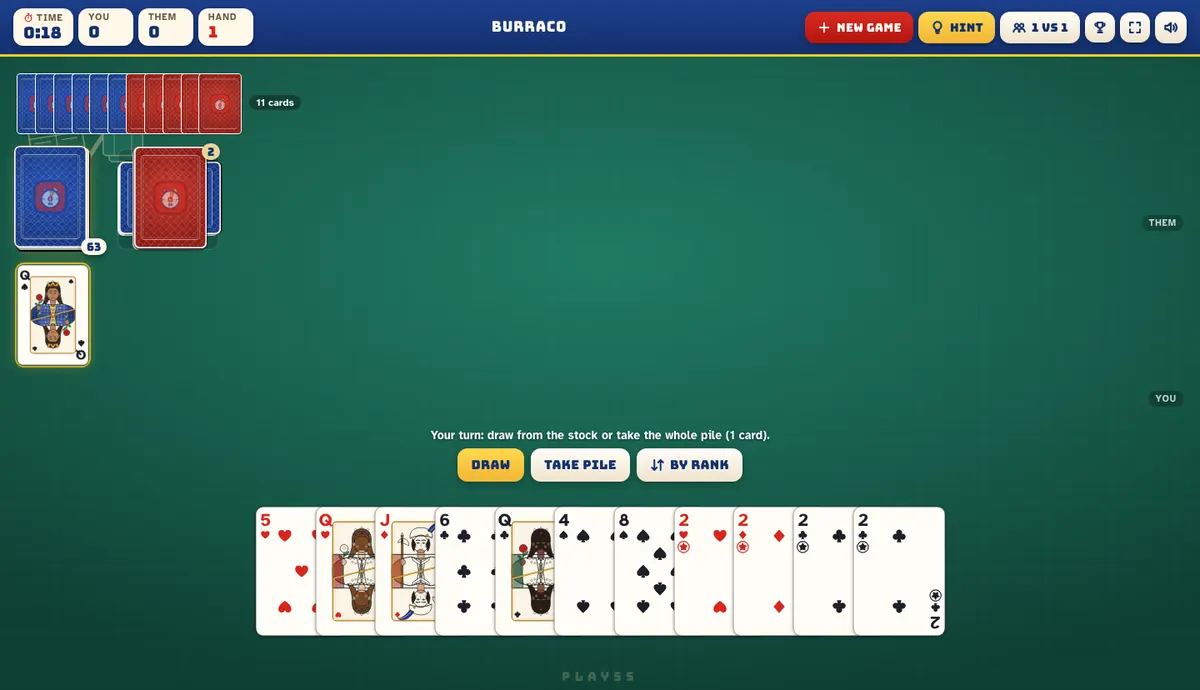
Burraco uses two standard 52-card packs and four jokers, 108 cards in all. Each player gets 11 cards. Two more stacks of 11 cards, the pozzetti, are dealt face down and laid in a cross at the side of the table: the first player of each side to run out of cards will pick one up as a new hand. One card is turned face up to start the discard pile and the rest is the stock. In 1 vs 1 the stock starts with 63 cards; in 2 vs 2, with 41.
The jokers (jolly) and all eight 2s (pinelle) are wild cards. The Play5s cards print a small star in a ring under the corner of every 2, as Italian Burraco packs do, and the two packs have different backs, one blue and one red, so you can tell the twin cards apart.
 Zoom in
Your turn: draw or take the pile, meld, discard
Every turn has three parts. First, draw the top card of the stock or take the whole discard pile; you can never take only part of the pile, and you do not need to use any of its cards. Second, lay down as many new melds as you like and add cards to your side's melds; this part is optional. Third, discard one card face up to end the turn.
When the discard pile is a single card and you take it, you cannot throw that same card straight back; the identical card from the other pack is fine. If, for a whole round, every player only takes the single card and discards another, the hand stops as a stalemate.
Melds: sets and runs
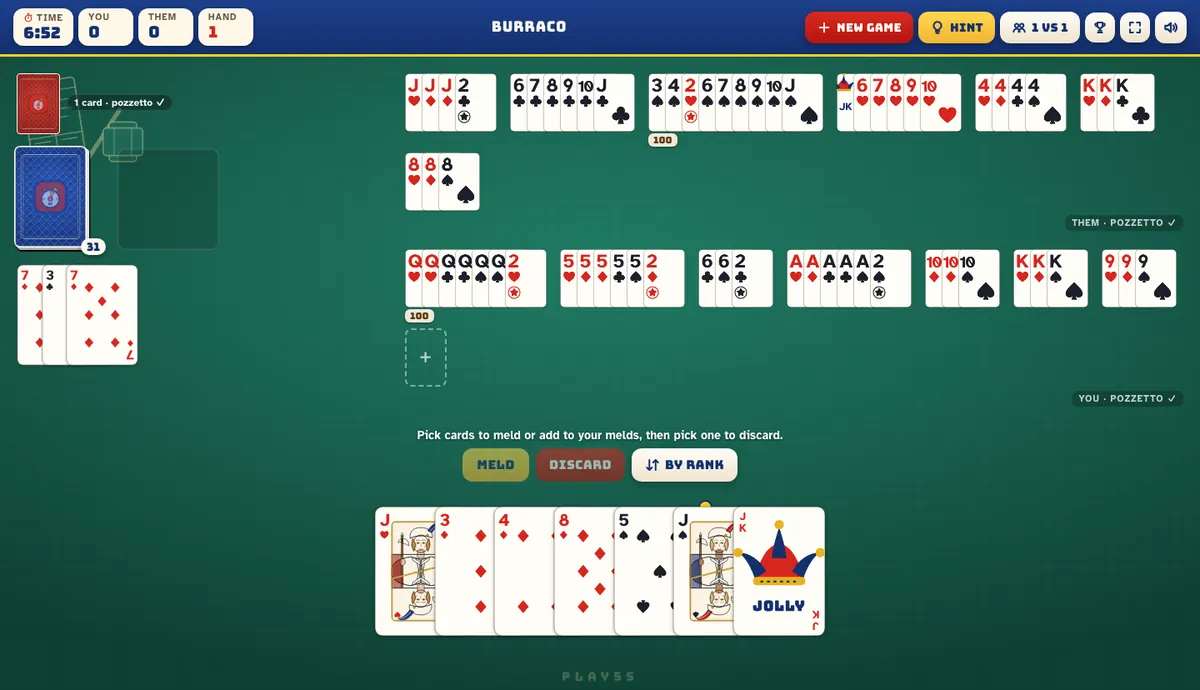
A set (combinazione) is three or more cards of the same rank, Ace or 3 to King, in any suits, so two cards of the same suit are fine; a set holds up to eight natural cards plus one wild card. Each side may have only one set of each rank, unless the set already on the table cannot hold the new cards (it already has its wild card, say): the federation's code treats a new meld laid over one that cannot hold it as valid. A run (sequenza) is three or more cards of one suit in order: A-2-3 up to J-Q-K-A, with the Ace at one end only, up to all thirteen cards plus a wild card. A side may have two runs in the same suit, but two runs are never joined.
A new meld needs at least three cards. You can only add cards to your own side's melds, never to the other side's.
 Zoom in
Wild cards: the jolly and the pinella
A set or a run may hold at most one wild card. A set made only of wild cards is not allowed. A 2 of the run's own suit can also sit in its natural place, between the Ace and the 3: there it is not a wild card, and the run can still take one joker or another 2 as its wild card.
A wild card that fills a gap in a run stands for that card until someone of its side adds the real card; the wild card then moves to the end of the run and can stand for the next card at either end. A wild card never goes back to a hand, and it can only be replaced by the card it stands for: another wild card cannot take its place, so a new joker joins the run only if you add the real card in the same move. In the Play5s version a free wild card is drawn at the bottom of the run, or at the top when the bottom card is an Ace, the way players place it at the table.
The pozzetto
The first time a player runs out of cards, their side picks up a pozzetto as a second hand. If the last cards went into melds, the player takes the pozzetto in diretta, straight away, and carries on with the turn. If the last card was the discard, the player takes it con lo scarto, with the discard, and plays it from the next turn. You may discard a wild card to go to the pozzetto. Each side takes one pozzetto; in 2 vs 2, once your partner has taken it, it is gone for you too.
Closing the hand
A side closes, the chiusura, when it has taken its pozzetto, has at least one burraco on the table, and one of its players discards their last card. The last discard cannot be a joker or a 2. Closing by melding every card, with nothing left to discard, is not allowed, so the game keeps a card in your hand for you: with your pozzetto taken, a meld that would leave you no legal discard is refused.
If nobody closes, the hand ends when the stock is down to two cards: the player who drew the third-last card finishes the turn, and that is the end; the discard pile cannot be taken any more. No closing bonus is scored then.
Burraco pulito, semipulito and sporco
A burraco is a set or a run of seven or more cards, and it scores a bonus on top of its card points: 200 when it is clean, 150 when it is semi-clean and 100 when it is dirty.
The burraco is the meld that gives the game its name, and you need one to close. How clean it is depends on the wild card, following article 13 of the FIBur Codice di Gara:
- Burraco pulito (clean), 200: no wild card at all. A 2 of the run's suit in its natural place keeps it clean.
- Burraco semipulito (semi-clean), 150: a run whose wild card sits beside an unbroken stretch of at least seven natural cards, or a set of eight cards with the wild card.
- Burraco sporco (dirty), 100: any other burraco with a wild card in it.
The kind is counted at the end of the hand, so a dirty burraco can still become clean: if you add the 7 to 2-3-4-5-6-8 with a 2 standing in for the 7, the 2 goes back to its place and the run is clean. On the table, the Play5s version marks each burraco with its bonus, 200, 150 or 100.
Some other federations and home games also count a royal burraco (a clean run from Ace to King) and a super burraco (eight equal cards). The FIBur rules this version follows do not, so neither does the Play5s scoring.
Burraco scoring
At the end of each hand each side adds the points of its melded cards, its burraco bonuses and 100 for closing, then subtracts the points of the cards still in its players' hands and 100 if it never took its pozzetto.
| Card | Points |
|---|---|
| Joker (jolly) | 30 |
| 2 (pinella) | 20 |
| Ace | 15 |
| K, Q, J, 10, 9, 8 | 10 |
| 7, 6, 5, 4, 3 | 5 |
A hand can score below zero when the cards left in hand are worth more than the cards melded. The match goes to 1005: when a side passes it at the end of a hand, the side with more points wins; if both sides are level, another hand is dealt.
| Item | Points |
|---|---|
| Burraco pulito (clean) | +200 |
| Burraco semipulito (semi-clean) | +150 |
| Burraco sporco (dirty) | +100 |
| Closing (chiusura) | +100 |
| Cards left in hand | minus their points |
| Pozzetto not taken | −100 (not when neither side took one) |
| Pozzetto taken but not yet played | minus the points of its cards |
An example hand
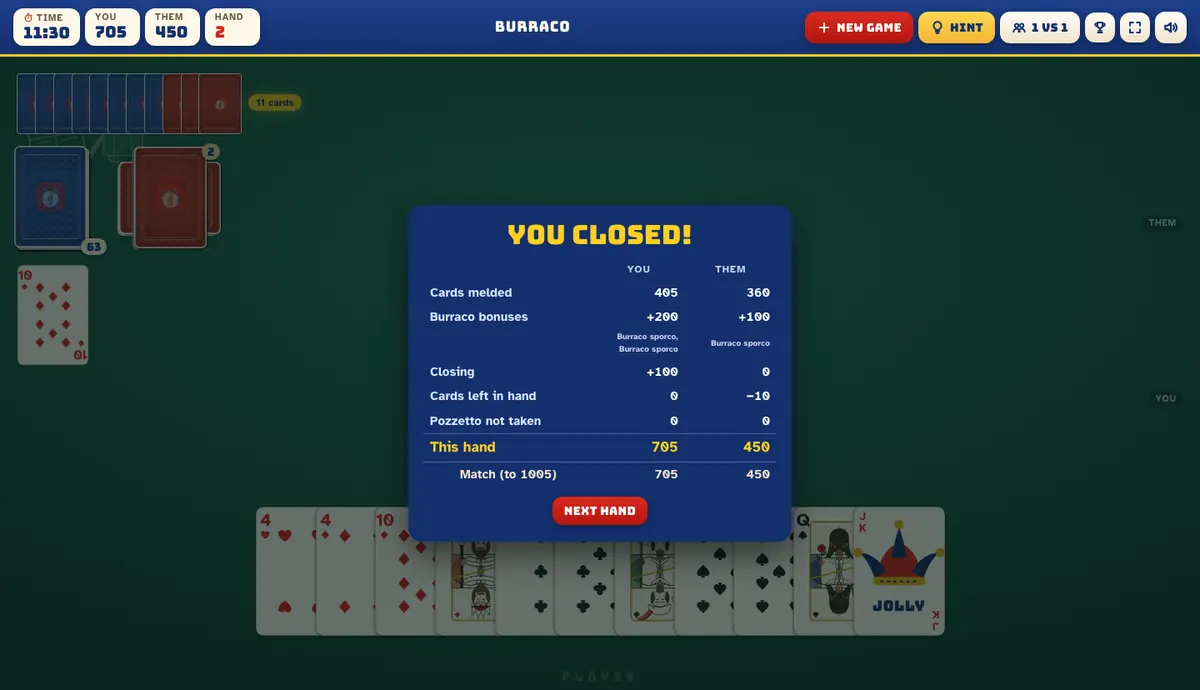
In the hand in the picture below you close. Your melds hold 405 points of cards and two dirty burraco (+200), and closing adds 100: 705. The computer melded 360 points with one dirty burraco (+100) but still holds 10 points in its hand: 450. Both sides took their pozzetto, so nobody pays the 100. The match score after this first hand is 705 to 450.
 Zoom in
1 vs 1 or 2 vs 2 against the computer
The Play5s Burraco has two modes: 1 vs 1, you against the computer, and 2 vs 2, you and a computer partner against two computer players, both played to 1005 points.
In 1 vs 1 each player is a side with its own pozzetto, so the race to run out of cards matters from the first turn. In 2 vs 2 you sit South with your partner North, against West and East; your side shares its melds and its pozzetto, and either of you can close once one of you has picked it up. The other players' card counts are shown at the top of the table.
For practice there is also a 1 vs 1 match against the easy computer, which never grabs a big pile and ignores what its discards feed you; it is not ranked and not on the leaderboards. The normal computer players follow rules of thumb: they take the pile when it holds cards they can use, lay down sets and runs as they find them, keep their wild cards for a burraco or for going out, and avoid discarding cards that fit the other side's melds. They decide only from their own hand and what is on the table, never from your cards or the stock.
Burraco tips for beginners
Get to your pozzetto early, build one clean burraco, and watch what you feed the next player.
- Reaching the pozzetto gives your side eleven new cards and opens the way to closing; in 1 vs 1 a fast pozzetto is often the whole hand.
- A large discard pile is worth taking when several of its cards fit your melds: more cards means more to meld, but every card still in hand at the end counts against you.
- Keep a wild card back for the seventh card of a burraco, or for the last meld before you go out. Remember that a joker or a 2 cannot be your closing discard.
- Aim for a clean burraco first: 200 points against 100 for a dirty one, and a wild card added later can still leave it semi-clean at 150.
- Before you discard, look at the other side's melds: a card that extends them is a gift when they take the pile.
- When the stock gets low, meld what you can; the hand ends two cards before the stock runs out, and cards left in hand cost points.
How to play on Play5s
Tap the stock or Take pile to start your turn, tap cards to pick them, then tap Meld, one of your melds, or Discard.
The cards you pick lift up; the melds they fit light up, and so does the + slot after your melds when they make a new set or run. You can also drag a card onto the discard pile to discard it, onto one of your melds to add it, or onto the + slot. The game refuses a move that breaks a rule and says why. Hint shows what the computer's own reasoning would do in your place, and the sort button switches your hand between suits and ranks. There is no Undo.
- D: draw from the stock
- T: take the discard pile
- Left and right arrows: move between your cards; Enter or Space picks or puts back a card; Escape clears your pick
- L: lay down the picked cards as a new meld
- 1 to 9: add the picked cards to your meld with that number
- X: discard the picked card
- S: sort by suit or by rank
- H: hint · N: new match · F: full screen · M: sound on or off
Daily Deal and leaderboards
The Daily Deal is a 1 vs 1 match that every player starts from the same deal on the same day, and each day's deal was checked to be winnable: our own Hint wins it against the computer.
A new Daily Deal begins at midnight New York time. Every hand of the match is dealt from the day's seed, but the computer answers your choices, so the match goes its own way as soon as you play differently. Our server hands out the Daily Deal, so it needs an internet connection, and each connection gets one ranked Daily result per day; after that you can still play it as practice.
Only matches your side wins go on the leaderboards, ranked by your lead at the end: your side's total minus the other side's. A tie goes to the shorter time, then to whoever posted first; the time is measured by our server from the deal. After a win, type a nickname of 2 to 12 characters and press Submit; offensive nicknames are refused, and there is no sign-up. There are boards for the Daily Deal, 1 vs 1 and 2 vs 2. Starting a ranked match asks our server for a deal and a ticket; your moves and nickname are sent only when you submit a score.
Where Burraco comes from
Burraco probably began in Uruguay in the 1940s as a variant of Canasta and spread through Italy from the 1980s, according to the Italian Wikipedia.
The name probably comes from the Portuguese buraco, "hole". The Italian game took shape in the south of Italy in the mid-1980s and spread across the country after the Federazione Italiana Burraco (FIBur) was founded in 1994; the federation's tournament code is what made the Italian rules more or less the same everywhere. Brazilian Buraco and Argentine Burako, played with tiles, are close relatives rather than the root of the Italian game, and like Canasta they all belong to the large rummy family of draw-and-discard games.
Sources for the rules
The rules on this page follow the Italian federation's own code and were checked against three other descriptions, read on 24 November 2026.
- FIBur Codice di Gara, edizione 2026: the cards and their points, the deal, sets, runs, wild cards, the three kinds of burraco, the closing, the end of a hand and the scoring table.
- Burraco on the Italian Wikipedia: the history, the pozzetto taken directly or with the discard, the targets of 505, 1005 and 2005, and which federations count which burraco.
- The Burraco page on pagat.com: the order of play, the stalemate, the 2 as a natural card, and the variants for two and three players (named, not linked).
- The FITAB Codice di gara 2017, a second Italian federation: the royal and super burraco it adds, which the FIBur rules and this version do not use.
Burraco questions
How many cards are dealt in Burraco?
Eleven cards to each player, from two 52-card packs and four jokers. Two more stacks of 11 cards are the pozzetti, one card starts the discard pile, and the rest is the stock.
What is the pozzetto?
A second hand of 11 face-down cards. The first player of each side to run out of cards picks one up: straight away if the last cards were melded, or on the next turn if the last card was discarded. A side cannot close without it.
What is a burraco?
A set or a run of seven or more cards. It scores a bonus of 200 when clean, 150 when semi-clean and 100 when dirty, and every side needs at least one to close.
Can you use two wild cards in one meld?
No, at most one. The only exception is a 2 of the run's own suit in its natural place, between the Ace and the 3: it counts as a natural card, so the run can still take one joker or another 2.
Can you close by discarding a joker or a 2?
No. The closing discard cannot be a wild card. You may discard a joker or a 2 at any other time, including the discard that takes you to your pozzetto.
Do you have to take the whole discard pile?
Yes. You take the top card of the stock or the whole pile, never part of it, and you do not have to use any of its cards.
What happens if you do not take the pozzetto?
Your side loses 100 points at the end of the hand, unless neither side took its pozzetto. A pozzetto taken but not yet played counts its cards against you instead.
How many points do you need to win Burraco?
In the Play5s version the match goes to 1005 points, a common target in Italy along with 505 and 2005. When a side passes 1005 at the end of a hand, the side with more points wins.
Can two people play Burraco?
Yes. 1 vs 1 uses the same rules as the partnership game, with one pozzetto for each player. Here you play it against the computer, or 2 vs 2 with a computer partner.
What is the difference between Burraco and Canasta?
Both are partnership rummy games for two packs, but in Burraco both sets and runs can be melded, only one wild card goes in a meld, there is no minimum for a first meld, and each side has a pozzetto as a second hand.
What is the difference between Italian Burraco and Brazilian Buraco?
Brazilian Buraco counts a 2 as 10 points and a joker as 20, is usually played to 3000, and in its common open form only runs can be melded and you need a clean canasta to close, according to the Italian Wikipedia. The Play5s game follows the Italian FIBur rules described on this page.
Can the computer see my cards?
No. The computer players decide from their own hand, the melds on the table, the discard pile and the cards each player took from it. They never look at your hand or the stock.
Does the game save my match?
Yes. The match is saved in this browser on this device after every action, so you can close the page and carry on later. Clearing your browser data removes it.
Is Burraco free on Play5s?
Yes. It is free in your browser, with no download and no account, on a phone, a tablet or a computer.
About this version
This Burraco was built by Play5s to run in any modern web browser. It follows the 2026 rules of the Federazione Italiana Burraco described above, plays you against computer opponents that decide only from what a player at the table can see, and offers 1 vs 1, 2 vs 2 and the Daily Deal. The cards, the jolly and the felt are drawn by Play5s.
There is nothing to install and no account to create. Your match in progress is kept in your browser. Starting a ranked match asks our server for a deal and a ticket; your moves and nickname are sent only when you submit a score, and our server then replays the whole match to check it.
Read more about Play5s, or see all of our free card games.