

On this page
How do you play 500 Rummy?
You play 500 Rummy by drawing from the stock or digging into the open discard pile, laying sets and runs on the table, and discarding one card each turn; the first player whose running total reaches 500 points wins the match.
The deal and setup
Rummy 500 uses one standard 52-card deck (54 cards if you switch on +2 Jokers in Practice mode). In a two-player game, each player is dealt 13 cards; in three- or four-player games, each player receives 7 cards. One card is turned face up to begin the spread discard pile, and the remaining deck forms the face-down stock.
In the Play5s version, the dealer rotates clockwise after each hand (starting with the computer on hand 1 so you act first). Your hand sorts itself: sets and runs you could lay down now sit first with a yellow bar under them, and the remaining cards follow in rank order. On a narrow phone a long hand splits into two overlapping rows so every card stays easy to tap.
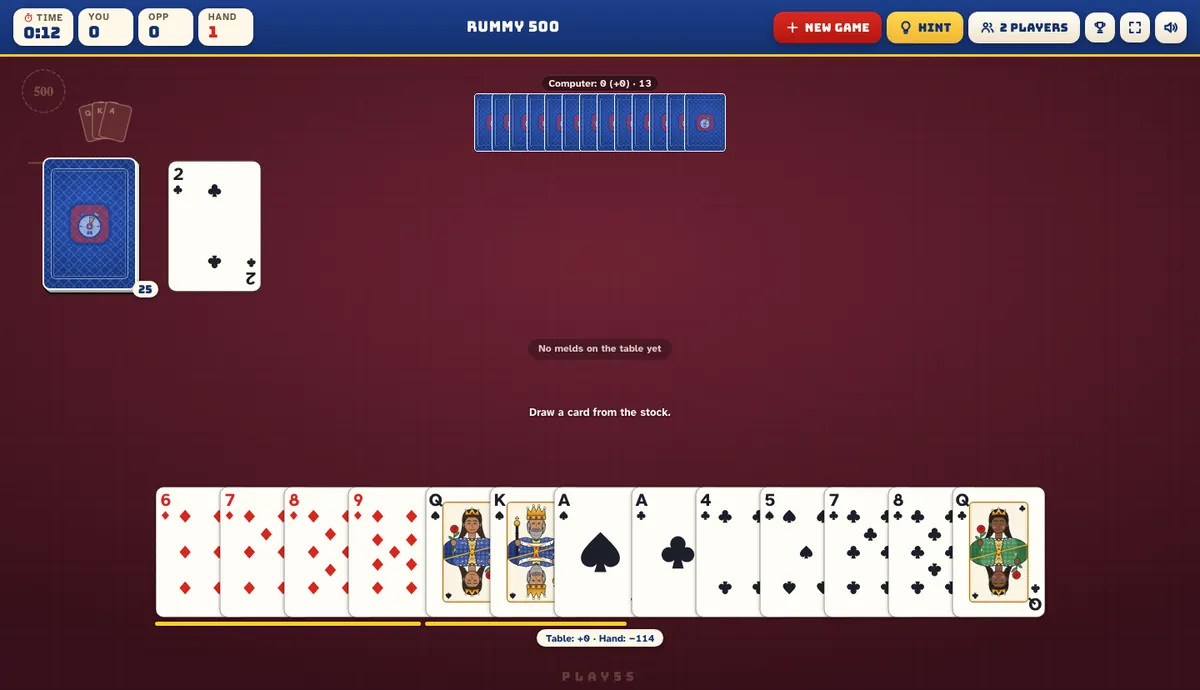 Zoom in
Your turn: draw or dig, meld, discard
Every turn has three parts in order: draw one card from the stock (or dig a slice from the discard pile), optionally meld new combinations or lay off cards onto existing table melds, and discard one card to end your turn.
The signature rule of 500 Rum (Wikipedia) is the fanned discard pile: every discarded card stays visible in order. Instead of drawing unseen from the stock, you can tap any card in the discard pile—even several cards deep—to pick up that card plus every card placed after it. In return, you are required to meld or lay off the deepest card you chose on that very same turn.
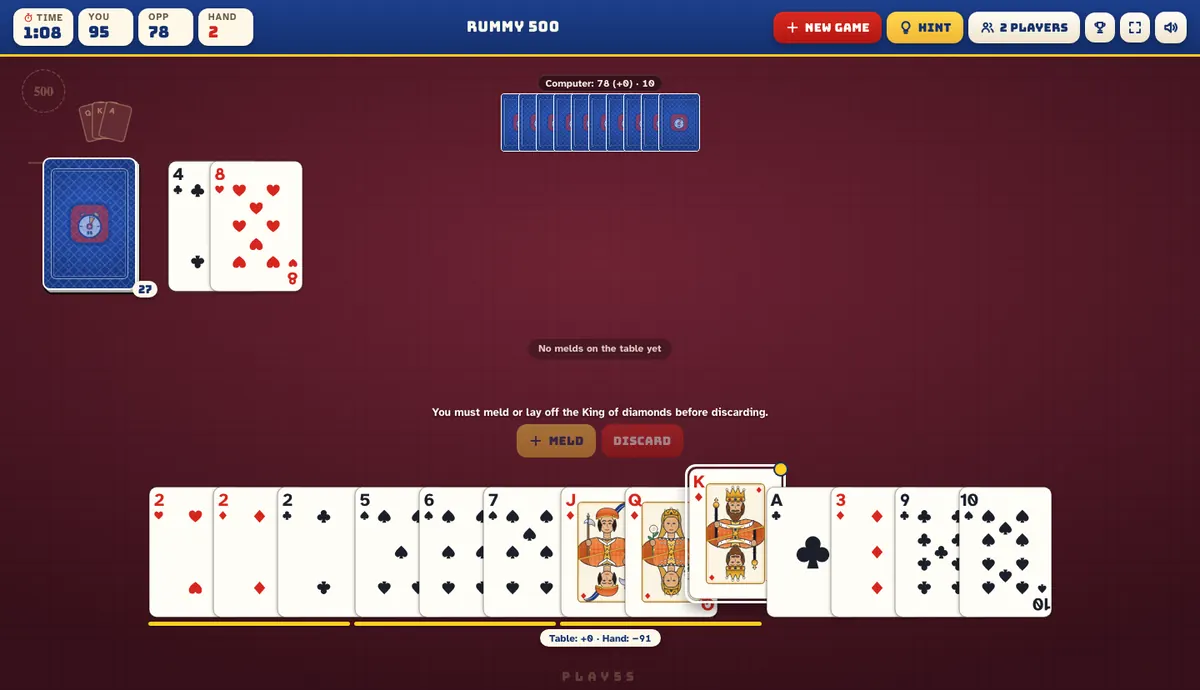 Zoom in
How a hand and a match end
A hand ends the instant any player reaches zero cards in hand—either by discarding their last card or by melding/laying off all remaining cards. Play5s follows the main rule on Pagat.com here: you do not need to keep a final discard when your last meld or lay-off empties your hand.
If the stock runs out before anyone goes out, you can still take from the discard pile when you can use the card, or pass; a pass with an empty stock closes the hand at once and every card left in a hand counts against its holder. After a hand is scored, match totals update. Whoever reaches 500 points with the single highest total wins; if the top totals are tied at 500 or more, another hand is dealt.
If you dug a card out of the discard pile, every meld or lay-off you make before using it must leave that card a way onto the table. A move that would strand it is refused with a short note, so a turn can never get stuck with a card you may neither meld nor discard.
Melds, lay-offs and table ownership
Unlike hidden-hand rummy games, every meld in Rummy 500 lives face up on the shared felt, and every player can build onto any meld on the table.
Valid sets and runs
A set (book) consists of 3 or 4 cards of the same rank in distinct suits, such as three Queens or four 7s. A run (sequence) consists of 3 or more consecutive cards of the same suit, such as 5-6-7 of hearts.
Aces are versatile in Rummy 500: they can anchor a low run (A-2-3) or finish a high run (Q-K-A), though wrap-around runs (K-A-2) are not allowed. With the +2 Jokers option, a Joker can stand for any card in a set or run, as on Pagat.com, so two Jokers and a 5 make a set of 5s. Every meld still needs at least one natural card, a set holds at most four cards, and a Joker scores 15 points wherever it ends up.
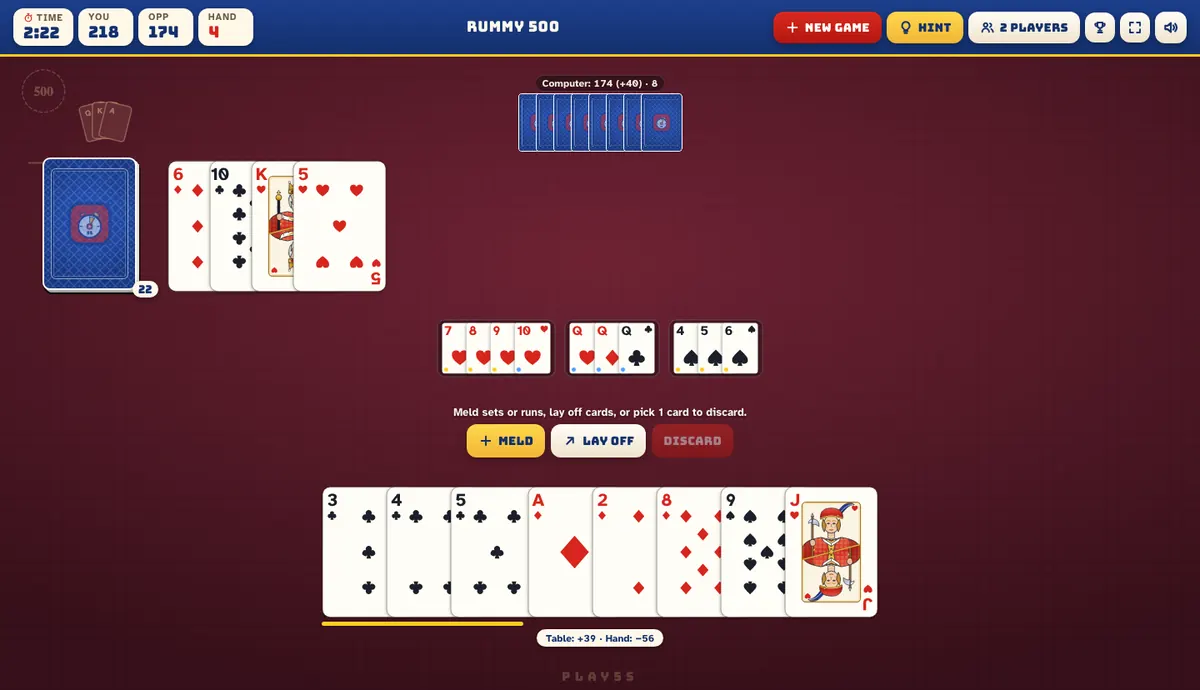 Zoom in
Laying off cards onto anyone’s meld
During the play phase of your turn, select one card that extends a table meld—for instance, the 9 of spades for a 6-7-8 run of spades, or the fourth King for a set of three Kings—and tap the meld that lights up (or press the Lay Off button). With no card selected, Lay Off plays the best lay-off it finds for you.
Because points stay tied to the player who played each individual card, extending an opponent’s meld adds points to *your* score, not theirs. Wait too long holding a 10 or Ace and an opponent may go out and turn those unmelded points negative!
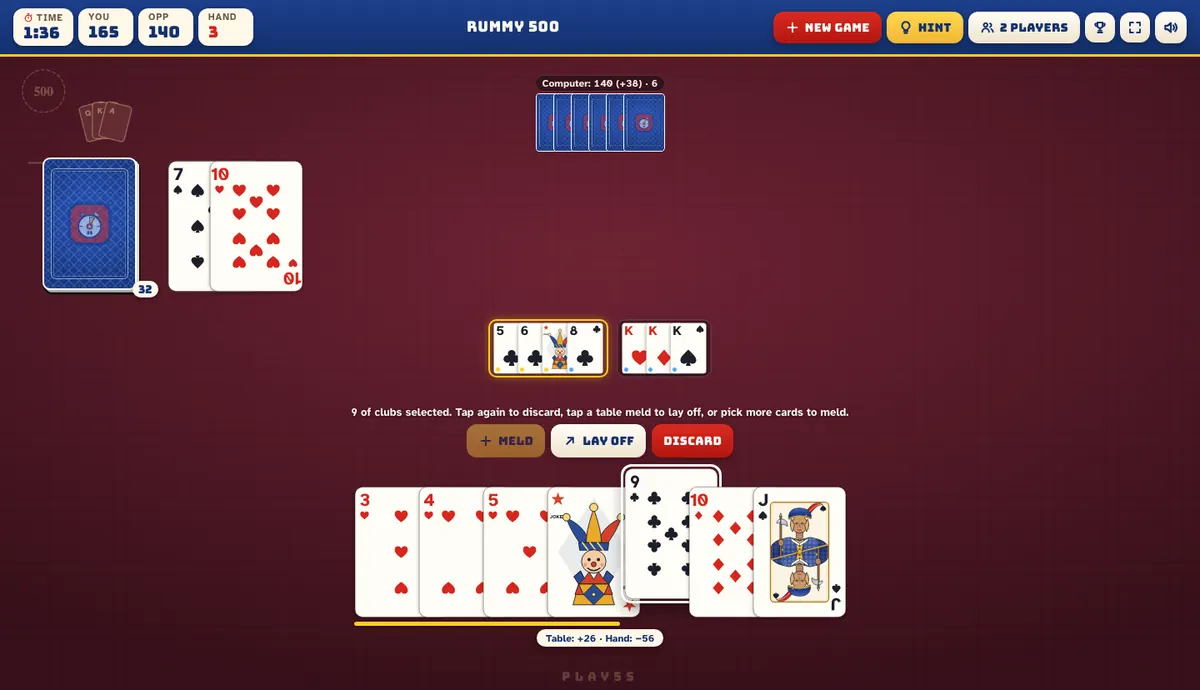 Zoom in
Card values and Rummy 500 scoring
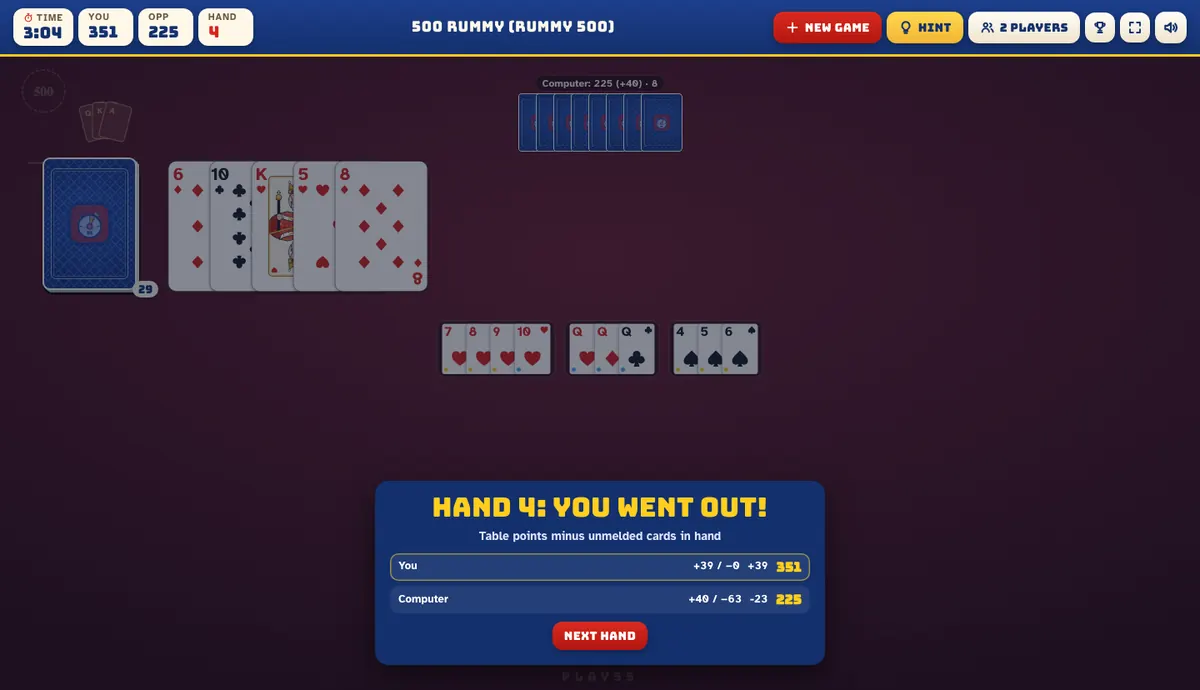
Each card melded onto the table adds its point value to your hand score, while every card still trapped in your hand when the round ends subtracts that same value.
Hand scores can go negative if you are caught with many high cards and few melds. At the end of each round, Play5s shows a full Hand Recap detailing melded points minus leftover hand penalties for every seat before adding them to match totals.
Play5s uses the face-value card points listed on Pagat.com (read 24/11/2026): every player scores their table cards minus the cards left in hand, each hand. Two common variants are not used: the 5/10/15 count (low cards worth 5, 10s and court cards worth 10, a high Ace worth 15) given on Wikipedia and as a Pagat variation, and the Pagat rule that lets anyone call "Rummy!" to grab a playable card someone just discarded.
| Card / Combination | Points | Notes |
|---|---|---|
| 2 through 10 | Face value (2–10) | Same points on table and deadwood penalty in hand |
| Jack, Queen, King | 10 points | High payoff in melds, risky to hold late in a hand |
| Ace (set, high Q-K-A, or in hand) | 15 points | High Ace value as listed on Pagat.com |
| Ace (low run A-2-3) | 1 point | Scores 1 point when melded on the low end of a run |
| Joker (+2 Jokers toggle) | 15 points | Wild card; scores 15 on table or -15 if stuck in hand |
 Zoom in
Strategy tips to win Rummy 500
Good Rummy 500 play balances greedy discard-pile digs against the danger of giving opponents deadwood traps or easy lay-offs.
- Don’t dig deep without a plan: picking up four extra cards just to score a single 3-point meld can stick you with 40 deadwood points if your opponent goes out next turn.
- Watch what stays on top: if an opponent passes over a Queen or an Ace in the pile, holding matching cards gets safer; if they dig deep, expect them to sprint toward 0 cards.
- Unload high cards early: Kings, Queens, Jacks and 15-point Aces swing hands by 20–30 points at a time (up on your side vs. down against you).
- Lay off onto opponents’ runs when the match nears 500: each lay-off moves those points from your hand penalty to your own table score.
- Track the open pile in 2-player 500 Rum: 26 of the 52 cards are dealt at the start and every discard stays visible in the spread, so you can see which 10s and court cards are already gone.
Daily Deal and leaderboards
The Daily Deal gives every player the exact same two-player 52-card deal and stock sequence for the day.
A new Daily Deal opens each day at midnight New York time. While starting cards and stock order match for everyone, computer decisions respond dynamically to what you pick and discard—so two players can reach completely different scores.
Ranked scores use 52-card Normal mode (without +2 Jokers) and rank winning matches by winning margin: your final score minus the highest opponent score. Ties break by faster match completion time, measured on our server. Enter a short nickname of 2 to 12 characters when you win—no account or email required.
 Zoom in
Game modes and controls
Play 2, 3 or 4 players on phones or desktop, with optional Jokers, instant Hint and automatic local saving.
- Players (2P / 3P / 4P): 2 players deal 13 cards each; 3 or 4 players deal 7 cards each. Each seat count has its own leaderboard in 52-card Normal mode.
- Practice toggles: switch +2 Jokers on for wildcard combos (54-card deck), or drop computer strength to Easy while learning the rules.
- Controls: tap the stock, or a highlighted card in the fanned discard pile, to draw; tap cards in hand to select them, then tap Meld, Lay Off or a highlighted table meld; tap a selected card again, drag it up, or press Discard to end your turn.
- Keyboard shortcuts: D draws from the stock, T takes from the discard pile, K or G melds, L lays off, X discards the selected card, P passes when the stock is empty, H shows a hint, N starts a new game, F toggles fullscreen and M toggles sound. Arrow keys move along your hand, Enter or Space selects a card and Esc clears the selection.
History and rule sources
Rummy 500 grew out of classic straight Rummy in North America, adding the signature fanned discard pile and table lay-offs that made every discarded card matter.
- 500 rum on Wikipedia: overview of 2–4 player dealing counts, spread discard pile pickup rule, card values and 500-point goal.
- Pagat.com ("500 Rummy", named without link): detailed rules for deep pile digging, mandatory meld of the picked card and Ace scoring options.
- Bicycle Cards ("500 Rum", named without link): 13 cards for two players and 7 for more, digging the spread pile on condition that the chosen card is used at once, no K-A-2 runs, table points minus hand points, and first to +500 wins.
Rummy 500 questions
What is the difference between 500 Rummy and Rummy 500?
None: 500 Rummy, Rummy 500 and 500 Rum are names for the same game. Pagat.com notes that books usually call it 500 Rum, while players more often say 500 Rummy or Rummy 500.
How many cards are dealt in Rummy 500?
In a 2-player game each player receives 13 cards. With 3 or 4 players each player gets 7 cards. One card is turned face up to start the discard pile and the rest stays in the stock.
Can you pick up more than one card from the discard pile in Rummy 500?
Yes. Because the discard pile is fanned face up, you can pick up any visible card deeper in the pile—as long as you take every card stacked above it too AND immediately meld or lay off that picked card on the same turn.
What are Aces worth in Rummy 500?
In Play5s Rummy 500, an Ace counts 15 points when melded in a set of Aces, in a high run (Q-K-A), or when left unmelded in your hand at the end of a round. In a low run (A-2-3), an Ace counts 1 point.
Can you wrap a run around King-Ace-2?
No. Runs must stay strictly low (A-2-3) or strictly high (Q-K-A) in the same suit. K-A-2 is not legal.
Do you have to discard to go out in Rummy 500?
No. If melding or laying off your last card(s) leaves you with zero cards, the hand ends immediately without needing a final discard. You can also go out normally by discarding your single remaining card.
How does laying off on another player’s meld work?
Once any set or run is on the table, any player on their turn can add valid extending cards to it. Those cards keep your own seat badge, so you score their points—not the player who started the meld.
What happens when the stock pile runs out?
Play continues using the open discard pile until a player melds down to zero cards or passes when drawing isn’t possible or desired, at which point remaining cards in every hand are deducted.
Are Jokers included in ranked Rummy 500?
No. Standard 52-card Normal mode (without Jokers) is used for ranked leaderboards and Daily Deal. You can switch on +2 Jokers anytime in the start menu for practice games.
Does Rummy 500 save my game?
Yes. Every move saves locally in your browser so you can resume where you left off. Ranked matches verify your full move log on our server when you submit a winning score.
About this version
This Rummy 500 game was built by Play5s for browser play on phones, tablets and computers, with full touch and keyboard controls, cards drawn by Play5s and a Hint that uses the same logic as the Normal computer player.
In-progress matches are stored locally on your device. Ranked games and the Daily Deal request a server seed and record your move sequence so every leaderboard score can be verified by replaying the exact match.
Read more about Play5s, or see all of our free card games.