

On this page
How to play 2048
To win 2048, slide numbered tiles across a 4×4 grid so matching powers of two merge into a single 2048 tile before the board fills up.
The starting board
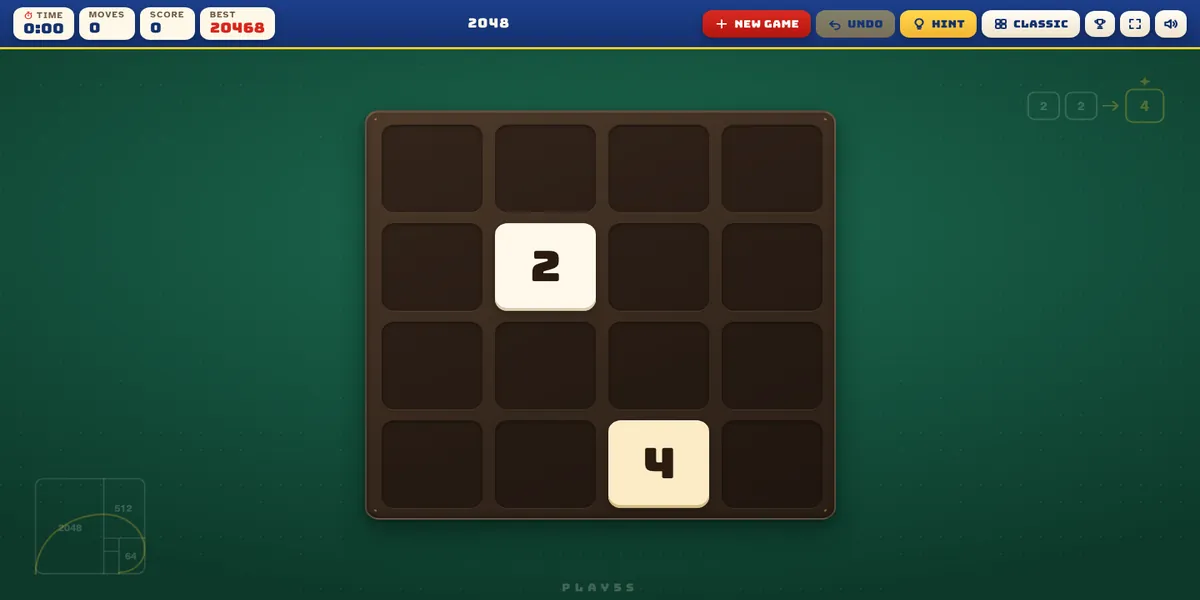
Every game of 2048 begins on a 4×4 grid with two tiles placed on empty squares. Each starting tile has a 90% chance of being a 2 and a 10% chance of being a 4, matching the original 2014 open-source rules by Gabriele Cirulli.
All 16 spaces are visible from the first move. When you choose a direction—up, down, left or right—every tile on the board slides as far as it can go in that direction until it reaches the edge or another tile.
 Zoom in
Sliding and merging tiles
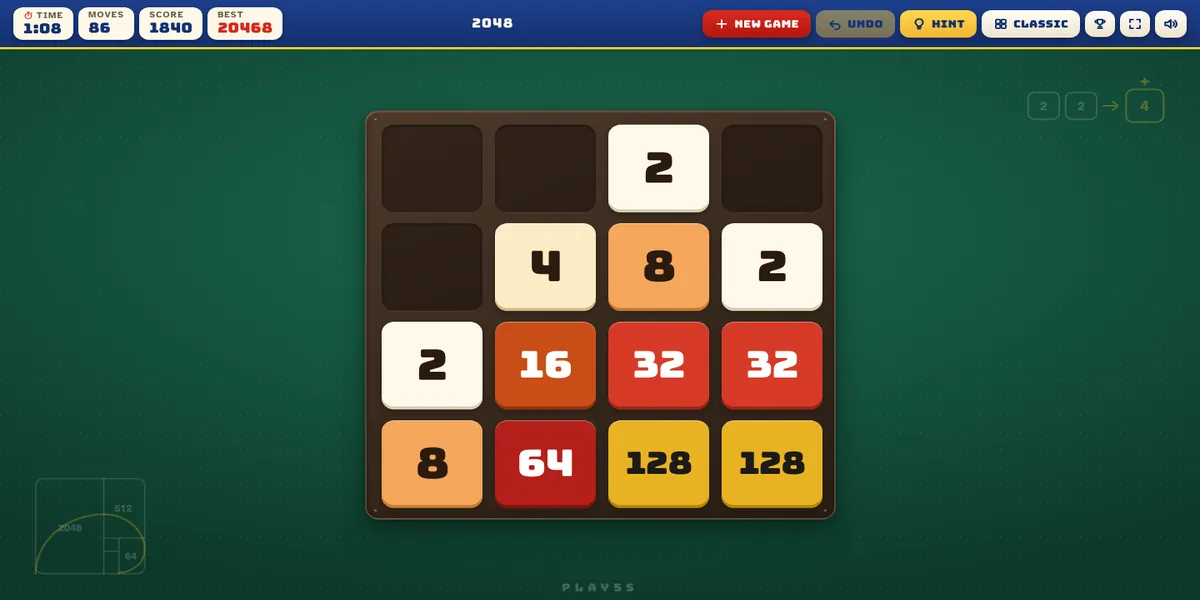
When two tiles of the same number touch along the direction of your slide, they combine into one tile showing their sum: two 2s become 4, two 4s become 8, two 8s become 16, and so on up through 512, 1024 and 2048.
Each tile can merge only once per move. If a row holds 2, 2, 2, 2 and you slide left, the pair on the left merges into 4 and the pair on the right merges into 4, giving 4, 4 rather than jumping straight to 8. Likewise, sliding 2, 2, 4 left produces 4, 4 because the newly created 4 cannot merge again on the same turn.
 Zoom in
New tiles after every move
After every move that shifts at least one tile or creates a merge, one new tile appears in a random empty cell—90% of the time a 2, and 10% of the time a 4. If a slide does not move or merge any tile, nothing changes, no tile spawns, and your move count stays the same.
Winning, Endless mode and game over
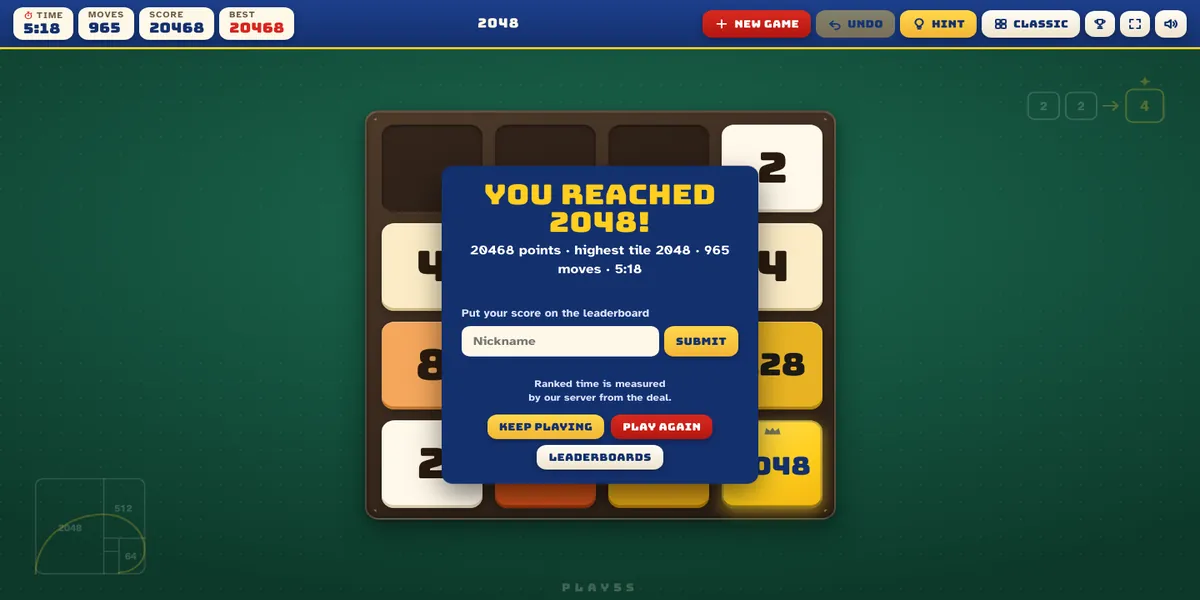
You win the moment you merge two 1024 tiles into a 2048 tile. Reaching 2048 opens the victory panel, where you can post your score to the leaderboard right away or press Keep playing to continue the same run toward 4096, 8192 and higher.
A game ends when all 16 squares are occupied and no two horizontally or vertically adjacent tiles share the same number. At game over, you can submit your final score to the leaderboard or start a fresh board.
Classic or With Undo?
Classic follows the strict 2014 original rules with no Undo, while With Undo lets you take moves back for 10 points each on a separate leaderboard.
In Classic mode, every slide is final. Because each move introduces a new random tile, Classic rewards careful lookahead and is the mode used for the Daily 2048.
In With Undo mode, pressing Undo restores the previous board, score and tile stream, counts as a move (so your move counter never drops), and subtracts a fixed 10-point penalty. Undoing and repeating the exact same slide spawns the same tile in the same square, so Undo fixes slips without letting players farm random spawns. Classic and With Undo each keep their own best score and all-time leaderboard.
 Zoom in
How scoring works in 2048
Every time two tiles merge, your score increases by the value of the new tile created—so merging two 64s adds 128 points and creating 2048 adds 2,048 points.
Sliding tiles without merging adds zero points. Because a 4 spawned directly by the board gives no merge points, while two 2s merged into a 4 earn 4 points, two players who both reach the 2048 tile can finish with slightly different scores—usually around 20,000 points for a first 2048 tile, depending on how many 4s spawned and what smaller tiles sit on the board.
In Classic mode there are no penalties and no time bonus. In With Undo mode, each Undo restores the points from the move taken back and adds a 10-point penalty (your shown score never drops below zero). Time never changes your score; it only breaks ties on the leaderboards.
Daily 2048 and leaderboards
The Daily 2048 gives every player the exact same Classic seed on that day, so everyone starts with the same two tiles and receives the same seeded stream of 2s and 4s.
A new Daily 2048 begins at midnight New York time. Because our server hands out the day’s seed along with a signed ticket, the Daily 2048 requires an internet connection, and each connection gets one ranked Daily submission per day—after that, replaying today’s board counts as practice.
Leaderboards are ranked by highest score first. Ties go to the faster server-measured time, then to whoever posted first. Any game that reaches 2048 or finishes at game over can be submitted with a nickname of 2 to 12 letters or numbers (offensive names are refused), with no account needed. Our server replays your entire move log against the seed it issued, computes your score itself and measures elapsed time from the moment the game started.
 Zoom in
Tips and strategy to beat 2048
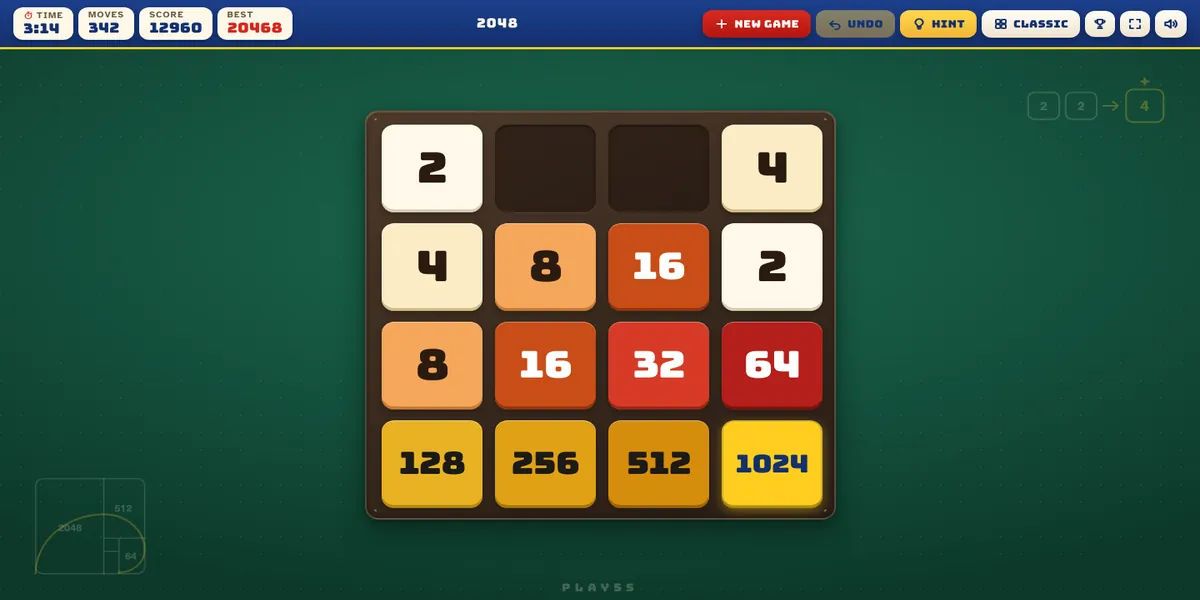
The most reliable way to beat 2048 is the corner strategy: lock your highest tile into one corner and keep your tiles ordered in a snake-like chain beside it.
Players who swipe in all four directions usually end up with large tiles marooned in the center, surrounded by tiny 2s and 4s that cannot reach each other. Keeping one corner fixed turns a chaotic 16-cell puzzle into a tidy conveyor belt that feeds medium tiles directly into your biggest tile.
 Zoom in
- Pick one corner—such as bottom-right or bottom-left—and commit to keeping your highest tile there for the whole game.
- Stick primarily to two or three directions. If your corner is bottom-right, lean on Down and Right, use Left only when the bottom row is completely full, and avoid Up unless forced.
- Keep the anchor row full of four tiles before sliding horizontally away from your corner; an empty gap on that row lets a random 2 spawn in your corner and dislodge your biggest tile.
- Build a monotonic snake chain: arrange tiles in descending order along your anchor row (for example 1024, 512, 256, 128) and bend back across the second row (64, 32, 16, 8) so big merges cascade in seconds.
- Protect empty squares. A board with five or six open spaces recovers easily from an awkward 4 spawn; a board with one or two spaces left is one bad spawn from game over.
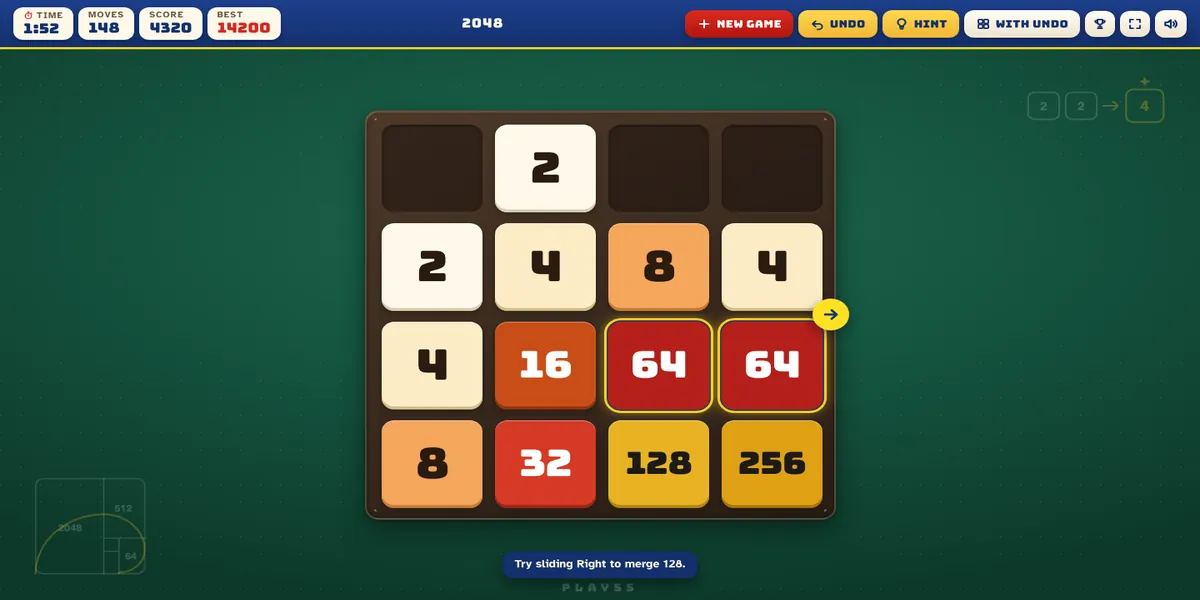
- Use Hint when a tight board is hard to read: the Play5s Hint button runs an Expectimax lookahead search over empty cells and highlights the direction that best preserves space, merges and monotonicity.
Controls and keyboard shortcuts
Slide tiles by swiping anywhere on the board with a finger or mouse, or by pressing the arrow keys or WASD on a keyboard.
Buttons on the bar
The bar above the board shows your elapsed time, total moves, current score and best score for the active mode. New game starts a fresh board and asks for confirmation if a run is in progress. Undo takes back your last move in With Undo mode (in Classic mode it stays dimmed and explains that Classic has no Undo). Hint evaluates legal directions with Expectimax and points a yellow arrow along the strongest slide while highlighting tiles that will merge. Classic / With Undo switches rule sets, the trophy opens the Daily and all-time leaderboards, the full-screen button expands the board, and the gear (Settings) button opens the switches for synthesized wood-tile sound effects and optional background music, with the language of the game’s own words.
- Arrow keys or W, A, S, D: slide tiles Up, Left, Down or Right
- Swipe / click-drag on the tray: slide tiles in any of the four directions
- U or Ctrl+Z: undo one move (With Undo mode)
- H: show an Expectimax move hint
- N: start a new game
- F: enter or exit full screen
- M: mute or unmute sound effects
2048 terms
2048 strategy guides use a few short names for board patterns and tile behavior.
- Corner lock (anchor): keeping your highest-value tile fixed in one corner square so it is never trapped in the middle.
- Snake chain (monotonicity): ordering tile values smoothly downward along one edge and winding back along the next row.
- Spawn: the new 2 (90% probability) or 4 (10% probability) that appears in an empty cell after every valid slide.
- Endless mode: continuing to play the same board after creating the 2048 tile to chase 4096, 8192 and higher scores.
- Expectimax: a game-tree search algorithm that averages player moves against random 2/4 tile spawns, used by strong 2048 solvers and the Play5s Hint button.
History and math of 2048
2048 was created in March 2014 by 19-year-old Italian web developer Gabriele Cirulli as a weekend open-source project released under the MIT License.
Cirulli built the game in a single weekend as a test of whether he could write a browser puzzle from scratch, inspired by 1024 and the earlier sliding puzzle Threes. He published the full source code on GitHub under the permissive MIT License (gabrielecirulli/2048 (opens in a new tab)), and the weekend project drew over 4 million visitors in less than a week, as documented in 2048 (video game) (opens in a new tab) on Wikipedia.
Mathematically, a 4×4 board has 16 cells, so the largest tile theoretically reachable under standard rules is 2¹⁷ = 131,072—achieved only if 15 cells hold every power of two from 4 through 65,536 and a final 4 spawns in the last open square to trigger a complete 16-tile cascade.
2048 questions
How do you win 2048?
Slide tiles up, down, left or right to combine matching numbers until two 1024 tiles merge into a 2048 tile. Anchoring your largest tile in one corner and building a descending chain beside it is the most consistent way to get there.
What happens after you reach 2048?
A victory screen appears showing your score and moves. You can submit your score to the leaderboard right away, start a new game, or click Keep playing to continue in Endless mode toward 4096, 8192 and higher.
What is the highest possible tile in 2048?
On a standard 4×4 grid with 2 and 4 spawns, the theoretical maximum tile is 131,072 (2¹⁷). Reaching it requires packing every power of two from 4 to 65,536 into 15 cells and getting a 4 spawn in the final square.
What is the chance of getting a 4 instead of a 2?
Every new tile spawned after a valid move has a 90% chance of being a 2 and a 10% chance of being a 4, matching Gabriele Cirulli’s original open-source game.
Can a tile merge twice in a single move?
No. Each tile can merge at most once per move. Sliding 2, 2, 2, 2 left produces 4, 4 rather than 8, and sliding 2, 2, 4 left also produces 4, 4.
Does 2048 on Play5s have an Undo button?
Yes, in With Undo mode. Classic mode follows the original 2014 rules with no Undo, while With Undo lets you take moves back (each Undo counts as a move and costs 10 points) and has its own leaderboard.
How does the Daily 2048 work?
Everyone who opens the Daily 2048 on the same day gets the same Classic seed—meaning the same two starting tiles and the same seeded sequence of new 2s and 4s (where each one lands depends on your moves). A new challenge starts at midnight New York time, requires an internet connection, and allows one ranked submission per connection each day.
Does Play5s save my 2048 game automatically?
Yes. Your board, score, moves, mode and elapsed time are saved in your browser on this device after every move, so you can close the tab and resume later. Clearing browser storage removes the saved game.
Can I play 2048 on my phone without downloading an app?
Yes. Play5s 2048 runs directly in any mobile or desktop browser with responsive swipe controls, light and dark themes, and no download or sign-up.
About this version
This version of 2048 was built by Play5s following the original MIT-licensed rules published by Gabriele Cirulli in 2014. Every board uses a deterministic seeded generator so the Daily 2048 deals the same sequence to every player and the leaderboard server can replay submitted games move by move.
There is nothing to install and no account to create. Your game in progress is stored locally in your browser; starting a ranked game requests a seed and signed ticket from our server, and your move log and nickname are sent only when you choose to submit a score. Looking for a card puzzle next? Try Klondike Solitaire or FreeCell, or browse every classic game on Play5s.
Read more about Play5s, or see all of our free puzzle games.