
On this page
How to play Block Puzzle
To score high in Block Puzzle, place three polyomino pieces at a time onto an 8×8 grid so full rows and columns clear before the board runs out of room.
The 8×8 grid and three-piece tray
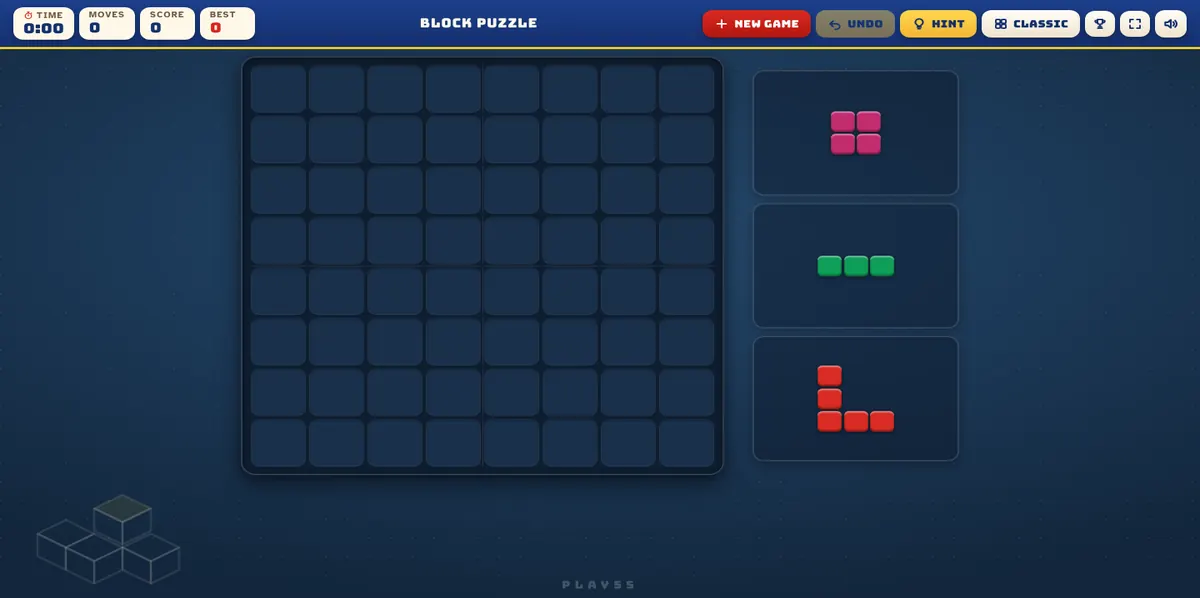
Every round starts on an empty 8×8 grid of 64 squares with three polyomino shapes waiting in the tray. Colors help you tell adjacent shapes apart, and they do not restrict where a block can sit or which lines clear.
You must place all three pieces in the tray before a new set of three appears. You may place them in whichever order creates the cleanest space on the grid.
 Zoom in
Placing blocks without rotation
Pieces cannot be rotated or flipped: each shape goes onto the board in the exact orientation shown in the tray. A placement is legal as long as every square of the piece lands on an empty cell inside the 8×8 border.
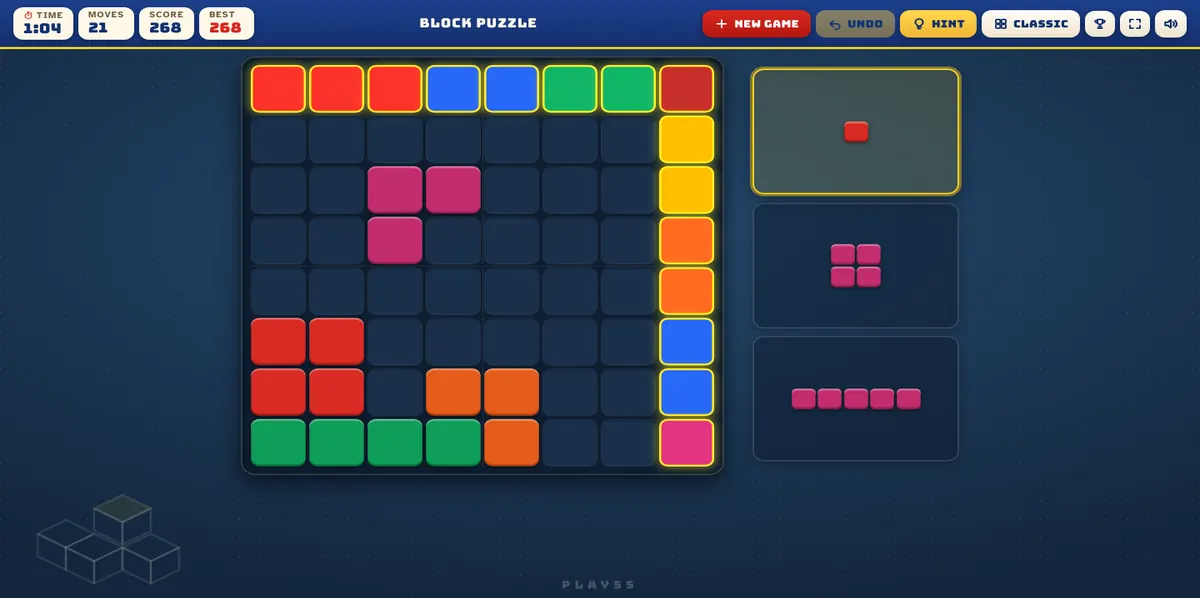
When you drag a piece over a legal spot—or move it with the keyboard—the grid shows a translucent preview. If that drop will complete a row or column, the full line glows gold before you release.
 Zoom in
Clearing rows and columns simultaneously
Whenever a placement fills all eight cells of a row or all eight cells of a column, that line disappears immediately and frees those squares for future pieces. Blocks do not fall down with gravity after a clear; every remaining block stays where you placed it.
A single placement can complete two or more lines at once—such as a row and a column crossing at one corner, or two parallel rows filled by a tall block. All completed lines clear together and award a multi-line combo bonus.
How a game ends
Block Puzzle has no countdown timer and no fixed winning state: you keep playing for the highest possible score. After every placement, the game checks whether at least one piece still in the tray can fit somewhere on the 8×8 grid.
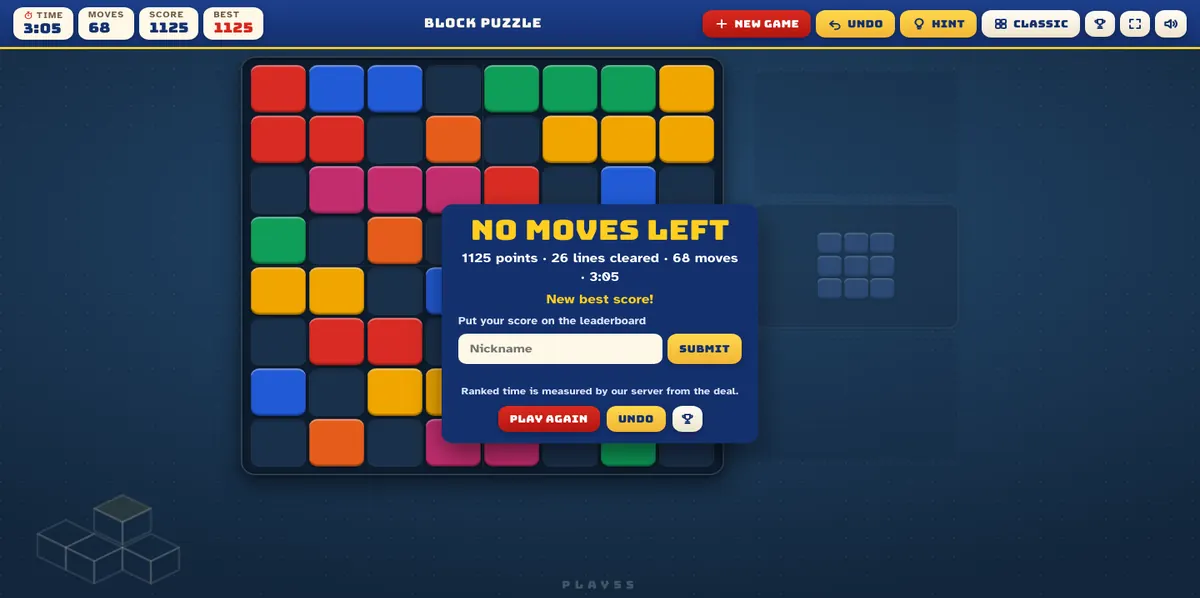
Any piece that currently has no legal spot dims in the tray. When none of the remaining pieces can fit anywhere on the board, the game ends and shows your final score, lines cleared, moves and leaderboard form.
Classic or Relaxed mode?
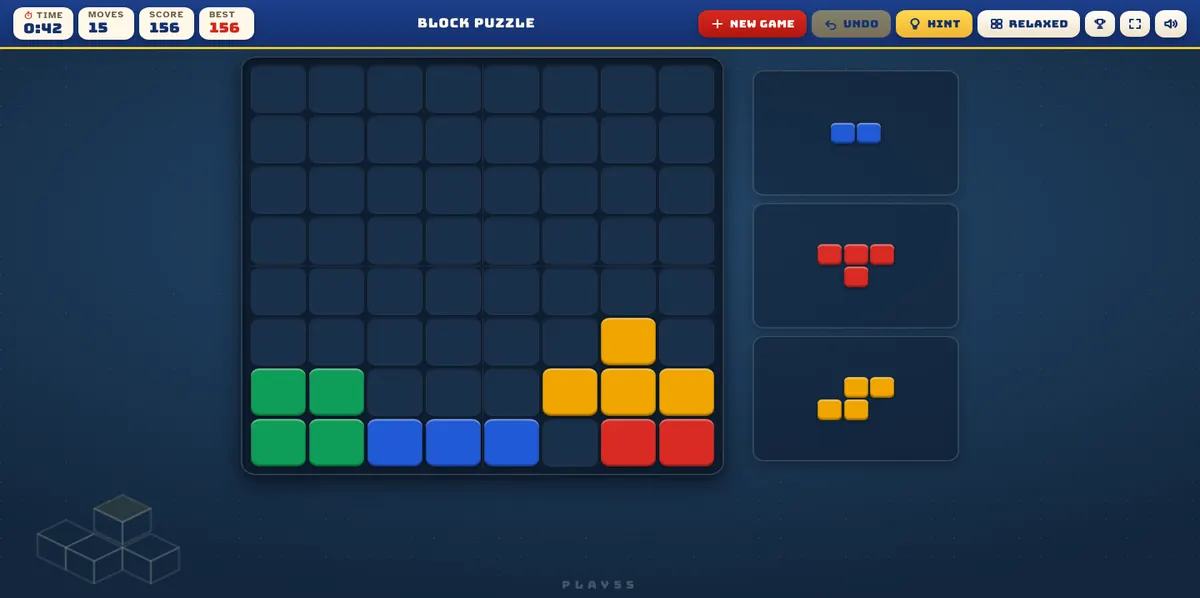
In the Play5s version, Classic uses all 37 fixed polyomino shapes (from single squares to 1×5 bars and 3×3 squares), while Relaxed keeps only the 28 smaller shapes of 1 to 4 squares.
Classic includes 9 small shapes (1×1, two 1×2 dominoes, two 1×3 bars, four 3-cell L-corners), all 19 fixed four-cell tetrominoes (bars, 2×2 square, T, L, J, S and Z orientations), and 9 large shapes (two 1×5 bars, four 5-cell big L-corners, two 2×3 rectangles and the 3×3 square). To avoid unfair instant-loss deals, each three-piece tray in Classic contains at most one large shape of 5 to 9 squares, and no tray repeats three identical shapes.
Relaxed removes the nine large shapes so every piece fits in tighter pockets, making it easier to learn line-clear setups or play longer high-score runs. Switch modes with the mode button in the top bar; your personal best and all-time leaderboard are tracked separately for Classic and Relaxed.
 Zoom in
How scoring, combos and streaks work
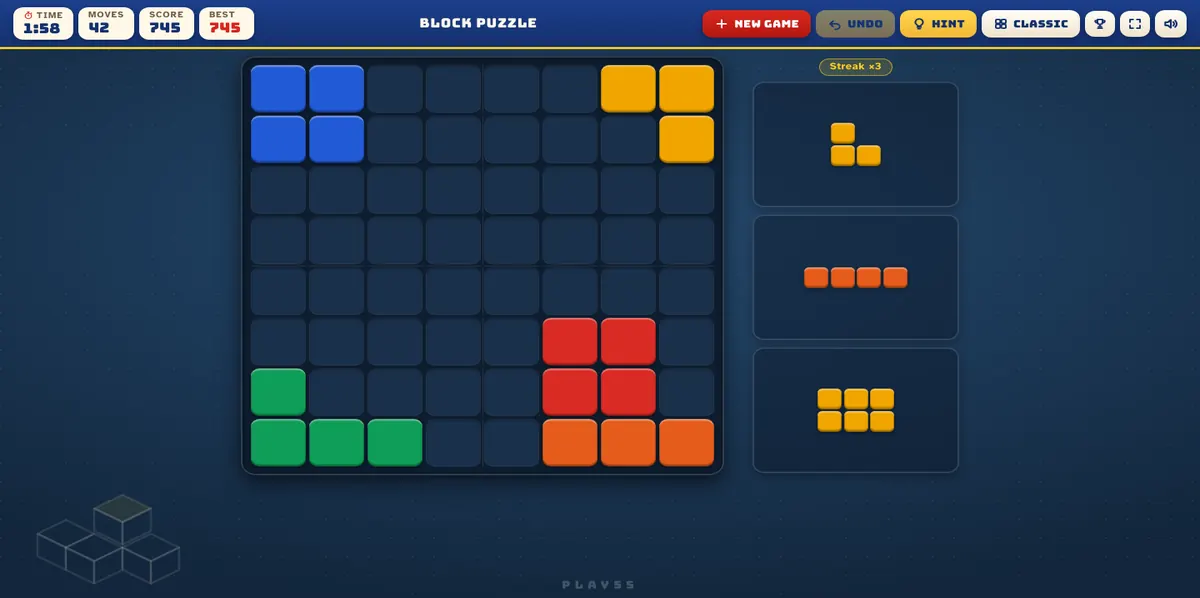
In Play5s Block Puzzle, you earn 1 point per placed square, escalating triangular bonuses for multi-line clears, +10 per step for consecutive clear streaks, and +100 for clearing the entire board.
Every placement scores 1 point for each cell in the piece (for example, +4 for a 2×2 square and +9 for a 3×3 square). Clearing lines adds a triangular line bonus of 10 × k × (k + 1) / 2, where k is the number of rows and columns cleared by that single placement: 1 line scores +10, 2 lines score +30, 3 lines score +60, 4 lines score +100, 5 lines score +150, and 6 lines score +210.
Clearing at least one line on back-to-back placements builds a Streak. Your first clear starts a streak of 1; a second consecutive clear adds +10 bonus points (Streak ×2), a third adds +20 (Streak ×3), a fourth adds +30, and so on until a placement clears zero lines and resets the streak to 0. If a line clear leaves all 64 squares empty, you also receive an All Clear bonus of +100 points.
Undoing a move within the current three-piece tray returns the score to what it was before that placement and deducts 5 points (the score never goes below 0). Time does not change your score; on the leaderboards, faster server time only breaks exact score ties.
 Zoom in
Daily Block Puzzle and leaderboards
The Daily Block Puzzle gives every player the exact same seeded sequence of Classic three-piece trays each day, ranked by final score.
Because each tray in Play5s is generated purely from the day’s seed and round number—not adjusted to your board—every player on the Daily Block Puzzle faces the same pieces in the same order. The Daily Block Puzzle resets at midnight New York time, and each connection gets one ranked Daily result per day; playing it again that day is practice.
There is also an all-time leaderboard for Classic and an all-time leaderboard for Relaxed. Any finished game (when no moves remain) can be submitted with a nickname of 2 to 12 letters or numbers, with no account required; offensive nicknames are refused. Higher scores rank first, with faster time breaking ties, followed by whoever posted first.
Starting a ranked game or the Daily Block Puzzle asks our server for a seed and a signed ticket, so the Daily Block Puzzle requires an internet connection. Ranked time is measured by our server from the moment the puzzle starts, and the server replays your entire move log—including any Undos—to verify every placement and compute the final score before posting it.
 Zoom in
Tips to score higher in Block Puzzle
The most reliable habit in 8×8 Block Puzzle is to protect at least one open 3×3 pocket and plan all three tray pieces together before placing the first one.
- Look at all three pieces in the tray before making a move. Because you can place them in any order, placing a small piece first to clear a line often opens the exact space needed for a 1×5 bar or 3×3 square.
- Keep the center of the 8×8 grid open and build outward toward the edges and corners. Cluttering the middle splits the board into narrow strips where 2×3 rectangles and 3×3 squares cannot fit.
- Avoid creating isolated single-square holes. Only 1 of the 37 shapes in Classic is a 1×1 single block, so scattered 1-cell gaps stay blocked for many rounds.
- Set up intersecting row-and-column clears instead of clearing one line at a time: a 2-line clear scores 30 points (three times a 1-line clear) and a 3-line clear scores 60 points.
- Maintain a clear streak when the board is comfortable: clearing one line on each of three turns in a row earns +10 on turn 2 and +20 on turn 3, adding steady points without over-risking space.
- Watch out for common mistakes that end runs early: ignoring a 5-cell straight bar until the last slot, or placing a piece that leaves a 2-wide channel when you still need room for a 3×3 block.
Controls: drag, tap or keyboard
Drag any block from the tray directly onto the 8×8 grid, tap a block then tap where it should land, or play the whole game from a keyboard.
On a phone or tablet, dragging a piece lifts it slightly above your fingertip so your thumb never hides the shape or the target squares. You can also tap a piece in the tray to select it and then tap the grid to place it.
Undo takes back your last placement inside the current three-piece tray, counts as a move and costs 5 points. Once you place the third piece and a new set of three pieces appears, Undo locks at that boundary so no player can peek at upcoming pieces and step back. Hint highlights both a piece in the tray and a high-value placement on the 8×8 grid.
Keyboard shortcuts
Press 1, 2 or 3 (or Tab to a piece and press Enter) to pick up a block from the tray. Use the arrow keys to move the ghost preview across the 8×8 grid, press Enter or Space to place it, or Escape to put it back.
- 1, 2 or 3: pick up piece 1, 2 or 3 from the tray
- Arrow keys: move the selected piece across the 8×8 grid
- Enter or Space: place the selected piece
- Escape: cancel selection (or close overlays / exit full screen)
- U or Ctrl+Z: undo within the current three-piece tray (-5 points)
- H: show a suggested placement
- N: start a new game
- F: full screen on or off
- M: sound effects on or off
Block Puzzle terms
Block Puzzle borrows its shape names from recreational mathematics and its scoring terms from classic line-clearing games.
- Polyomino: a flat shape formed by joining equal squares edge to edge—including monominoes (1 square), dominoes (2), trominoes (3), tetrominoes (4) and pentominoes (5).
- Tray: the set of three pieces dealt together; all three must be placed before the next set arrives.
- Line clear: filling all eight squares of any horizontal row or vertical column so that line disappears.
- Combo: clearing two or more rows and/or columns with a single placement for a triangular point bonus.
- Streak: clearing at least one line on consecutive placements without an intervening non-clearing move.
- All Clear: emptying every square on the 8×8 grid with a line clear (+100 bonus points).
History of Block Puzzle
Modern 8×8 Block Puzzle combines 20th-century polyomino packing puzzles with the line-clearing loop popularized on mobile in 2014.
The mathematical shapes behind the game were named in 1953 by American mathematician Solomon W. Golomb, popularized to a wide audience by Martin Gardner’s November 1960 Mathematical Games column in Scientific American, and collected in Golomb’s 1965 book Polyominoes (see Polyomino (opens in a new tab) and Tetromino (opens in a new tab) on Wikipedia).
In 1984, Alexey Pajitnov adapted four-square tetrominoes into falling-block line clearing with Tetris (opens in a new tab). Thirty years later, in August 2014, Gram Games popularized the turn-based, gravity-free format with 1010!, dealing three unrotatable polyominoes onto a 10×10 grid and clearing full rows and columns in both directions (see Fabien Coelho’s mathematical analysis of 1010! (opens in a new tab)). The smaller 8×8 grid variant became a staple casual puzzle format for quick browser and mobile sessions.
Block Puzzle questions
Can you rotate blocks in Block Puzzle?
No. In standard Block Puzzle rules, shapes cannot be rotated or flipped. Planning around the fixed orientations—especially long 1×5 bars and asymmetric L or Z shapes—is the core spatial challenge.
Do block colors matter when clearing a line?
No. Colors only make individual shapes easier to tell apart on the grid. Any full row or column of eight filled squares clears regardless of color.
Is Block Puzzle the same as Tetris?
No. Both use polyomino shapes and clear full lines, but Block Puzzle has no falling pieces, no gravity, no timer and no rotation, and it clears both horizontal rows and vertical columns on an 8×8 grid.
Why can I not undo after placing the third block?
Placing the third block in your tray deals three new pieces. Locking Undo at a new tray prevents peeking at upcoming shapes and stepping back, keeping both Classic and Daily Block Puzzle leaderboards consistent.
Does every player get the same pieces in the Daily Block Puzzle?
Yes. Each Daily Block Puzzle uses a fixed server-issued seed for Classic mode, and every tray of three pieces is generated purely from that seed and round number, so everyone gets the exact same piece sequence.
What is the highest single-move bonus possible?
Clearing multiple lines at once awards 10 × k × (k + 1) / 2 points (up to +210 for a 6-line clear), plus any active Streak bonus (+10 per consecutive clear after the first) and +100 if the clear empties all 64 squares.
About this version
Play5s Block Puzzle is a self-built HTML5 8×8 polyomino puzzle that runs right in your browser with no download and no sign-up. It follows standard unrotatable three-piece tray rules with two modes (Classic with 37 shapes and Relaxed with 28 smaller 1–4 cell shapes), a seeded Daily Block Puzzle, and server-verified leaderboards.
Starting a ranked game asks our server for a seed and a signed ticket; your move log and nickname are sent only when you submit a finished score. Your current board, personal bests, sound toggle and theme choice stay saved locally in your browser.
Read more about Play5s, or see all of our free puzzle games.