

On this page
How to play Mahjong Solitaire
To win Mahjong Solitaire, remove all 144 tiles from the board in 72 matching pairs, choosing only tiles that are free to slide out.
What makes a tile free
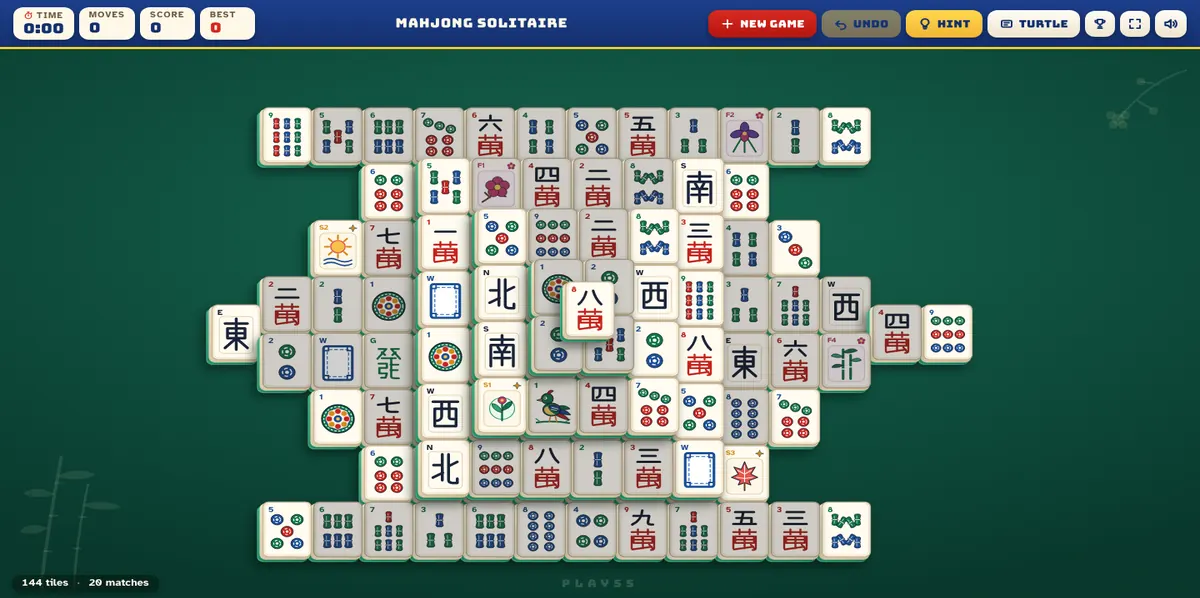
A tile is free (or open) when it meets two conditions at the same time: no other tile sits on top of it—even partially—and at least one of its long vertical sides (left or right) is completely open on the same layer.
Tiles sitting directly above or below a tile on the same layer do not block it. On Play5s, blocked tiles appear slightly dimmed so you can spot open tiles at a glance while still reading every symbol underneath to plan ahead.
 Zoom in
The 144-tile set and matching rules
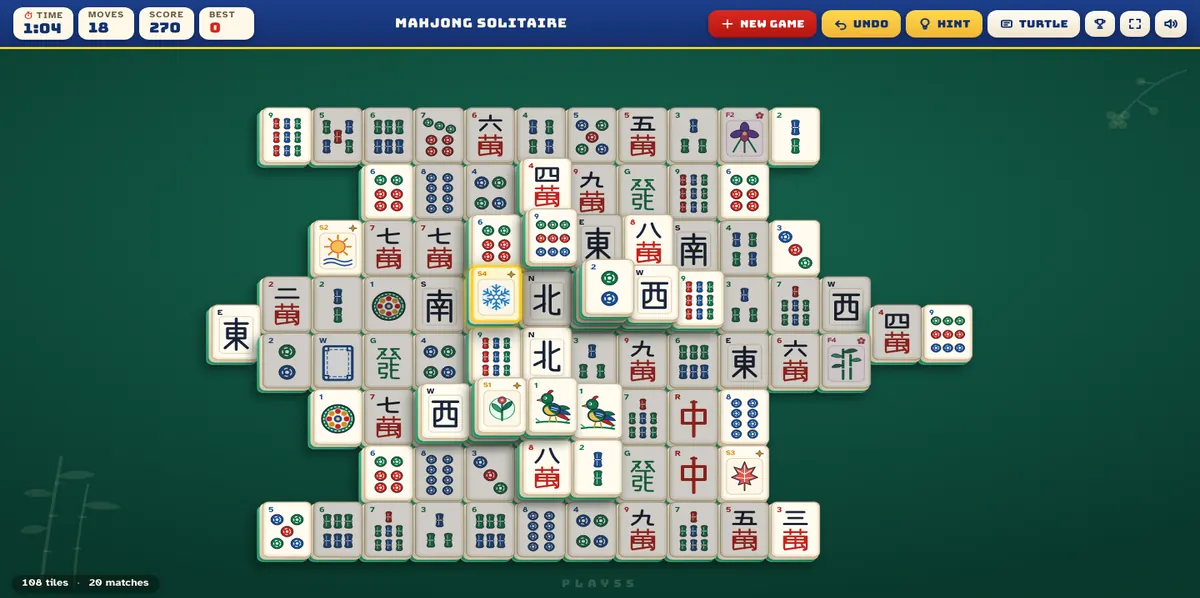
Mahjong Solitaire borrows the traditional 144-tile Chinese mahjong set, whose 42 different tile faces are listed in the Unicode Mahjong Tiles block. Most tiles come in four identical copies and must be paired with an exact match: Dots (Circles) 1–9 (36 tiles), Bamboo 1–9 (36 tiles, with 1 Bamboo drawn as a bird), Characters 1–9 (36 tiles), Four Winds—East, South, West and North (16 tiles)—and Three Dragons—Red, Green and White (12 tiles).
The final eight bonus tiles are unique singletons with one special rule: any of the four Flowers (Plum, Orchid, Chrysanthemum, Bamboo) matches any other Flower, and any of the four Seasons (Spring, Summer, Autumn, Winter) matches any other Season. Flowers never match Seasons. Every Play5s tile includes a crisp corner index (1–9, E/S/W/N, R/G/W, F1–F4, S1–S4) alongside its traditional art.
 Zoom in
Solitaire vs. four-player Mahjong
Mahjong Solitaire uses the same physical tiles as traditional four-player Chinese or Japanese Mahjong, but the rules are completely different. Four-player Mahjong is a draw-and-discard rummy-style table game of building sets and hands against opponents; Mahjong Solitaire (also called Shanghai) is a one-player spatial matching puzzle with no drawing, discarding or hand-building.
Five solvable layouts: Turtle, Pyramid, Arena, Bridge and Tower
Play5s includes five 144-tile layouts, and every deal is generated in reverse by removing legal pairs so every fresh board has at least one guaranteed solution.
Because a random deal of 144 tiles can easily trap matching pairs underneath one another—an analysis of ten million Turtle deals found that about 3 percent cannot be solved even when looking below tiles is allowed, according to Wikipedia—Play5s builds each board backward from a full layout, peeling off valid free pairs until the board is empty and assigning shuffled pairs along that exact path. You can still walk into a dead end through your own move order, which is where strategy, Undo and Shuffle matter.
 Zoom in
Tower: the layout built for phones
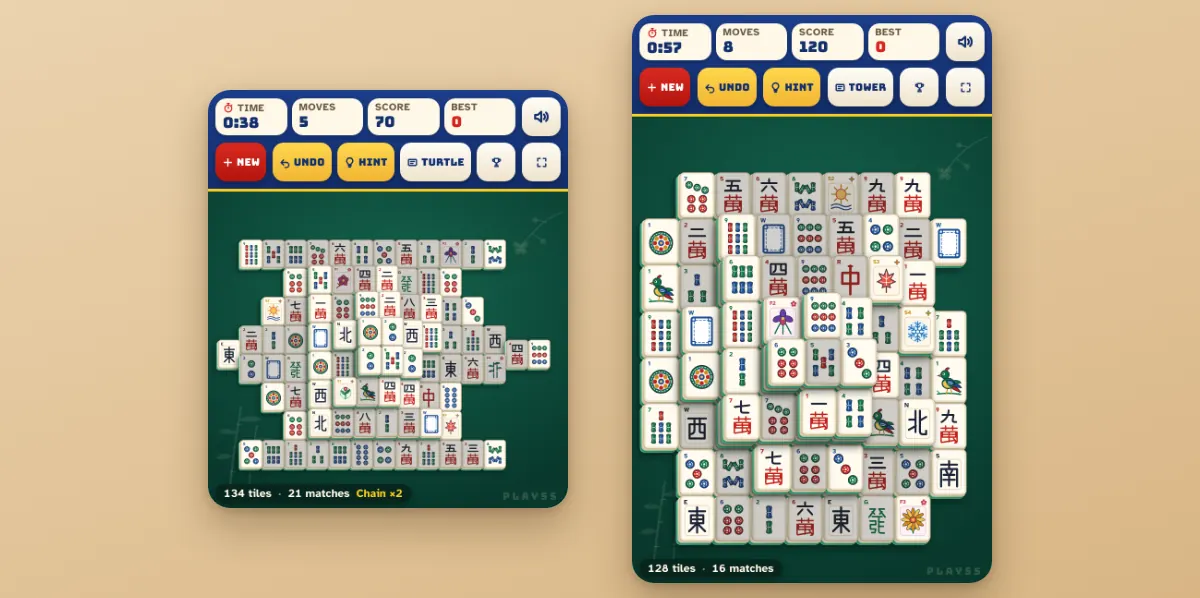
Turtle is 15 tiles wide, which shrinks its tiles to about 24 px on a 390 px phone. Tower is only nine tiles wide, so the same screen shows tiles about 39 px wide—large enough to tap and to read the corner indexes. Play5s starts on Tower when you hold the phone upright, and the layout button switches back to Turtle at any time.
 Zoom in
- Turtle (classic default & Daily Mahjong): The classic default layout, a five-layer stack—87 tiles on the base, 36 on layer 2, 16 on layer 3, 4 on layer 4, and 1 capstone tile on top, flanked by the single left wing and double right tail.
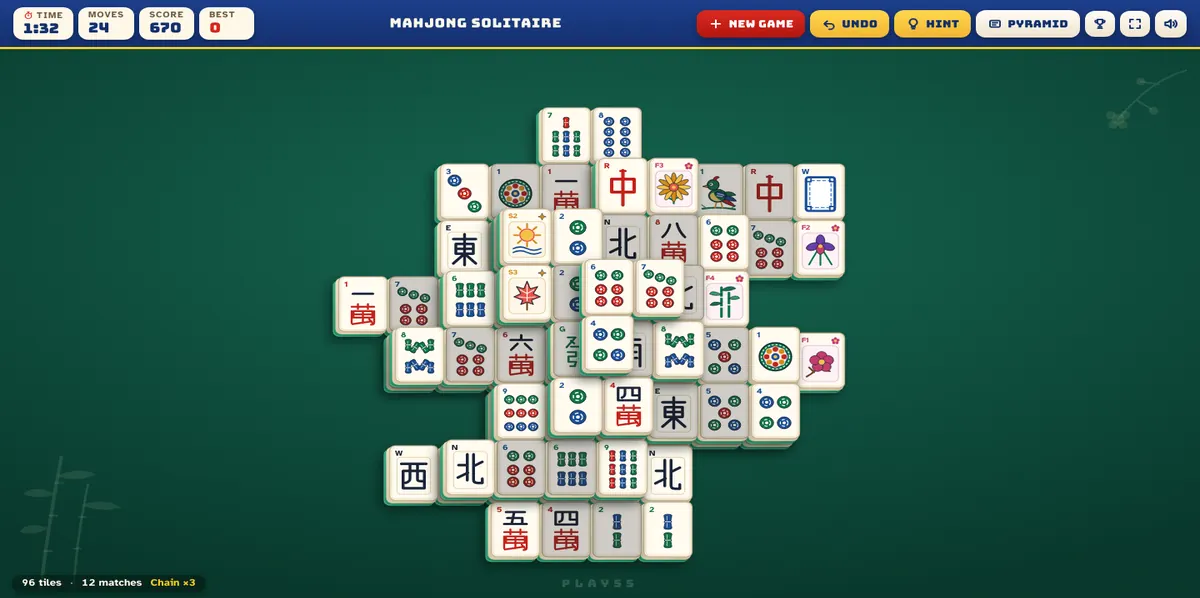
- Pyramid: A symmetrical five-layer stepped pyramid rising to a two-tile peak, rewarding steady top-down dismantling.
- Arena: Four tall tiered walls surrounding an open central courtyard, creating tight outer locks and fast inner reveals.
- Bridge: A wider three-layer arch with more open pairs early on, suited to quick rounds and beginners.
- Tower (default on phones held upright): A tall octagonal stack only nine tiles wide—68 tiles on the base, then 38, 20, 12 and 6 above—so tiles stay large enough to tap on a narrow screen. The Daily Mahjong is always a Turtle board.
How scoring and Suit Chains work
Each cleared pair scores 10 points for suit tiles, 20 for Winds, 30 for Dragons and 40 for Flowers or Seasons, plus up to +50 extra points per pair for matching the same group in a row.
Play5s adds a Suit Chain bonus so careful move order earns a higher score than clearing pairs at random. When you clear two pairs from the same family in a row (Dots, Bamboo, Characters, Winds, Dragons, Flowers or Seasons), the second pair earns +10 bonus points, the third earns +20, and so on up to +50 per pair. Switching to another family resets the chain to zero.
Using Undo restores the previous pair, returns the points that move earned, resets any active chain, counts as a move and adds a 15-point penalty. Using Shuffle when no legal pairs remain rearranges the remaining tiles into a solvable order on their current spots, counts as a move, resets the chain and adds a 50-point penalty. The displayed score never drops below zero, and time does not change your score—it only breaks ties on the leaderboards.
Daily Mahjong and leaderboards
The Daily Mahjong is one shared Turtle board for every player on that date, verified to be solvable and reset at midnight New York time.
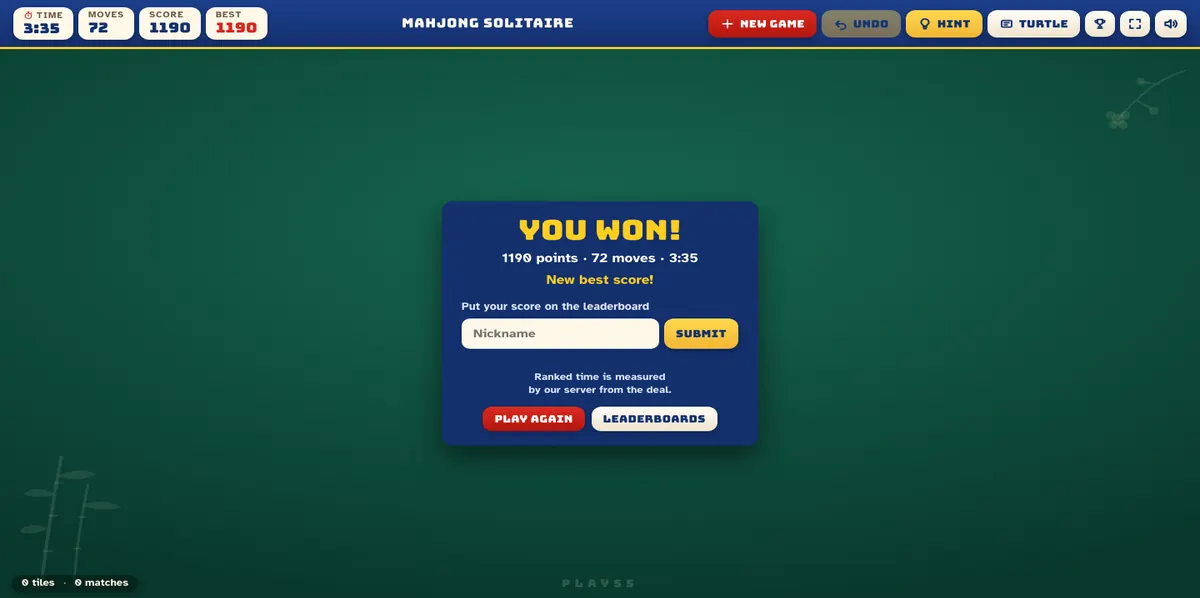
Every layout—Turtle, Pyramid, Arena, Bridge and Tower—has its own all-time leaderboard alongside the Daily Mahjong board. Players are ranked by score (higher is better), with ties broken by fewer seconds and then by who submitted first. Only completed wins of all 144 tiles can be submitted.
Starting a ranked game or the Daily Mahjong requests a seed and signed ticket from our server, so the Daily Mahjong requires an internet connection. Each connection gets one ranked Daily Mahjong entry per day; extra replays on the same day run as practice. When you submit a score with a 2–12 character nickname (no account required, offensive names are refused), our server replays your move log—including any Undos or Shuffles—through the same game rules, checks every move, computes the score itself and measures your ranked time from the moment the deal was issued.
 Zoom in
Strategy tips to win more Mahjong games
The strongest habit in Mahjong Solitaire is to clear tiles that unlock the most blocked neighbours—especially top layers and long horizontal rows—before grabbing easy isolated pairs.
- Peel from the top down and the outside in: removing high-layer tiles and row ends exposes the widest number of new options.
- Clear all four copies of a tile when all four are open—there is zero risk of stranding a match, and doing two pairs back to back starts a Suit Chain.
- Be cautious when three identical tiles are visible: check which two free more locked tiles beneath or beside them before pairing.
- Target the long middle rows and the left/right tails in the Turtle layout early, because those rows hold the tightest horizontal locks.
- Avoid removing a pair that frees nothing at all unless you need it to extend a high-value Suit Chain or save a deadlock.
- Look one step ahead before matching Flowers or Seasons: any two in the group pair up, so pick the two sitting on top of deep stacks.
Controls, Shuffle, Hint and keyboard shortcuts
Tap or click two matching free tiles to remove them, or play entirely from the keyboard on desktop.
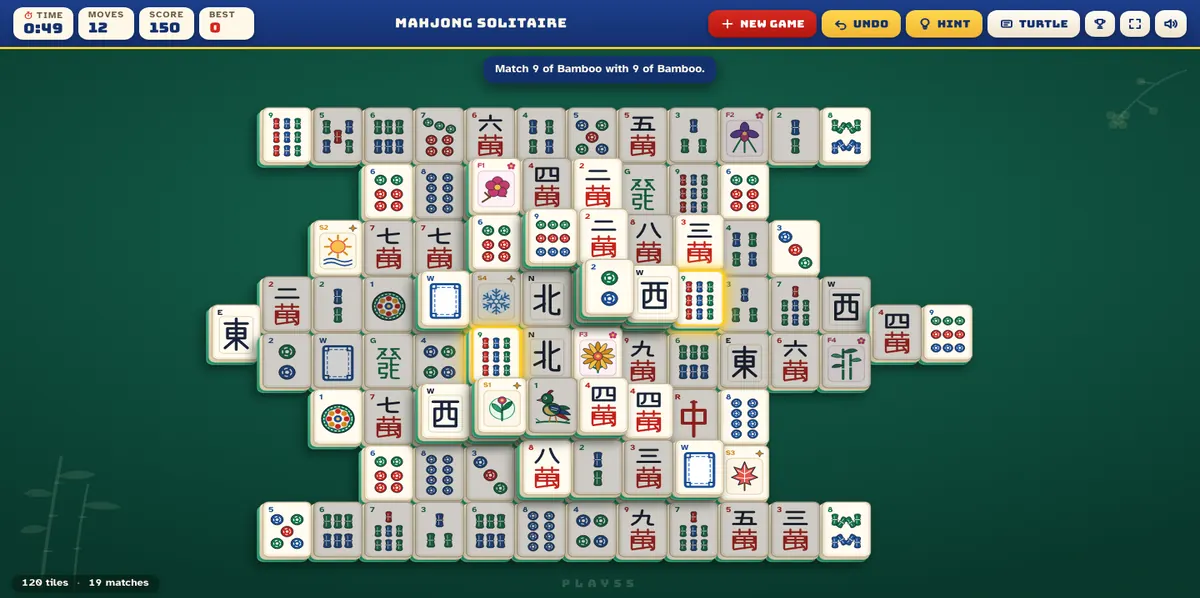
Tapping a free tile lifts it with a yellow border; tap it again (or press Escape) to deselect, or tap a matching free tile to clear the pair. If you tap a different free tile, the selection moves straight to it. Tapping a blocked tile shakes it gently and reminds you to uncover it or free one side first.
 Zoom in
Toolbar buttons
Undo steps back one pair at a time (including after a page reload), counts as a move, costs 15 points and cannot cross a Shuffle because shuffling rearranges tiles. Hint highlights a high-value legal pair in yellow without charging points. Shuffle appears whenever zero legal pairs remain on the board, rearranging the remaining tiles into a solvable pattern for 50 points (if the remaining geometry is vertically stacked into an unsolvable column, the game asks you to Undo or start fresh). Mode cycles through Turtle, Pyramid, Arena, Bridge and Tower. The gear (Settings) button opens the switches for Play5s’s synthesised ivory-tile sound effects (on by default) and an optional background music loop (off by default), and the M key mutes the sound effects.
Keyboard shortcuts
Press Tab to enter the board, Arrow keys to move focus across free tiles, Enter or Space to select or match the focused tile, and Escape to clear a selection or exit full screen.
- U or Ctrl+Z: undo last match
- H: highlight a hint pair
- S: shuffle remaining tiles when no matches are left
- N: start a new game
- F: toggle full screen
- M: mute or unmute sound effects
Mahjong Solitaire glossary
Knowing the six traditional tile groups and a few board terms makes scanning a 144-tile stack much faster.
- Free (open) tile: a tile with nothing on top of it and at least its left or right side clear.
- Suits (Dots, Bamboo, Characters): the three numbered families from 1 to 9, four copies of each (108 tiles total).
- Honors (Winds and Dragons): the 28 non-numbered tiles—East, South, West, North and Red, Green, White Dragons.
- Bonus tiles (Flowers and Seasons): eight unique tiles where any two Flowers pair and any two Seasons pair.
- Capstone: the single highest tile on layer 5 of the Turtle layout, resting across all four layer-4 tiles beneath it.
- Deadlock: a board state with tiles remaining but zero legal free pairs left, resolved with Undo or Shuffle.
Where Mahjong Solitaire comes from
Mahjong Solitaire was created in 1981 by Brodie Lockard on the PLATO computer system and reached home computers in **1986 as Activision’s *Shanghai***.
Lockard originally created the game under the name *Mah-Jongg* on the PLATO system, where it was played on a CDC-721 touch-screen terminal and released for free (see Mahjong solitaire on Wikipedia). Five years later, Activision released *Shanghai* for the IBM Personal Computer, Commodore Amiga, Macintosh, Atari ST and Apple IIGS, and marketed it as based on a centuries-old Chinese game called “the Turtle”—a claim Lockard never made himself. The Macintosh version was implemented by Lockard.
Shanghai sold more than 500,000 copies by 1991, and the game spread under many names: Mahjong solitaire is also known as Shanghai solitaire, the Turtle, Taipei (the 1990 Microsoft Entertainment Pack version) and Kyodai, and Windows Vista and Windows 7 Premium editions shipped it as Mahjong Titans. The name “Shanghai” was trademarked by Activision.
Mahjong questions
How do you play Mahjong Solitaire?
Find two matching free tiles and tap both to remove them from the board. A tile is free when nothing sits on top of it and either its left or right side is open. Clear all 144 tiles (72 pairs) to win.
Is Mahjong Solitaire the same as four-player Mahjong?
No. Both use the standard 144-tile set, but four-player Mahjong is a competitive draw-and-discard table game similar to rummy, whereas Mahjong Solitaire is a single-player puzzle about matching exposed pairs.
Is Mahjong Solitaire the same as Shanghai?
Yes, they are the same kind of game. Mahjong solitaire is also called Shanghai solitaire, after Activision’s 1986 game Shanghai, and goes by other names such as the Turtle, Taipei and Kyodai. The rules are the same: remove pairs of free tiles from a stack of 144.
Why do different Flower tiles or Season tiles match each other?
A standard 144-tile set contains only one copy of each of the four Flowers (Plum, Orchid, Chrysanthemum, Bamboo) and one copy of each of the four Seasons (Spring, Summer, Autumn, Winter). Under standard rules, any two Flowers form a legal pair and any two Seasons form a legal pair, but a Flower never matches a Season.
Is every Mahjong board on Play5s solvable?
Yes. Every deal across Turtle, Pyramid, Arena, Bridge, Tower and the Daily Mahjong is built in reverse by removing valid pairs from the layout, guaranteeing at least one winning line from the starting stack.
What happens when there are no matching pairs left?
A Shuffle button appears in the toolbar whenever zero legal pairs remain. You can tap Shuffle to rearrange the remaining tiles into a solvable pattern (-50 points), use Undo (-15 points) to backtrack to a better branch, or start a new deal.
How does scoring work in Mahjong Solitaire on Play5s?
Suit pairs score 10 points, Winds score 20, Dragons score 30 and Flowers or Seasons score 40. Clearing consecutive pairs from the same tile group adds a Suit Chain bonus of +10, +20, +30, +40 or +50 per pair. Undo costs 15 points and Shuffle costs 50.
What is the Daily Mahjong?
The Daily Mahjong is one shared Turtle layout that every player gets on the same day, checked to be solvable and refreshed at midnight New York time. It needs an internet connection because our server issues the daily game, and each connection gets one ranked result per day.
How do the Mahjong leaderboards work?
After winning any ranked game, enter a 2–12 character nickname and press Submit—no account is needed. Boards rank by score, then by server-measured time from the deal. Our server replays your move log to verify every match, Undo and Shuffle before posting the score.
Can I play Mahjong Solitaire on my phone?
Yes. All five layouts scale to portrait and landscape phone screens, with corner indexes on every tile and a full-screen toggle. When you hold the phone upright, Play5s starts you on Tower, a nine-tile-wide layout whose tiles are about 39 px wide on a 390 px screen, so they are easy to tap.
Does Play5s save my Mahjong game in progress?
Yes. Your board, move history, score and clock are stored in your browser on this device so you can close the tab and continue later. Clearing browser storage removes saved games.
Is Mahjong Solitaire free on Play5s?
Yes. It is 100% free to play in your browser with no download, no sign-up and no ads.
About this version
This Mahjong Solitaire was built by Play5s for modern web browsers. It uses the full 144-tile standard set with custom-drawn SVG tiles, five guaranteed-solvable layouts (Turtle, Pyramid, Arena, Bridge and Tower), deterministic Shuffle on deadlocks, Undo, Hint and the Daily Mahjong.
There is nothing to install and no account to create. Your game in progress is kept locally in your browser. Starting a ranked game asks our server for a deal and a ticket; your moves and nickname are sent only when you submit a score.
Read more about Play5s, or see all of our free puzzle games.