

On this page
How to play Sudoku and official rules
To solve a classic Sudoku puzzle, fill all 81 cells of the 9×9 grid with digits 1 through 9 so that each row, each column and each 3×3 box contains every digit from 1 to 9 exactly once.
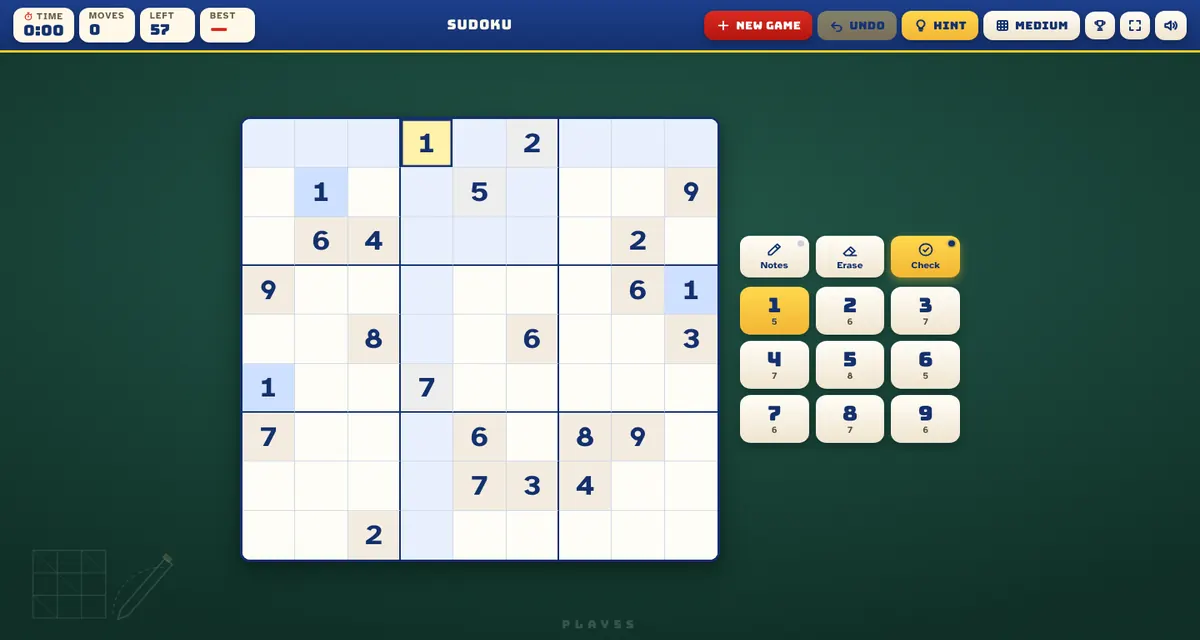
The 9×9 grid and starting clues
Every puzzle begins with a partially filled grid of fixed starting numbers called givens (or clues). Given numbers are shown on a warm ivory background and cannot be edited. Your job is to deduce the remaining empty cells using logic alone—Sudoku requires no addition, multiplication or arithmetic of any kind (Wikipedia, "Sudoku" (opens in a new tab)).
Every puzzle generated on Play5s is verified by our solver to have exactly one unique solution. Because there is only one valid finished board, you never need to guess blindly on Easy through Expert puzzles: every placement follows from the clues on the board.
 Zoom in
Using pencil marks (notes) and highlighting
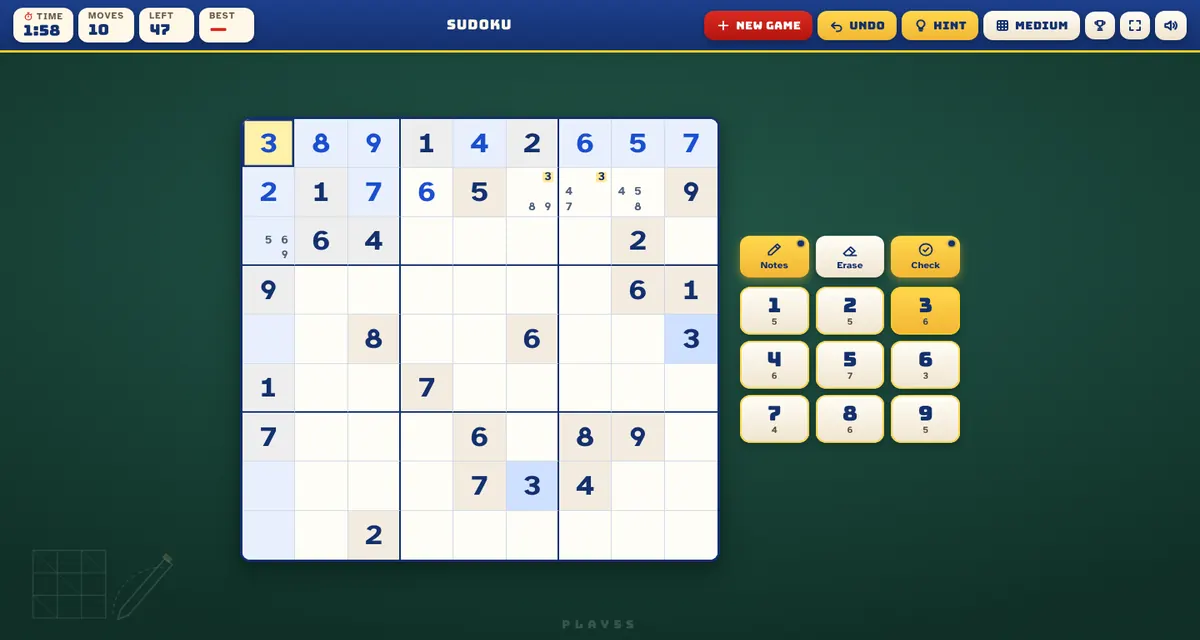
As puzzles get harder, tracking every possible digit in your head gets error-prone. Switch on Notes (or press P, or hold Shift while pressing a digit) to place small candidate digits inside an empty cell. When you select a filled number on the board, every matching digit—and every matching pencil mark—lights up across the grid so you can spot patterns at a glance.
Whenever you commit a digit to a cell, Play5s automatically removes that digit from the pencil marks of every cell in the same row, column and 3×3 box. If you press Undo, those cleared pencil marks are restored along with the cell.
 Zoom in
Duplicate highlighting and optional mistake checking
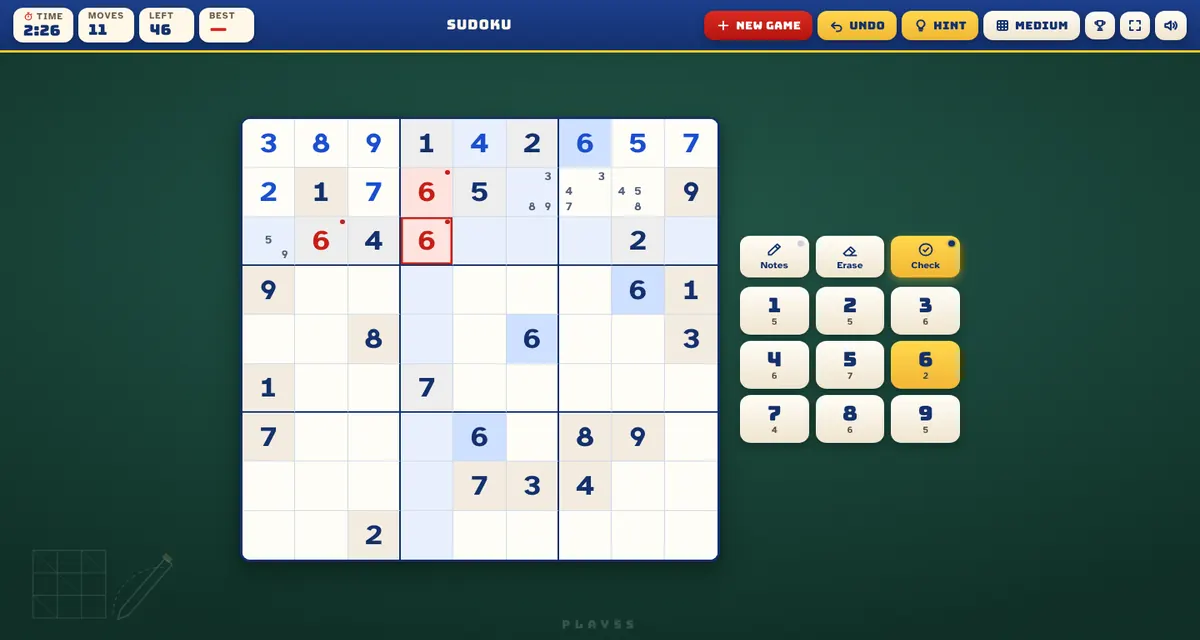
Two identical digits in the same row, column or 3×3 box always break the rules of Sudoku, so direct duplicates are highlighted in red with a corner marker dot even when automatic checking is off. The corner dot ensures conflicts stay clear without relying on color alone.
With the Check toggle turned on (default), entering a digit that disagrees with the puzzle’s unique solution is also flagged right away. Turn Check off (or press E) if you prefer traditional paper-style play where only visible rule clashes are marked.
 Zoom in
Sudoku difficulty levels: Easy, Medium, Hard, Expert and Evil
On Play5s, difficulty is graded by the hardest human solving technique required to finish the puzzle, not simply by counting how many clues are given.
A common misconception is that fewer starting numbers automatically make a harder Sudoku. In reality, a 28-clue puzzle can be solved with basic scanning while a 30-clue puzzle can demand an X-Wing. Following the human-technique taxonomy used by open analyzers such as HoDoKu (opens in a new tab), our generator runs a step-by-step logical solver on every generated board and assigns it to one of five strict tiers:
- Easy (typically 36–43 givens): solvable completely with Full House, Hidden Singles and Naked Singles—ideal for learning the rules or playing a relaxed warm-up.
- Medium (the default level, also used for the Daily Sudoku): introduces Locked Candidates (Pointing Pairs/Triples and Box-Line Reduction) alongside singles.
- Hard: requires spotting Naked Pairs or Hidden Pairs to eliminate candidates and unlock the next placements.
- Expert: demands advanced human logic—Naked or Hidden Triples, X-Wing, XY-Wing or Swordfish—while remaining 100% logically solvable without guessing.
- Evil: puzzles where every standard single, subset, fish and wing technique stalls, requiring forcing chains or deep multi-step bifurcation.
Sudoku solving techniques and tips
Start every board by scanning for Hidden Singles and Naked Singles, then switch to pencil marks only when simple scanning stops yielding new placements.
Core beginner techniques (Easy & Medium)
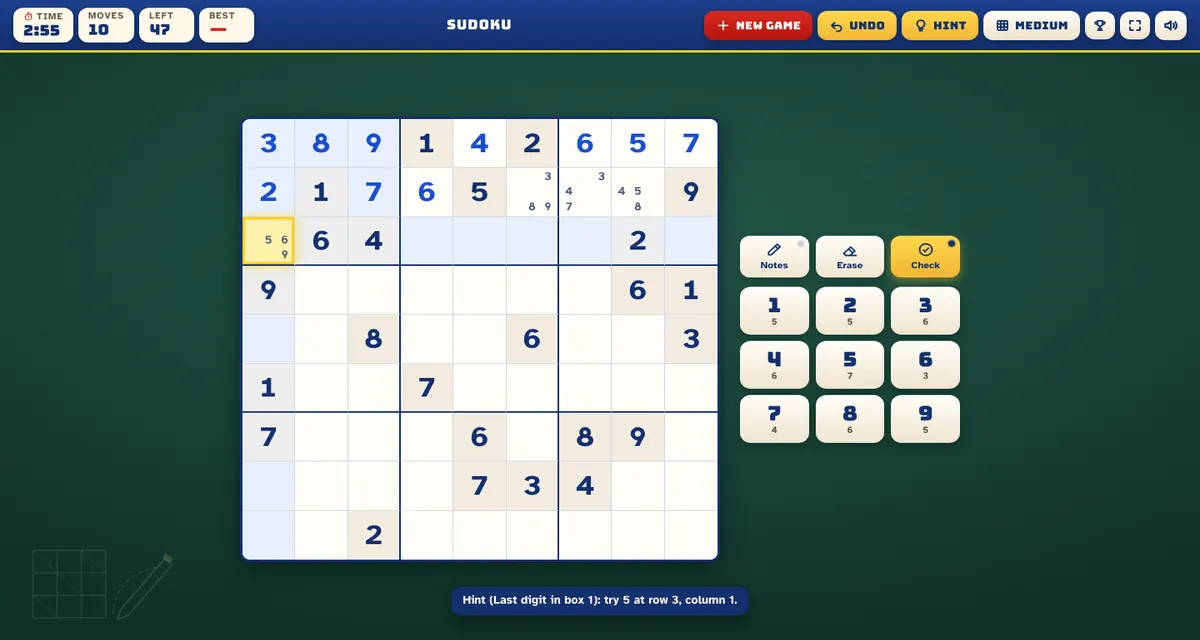
A Full House occurs when eight cells of a row, column or 3×3 box are already filled, leaving only one possible digit for the ninth cell. A Hidden Single happens when a digit can legally fit in only one cell of a row, column or box even if that cell could otherwise take other numbers. A Naked Single is a cell whose row, column and box already contain eight other digits, leaving only one candidate.
Once singles run dry, look for Locked Candidates. In a Pointing Pair or Triple, every candidate for a digit inside a 3×3 box lies along a single row or column, which lets you erase that digit from the rest of that line outside the box. Box-Line Reduction (Claiming) works in reverse: if a digit in a row or column can only appear inside one 3×3 box, it can be removed from the other cells of that box.
 Zoom in
Intermediate and advanced strategies (Hard, Expert & Evil)
A Naked Pair occurs when two cells in the same house (row, column or box) contain only the same two candidates, such as `{3, 8}`. Because 3 and 8 must occupy those two cells, you can eliminate 3 and 8 from every other cell in that house. A Hidden Pair is the mirror image: two digits appear as candidates in only two cells of a house, so any other candidates in those two cells can be cleared.
At Expert level, look for an X-Wing: a digit appears as a candidate in the exact same two columns across two rows (forming a rectangle). Since the digit must occupy opposite corners of that rectangle, you can eliminate it from all other cells in those two columns. An XY-Wing links a two-candidate pivot cell `{X, Y}` to two peers `{X, Z}` and `{Y, Z}`, eliminating `Z` from any cell that sees both pincers.
- Scan digits 1 through 9 in order at the start of a game; tap a number on the grid to highlight all its copies at once.
- Keep pencil marks tidy—fill candidates in a box or row only once basic scanning slows down.
- Watch the remaining-count badges under keypad digits 1–9: digits with only 1 or 2 copies left are quick wins.
- Use Hint (H) as a learning tool: it names the exact human technique and unit so you can spot the same pattern next time.
- On Expert and Evil boards, look for cells with only two candidates (bivalue cells)—they are the building blocks of Naked Pairs and XY-Wings.
Daily Sudoku and fastest-time leaderboards
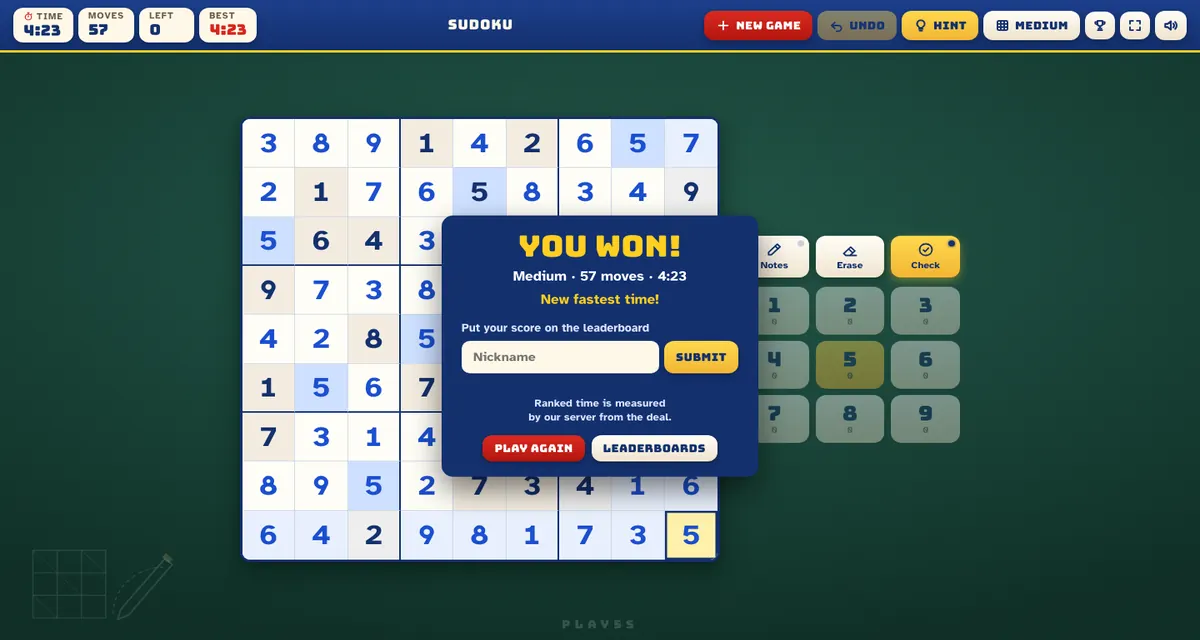
The Daily Sudoku is one shared Medium puzzle that every player gets on the same day, verified to have a unique solution and ranked by fastest solve time.
A new Daily Sudoku starts at midnight New York time (`America/New_York`). Because everyone solves the exact same grid, the Daily leaderboard compares solvers head-to-head. Our server hands out each day’s Daily seed, so starting a Daily Sudoku requires an internet connection, and each connection gets one ranked Daily result per day—after that you can replay the day’s puzzle as practice.
There is also an all-time leaderboard for every difficulty level (Easy, Medium, Hard, Expert and Evil). Only completed, valid wins can be posted. Players are ranked by fastest solve time (lower is better), with ties broken by who submitted first. Time is measured by our server from the moment the puzzle ticket is issued, and our server replays your move log with the same Sudoku engine to confirm every placement, clear and Undo is legal before recording your result. Pick any nickname of 2 to 12 characters—no account is required, and offensive nicknames are refused.
 Zoom in
Sudoku controls, notes and keyboard shortcuts
Tap or click any cell and enter a digit from the on-screen keypad, or play the entire grid from the keyboard without touching the mouse.
Buttons and HUD
The top bar shows your Time, Moves, empty cells Left and fastest Best time for the current difficulty. New game starts a fresh puzzle (and asks for confirmation if you have moves in progress). Undo reverses your last placement or erase—including restoring auto-cleared pencil marks—and adds 1 to Moves so the move count never goes down. Hint checks for mistakes first, then highlights a cell and names the logical technique. The difficulty button opens a quick picker for Easy, Medium, Hard, Expert, Evil and Daily. The trophy opens the leaderboards, the expand icon toggles full screen, and the gear (Settings) opens the sound effects, the optional background music and the language of the game’s own words.
Next to (or below, on phones) the 9×9 grid sit three tools—Notes, Erase and Check—above the 1–9 keypad. Each number key displays how many instances of that digit still need to be placed.
- Arrow keys: move selection around the 9×9 grid
- 1–9: enter a digit (or toggle a note when Notes mode is on)
- Shift + 1–9: toggle a pencil note directly without switching modes
- Backspace, Delete or 0: erase the selected cell (or clear its notes)
- P: toggle Notes (pencil marks) mode
- E: toggle automatic mistake check on or off
- U or Ctrl+Z: undo last move
- H: show a logical hint with technique name
- N: start a new puzzle
- F: full screen on or off · M: sound effects on or off · Esc: close menu or exit full screen
Sudoku terms
Standard Sudoku guides share a small set of names for the parts of the grid and common candidate patterns.
- Cell: one of the 81 squares in the 9×9 grid.
- Box (or block / region): one of the nine 3×3 sub-grids outlined by thicker borders.
- House (or unit): any complete group of nine cells—a row, a column or a 3×3 box.
- Peers: the 20 cells that share a row, column or 3×3 box with a given cell.
- Given (or clue): a fixed starting digit provided when the puzzle begins.
- Candidate (or pencil mark): a small note marking a digit that could still legally go in an empty cell.
- Single: a forced placement, either because a cell has only one candidate (Naked Single) or a digit has only one spot in a house (Hidden Single).
History and mathematics of Sudoku
Modern 9×9 Sudoku was invented in 1979 by American retired architect Howard Garns under the name *Number Place*, then named Sudoku in Japan in 1984.
A finished Sudoku grid is a special kind of Latin square (a structure Leonhard Euler studied, see Latin square (opens in a new tab)) with the nine 3×3 box constraints added on top (Wikipedia, "Sudoku" (opens in a new tab)). Dell Magazines first published Howard Garns’s 9×9 box-constrained puzzle in 1979 as *Number Place*. Five years later, Japanese puzzle publisher Nikoli, led by Maki Kaji, introduced it in *Monthly Nikolist* under the name *Sūji wa dokushin ni kagiru* ("the digits must remain single"), shortened to Sudoku.
Wayne Gould, a retired Hong Kong judge born in New Zealand, spent six years writing a computer program that could mass-produce puzzles, and brought Sudoku to *The Times* in London, which launched it on November 12, 2004 and sparked a global newspaper boom. Competitive play followed quickly: the first World Sudoku Championship was held in Lucca, Italy in 2006, and the World Puzzle Federation (opens in a new tab) has organised it since.
Mathematicians have also answered two landmark questions about standard 9×9 Sudoku (Wikipedia, "Mathematics of Sudoku" (opens in a new tab)). In 2005, Bertram Felgenhauer and Frazer Jarvis proved there are exactly 6,670,903,752,021,072,936,960 valid completed 9×9 grids (5,472,730,538 essentially different grids after symmetry). In 2012 (published 2014), Gary McGuire, Bastian Tugemann and Gilles Civario proved through an exhaustive computer search (arXiv:1201.0749 (opens in a new tab)) that 17 is the minimum number of clues a proper 9×9 Sudoku with a unique solution can have.
Sources
The rules, solving taxonomy and mathematical figures on this page come from these references, all checked on 22 November 2026.
- Wikipedia, "Sudoku" (opens in a new tab)
- Wikipedia, "Mathematics of Sudoku" (opens in a new tab)
- World Puzzle Federation (WPF) (opens in a new tab) — World Sudoku Championship rules and history
- HoDoKu, "Solving Techniques" (opens in a new tab) — human technique hierarchy reference
- McGuire, Tugemann & Civario, "There is no 16-Clue Sudoku: Solving the Sudoku Minimum Number of Clues Problem" (arXiv:1201.0749) (opens in a new tab)
Sudoku questions
How do you play Sudoku for beginners?
Fill the 9×9 grid with the digits 1 to 9 so that every row, every column and every 3×3 box contains each digit once with no repeats. Start on Easy, scan for boxes or rows that already have many numbers filled in, and look for spots where only one digit can legally fit.
Does every Sudoku on Play5s have only one solution?
Yes. Every puzzle across all five levels and the Daily Sudoku is checked by our solver to ensure it has strictly one unique solution.
How are Easy, Medium, Hard, Expert and Evil graded?
Play5s grades puzzles by the hardest human solving technique required rather than clue count alone: Easy uses Singles, Medium requires Locked Candidates (Pointing or Claiming), Hard requires Naked or Hidden Pairs, Expert requires Triples, X-Wing, XY-Wing or Swordfish, and Evil requires forcing chains beyond those methods.
How do pencil marks (Notes) work?
Tap Notes (or press P) to enter small candidate digits inside empty cells. You can also hold Shift while pressing 1–9 on a keyboard. When you place a final digit, Play5s automatically clears that digit from notes in the same row, column and 3×3 box.
Can I turn off automatic mistake checking?
Yes. Tap Check (or press E) at any time. Even with Check turned off, direct rule clashes—two identical digits in the same row, column or 3×3 box—stay highlighted so you never miss an illegal duplicate.
How does the Sudoku leaderboard work?
Leaderboards rank completed wins by fastest solve time (lower is better), with ties broken by who submitted first. Time is measured by our server from the deal ticket, and the server replays your move log to verify every move. There is a daily board for the Daily Sudoku and an all-time board for each of the five difficulty levels.
What is the Daily Sudoku?
A shared Medium-level puzzle that every player gets on the same day, resetting at midnight New York time. It requires an internet connection because the server issues the daily seed, and each connection gets one ranked result per day (replays after that are practice).
Does Play5s save my Sudoku progress?
Yes. Your current grid, pencil marks, move log, Undo history, timer and fastest times are saved in your browser on this device. Clearing browser site data removes them.
What is the fewest clues a valid Sudoku can have?
17 clues. Mathematicians Gary McGuire, Bastian Tugemann and Gilles Civario proved that no 16-clue 9×9 Sudoku puzzle can have a unique solution (arXiv:1201.0749 (opens in a new tab)).
How do you pronounce Sudoku?
In English it is usually pronounced soo-DOH-koo (from the Japanese *Sūdoku*, short for *Sūji wa dokushin ni kagiru*, "the digits must be single").
Is Sudoku free on Play5s?
Yes. Sudoku is free to play 24/7 in your browser on phone, tablet or computer, with no download and no account.
About this version
This Sudoku was built by Play5s to run fast in any modern web browser. It follows the classic 9×9 rules above, generates deterministic unique-solution puzzles graded by human solving techniques across five levels (Easy, Medium, Hard, Expert and Evil), and includes pencil marks, logical hints, optional mistake checking and a shared Daily Sudoku.
There is nothing to install and no account to create. Your puzzle in progress and fastest times stay in your browser on this device. Starting a ranked game asks our server for a deal and a ticket; your moves and nickname are sent only when you submit a result to a leaderboard.
Read more about Play5s, or see all of our free puzzle games.