

On this page
How to play Truco Paulista
In Truco Paulista each player gets three cards, the hand is three tricks, and the side that wins two of them scores the hand, worth 1 point unless somebody called TRUCO!.
The deck, the pairs and the deal
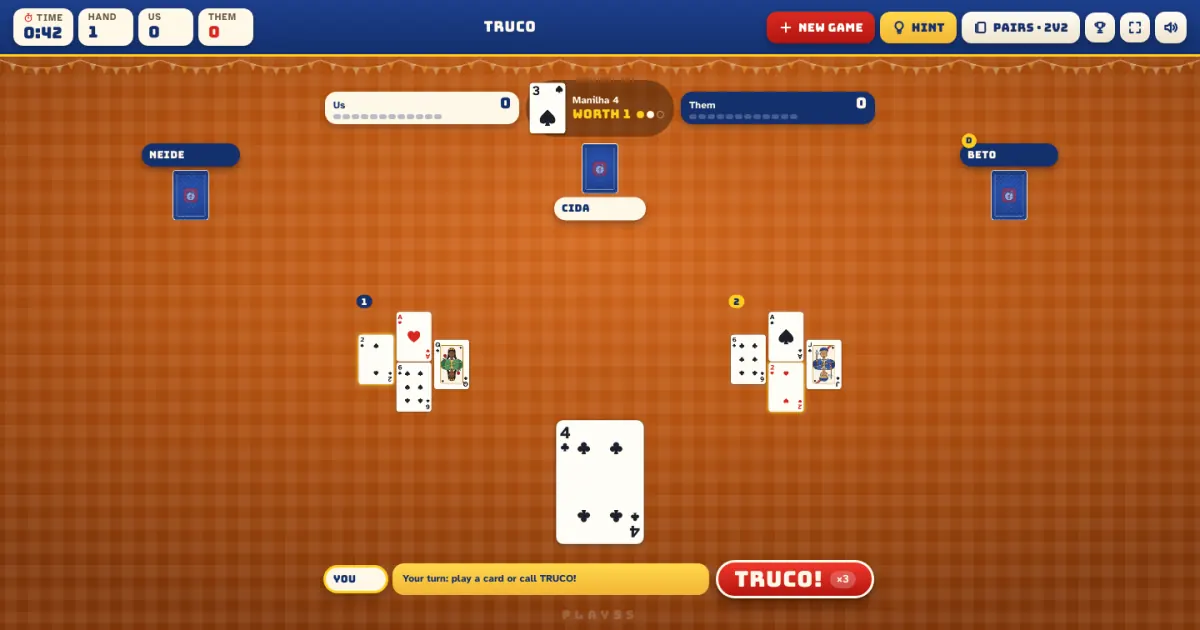
Truco uses a 40-card deck, the usual 52 without the 8s, 9s and 10s. Each player is dealt three cards, and the next card of the deck is turned face up: the vira. In Pairs you sit at the bottom with the computer as your partner across the table (Cida), and the two opponents on your right (Beto) and left (Neide). In the Duel you play one on one against Beto.
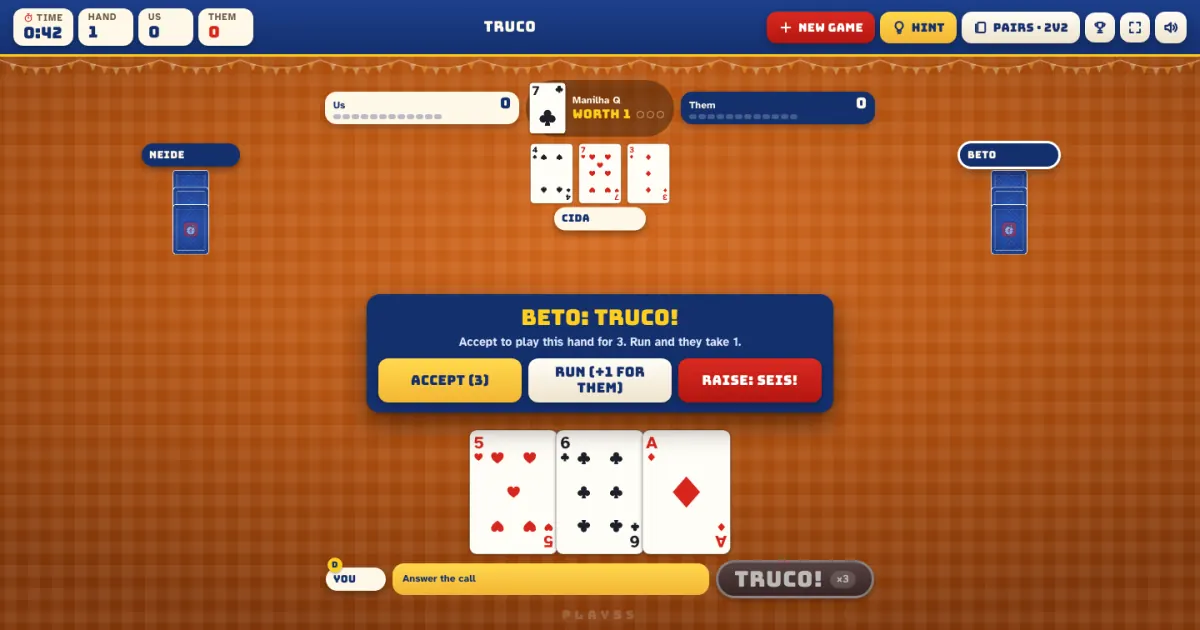
Play goes counter-clockwise, as in Brazil. The dealer changes every hand, and the player after the dealer plays the first card of the hand. Everybody sees the vira, and you only see your partner’s cards when your side has to answer a call or decide a mão de onze.
 Zoom in
Playing a trick
A trick is one card from every player. There is no obligation to follow suit or to beat the card before yours: you may play any card you hold. The highest card wins the trick, and the player who played it leads the next one. Your cards rise a little when it is your turn, and you play one by tapping or clicking it.
If the best cards of a trick are equal and belong to different sides, the trick is tied (in Brazil it is “cangada”, or “embuchada”). Nobody takes it, and the player who led it leads again. If two partners play equal best cards, their side wins the trick.
Winning the hand
Win two of the three tricks and you win the hand. Ties follow three simple rules: if the first trick is tied, whoever wins the second trick wins the hand; if the second or the third is tied, whoever won the first trick wins it; and if the first two are tied, the third decides. If all three are tied, nobody scores and the next hand is dealt.
So winning the first trick matters a lot: after it, a tie is enough, and the other side needs both of the other tricks.
The vira, the manilhas and the order of the cards
The manilhas are the four cards of the rank just above the vira, and they beat every other card, so which cards are strongest changes with every hand.
Without manilhas the cards rank 4, 5, 6, 7, Queen, Jack, King, Ace, 2, 3, from weakest to strongest, and the suits do not matter: all four 3s are equal. The Queen ranks below the Jack, as in many games of Portuguese origin. The manilha is the next rank in that circle: with a 5 as vira the 6s are manilhas, with a 7 the Queens are, and with a 3 as vira, the strongest rank, the manilhas are the 4s, the weakest. The strip at the top of the table always shows the vira and the manilha rank.
The four manilhas are ranked by suit: clubs (the “zap”) are the strongest, then hearts (“copas”), then spades (“espadilha”), and diamonds (“pica-fumo”) are the weakest. Even the weakest manilha beats a 3.
| What | Cards |
|---|---|
| Plain cards, weakest to strongest | 4, 5, 6, 7, Queen, Jack, King, Ace, 2, 3 (suits do not matter) |
| Manilhas, above every plain card | Diamonds, spades, hearts, clubs (weakest to strongest) |
| Which rank is the manilha | The rank above the vira: vira 4 → 5s, 5 → 6s, 6 → 7s, 7 → Queens, Queen → Jacks, Jack → Kings, King → Aces, Ace → 2s, 2 → 3s, 3 → 4s |
Truco, seis, nove and doze: raising the stakes
On your turn, before you play a card, you can call TRUCO! to raise the hand from 1 point to 3, and the other side has to run, accept or raise.
The hand is worth 1 point to start with. The red TRUCO! button is lit only when you may call. When a side calls, the other side answers, and the answer is binding for the whole side: if they run, the caller scores what the hand was worth before the call, with no more cards played; if they accept, the hand is now worth the new stake and play goes on; and if they raise, the hand is worth the new stake once the caller accepts, and the call goes back. After truco (3) the next calls are seis (6), nove (9) and doze (12), and nothing goes above 12.
Calls alternate between the sides. The side that raised last cannot raise again, so the other side has to be the next to go up, and it can do so right away or on a later turn, always before it plays a card. A side may not raise when just accepting would already win it the game, and may not call at all when the hand is already worth enough to win it the game.
| Call | The hand is worth | If the other side runs, the caller scores |
|---|---|---|
| TRUCO! | 3 | 1 |
| SEIS! | 6 | 3 |
| NOVE! | 9 | 6 |
| DOZE! | 12 | 9 |
 Zoom in
A call is about the whole hand
A call does not bet on the trick you are in: it raises the value of the hand, and the hand is still decided by the usual rules, two tricks out of three. Cards already played stay played, so you can call after winning the first trick, or when you are behind and want the other side to run.
Mão de onze and mão de ferro: the hands at 11
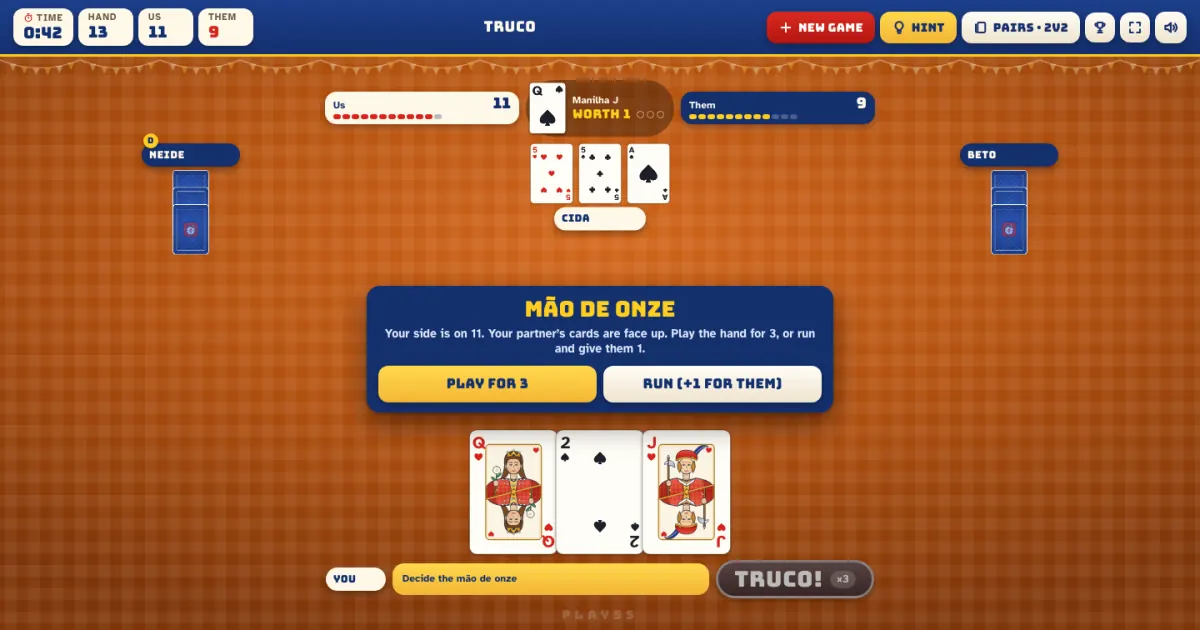
When one side is on 11 points, the hand is a mão de onze: that side looks at its cards together and chooses to play for 3 or run, and nobody can call truco.
The side on 11 sees its partner’s cards, which lie face up for the decision. It can play the hand for 3 points: winning wins the game, and losing gives the other side 3. Or it can run, which gives the other side 1 point and costs nothing else. In a Duel you have only your own cards to look at. During a mão de onze nobody may call truco, seis, nove or doze, and the button stays off.
 Zoom in
Mão de ferro: both sides on 11
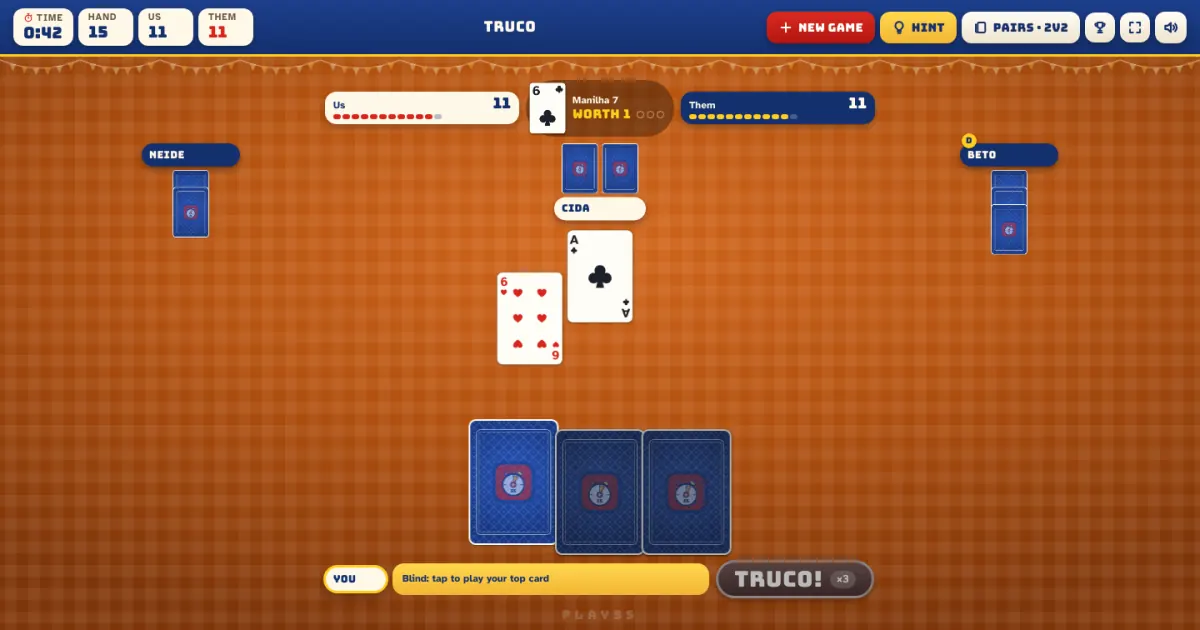
When both sides are on 11 the hand is a mão de ferro, the “iron hand”: nobody looks at their cards. You play blind, and each card is the top card of your hand. There is no truco, the first side to win the hand wins the game, and if all three tricks are tied the hand is dealt again as another mão de ferro.
 Zoom in
How a hand and a game are scored
Each hand scores its value for the side that wins it, 1 point normally and up to 12 after calls, and the first side to reach 12 points wins the game.
The winner of a hand scores what the hand was worth: 1, 3, 6, 9 or 12. A hand ends when a side wins two tricks, when a side runs from a call, or when a mão de onze is declined (1 point for the other side). A game is a series of hands, so it can end after one doze or after many single points. In our computer-versus-computer test games a game took between 8 and 9 hands on average.
The point that wins the game can be bigger than 12: a mão de onze won for 3 ends the game at 14. The score strip shows each side’s points as a row of twelve marks, and the bar above the table shows the hand number and both scores. If a game is still undecided after sixty hands, the higher score wins.
Pairs (2v2) or Duel (1v1)?
Pairs is the usual Truco, four players in two pairs, and the Duel is the same game for two with three cards each.
In Pairs the computer plays your partner. You decide for your side when a call is made, but your partner plays his own cards and can call truco on his turn, so you have to read what he does. In the Duel you play one against one computer opponent, with the same cards, calls and rules. A Duel is faster and makes bluffs more personal, and Pairs is closer to the table game.
Both modes have their own all-time leaderboard, and Pairs is the mode of the Daily Deal.
How the computer plays and bluffs
The computer plays your partner and your opponents using only what a player at that seat could know: its own cards, the vira, the cards already played and the score.
To choose a card it follows plain rules: it leads with its second-best card when it holds two good ones, plays the cheapest card that beats the card on the table, and keeps its strong cards when its partner is already winning. To decide a call, it deals the unseen cards at random dozens of times, plays each hand out, and counts how often its side wins. When a side has to answer a call, partners are allowed to show each other their cards, so a computer side uses both of its hands, and in Pairs your partner’s cards turn face up for you while you answer.
Each computer player has its own bluffing nature, drawn when the game is dealt: now and then it calls truco on a weak hand, and sometimes it raises back when it holds little. The computer decides from the same dealt cards every time, so the Daily Deal plays out the same for everybody who makes the same choices.
When to accept: the break-even chance
Whether it is right to accept a call depends on the stakes, not only on your cards. If you win the hand you gain the new value, and if you lose you lose it, while running costs only the old value. That puts a floor under the chance of winning the hand that makes accepting worth it:
| Call | Running costs you | Playing risks | Break-even chance of winning the hand |
|---|---|---|---|
| TRUCO! | 1 | 3 | 33% |
| SEIS! | 3 | 6 | 25% |
| NOVE! | 6 | 9 | 17% |
| DOZE! | 9 | 12 | 13% |
These figures are the arithmetic of the points, rounded, and not a measurement of our computer players. The computer adds a safety margin on top of them and always accepts when running would hand the game to the other side.
Daily Deal and leaderboards
The Daily Deal is one Pairs game that every player gets on the same day: the same deals, hand after hand, with a new one starting at midnight New York time.
Because everyone gets the same cards, the Daily Deal leaderboard compares players on one set of deals. Truco is not a puzzle, so the Daily Deal is not checked to be winnable: whether you win depends on how you play it. Our server hands out the deal, so it needs an internet connection, and each connection gets one ranked result per day: after that you can still play the Daily Deal for practice.
The leaderboards rank the winning margin, your final points minus theirs, and only games you win. A bigger margin ranks higher, and a tie goes to the faster game, then to whoever posted first. The time is measured by our server from the moment it dealt the game. Pick a nickname of 2 to 12 characters (offensive names are refused); no account is needed. There is a board for each Daily Deal and an all-time board for Pairs and for the Duel.
Truco strategy for beginners
The most useful habit in Truco is to look at the vira first, because it decides which of your cards are strong in this hand.
- Find the manilha before you look at anything else. A hand with the zap (the clubs manilha) or two manilhas is a strong hand, and a hand of 4s, 5s and 6s is weak unless one of them is a manilha.
- Count your 3s and 2s: after the manilhas they are the strongest cards, and a 3 beats everything except a manilha.
- Win the first trick if you can cheaply. After it, a tied trick is enough to win the hand, and your opponents need both of the others.
- If the first trick is tied, the second one decides the hand, so play your best card there.
- Run when your chance is low: running from truco costs 1 point, while losing the hand costs 3. As a rule of thumb, accept a truco when you think you win the hand at least one time in three.
- Call truco with a strong hand when you are ahead after the first trick, and call rarely on a weak one: a bluff works because the other side believes it, and each bluff caught costs you points.
- Do not beat your own partner. When his card is already winning the trick and nobody can beat it, play your lowest card.
- Watch the score. At 9, 10 or 11 points a single call can end the game, and you may not raise a hand that already wins you the game by being accepted.
- At 11, run the mão de onze when the cards in front of you are weak: it gives away 1 point, while losing the hand gives away 3 and may hand over the game.
- Use Hint to see what the computer would do in your seat: a card, a call, accept or run.
Truco controls: tap, click or keyboard
To play, tap or click one of the cards raised above your hand; to call, press the red TRUCO! button, and to answer a call, press Accept, Run or Raise.
The cards you can play rise a little on your turn. In a mão de ferro all your cards are face down, and tapping any of them plays the top one. The computer players act at a pace you can follow, with a speech bubble for every call, and every finished trick moves to a small pile at the foot of the table (beside the middle on a wide screen) so you can look back at it. The answer panel opens above your cards, so you can still see them while you decide.
Buttons and the table
The bar above the table shows your time, the hand number, and the score of your side (Us) and the other side (Them). The strip at the top of the table shows the vira, its manilha, what the hand is worth now and the tricks taken. New game deals a fresh game and asks first when one is in progress. The mode button switches between Pairs and Duel, and the trophy opens the leaderboards.
Keyboard
On a computer you can play without the mouse. Tab moves to your playable cards, the arrow keys step along them and Enter or Space plays the card. The keys below work anywhere on the page.
- 1, 2, 3: play your first, second or third card
- T: call truco (or raise back when you answer)
- A: accept a call, or play the mão de onze
- R: run
- H: show a hint
- N: start a new game
- F: full screen on or off
- M: sound effects on or off
Truco words
Truco has a colourful vocabulary, and most of it is Portuguese.
- Truco: the call that raises the hand to 3, and the name of the game. Seis, nove and doze are the calls to 6, 9 and 12 (a call to 6 is also called “meio-pau” in some places).
- Vira: the card turned face up after the deal. The rank above it is the manilha.
- Manilha: one of the four strongest cards of the hand. Zap is the clubs manilha, copas the hearts, espadilha the spades and pica-fumo the diamonds.
- Vaza or rodada: a trick, one card from each player.
- Mão: the player who leads the first trick, the one after the dealer. Pé: the dealer, who plays last.
- Cangar, embuchar or empatar: to tie a trick.
- Correr: to run, to give up a hand after a call.
- Mão de onze: the hand when one side is on 11. Mão de ferro: the hand when both are, played blind.
- Tento: a point, a way to count the score.
Truco Paulista or Truco Mineiro?
This game is Truco Paulista, the version played in São Paulo, in which the manilhas change with the vira every hand.
In Truco Mineiro, played in Minas Gerais, the manilhas never change: the 4 of clubs is the strongest card, then the 7 of hearts, the ace of spades and the 7 of diamonds, and there is no vira. Mineiro also has a different deal, where the first player may keep, pass or burn the cards. The two versions share the 40-card deck, the three tricks and the calls, but a call in Mineiro bets on the trick in progress instead of the whole hand, and after a tied trick the player of the first tying card leads, not the one who led it. The sources also disagree on the hands near the end of the game. Only Truco Paulista is in this game. In the south of Brazil people also play with a Spanish deck, a game close to Argentine Truco, which is not included either.
Where Truco comes from
Truco began in the Kingdom of Valencia, in Spain, where it is called “truc”, and it is played today in several countries of South America and in parts of Spain and Italy.
In Brazil the game was popularised by Italian, Portuguese and Spanish immigrants and spread across the country. In the southeast it is played with the French deck, the one used here, and in the south with the Spanish deck. Its appeal is the betting system: every call can be accepted, refused or raised, so bluffing and nerve count as much as the cards. The history and the regional versions are covered in Truco on Wikipedia.
Where these rules come from
These rules follow published descriptions of Truco Paulista, and where they differ this version takes the most common rule and says so.
- The basics (a 40-card deck, three cards each, the vira and the manilhas, three tricks, 12 points) are the same in pagat’s Brazilian Truco page, in Portuguese Wikipedia and in a 2019 tournament rulebook.
- The suits of the manilhas (clubs, hearts, spades, diamonds) are the same in pagat, in the tournament rulebook and in the open-source minitruco-android project (BSD license), which we read to check the corner cases.
- Calls go 3, 6, 9, 12 and running gives the stake before the call (Portuguese Wikipedia, the tournament rulebook and minitruco).
- A tied trick: the same player leads again (pagat, minitruco). If all three tricks are tied nobody scores (the general section of Portuguese Wikipedia, and minitruco), and a mão de onze tied all the way is dealt again. Two sources differ, and their choices are not taken here: the tournament rulebook gives the points to the dealer’s side, and the Paulista section of Portuguese Wikipedia has the first player (the mão) lead after a tie and win a hand tied all the way, while its scoring section gives the other side 3 points when a mão de onze is tied.
- A side that would win the game by only accepting may not raise: pagat states it for Truco Mineiro, and we apply it to both.
- Mão de onze and mão de ferro follow pagat, Portuguese Wikipedia and the tournament rulebook. Pagat says that calling truco at 11 loses the whole game, so this game simply keeps the button off.
- Not included: covered cards (the tournament rulebook allows them from the second trick), Truco Mineiro, and more than four players.
- The computer players are our own code. We read minitruco’s decisions to see their shape and wrote our own.
Truco questions
How many cards does each player get in Truco?
Three. The deck has 40 cards, the usual 52 without the 8s, 9s and 10s, and after the deal the next card is turned face up as the vira.
What is the vira in Truco?
The vira is the card turned face up after the deal. The rank just above it is the manilha of that hand, the strongest rank, so the vira decides which cards are strong.
What are the manilhas, and which one is the strongest?
The four cards of the rank above the vira. Clubs (the zap) is the strongest, then hearts (copas), spades (espadilha) and diamonds (pica-fumo). All four beat every other card.
What is the order of the cards in Truco Paulista?
Weakest to strongest: 4, 5, 6, 7, Queen, Jack, King, Ace, 2, 3, with the manilhas of the hand above all of them. Suits do not matter for the other cards.
What happens when a trick is tied?
Nobody takes it, and the player who led the tied trick leads the next one. If the first trick is tied, the second trick decides the hand; if the second or third is tied, the winner of the first trick wins the hand.
What does it mean to call truco?
On your turn, before you play a card, you raise the hand from 1 point to 3. The other side can accept, run (you score 1 point) or raise to seis, 6 points.
How do seis, nove and doze work?
They are the next calls after truco: the hand goes to 6, then 9, then 12 points. The sides raise by turns, running gives the caller the stake before the call (3, 6 or 9), and nothing goes above 12.
What is the mão de onze?
The hand played when one side is on 11 points. That side sees its partner’s cards and chooses to play for 3 or to run, giving the other side 1 point. Nobody can call truco in that hand.
What is the mão de ferro?
The hand played when both sides are on 11 points. You play blind: the top card of your hand each trick, with no calls, and the winner of the hand wins the game.
How many points do you need to win Truco?
12. A hand is worth 1 point and up to 12 after calls, and a mão de onze won for 3 can finish the game at 14.
Can I play Truco on my own against the computer?
Yes, in two ways: Pairs, where the computer is your partner and plays your two opponents, or the Duel, one against one.
Does the computer bluff?
Yes. Each computer player has its own bluffing nature drawn when the game starts: it sometimes calls truco on a weak hand, and it sometimes raises back when it holds little.
What is the Daily Deal in Truco?
A Pairs game that is the same for every player on a given day. It needs an internet connection, each connection gets one ranked result per day, and a new one starts at midnight New York time.
How are the Truco leaderboards ranked?
By the winning margin, your final points minus the other side’s, and only for games you win. A bigger margin ranks higher, and a tie goes to the faster game. There is a board for each Daily Deal and an all-time board for Pairs and for the Duel.
Is there an Undo button?
No. The computer answers every card you play and every call you make, so taking one back would show you what happens before you choose. Hint shows what the computer would do in your seat.
Does the game save my progress?
Yes. Your current game and time are saved in this browser on this device, so you can close the page and pick up where you left off. Clearing your browser data removes the saved game.
Is Truco free on Play5s?
Yes. It is free to play in your browser, with no download and no account.
About this version
This Truco was built by Play5s to run in any modern web browser. It is Truco Paulista with the rules described above, a new deal for every game, and a choice of Pairs, Duel or the Daily Deal. The cards, including the Jacks, Queens and Kings, and the table are drawn by Play5s, and the computer players are our own code.
There is nothing to install and no account to create. Your game in progress is kept in your browser. Starting a ranked game asks our server for a deal and a ticket; your cards, calls and nickname are sent only when you submit a score.
Read more about Play5s, or see all of our free card games.