

On this page
How to play Scopa
To play Scopa, play one card per turn from your hand and take the table cards that match it, either one card of the same value or several cards that add up to it.
The cards and their values
Scopa is played with a 40-card Italian deck in four suits: Denari (coins), Coppe (cups), Spade (swords) and Bastoni (clubs). Each suit has the Ace, the 2 to the 7, the Fante (Jack, 8), the Cavallo (Horse, 9) and the Re (King, 10). The Play5s deck is drawn by Play5s in the Napoletane style; every card has its value in the corner.
For taking, a card is worth its number: the Ace is 1, the Fante 8, the Cavallo 9 and the Re 10. The third column of the table below is a different scale that only counts for the Primiera point.
| Card | Value for taking | Value for the Primiera |
|---|---|---|
| Ace (Asso) | 1 | 16 |
| 2 | 2 | 12 |
| 3 | 3 | 13 |
| 4 | 4 | 14 |
| 5 | 5 | 15 |
| 6 | 6 | 18 |
| 7 | 7 | 21 |
| Jack (Fante) | 8 | 10 |
| Horse (Cavallo) | 9 | 10 |
| King (Re) | 10 | 10 |
The deal
Each player gets three cards and four cards are laid face up on the table. If three or four of those table cards are Kings, the deck is shuffled and dealt again, because with that many Kings nobody could ever sweep the table. When both players have played their three cards, three more are dealt to each, and nothing more goes to the table, until the deck is gone. That makes six deals of three cards in a hand, 18 cards for each player.
The player who did not deal plays first, and the dealer changes every hand. In the Play5s version the first dealer is picked at random from the deal, so you sometimes open the hand and sometimes the computer does.
Taking cards
A turn is one card from your hand. If the card has the same value as a card on the table, it takes that card. If there are two or three equal cards on the table, you choose one of them. An equal card always comes before a sum: with an Ace, a 3, a 4, a 5 and a 7 on the table, a 5 takes the 5 and not the Ace and the 4.
If no table card has the same value, the card takes a set of two or more table cards that add up to its value. With that same table a 6 takes the Ace and the 5, and an 8 can take 5 and 3, or 4, 3 and Ace, or 7 and Ace: when there are several sets, you choose which one. If nothing matches, the card stays on the table where it can be taken later. Taking is compulsory when you can take, but you can play any card from your hand, including a card that takes nothing even when another card of yours could take.
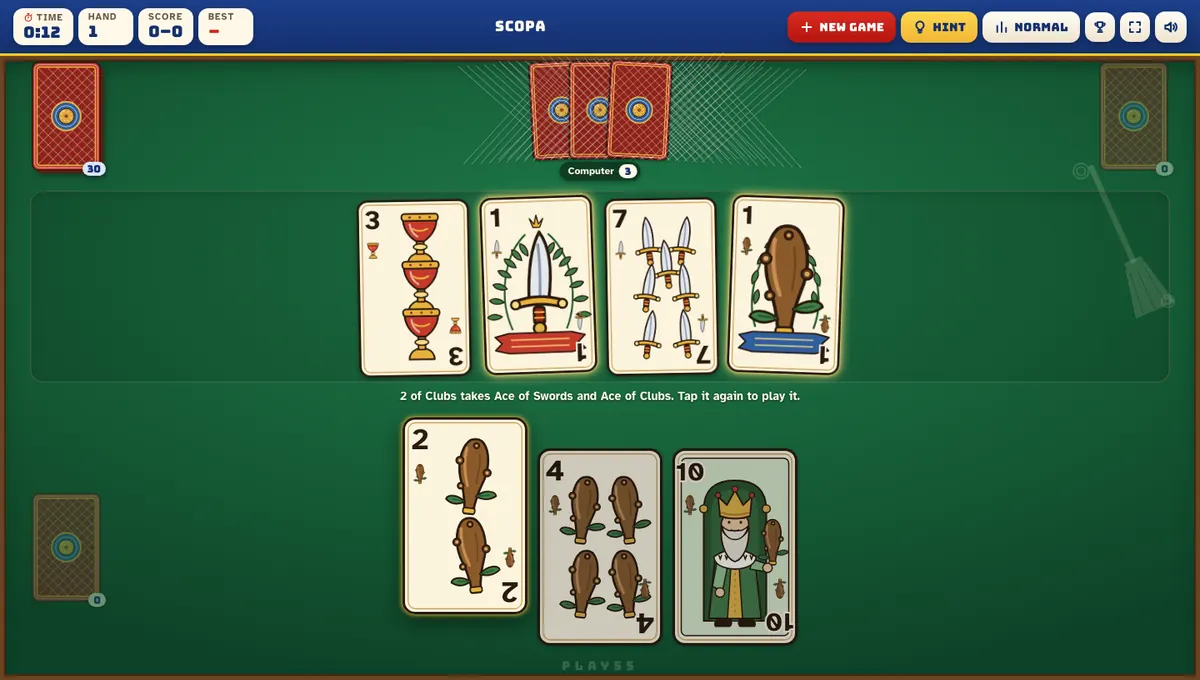
The taken cards and the card you played go to your pile, face down. In the Play5s version you tap a card to pick it up, and the table cards it can take light up. A second tap plays it. When a card can take in more than one way, a bar with one button per way appears and the table cards carry the same numbers, so you tap the way you want.
 Zoom in
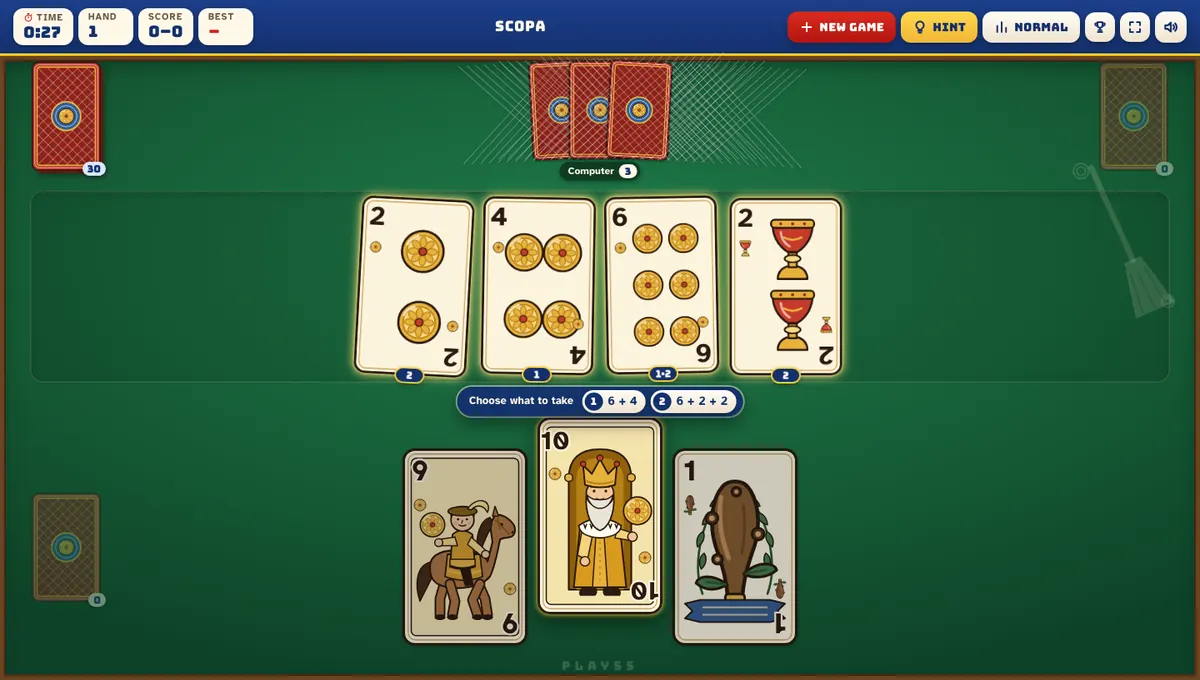
When a card has more than one way to take, Play5s lists them by their values and numbers the cards on the table. Take the King of coins on a table of 2 of coins, 4 of coins, 6 of coins and 2 of cups: 6 + 4 is one way and 6 + 2 + 2 is the other. The choice is yours; the rule books name no preferred set.
 Zoom in
Scopa, the sweep
If the card you play takes every card on the table, that is a scopa (a sweep, from the broom that sweeps the table), and it is worth one point. The next card played then lands on an empty table and cannot take anything. A scopa made with the very last card of the hand does not count, though the cards are taken as usual.
When all the cards have been played, whatever is left on the table goes to the player who took last, and then the hand is scored. The board in Play5s keeps the number of scope next to each pile, with a gold star.
How scoring works in Scopa
At the end of every hand you can score up to five kinds of points: scope, the most cards, the most coins, the Settebello and the best Primiera.
The points are added hand after hand until one player reaches 11. A tie for the most cards, for the most coins or for the Primiera scores for nobody, but the Settebello always has an owner, because there is only one 7 of coins. The most cards needs at least 21 of the 40, and the most coins at least 6 of the 10.
| Point | Who gets it | If tied |
|---|---|---|
| Scopa | 1 point for each time you swept the table (not with the last card) | Not applicable: every scopa counts |
| Carte (cards) | The player with more cards in the pile | Nobody scores |
| Denari (coins) | The player with more cards of the coins suit | Nobody scores |
| Settebello | The player who took the 7 of coins | Not applicable: one card |
| Primiera | The player with the higher prime, one card of each suit | Nobody scores |
The Primiera
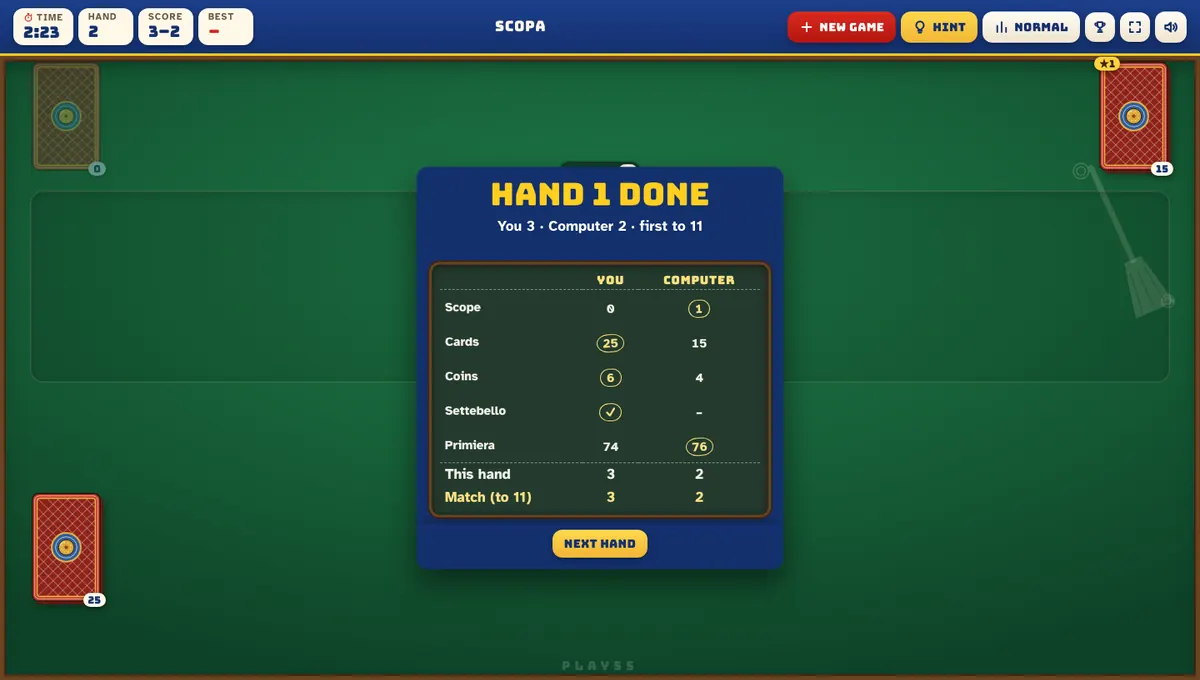
The Primiera is a hand of four cards, one from each suit, taken from your pile: for each suit, pick your best card by the Primiera values (the 7 is worth 21, the 6 is worth 18, the Ace 16, the 5 15, the 4 14, the 3 13, the 2 12, and the Jack, Horse and King 10 each) and add the four numbers. The best prime scores a point. A player who has no card of one suit cannot score the Primiera, and if neither player has all four suits nobody scores it.
The largest possible prime is 84, which is the four 7s. Because every 7 is worth so much, a 7 is worth taking even when it takes few cards, and the 7 of coins counts toward three points at once: the Settebello, the coins and the Primiera.
 Zoom in
Winning the match
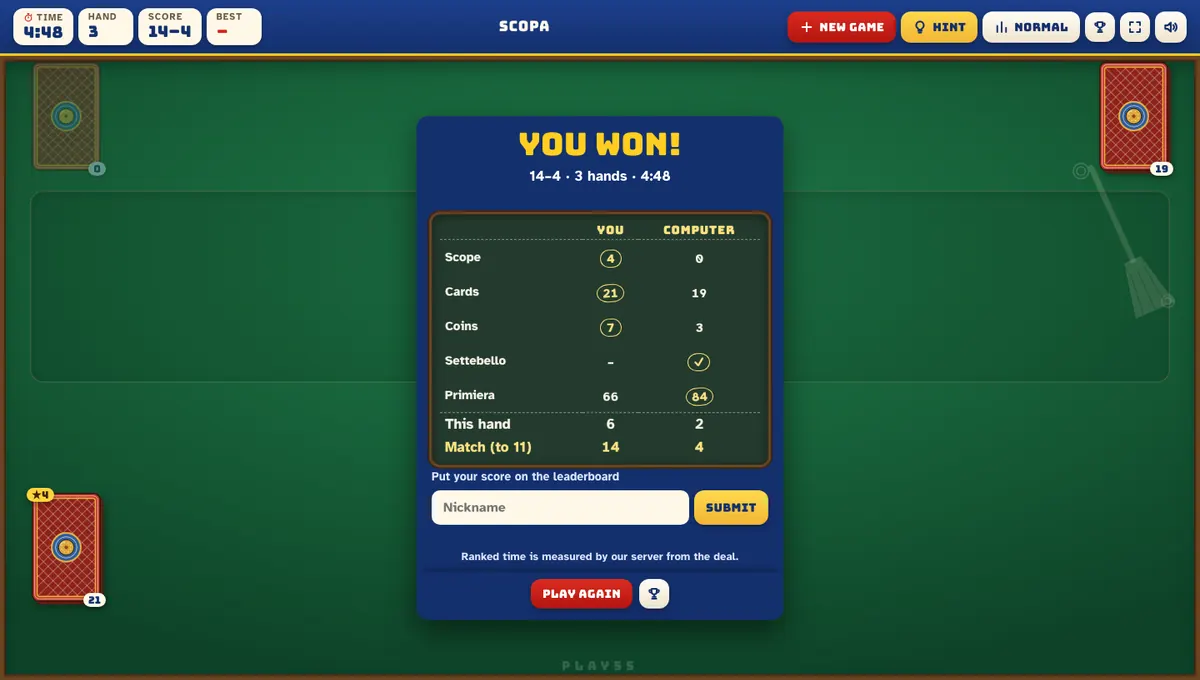
The match goes to 11 points over as many hands as it takes. If both players pass 11 in the same hand, the higher total wins, and if the totals are equal after the target, another hand is played. In the Play5s version the standard match is to 11, which is the one that goes on the leaderboards, and a practice match can be played to 21.
 Zoom in
Scopa variants and what Play5s uses
Scopa has many regional variants, and Play5s plays the standard two-player game and offers three extra rules as practice options.
The standard game on this page is the one that pagat and Wikipedia describe, played to 11. The three options below are the most common additions in the sources, and you switch them on at the start screen. A match with an option, or to 21, is practice: it is never put on a leaderboard.
| Variant | What changes | In Play5s |
|---|---|---|
| Asso piglia tutto (Ace takes all) | An Ace takes the whole table unless an Ace is on it, in which case it takes only that Ace; on an empty table it stays | Option; counts as a scopa |
| Scopa d’Assi | The same Ace rule, but taking the whole table with an Ace does not count as a sweep (pagat) | Not offered as such; the Asso piglia tutto option counts the sweep |
| Re bello | The King of coins is worth one extra point | Option |
| Napola | The Ace, 2 and 3 of coins, and any unbroken run above them, score one point per card | Option (from 3 cards; no cap, all ten coins score 10) |
| Scopa a quindici | A card may also take cards that add up to 15 together with it | Not offered |
| Scopone | Four players in two teams, with all the cards dealt out | Not offered |
| Primiera counted by Sevens (Milan) | The player with more 7s wins the point, then the 6s, then the Aces | Not offered |
The computer player and its three levels
The computer plays at three levels, Easy, Normal and Hard, and it never sees your hand or the order of the deck.
The computer uses only what a player at the table can see: its own cards, the cards on the table, the piles of taken cards and the number of cards left in the deck. Easy takes whenever it can and sometimes plays a random card. Normal gives every move a score from what it takes (a sweep, the Settebello, coins, sevens, the number of cards) and from what it leaves on the table for you. Hard does the same and also looks at your possible replies, using the cards that have already been taken to work out which cards you can hold.
The same move is made every time the same position comes up, so a ranked match can be checked by our server from the deal and your moves. The start screen picks the level, and the Daily match is always played against Normal.
Scopa strategy: tips that follow from the scoring
The best Scopa tip is to count points, not cards: five things score, and the Settebello, the sevens and the coins are worth more than their share of the deck.
- Take the 7 of coins when you can. It is the only card that counts toward three points at once (Settebello, coins and Primiera), and nobody can tie for the Settebello.
- Collect sevens and sixes. The Primiera is the sum of your best card in each suit, so a 7 adds 21 and a 6 adds 18, while a King adds only 10.
- Do not leave a table that one card can sweep. Before you play a card that takes nothing, check whether some value from 1 to 10 would take every card on the table: a table of 3 and 4 is swept by a 7, and an Ace alone by another Ace.
- When you must put a card on the table, put down the one that is worth least: a King or a Jack of cups helps the computer far less than a 7 or a coin would.
- Take more cards when two moves look equal. The 21-card majority scores a point, and every card taken is one the other player does not have.
- Near the end of the hand, count the sevens and coins that have gone by. The Hard computer does this, and the piles you can see tell you the same.
- Use Hint when you are stuck. It shows the card the Normal computer would play and what it takes.
Daily match and leaderboards
The Daily match is one match that every player gets on the same day, against the Normal computer, and the leaderboards rank your winning margin.
The leaderboards count matches with the standard rules to 11 at one of the three levels. There is one board for Easy, one for Normal and one for Hard, and the Daily match has its own board. Only a match that you win goes on a board, and the boards are ranked by the winning margin, which is your points minus the computer’s, so a higher number is better. If two players have the same margin, the one with fewer seconds wins, and then whoever posted first.
The Daily match is the same deal for everyone: every hand of it is dealt from the day’s seed. The day changes at midnight New York time, and each day’s match is chosen from a list in which a winning line was found for every day. It needs a connection because our server hands out the deal. Each connection gets one ranked Daily result per day, and after that the Daily match is practice.
The time is measured by our server, from the moment the server dealt the match. The nickname is 2 to 12 characters, offensive names are refused, and you do not need an account. When you submit, your moves and nickname are sent to our server, which replays the match with its own copy of the rules and the computer to work out the margin.
Controls and saving
You play by tapping a card to pick it up and tapping it again to play it, you can drag it onto the table, and the keyboard works for everything.
- Tap or click a card in your hand to pick it up. The table cards it can take light up and a message says what it does. Tap it again to play it, or tap one of the lit table cards.
- Drag a card from your hand onto the table to play it. A card that has more than one way to take opens the bar of ways, and you tap the one you want.
- Hint (key H) lights up the card the Normal computer would play and the cards it takes.
- Keyboard: keys 1, 2 and 3 pick up the first, second or third card, Enter or Space plays the card you hold, Esc puts it back, and when the bar of ways is open the number keys choose a way. N starts a new match, F switches full screen and M switches the sound.
- There is no Undo in Scopa, because taking back a card after the computer has answered would show you its hand.
- The start screen has the level, the target (11 or 21) and the three variants. It remembers your choice. Your match in progress and your best margins are saved in this browser on this device; clearing your browser data removes them.
Where Scopa comes from
Scopa is an Italian game whose name means “broom”, and it was already played all over Italy in the 18th century.
According to Italian Wikipedia, Scopa was already widespread across Italy in the 18th century, with no earlier record of where it began. The name comes from the sweep that clears the table. The Primiera scale comes from an older gambling game called Primiera, in which the aim was to hold the best four cards of the four suits.
Scopa is played with whichever pattern of 40-card Italian deck belongs to the region, and, as Wikipedia it adds, with a French-suited pack (for example the Milanese, Piedmontese, Genoese or Tuscan patterns) where Hearts stand for Coppe, Diamonds for Denari, Clubs for Bastoni and Spades for Spade. The Play5s deck is in the Napoletane style, drawn from scratch by Play5s, with coins, cups, swords and clubs.
Where the rules come from
The rules on this page come from sources that were read on 23 November 2026, and every choice that is specific to Play5s is listed here.
- pagat (John McLeod, Scopa): the deal, the equal-card rule, choosing between sets, the scopa and its last-card exception, the points of a hand, the Primiera scale and the need for all four suits, the target of 11, and the variants Asso piglia tutto, Re bello and Napola.
- Wikipedia: Scopa (opens in a new tab) and Wikipedia in Italian: Scopa (gioco) (opens in a new tab): the same rules, the three-King redeal, the 11-point game for two players, a tie at the target, the origin of the Primiera, and regional ways of counting it.
- Aranzulla (Come si gioca a Scopa): the compulsory single-card take, taking by sum, the last-card exception, the points and the optional Re bello and Napola.
- Two open-source Scopa programs, read to compare the rules and the computer’s play: goblindegook/scopa (opens in a new tab) (MIT licence) makes you take the fewest cards possible, which is the rule of Scopa a quindici, so Play5s follows the three sources above and lets you choose between sets. The code of Play5s is written from scratch.
- The Primiera: some regions use other scales; Play5s uses the standard 21, 18, 16, 15, 14, 13, 12 and 10, and a player needs all four suits to score it.
- Asso piglia tutto: Play5s counts the sweep as a scopa, as pagat does; some groups do not.
- Match target: 11 points, as pagat and Wikipedia give for two players; 21 is a practice option.
Scopa questions
How do you play Scopa?
Each turn you play one card from your hand. If it matches the value of a table card, or the sum of several, you take them; otherwise it stays on the table. When the cards run out you score the most cards, the most coins, the Settebello, the best Primiera and each sweep, and the first to 11 points wins.
How many points do you play to in Scopa?
In the standard two-player game the match goes to 11 points over as many hands as it takes. Groups sometimes agree on 16 or 21. In Play5s the ranked match is to 11 and 21 is a practice option.
What is the Settebello in Scopa?
The Settebello is the 7 of coins (Sette Bello, “beautiful seven”). Whoever takes it scores one point, and it also counts as a coin and as the best 7 for the Primiera.
What is the Primiera?
The Primiera is a prime of four cards, one of each suit, from the cards you took. Each card has a value: 7 is 21, 6 is 18, Ace 16, 5 15, 4 14, 3 13, 2 12, and the Jack, Horse and King 10. The higher total scores a point, and you need all four suits.
Does a card have to take if it can?
Yes. If the card you play can take, it must take. You may, however, play any card from your hand, even one that takes nothing while another of your cards could have taken.
What if a card matches one card and also a sum?
The single card always comes first. With a 3 on the table, a 3 takes the 3 and not an Ace and a 2. When no table card matches, you may choose any set that adds up to your card.
What is a scopa in Scopa?
A scopa is a sweep: playing a card that takes every card on the table. It is worth one point, except when it is the very last card of the hand.
Why is the last scopa of the hand not counted?
Pagat, Wikipedia and Aranzulla all give no point for sweeping the table with the last card of the hand. The cards are still taken, and whoever took last also gets what is left on the table.
What does “scopa” mean in Italian?
It means broom. The game takes its name from sweeping the table clean with a single card.
Can you play Scopa with more than two players?
Yes, with three players alone or four or six in teams, but this version is for two: you and the computer. Four players usually play Scopone, a related game.
What cards do you play Scopa with?
With a 40-card Italian deck: coins, cups, swords and clubs, each with the Ace, 2 to 7, Jack, Horse and King. A 52-card deck without the 8s, 9s and 10s can also be used. The Play5s cards are drawn by Play5s.
What is Asso piglia tutto?
Ace takes all: an Ace takes the whole table when no Ace is on it. It is a common variant, and you can switch it on at the start screen for a practice match.
Is there a Scopa leaderboard and a Daily match?
Yes: a Daily match that is the same for everyone on a given day, and an all-time board for each of the three levels. Boards rank the winning margin of a match to 11 with the standard rules, and you only need a nickname.
Is Scopa free to play here?
Yes. It is free in your browser, with no download and no account.
Can the computer see my cards?
No. It uses its own cards, the table, the piles of taken cards and how many cards are left. It never looks at your hand or the order of the deck.
Does the game save my progress?
Yes. Your current match, your options and your best margins are saved in this browser on this device. Clearing your browser data removes them. Only matches you choose to submit to a leaderboard are sent to our server, with your nickname.
About this version
This Scopa was built by Play5s to run in any modern web browser. It deals a new shuffled hand every time, and the computer follows fixed rules that are described on this page. The 40 cards, including the Fante, the Cavallo and the Re of each suit, are drawn by Play5s.
There is nothing to install and no account to create. Your match in progress and your best margins are kept in your browser on this device. Starting a ranked match or the Daily match asks our server for a deal and a ticket; your moves and nickname are sent only when you submit a match to a leaderboard.
The page gives the rules as pagat, Wikipedia and Aranzulla describe them, and the choices that are specific to this version are listed in the section on where the rules come from.
Read more about Play5s, or see all of our free card games.