

On this page
How to play Briscola
To win Briscola, take more than half of the 120 card points by winning tricks, and the suit of the one card turned up at the start, the briscola, is trump: it beats every other suit.
The cards
Briscola is played with the Italian 40-card deck: four suits, called coins (denari), cups (coppe), swords (spade) and batons (bastoni), with ten cards in each. A suit has the Ace, the numbers 2 to 7, and three court cards: the Jack (fante), the Knight (cavallo) and the King (re). The cards you see in the Play5s version are drawn by Play5s in the Italian style.
The deal and the briscola
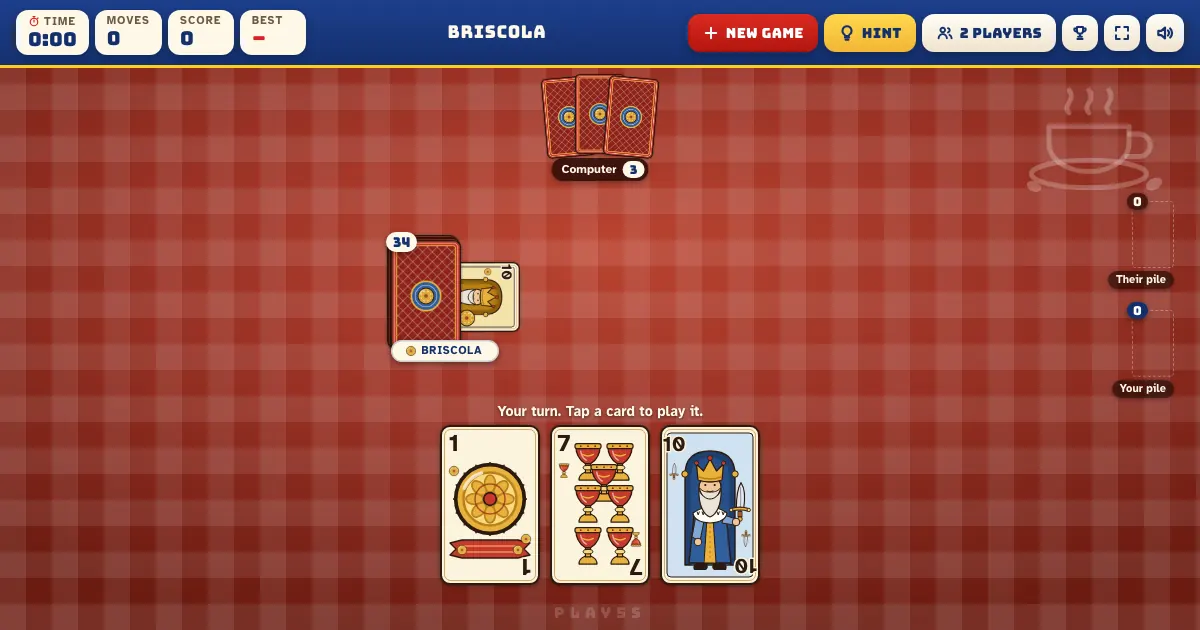
Each player gets three cards. The next card is turned face up and slid under the stock, and its suit is the briscola for the whole game. That card stays under the stock where everyone can see it, and it is the last card drawn. In the Play5s version the briscola card lies across the bottom of the stock, with a small plate that names the suit.
The player to the dealer's right plays first, and play goes counter-clockwise. In a single game of the Play5s version you play first.
 Zoom in
Playing a trick
The first player puts one card on the table, and the other players answer in turn. Nobody has to follow suit or play a briscola, even when they could: any card in your hand is allowed. This is what sets Briscola apart from most trick-taking games.
The trick goes to the highest briscola if any was played. If nobody played a briscola, it goes to the highest card of the suit that was led, and a card of another suit never wins, however high it is. So if you lead the 7 of coins and the next player answers with the Ace of cups, you win the trick, unless the briscola is cups, in which case their Ace is a briscola and takes it. In the Play5s version a small ring marks the card that is winning the trick at the moment.
Drawing and the last tricks
The winner of a trick keeps the cards face down, draws first from the stock, and the other players draw in turn, so everybody is back to three cards. The winner leads the next trick. When the stock is empty, the last three tricks are played without drawing.
The briscola card is the last card drawn. With two players, the winner of the trick before takes the last face-down card and the other player takes the briscola card, so that last trick of the draw matters. With two players there are 20 tricks in a game, and with four players there are 10.
Briscola card values and ranking
In Briscola the Ace is the strongest card and is worth 11 points, the Tre is second and is worth 10, and only five ranks in each suit are worth anything.
The order of the cards, from the highest to the lowest, is Ace, Tre (3), King, Knight, Jack, 7, 6, 5, 4 and 2. The odd thing is the Tre, which beats the King and is worth 10 points. The Ace and the Tre are called carichi (loads), the three court cards are called figure, and the cards that are worth nothing are called lisci. All 40 cards together carry 120 points.
| Rank | Italian name | Points |
|---|---|---|
| Ace | Asso | 11 |
| Tre (3) | Tre | 10 |
| King | Re | 4 |
| Knight | Cavallo | 3 |
| Jack | Fante | 2 |
| 7, 6, 5, 4, 2 | 7, 6, 5, 4, 2 | 0 |
The rank only matters for deciding who takes a trick. A 2 of the briscola suit is worth no points, but it still beats the Ace of any other suit. In the Play5s version the Score tile shows the points your team has taken so far, and the number on each pile of taken cards shows how many cards are in it.
How scoring and winning work in Briscola
The player or team that takes at least 61 of the 120 points wins the game, and 60 points each is a draw.
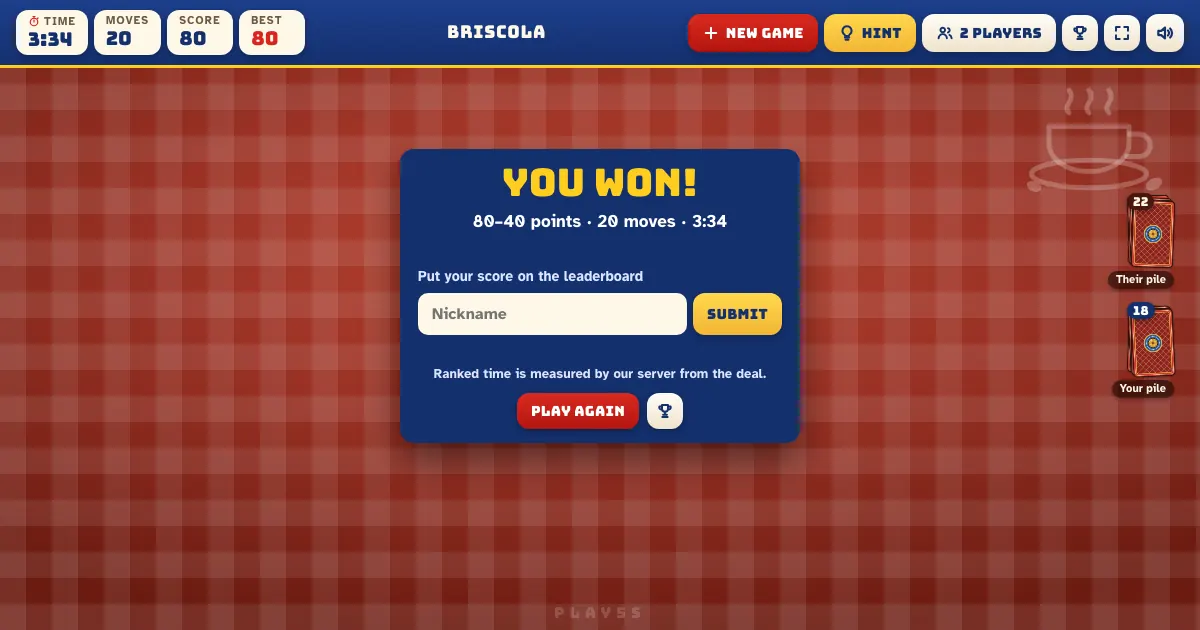
When the last trick has been played, each side adds up the points of the cards in its pile. With 120 points in the deck, 61 is the first score that the other side cannot match. A draw at 60-60 is possible and counts for neither side.
Briscola is usually played as the best of three or five games. In the Play5s version the Best of 3 option plays games until one side has won two of them, and a drawn game counts for nobody, so the next game is played. The panel at the end of each game shows the points of both sides and the games won.
 Zoom in
The last tricks often decide the game, because the players tend to keep their most valuable cards for them. Once the stock is gone, the hands are fixed and a player who has followed the cards played can work out exactly what the other player holds.
Briscola with four players
With four players Briscola is a partnership game: two teams of two, with partners sitting opposite each other, and the teammates add their points together.
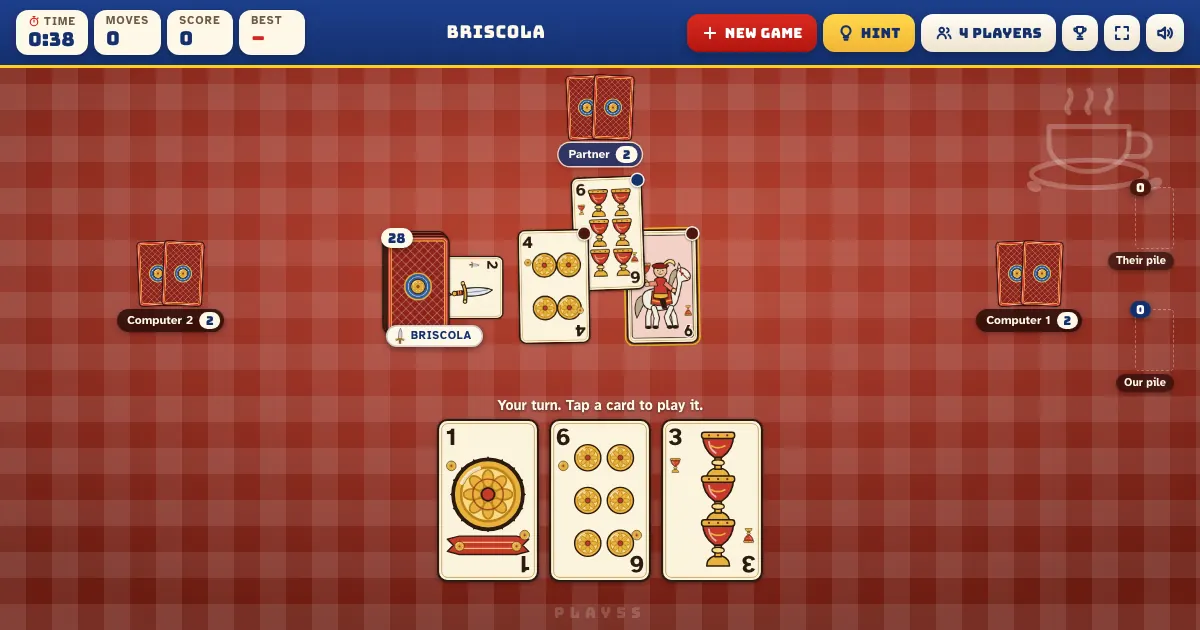
Everything else is the same. Each player has three cards, the player to the dealer's right leads, play goes counter-clockwise, and each trick has four cards. The trick goes to the highest briscola, or to the highest card of the suit led, and whoever wins it draws first. A team that wins a trick takes all four cards, whichever of the two teammates played the winning card.
In real play, partners are allowed to signal to each other, or to talk a little after the first trick, in the ways that pagat, Wikipedia and Board Game Arena describe. In the Play5s version your partner is a computer player, and nobody signals. You can see on each card of a trick whose team played it: a navy disc is your team, a brown one is the other team.
 Zoom in
In the Play5s version the four-player game has its own leaderboard board and the same rules for ranking: the points your team takes count when your team wins.
Briscola tips: how to win more tricks
The core idea in Briscola is to win the tricks that carry points and let the empty ones go, and to keep your briscole and your carichi for the right moment.
- Lead a liscio, a card worth no points, from a plain suit. It gives nothing away if the other player takes it.
- Do not spend a briscola on a trick with no points. A briscola is worth far more later, when it can take an Ace or a Tre.
- Take a trick with the cheapest card that wins it, and take it when the points on the table are worth the card.
- If the other player leads the Tre of a plain suit and you hold the Ace of that suit, take it with the Ace: that is 21 points in one trick. If they lead an Ace or a Tre and you cannot beat it in that suit, a low briscola can be a good trade for 10 or 11 points.
- Count the briscole. There are ten cards in the briscola suit, and one of them is the card under the stock.
- Remember which Aces and Tres have been played. If an Ace has not appeared, the other player may hold it.
- Keep your carichi until you are sure they will win. Playing an Ace into a briscola gives away 11 points.
- Plan for the end. The briscola card goes to the player who loses the last trick before it, so sometimes giving up a trick near the end gets you the briscola. Be ready for the last three tricks with your best cards.
- In the Play5s version the Hint button shows the card the Expert level would play, and it never reveals the other hands. In a ranked game or the Daily Deal it asks first, because using it makes that game practice.
Briscola variants and regional rules
Briscola has many local forms, and the Play5s version offers two of them as options: the Best of 3 and the Piedmont order of the cards.
Regional card order
Wikipedia reports that in lower Piedmont, the Oltrepò Pavese, the Nuorese area of Sardinia and parts of Liguria, the values of the Tre and the 7 are swapped. The 7 becomes the second strongest card and the Tre becomes a plain card between the 4 and the 2. The Piedmont option in Play5s gives the 7 the Tre's place in the order and its 10 points, and turns the Tre into a card worth nothing. In some areas of Tuscany the Jack, called the gobbo, ranks right behind the King and the Knight comes after the Jack. Play5s does not have that order.
Other versions of the game
Briscola chiamata is the five-player version, in which the players bid for the right to name the briscola and a partner. Briscola scoperta is the two-player game with open hands, and briscola a 31 stops as soon as a player claims 31 points. Briscolone is a two-player game with five cards and no briscola, and Schembil is a six-player partnership version. These are different games from the one on this page, and Play5s does not have them.
Some groups turn the briscola card again if it is an Ace or a Tre, and some play to 120 points over two deals. Play5s uses neither of these. The accusi, a declaration of the Knight and the King of the same suit that adds 20 or 40 points, is a rare extra rule that Wikipedia mentions, and Play5s does not use it.
How the computer players play
The computer players only use what a player at their seat could see: their own cards, the cards already played, the briscola card under the stock and who took it.
A computer player never looks at your hand or at the face-down stock. Each of its moves depends only on the deal and on the cards that have been played, so a ranked game can be replayed on our server from your cards alone, with the computer players' moves worked out again.
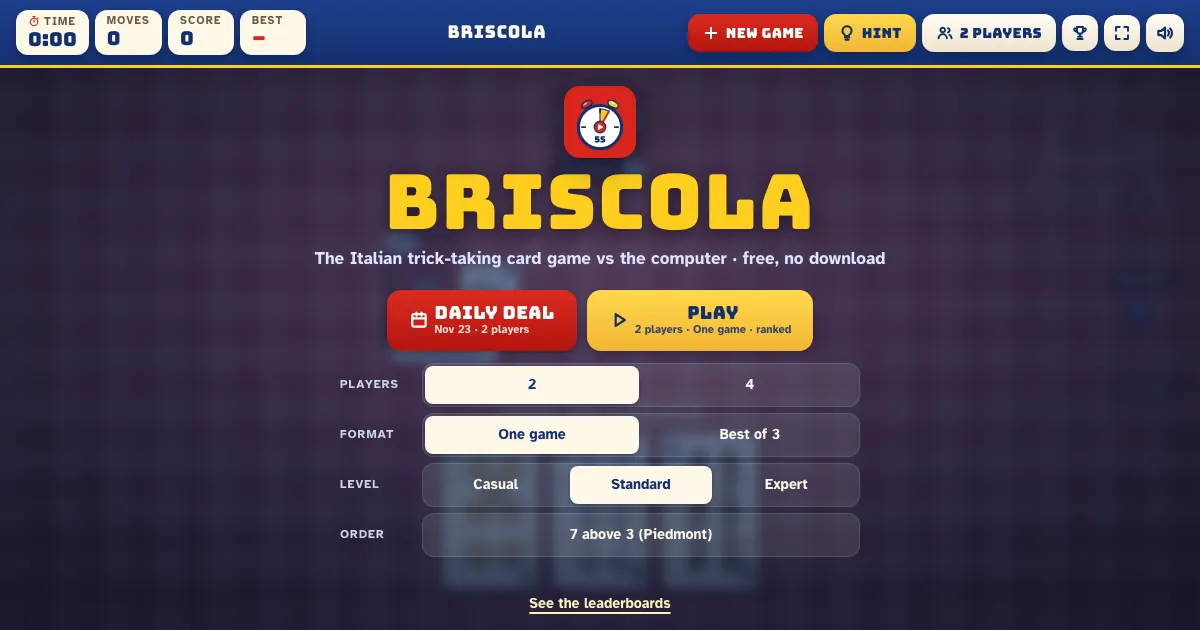
There are three levels. Casual plays a random card now and then and uses simple rules the rest of the time. Standard follows simple rules: it leads a card that gives nothing away, takes a trick only when the points on the table are worth the card it would spend, and keeps its briscole. In a two-player game, Standard and Expert also play the last three tricks exactly, because once the stock is gone they can work out the cards you hold from the cards they have not seen. Expert goes further earlier in the game: for each card it could play, it plays the rest of the game out many times with the cards it cannot see dealt at random, and picks the card that does best.
In a Play5s test on 23 November 2026, a player who always followed the Hint button won 64% of 600 simulated two-player games against the Standard computer, and a Standard player against a Standard computer won 50% of 2,000. The leaderboards use the Standard level.
 Zoom in
Daily Deal and leaderboards
The Daily Deal is one two-player game that every player gets on the same day, and the leaderboards rank the points your team took in a win.
The leaderboards count one game at the Standard level with the usual card order. There is a board for two players and one for four players, and the Daily Deal has its own board. Only a game that your team wins goes on a board, and the boards are ranked by the points your team took, from 61 to 120, so a higher number is better. If two players have the same points, the one with fewer seconds comes first, and then whoever posted first. The Best of 3, the Casual and Expert levels and the Piedmont order are for practice and are not ranked.
The Daily Deal is the same deal for everyone, the day changes at midnight New York time, and the deal comes from a list in which every deal has a winning line that our solver found and replayed. It needs a connection because our server hands out the deal. Each connection gets one ranked Daily Deal result per day, and after that the Daily Deal is practice.
The time is measured by our server, from the moment the server dealt the game. The nickname is 2 to 12 characters, offensive names are refused, and you do not need an account. When you submit, your cards and nickname are sent to our server, which replays the game with its own copy of the rules and the computer players to work out the points.
Controls and saving
You play by tapping or clicking a card to put it on the table, and the keyboard works for everything.
- Tap or click one of your three cards to play it. Any card is allowed.
- Press 1, 2 or 3 to play the first, second or third card of your hand from the left.
- Keyboard: Tab goes into your hand, the left and right arrows move along it, Enter or Space plays a card. H shows a hint, N starts a new game, F switches full screen and M switches the sound.
- Tap while the computer players are playing to make the rest of the trick quicker.
- The start screen has the number of players, the format, the level and the card order. It remembers your choice.
- There is no Undo in Briscola, because taking back a card after the computer players have answered would show you their hands.
- Your game in progress, your options and your best games are saved in this browser on this device. Clearing your browser data removes them.
Where Briscola comes from
Briscola is one of the most popular card games in Italy, and the first mention of it dates from 1828, according to the Italian Wikipedia.
The Italian Wikipedia gives 1828 for the first reference to the game, 1847 for its first mention in literature, in a poem by Giuseppe Gioachino Belli, and 1888 for the first treatise about it. The origins are not clear. Some authors derive it from the French games of the brusquembille and bazzica family, and the name briscola would then come from the French brisque. It is a game of the Italian regions, and in Croatia and Slovenia the same game is called briškula.
Briscola is played with Italian-suited cards of several local patterns, such as Napoletane and Piacentine, or with a French-suited deck from which the 8, 9 and 10 have been removed. Play5s uses its own Italian-style drawings of the 40 cards.
Briscola terms
Briscola has a small vocabulary, and the Italian words are often used even by players who speak another language.
- Briscola: the trump suit, and also the card that is turned up to show it.
- Carichi: the Ace and the Tre, the two cards worth 10 points or more. Figure: the Jack, the Knight and the King. Lisci: the cards worth nothing.
- Mano: a trick. The player who takes it draws first and leads the next one.
- Stock: the face-down pile that you draw from, with the briscola card at the bottom. Pozzo: the pile of cards a side has taken.
- Seme: a suit. The suit led is the suit of the first card of a trick.
Where the rules come from
The rules on this page come from five sources that were read on 23 November 2026, and every choice that is specific to Play5s is listed here.
The sources agree on almost everything: the deck, the order of the cards, the points, the 61 points that win, the briscola card, and the way a trick is won. The table shows where they differ and what Play5s does.
| Rule | What the sources say | Play5s |
|---|---|---|
| Deck | All five: Italian 40-card deck. pagat, Wikipedia and Board Game Arena also allow a French deck without the 8, 9 and 10 | Italian 40-card deck |
| Order and points | All five: Ace 11, Tre 10, King 4, Knight 3, Jack 2, the rest 0, 120 in all, the order Ace, Tre, King, Knight, Jack, 7, 6, 5, 4, 2 | As the sources |
| Winning | pagat and Wikipedia in Italian and English: 61 or more wins, 60-60 is a draw. Board Game Arena and Sky TG24: more than 60 wins | As the sources; a draw counts for nobody |
| The briscola card | pagat: turned up beside the stock. Wikipedia in Italian, Board Game Arena and Sky TG24: under the stock, the last card drawn | Under the stock, the last card drawn |
| Who leads | All: the player to the dealer's right, so the non-dealer with two players; counter-clockwise | You lead the first game; in a match the lead moves |
| Following suit | All: not required | Not required |
| Winning a trick | All: the highest briscola, otherwise the highest card of the suit led | As the sources |
| Drawing | All: the winner draws first and leads next; no drawing once the stock and the briscola are gone | As the sources |
| Four players | All: two teams, partners opposite; pagat, Wikipedia and Board Game Arena allow signals or limited talk | Two teams with a computer partner, no signals |
| Match | pagat and Wikipedia: best of 3 or 5 games. Board Game Arena: first to win 3 | Best of 3, for practice |
| Piedmont order | Wikipedia in Italian and English: the 7 takes the Tre's place in lower Piedmont, parts of Sardinia and Liguria | An option, off by default, never ranked |
| Turned-up Ace or Tre | pagat: some groups put it back and turn another card | Not used |
| Counting points during the game | Wikipedia in Italian: not allowed before the end of the game. Board Game Arena: an option, "display captured points during the round" | The Score tile shows your team’s points as you play, to help new players |
| Swapping the briscola card | Wikipedia in English: a player holding the 2 of the briscola suit may take the turned-up card. Board Game Arena: an option with the 7 or the 2 | Not used |
| Two-deal game | pagat: first to 120 points over two deals | Not used |
The sources are pagat (John McLeod, Briscola), the Board Game Arena help page for Briscola, Sky TG24 (Carte, come si gioca a briscola), and Wikipedia in Italian and English. Play5s names the sources that offer games and links only to Wikipedia.
Briscola questions
How many cards are in a Briscola deck?
Forty: the Italian deck has four suits of ten cards each, with the Ace, the numbers 2 to 7, the Jack, the Knight and the King. The Play5s version uses this deck.
What is the briscola?
The briscola is the trump suit. At the start of a game one card is turned up and slid under the stock, and its suit beats every other suit for the whole game. That card is the last one drawn.
How many points do you need to win Briscola?
You need 61 of the 120 points. If both sides take 60, the game is a draw.
Is the Tre higher than the King in Briscola?
Yes. The order from the top is Ace, Tre, King, Knight, Jack, 7, 6, 5, 4 and 2, and the Tre is worth 10 points. The Piedmont option in the Play5s version changes this, giving the 7 the Tre's place.
Can you count the points during a game of Briscola?
Traditionally not: Wikipedia in Italian says the points may not be counted before the end of the game, and Board Game Arena makes it an option. In the Play5s version the Score tile shows the points your team has taken so far, which helps new players, and the computer plays only from what it could see.
Do you have to follow suit in Briscola?
No. You may play any card from your hand, and you do not have to play a briscola even when you could. If nobody plays a briscola, the highest card of the suit that was led takes the trick.
Who plays first in Briscola?
The player to the dealer's right, which with two players is the player who did not deal. In a single game of the Play5s version you play first, and in a match the lead moves from game to game.
Can you play Briscola with four players?
Yes, in two teams of two with partners opposite each other. In the Play5s version you play with a computer partner against two computer players, and you pick two or four players on the start screen.
How does the winner of a trick draw?
The winner of the trick draws first from the stock, then the other players draw in turn, and the winner leads the next trick. When the stock is gone, the last three tricks are played without drawing.
Can the computer see my cards in Briscola?
No. The computer players use their own cards, the cards already played and the briscola card, never your hand or the face-down stock.
Which level should I choose?
Standard is the level used by the leaderboards. Casual is a good level to learn on, and Expert plays out the rest of the game many times before each card, so it is the toughest.
Is there a Briscola Daily Deal and a leaderboard?
Yes. The Daily Deal is the same two-player game for everyone on a given day, and there are all-time boards for two and four players. Boards rank the points your team took in a win at the Standard level, and you only need a nickname.
Does the game save my progress?
Yes. Your current game, your options and your best games are saved in this browser on this device. Clearing your browser data removes them. Only games you choose to submit to a leaderboard are sent to our server, with your nickname.
About this version
This Briscola was built by Play5s to run in any modern web browser. It shuffles a new deal every game, and the computer players follow the rules that are described on this page. The cards are drawn by Play5s in the Italian style.
There is nothing to install and no account to create. Your game in progress and your best games are kept in your browser on this device. Starting a ranked game or the Daily Deal asks our server for a deal and a ticket; your cards and nickname are sent only when you submit a game to a leaderboard.
The page gives the rules as pagat, Wikipedia, Board Game Arena and Sky TG24 describe them, and the choices that are specific to this version are listed in the section on where the rules come from.
Read more about Play5s, or see all of our free card games.