

On this page
How to play Tressette
In Tressette you win tricks that hold Aces and court cards, always following the suit that was led, and the side that first reaches 21 points over several hands wins.
The cards and their order
Tressette uses the Italian 40-card deck: four suits, coins (denari), cups (coppe), swords (spade) and batons (bastoni), with the Ace, the numbers 2 to 7, the Jack (fante), the Knight (cavallo) and the King (re) in each. The order inside a suit is the unusual part. The 3 is the highest card, then the 2, then the Ace, then the King, Knight, Jack, 7, 6, 5 and 4. There is no trump suit, so a card can only win in its own suit.
| Rank | Italian name | Points |
|---|---|---|
| 3 | Tre | ⅓ |
| 2 | Due | ⅓ |
| Ace | Asso | 1 |
| King | Re | ⅓ |
| Knight | Cavallo | ⅓ |
| Jack | Fante | ⅓ |
| 7, 6, 5, 4 | scartine | 0 |
The deal
With four players, the two partners sit opposite each other and everyone gets ten cards, dealt five at a time. Play goes counter-clockwise, and the player to the dealer's right leads the first trick; the deal passes to the right after each hand. In the Play5s version you lead the first hand, your partner is the computer player opposite you, and the lead moves one seat on with every new hand.
Modiano, the Trieste card maker, adds that a hand in which a player holds less than one point is thrown in and dealt again. The Play5s version does this on its own, so no hand starts without an Ace or at least three 3s, 2s or court cards.
Playing a trick
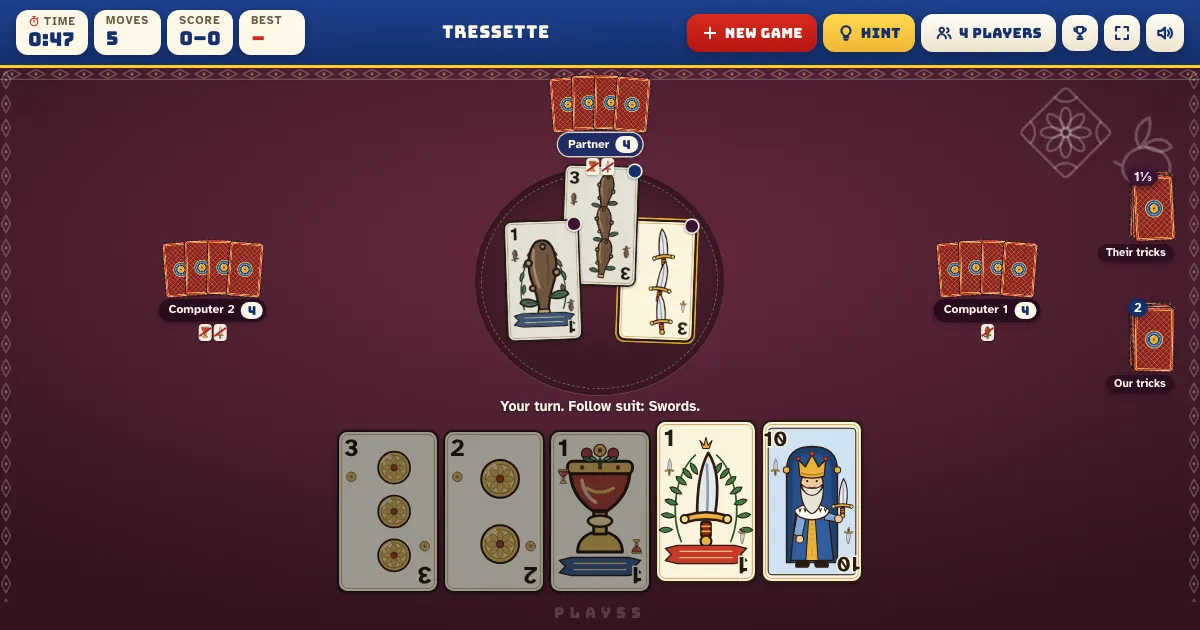
The leader plays any card, and the others must play a card of the same suit if they have one. A player with none of that suit may play anything, but that card cannot take the trick, however high it is. The highest card of the suit led wins, and its player leads the next one. This is the big difference from Briscola, where nobody has to follow suit and a trump beats everything.
Italian players have a word for being out of a suit: you are piombo, or you volo (fly) when you play your last card of it. In the Play5s version the cards you may not play are dimmed, and a tap on one says which suit you must follow. When a computer player does not follow, a small crossed-out suit sign appears under its name, so you can see which suits it has shown it is out of.
 Zoom in
How Tressette is scored
Each hand is worth 11 points: the Aces count 1, the 3s, 2s and court cards count a third, and the last trick adds 1, with every side's fractions dropped.
After ten tricks each side adds up the cards it took. Four Aces make 4 points and the twenty cards worth a third make 6⅔, so the deck holds 10⅔ points; the side that wins the last trick, the ultima, adds 1 more. Each side then drops its fraction, and the two totals always come to exactly 11. Three thirds make a whole point, so a side with 7⅔ scores 7.
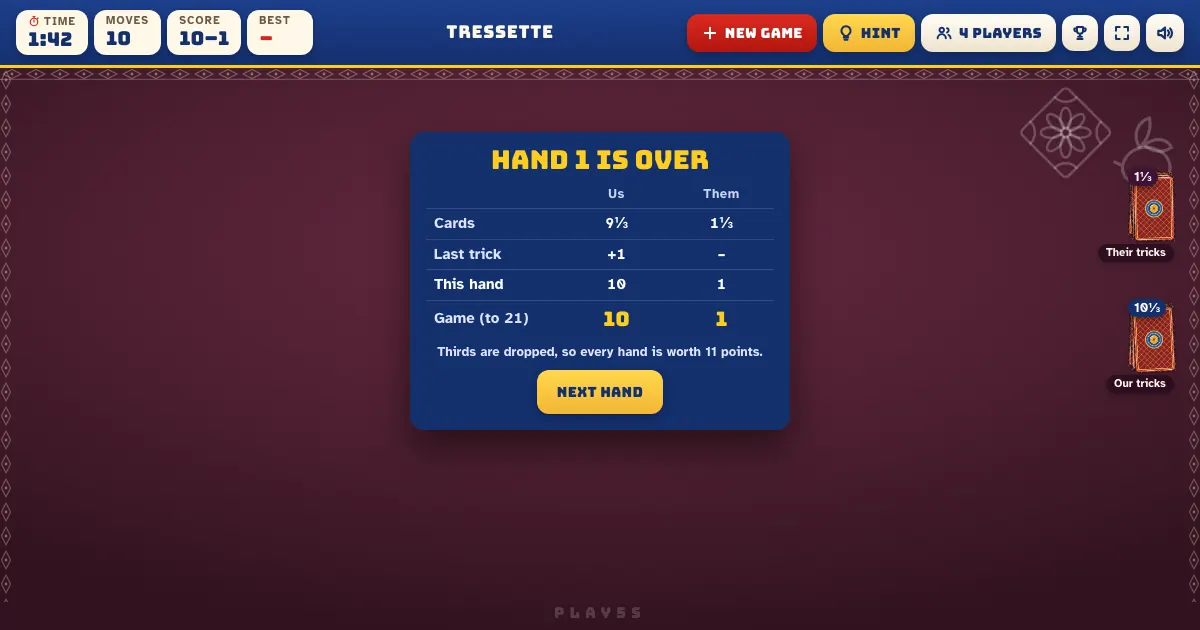
In the hand shown below, your side took the last trick and cards worth 9⅓, so it had 10⅓ and scored 10; the other side had 1⅓ and scored 1. Together that is 11. The leftover third is simply lost, as in every hand.
 Zoom in
A game runs over several hands until a side reaches the target. pagat, Modiano and the English Wikipedia give 21 points; the Italian Wikipedia says 21, 31 or 41 depending on the region. The Play5s version plays to 21 and offers 31 on the start screen. The game is checked after each hand: the side at or over the target with more points wins, and if both sides are level at or over it, one more hand is played. A game to 21 usually takes three or four hands.
Declarations: the Napoletana and the buongioco
With the declarations option on, a player who holds three or four 3s, 2s or Aces, or the 3, 2 and Ace of one suit, scores extra points before the cards are played.
These combinations are called accusi (declarations). Three of the same high rank, a buongioco, is worth 3 points, and all four is worth 4. The Napoletana, the 3, 2 and Ace of one suit, is worth 3. One card can count in two combinations: a Napoletana in cups and four 2s make 7 points, as pagat explains.
| Declaration | Cards | Points |
|---|---|---|
| Napoletana | the 3, 2 and Ace of one suit | 3 |
| Three of a kind | three 3s, three 2s or three Aces | 3 |
| Four of a kind | all four 3s, 2s or Aces | 4 |
With four players, each player declares at their turn in the first trick, and the points go straight to their side's game score. Some regions make the declarations compulsory and others leave them out, so groups usually agree first; with declarations, games are often played to 31. In the Play5s version the option is off by default, and when it is on, every player, you included, declares automatically at their first card, with a knock on the table and a line saying what was declared.
Tressette for two players
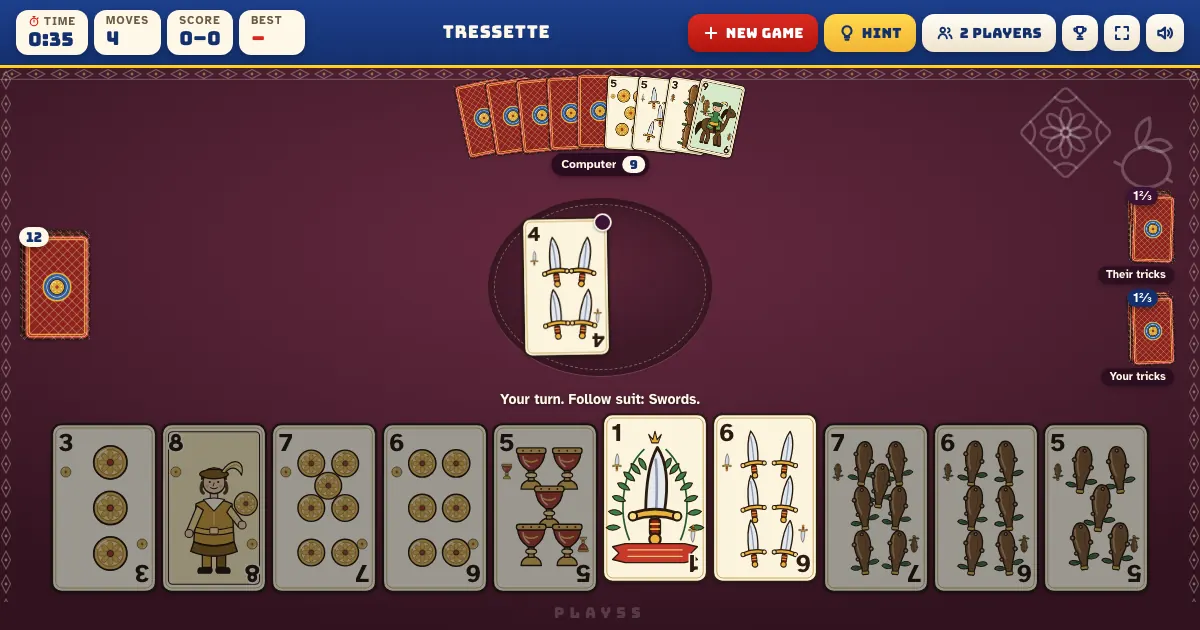
Two players each get ten cards, and the other twenty form a face-down stock: after every trick both draw a card, the winner first, and show it to the other player.
This is the version pagat calls Tressette in Due a metà mazzo, and the one the Italian and English Wikipedia describe. The rules of play are the same: you must follow suit, the highest card of the suit led wins, and the winner leads. Because every drawn card is shown, you always know some of the cards in the other hand. Once the stock is empty, the last ten tricks are played without drawing, so a hand has twenty tricks.
Being out of a suit is not final while the stock lasts, since a player can draw a card of that suit later. In the Play5s version the cards the computer drew stay face up in its fan until it plays them, which is what you would remember at a real table, and the crossed-out suit sign under its name means that none of its face-down cards is of that suit; it hides while the computer holds a card of that suit it drew. With declarations on, a drawn card that completes a combination is declared at once.
 Zoom in
Tressette tips: how to play your Aces
The core of Tressette is keeping your Aces safe until the 3 and the 2 of their suit are gone, because an Ace is worth three times any other card but loses to both.
- Count the 3s and 2s. An Ace is only safe to play once the 3 and the 2 of its suit have been played, or are in your own hand.
- With a Napoletana (3, 2 and Ace of one suit), lead the 3, then the 2, then the Ace: each one is the highest card left.
- Lead low cards from a long suit to draw out the other players' 3s and 2s, as the English Wikipedia suggests.
- When your partner is sure to take a trick, give them your points: the Ace of the suit if you have it, a court card if not.
- When you are out of the suit led, throw a 4 to 7 of a suit you will not need, and keep your Aces.
- Remember who has run out of a suit. With four players a player who did not follow is out of that suit for the rest of the hand; Play5s shows it as a small crossed-out suit sign under that player's name.
- Plan the end of the hand. The last trick is worth a full point, often the same as an Ace.
- In the Play5s version the Hint button shows the card the Expert level would play, and it never looks at the other hands. In a ranked game or the Daily Deal it asks first, because using it makes that game practice.
How the computer players play
The computer players only use what a player at their seat could see: their own cards, the cards played, the suits a player has run out of and, with two players, the cards the others drew.
A computer player never looks at your hand or at the face-down stock. Its moves depend only on the deal and on the cards played, so our server can replay a ranked game from your cards alone and work out the computer players' cards again.
There are three levels. Casual plays a random legal card now and then and simple rules the rest of the time. Standard tries each card it may play against several random deals of the cards it cannot see, and in a two-player game it plays the last five tricks exactly. Expert does the same with more deals and plays the last seven tricks exactly. In a Play5s test on 24 November 2026, with 900 simulated games to 21 per setting, you in the first seat and the computer at Standard, Expert won 61% of two-player games and 57% of four-player games, while a Standard player in the same seat won 49% in both; Casual won 3% with two players and 38% with four (300 games each). The leaderboards use the Standard level.
 Zoom in
Daily Deal and leaderboards
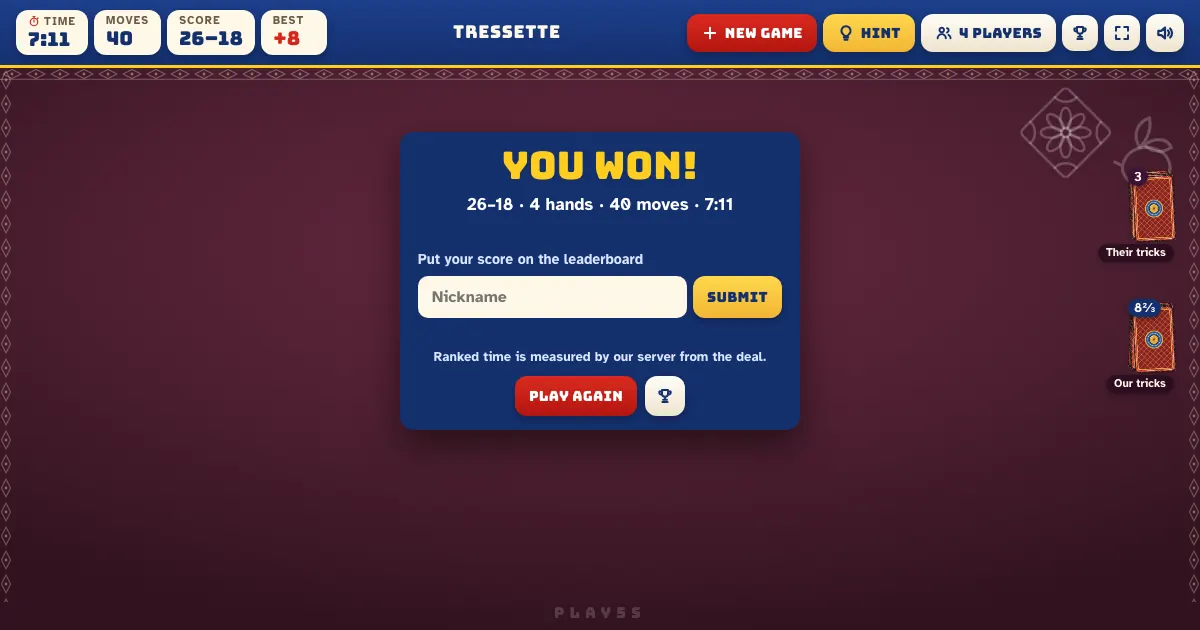
The Daily Deal is one four-player game that every player gets on the same day, and the leaderboards rank the margin by which your side won.
The leaderboards count a game to 21 without declarations at the Standard level. There is a board for four players and one for two players, and the Daily Deal has its own board. Only a game your side wins goes on a board, ranked by the margin: your side's final score minus the other side's, so a higher number is better. If two players have the same margin, the one with fewer seconds comes first, and then whoever posted first. Games to 31, declarations and the Casual and Expert levels are practice and are not ranked.
The Daily Deal is the same deal for everyone, the day changes at midnight New York time, and every deal on the list has a winning line for your side that our search found and replayed. It needs a connection because our server hands out the deal. Each connection gets one ranked Daily Deal result per day; after that the Daily Deal is practice.
The time is measured by our server from the moment it dealt the game. The nickname is 2 to 12 characters, offensive names are refused, and you do not need an account. Starting a ranked game asks our server for a deal and a ticket; your cards and nickname are sent only when you submit a score, and the server replays the game with its own copy of the rules to work out the margin.
 Zoom in
Controls and saving
You play by tapping or clicking a card to put it on the table, and the keyboard works for everything.
- Tap or click a card to play it. Only the cards you may play stand up; the others are dimmed.
- Press 1 to 9 to play the first nine cards of your hand from the left, and 0 for the tenth.
- Keyboard: Tab goes into your hand, the arrows move along it, Enter or Space plays a card. H shows a hint, N starts a new game, D or Enter on the button deals the next hand, F switches full screen and M switches the sound.
- Tap while the computer players are playing to make the rest of the trick quicker.
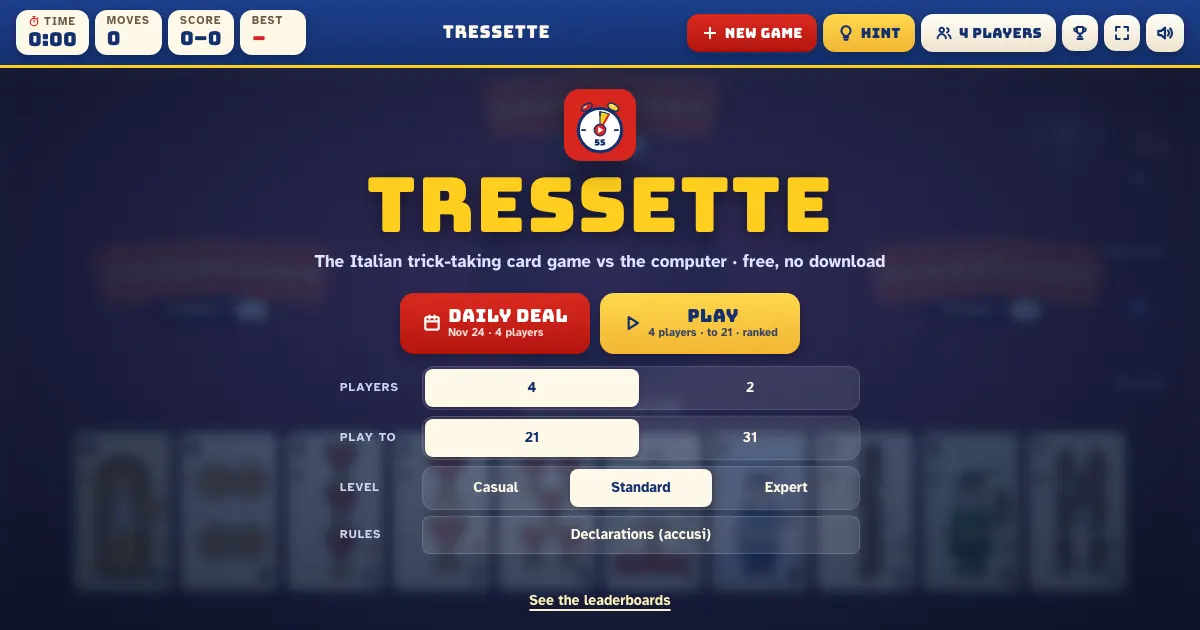
- The start screen has the number of players, the target, the level and the declarations option, and it remembers your choice.
- There is no Undo, because taking back a card after the others have answered would show you their cards.
- Your game in progress, your options and your best margins are saved in this browser on this device. Clearing your browser data removes them.
Where Tressette comes from
Tressette has been played in Italy since at least the early 18th century: the Italian Wikipedia cites a Latin poem about it printed in 1726.
The poem, "Ludus, vulgo dictus Tresette in quattro", was written by Gaetano Biondelli of Piacenza in 290 hexameters. A fuller account of the rules and strategy, the Codice di Chitarrella, was printed in Naples from 1840 on. The origin of the name is not clear; the Italian Wikipedia suggests that the 7s may once have been worth a third too, so that the scoring cards ran from the three to the seven. The game spread wherever Venice ruled, and it is still played as trešeta along the Croatian coast and in Slovenia.
Like Scopa and Briscola, Tressette is played with the 40-card Italian deck, and it has a family of related games: Spizzichino for two, Terziglio (Calabresella) for three, Tressette a chiamare, where partners are formed by calling a card, and Traversone or Ciapanò (the reverse game, also called Tressette a perdere), where the aim is to take as few points as possible. They are different games from the one on this page.
Tressette terms
Italian players use a handful of words for Tressette, and they often appear even in other languages.
- Passata: one trick. Mano: a hand of ten tricks (twenty with two players). Partita: the whole game to 21 or 31.
- Ultima: the last trick of a hand, worth one point. Some regions call it the rete or the dietra.
- Figure: the Jack, Knight and King. Scartine: the 4 to 7, worth nothing.
- Piombo: having no card of the suit led. Volo: playing your last card of a suit.
- Accuso: a declaration. Buongioco: three or four 3s, 2s or Aces. Napoletana (napoli): the 3, 2 and Ace of one suit.
- Busso, striscio, volo: signals a leader may give a partner in some regions. The Play5s computer players do not signal.
Where the rules come from
The rules on this page come from five sources read on 24 November 2026, and every choice specific to Play5s is listed here.
The sources agree on the deck, the order of the cards, the points, following suit and how a trick is won. The table shows where they differ and what Play5s does.
| Rule | What the sources say | Play5s |
|---|---|---|
| Order | All: 3, 2, Ace, King, Knight, Jack, 7, 6, 5, 4, no trumps | As the sources |
| Following suit | pagat, Wikipedia, Modiano: required; with none of the suit, any card, which never wins | As the sources |
| Points | All: Ace 1; 3, 2, King, Knight, Jack a third; last trick 1; fractions dropped, 11 a hand | As the sources |
| Four players | pagat, Wikipedia in Italian, Modiano: two teams, partners opposite, ten cards each | You and a computer partner against two computer players |
| Two players | pagat (Spizzichino), Wikipedia: ten cards each, 20 in the stock, winner draws first, drawn cards shown | As the sources |
| Target | pagat, Modiano, Wikipedia in English: 21. Wikipedia in Italian: 21, 31 or 41 by region | 21; 31 as an option |
| Declarations | pagat, Modiano, Wikipedia: three or four 3s, 2s or Aces 3 or 4, Napoletana 3. Modiano: compulsory; Wikipedia: regional | An option, off by default, never ranked |
| Throw-in | Modiano: a hand where a player holds under one point is dealt again | Done automatically |
| Calling out | pagat, Modiano, Wikipedia in Italian: a side may stop play and claim the target; a wrong claim loses | Not used: the game is checked after each hand |
| Signals | pagat, Wikipedia: busso, striscio, volo, not allowed everywhere | Not used |
| Cappotto | pagat: taking every trick wins two games. Wikipedia in Italian: worth 17 points (unsourced) | Not used: points are counted as usual |
The sources are pagat (John McLeod, Tressette, Spizzichino / Tressette in Due, and the Ciapanò page for the reverse game), the Tressette rules of the card maker Modiano, and Wikipedia in Italian and English. Play5s names the sources that offer games and links only to Wikipedia.
Tressette questions
What is the highest card in Tressette?
The 3. The order in each suit is 3, 2, Ace, King, Knight, Jack, 7, 6, 5, 4, and there is no trump suit, so a 3 only wins in its own suit.
How many points is a hand of Tressette worth?
Eleven. Aces count 1, the 3s, 2s and court cards a third, and the last trick 1; each side drops its fraction, so the two scores always add up to 11.
Do you have to follow suit in Tressette?
Yes. You must play a card of the suit led if you have one. With none of it you may play any card, but that card cannot win the trick.
How many points do you play to?
Usually 21; some regions play to 31 or 41, often 31 when declarations are used. The Play5s version plays to 21 and offers 31 on the start screen.
What is a Napoletana in Tressette?
The 3, 2 and Ace of the same suit. With declarations on, it is worth 3 points when declared, and three or four 3s, 2s or Aces are worth 3 or 4.
Can you play Tressette with two players?
Yes. Each player gets ten cards and the other twenty form a stock; after each trick both draw a card, the winner first, and show it. The Play5s version has this mode on the start screen.
What is the difference between Tressette and Briscola?
Briscola has a trump suit and no duty to follow suit, and the Ace and 3 are worth 11 and 10. Tressette has no trumps, you must follow suit, the 3 ranks highest and the points are counted in thirds.
Can the computer see my cards?
No. The computer players use their own cards, the cards played, the suits players have run out of and, with two players, the cards they saw you draw.
Which level should I choose?
Standard is the level used by the leaderboards. Casual is a good level to learn on. Expert tries more deals before each card and plays the last seven tricks exactly; in our test of 900 games it beat the Standard computer in about 6 games out of 10, where a Standard player wins 5 out of 10.
What is Tressette a perdere?
The reverse game, also known as Traversone, Rovescino, Ciapanò or Vinciperde: every player plays alone and tries to take as few points as possible. It is a different game from the one on this page, and Play5s does not have it.
Can you play Tressette with three players?
Not in the Play5s version, which has four players in two teams or two players. Games for three, such as Terziglio (Calabresella), are separate games with their own rules.
Is it Tressette or Tresette?
Both spellings are used for the same Italian game. This page uses Tressette, the spelling of pagat and of the English and Italian Wikipedia articles.
Is there a Tressette Daily Deal and a leaderboard?
Yes. The Daily Deal is the same four-player game for everyone on a given day, and there are all-time boards for four and two players. Boards rank your winning margin in a game to 21 at the Standard level, and you only need a nickname.
Does the game save my progress?
Yes. Your current game, your options and your best margins are saved in this browser on this device. Only games you choose to submit to a leaderboard are sent to our server, with your nickname.
About this version
This Tressette was built by Play5s to run in any modern web browser. It shuffles a new deal for every hand, and the computer players follow the rules described on this page. The cards are drawn by Play5s in the Italian style.
There is nothing to install and no account to create. Your game in progress and your best margins are kept in your browser on this device. Starting a ranked game or the Daily Deal asks our server for a deal and a ticket; your cards and nickname are sent only when you submit a game to a leaderboard.
The page gives the rules of Tressette as pagat, Modiano and Wikipedia describe them, and the choices specific to this version are listed in the section on where the rules come from.
Read more about Play5s, or see all of our free card games.