

On this page
How to play French Tarot
In French Tarot one player, the taker, plays alone against all the others in each deal and must win a minimum number of card points, which falls from 56 to 36 the more of the three bouts (the 1 of trumps, the 21 and the Excuse) the taker captures; partnerships change from deal to deal and each player keeps their own score.
The 78 cards and the three bouts
A tarot pack has 78 cards. Fifty-six are in the four usual suits, spades, hearts, diamonds and clubs, with fourteen cards each: King, Queen, Knight, Jack, then 10 down to 1. The Knight (cavalier) between the Queen and the Jack is the card a standard pack lacks. Then come 21 trumps (atouts), numbered 1 to 21, with the 21 highest; they beat every suit card. The last card is the Excuse, marked with a star, which works as an escape card rather than a trump.
Three cards matter more than any others: the 1 of trumps, called the petit, the 21 and the Excuse. They are the bouts (also written oudlers in English books). Each is worth 4½ points, and every bout the taker holds at the end lowers the score the taker needs.
Card points and the target
Every card in the tricks you win has a value. The whole pack is worth 91 points. Players count cards in pairs, a valuable card with a ½-point card, which gives round numbers: a king and a small card make 5, a queen and a small card make 4.
| Card | Points | Bouts held by the taker | Points needed |
|---|---|---|---|
| Bout (petit, 21, Excuse) | 4½ | 3 bouts | 36 |
| King | 4½ | 2 bouts | 41 |
| Queen | 3½ | 1 bout | 51 |
| Knight | 2½ | 0 bouts | 56 |
| Jack | 1½ | ||
| Any other card (2–20 of trumps, 1–10 of a suit) | ½ |
The deal and the chien
With four players everyone gets 18 cards, dealt three at a time, and six cards go face down in the middle: the chien (the dog, also called the kitty). Dealing, bidding and play all go anti-clockwise, so in Play5s the player on your right speaks and plays first when you deal. A player dealt the petit as their only trump, without the Excuse (the petit sec), must show it and the deal is cancelled; the game spots this and deals again. At a four-player table that happens in 0.18% of deals (exact odds).
Bidding: the four contracts
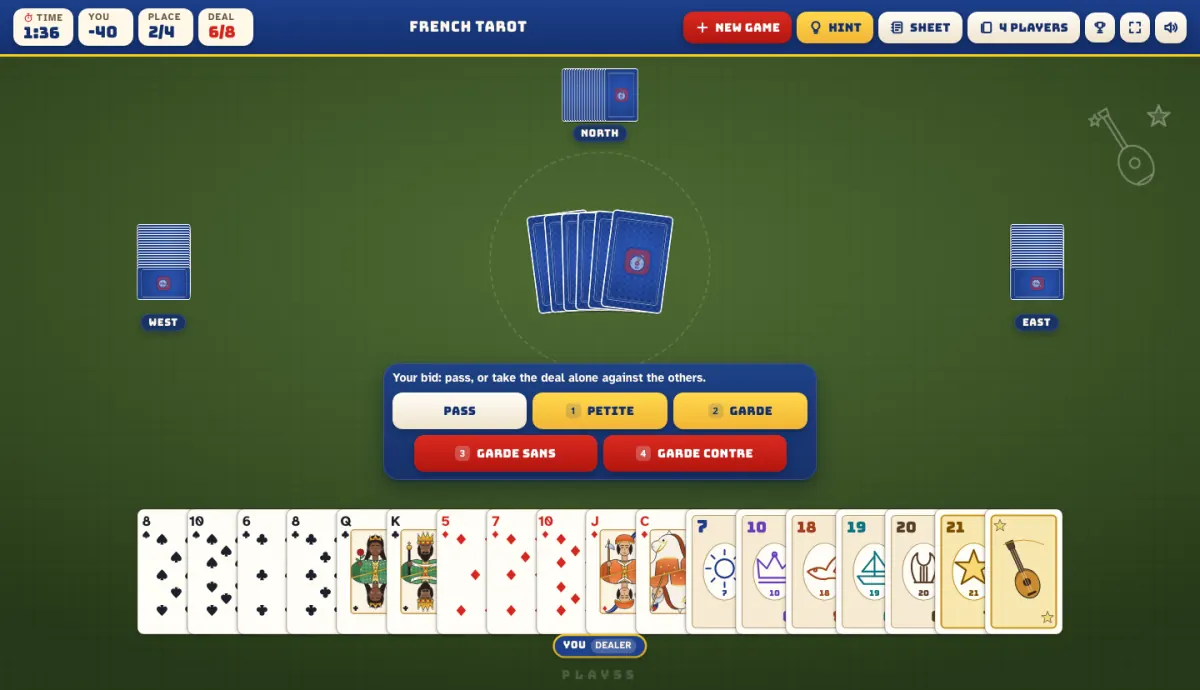
Starting on the dealer’s right, each player speaks once: pass, or bid a contract higher than any bid before. The highest bidder becomes the taker; the others form the defence for that deal. If everybody passes, the cards are thrown in and the next dealer deals.
| Contract | The chien | Multiplier |
|---|---|---|
| Petite (also called prise) | shown to all, taken by the taker, who then discards the same number of cards (six; three at five players) | ×1 |
| Garde | same as Petite | ×2 |
| Garde sans (sans le chien) | stays face down; its points count for the taker | ×4 |
| Garde contre (contre le chien) | stays face down; its points count for the defence | ×6 |
 Zoom in
The chien and the discard (écart)
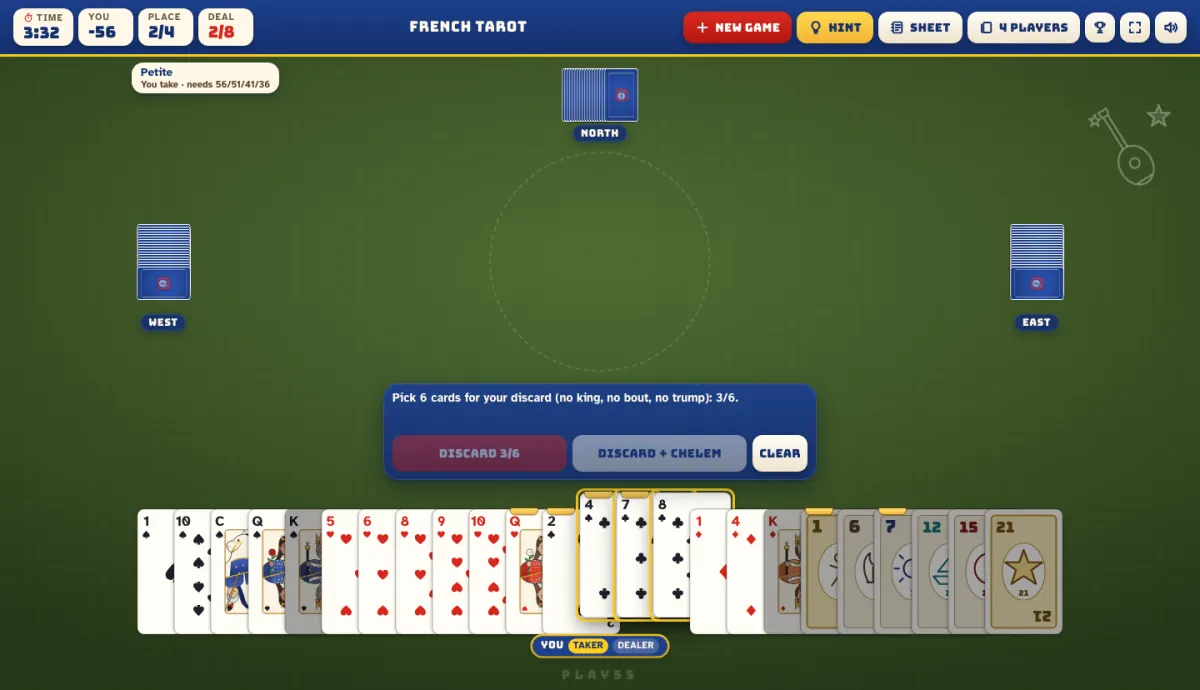
After a Petite or a Garde, the chien is turned face up for everyone to see and the taker adds it to their hand, then puts the same number of cards aside face down (six, or three at five players): the écart. The discard counts for the taker at the end. A king or a bout may never be discarded, and a trump only when nothing else is left; any trump put aside is shown to the defence. In Play5s the cards you may not discard are dimmed, and the cards that came from the chien carry a gold tab.
 Zoom in
Playing the tricks
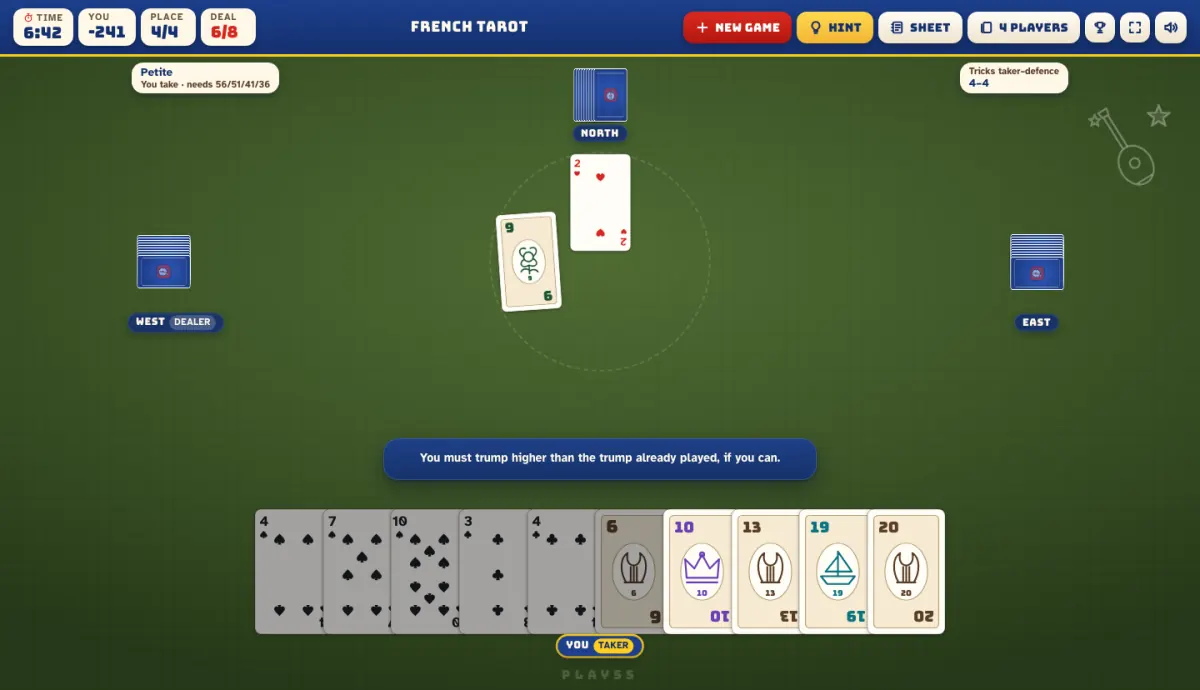
The player on the dealer’s right leads the first trick (the taker, if a chelem was announced), and the winner of each trick leads the next. You must follow the suit led, but you never have to play higher in a suit. With no card of that suit you must trump. When a trump is already in the trick, your trump must be higher than the highest one played if you can, even over a partner; if you cannot, you still play a lower trump (players say you "pisser"). Only with neither the suit nor a trump may you discard any card. When trumps are led, the same rule applies: go higher if you can.
The Excuse may be played on any trick instead of following. It never wins the trick, but its side keeps it and gives the winners a ½-point card in exchange. If the Excuse leads, the next card sets the suit. The FFT adds one rule that older books do not have: an Excuse played to the last trick goes to the other side, unless its side has taken every other trick, in which case it wins that last trick.
 Zoom in
How French Tarot is scored
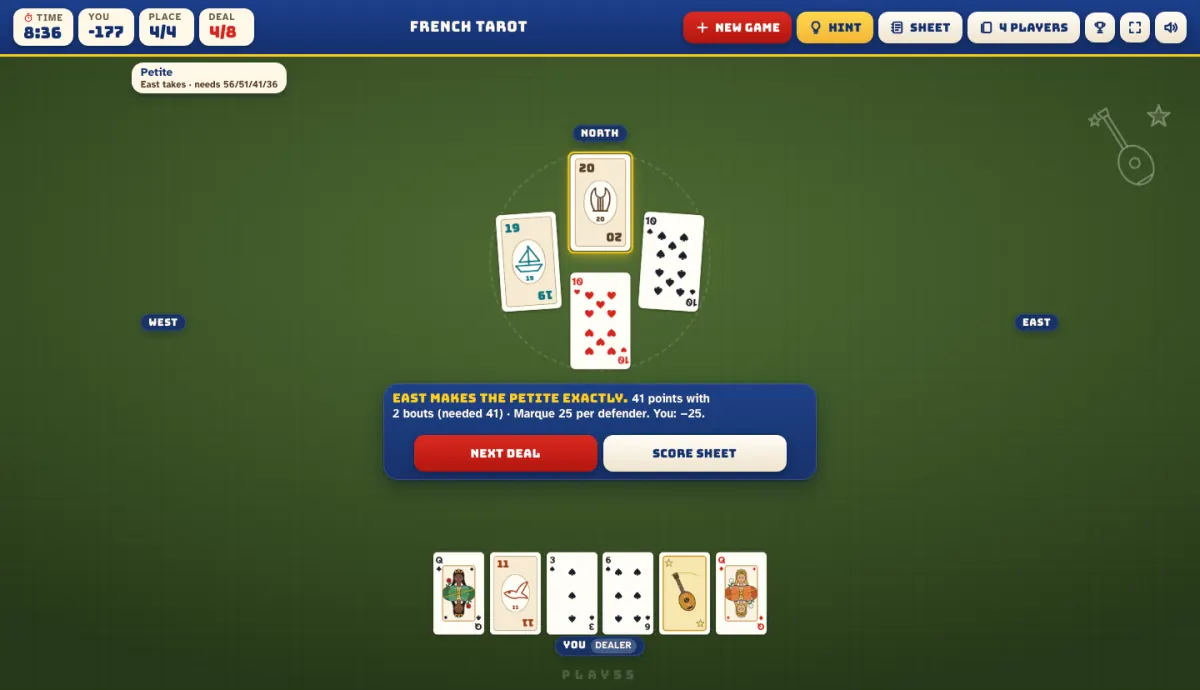
A deal is scored as 25 points plus the difference between the card points the taker made and the points they needed, multiplied by the contract (×1, ×2, ×4 or ×6); bonuses are then added, and each defender pays or receives that amount, so the scores of a deal always add up to zero.
If the taker reaches the target exactly, the contract is made by 0 and still scores 25. Short of it, the same formula is paid to the defenders. With four players the taker scores three times the amount, once from each defender. Example from the FFT rulebook: a Garde made with 49 points and two bouts (41 needed) is (25 + 8) × 2 = 66; add a poignée shown by the taker (20) and the petit taken in the last trick (10 × 2 = 20): 106 from each defender, 318 for the taker.
| Bonus | When | Value |
|---|---|---|
| Poignée (handful) | 10, 13 or 15 trumps shown before your first card (the Excuse may stand in for one only if no trump is hidden) | 20, 30 or 40, not multiplied; it goes to the side that wins the deal, whoever showed it |
| Petit au bout | the petit is in the last trick | 10 × the multiplier, to the side that takes that trick, whatever the result |
| Chelem (slam) | one side takes every trick | +400 if announced, +200 if not; −200 for an announced chelem that fails; +200 each to defenders who take every trick |
 Zoom in
French Tarot for three or five players
The FFT rules also cover three players, with 24 cards each and a six-card chien, and five players, with 15 cards each, a three-card chien and a called king: the taker names a king, and whoever holds it becomes the taker’s secret partner until that card is played.
With five players, a taker who holds all four kings may call a queen (with four kings and four queens, a knight). Calling a card from your own hand, or a card that turns out to be in the chien, means you play alone against four. The first trick may not be led in the called suit unless it is the called king itself. When there are halves in the count, the half point goes to the side that wins: 40½ with two bouts is 40, a contract down by one.
| 3 players | 4 players | 5 players | |
|---|---|---|---|
| Cards each / chien | 24 / 6 | 18 / 6 | 15 / 3 |
| Poignée (single, double, triple) | 13, 15, 18 trumps | 10, 13, 15 trumps | 8, 10, 13 trumps |
| Taker scores | 2 × the marque | 3 × the marque | 2 × with a partner (partner 1 ×), 4 × alone |
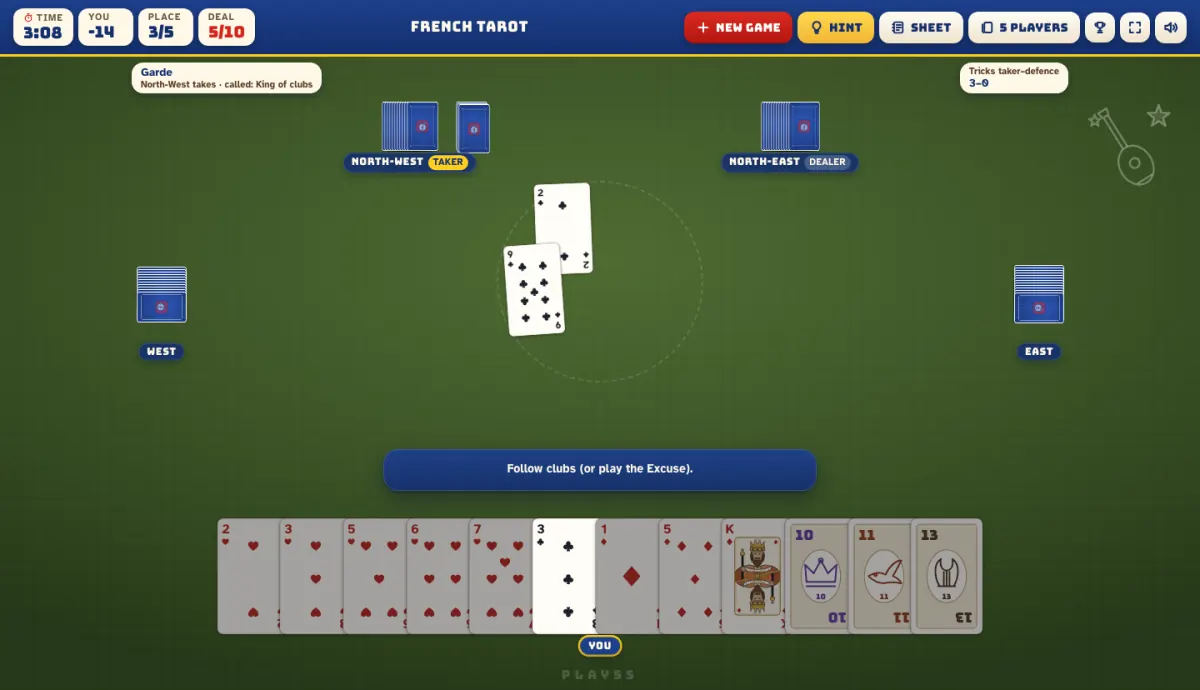
| A game on Play5s | 6 deals | 8 deals | 10 deals |
 Zoom in
Tips and odds for French Tarot
Most French Tarot hands are decided by the bouts and the trumps: bid when you hold two bouts or many trumps with a king or two, protect your petit, and as defender make the taker spend trumps; the exact odds in this section show how rare an extreme hand is, from holding the 21 to a petit sec.
Six habits separate a winning taker from a losing one, and most of them are about trumps and the petit.
- Count your hand before bidding. French players add points: 10 for the 21, 8 for the Excuse, up to 9 for a well-guarded petit, 2 per trump, 6 per king, more for long suits and voids. The Play5s computer bids with a count of this kind.
- Guard the petit. With few trumps the petit is easy to capture, and losing it costs 4½ points and lowers your bout count. Play it on a trick your side is sure to win.
- Hunt the petit as taker. Leading high trumps forces the other players to follow with trumps, and the petit falls when its owner runs out of smaller ones.
- Discard to make a void. Putting aside a whole short suit lets you trump it later; queens and knights you cannot protect score for you in the discard.
- Defend by leading where the taker is void. Each trick the taker has to trump is a trump that cannot hunt your petit.
- Save points with the Excuse. Play it on a trick you are losing rather than give away a queen, and never keep it for the last trick.
The odds of a hand
The table gives the exact chance of a few hands for one player, worked out from the 78-card pack. In 2,000 simulated four-player games between Play5s computer players, 29% of deals were thrown in because everybody passed, Petite was made 49% of the time and Garde 74%; at three players only 16% of deals were passed, and at five players fewer than 2%.
| Event | 3 players (24 cards) | 4 players (18 cards) | 5 players (15 cards) |
|---|---|---|---|
| Holding the 21 | 30.8% | 23.1% | 19.2% |
| At least one bout | 67.4% | 55.0% | 47.8% |
| Enough trumps for a single poignée | 0.11% | 0.52% | 2.13% |
| Petit sec (deal cancelled), any player | 0.012% | 0.18% | 0.66% |
Playing French Tarot on Play5s
This version deals you in against computer players with the FFT rules: four players by default, three or five players from the start screen, a game of two full rounds of dealers, and you win by finishing with the highest total.
The game and the computer players
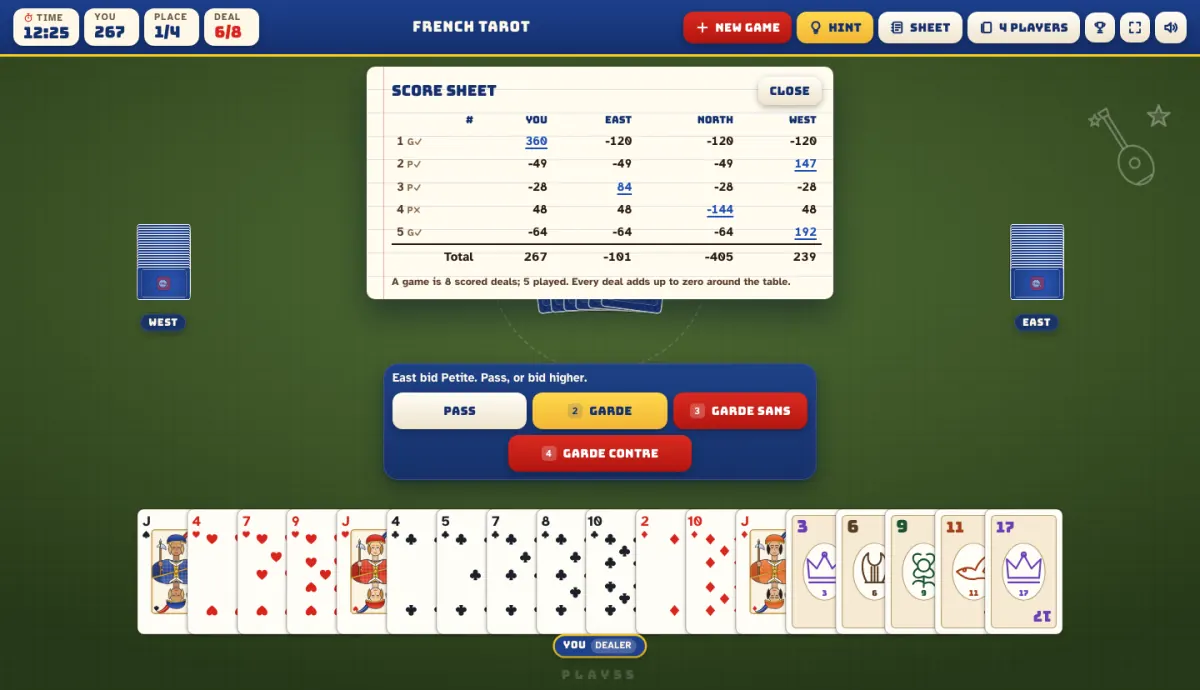
A game lasts two rounds of dealers: 8 scored deals at four players, 6 at three, 10 at five. Thrown-in deals do not count. The computer players decide only from their own cards and what has been shown, never from hidden cards, and with no randomness: the same deal and the same moves give the same game. You may show a poignée before your first card when you hold one, and announce a chelem after your discard or after a Garde sans or Garde contre. The Sheet button shows every deal and every player’s total.
 Zoom in
Controls
Everything can be played with a finger, a mouse or the keyboard alone.
- Tap or click a card to play it, or to pick it for your discard; tap it again to put it back.
- Keyboard: arrow keys move between your cards, Enter or Space plays or picks one; P passes and 1 to 4 bid Petite to Garde contre.
- H shows a hint (the card or bid the computer would choose), S opens the score sheet, N starts a new game (it asks first), F toggles full screen, M turns sound on or off.
- The game is saved on this device after every move: close the page and Continue later.
Daily Deal and leaderboards
The Daily Deal is the same four-player game for everyone that day, changing at midnight New York time; it needs a connection because our server deals it. Each connection gets one ranked Daily result per day; replays after that are practice. Each mode also has an all-time board. Only games you finish first go on a board, ranked by your total; ties go to fewer seconds, then to whoever posted first. Time is measured by our server from the deal. Starting a ranked game asks our server for a deal and a ticket; your moves and nickname (2–12 characters, offensive names are refused) are sent only when you submit a score. No account is needed.
Official FFT rules and house rules
Play5s follows the FFT rulebook, which has been the reference for clubs and tournaments since the federation was founded in 1973; several rules you may meet at home are variants that are not part of it, such as the Pousse bid, the misère bonus and the petit imprenable.
The table lists the house rules met most often, from Pagat and the French Wikipedia article, next to the FFT rule this game uses.
| Rule | FFT (Play5s) | House variants |
|---|---|---|
| Excuse in the last trick | goes to the other side (unless it wins a chelem) | goes to the trick winner (older books) |
| Bids | Petite, Garde, Garde sans, Garde contre | some add a Pousse between Petite and Garde, or play without Petite |
| Misère (no trumps or no court cards) | not a bonus | sometimes 10 points |
| Petit sec | deal cancelled | "petit imprenable": kept and played like an Excuse |
| Five players | a called king, partner 1/3 of the gain | the dealer sits out (the FFT’s own format for tournament tables of five), or a 14-card deal with an 8-card chien and no partner |
Where French Tarot comes from
French Tarot descends from the Italian tarocchi, card games with an extra suit of trumps played in northern Italy in the fifteenth century; the game reached France early in the sixteenth century, and its modern four-player rules were made official by the Fédération Française de Tarot, founded in 1973.
Rabelais lists tarot among Gargantua’s games in 1534. The game faded in most of France in the following centuries and came back strongly after 1950, played with the modern French-suited pack that has picture scenes on its trumps. Using tarot cards for fortune-telling came later, from the eighteenth century, and has nothing to do with the card game. Similar tarot games are still played in Austria, Hungary, Switzerland and elsewhere (French tarot on Wikipedia). The FFT rulebook (in French) can be read online.
French Tarot questions
Is French Tarot the same as fortune-telling tarot?
No. French Tarot is a card game for three to five players with a 78-card pack whose trumps are numbered; fortune-telling uses tarot cards in a different way and came later.
How many players does French Tarot need?
Four is the official game; the FFT rules also cover three players (24 cards each) and five players (15 cards each and a called king). On Play5s the computer fills every other seat.
What are the bouts in French Tarot?
The petit (1 of trumps), the 21 of trumps and the Excuse. Each is worth 4½ points, and the more of them the taker captures, the fewer points the taker needs: 56 with none, 51 with one, 41 with two, 36 with all three.
Which contract should I bid?
Petite or Garde when you can win with the help of the chien; Garde sans or Garde contre only with a very strong hand. A higher contract doubles or more what you win or lose.
How do you count points in French Tarot?
Add up the cards in the taker’s tricks (counted in pairs, 91 in the whole pack), compare the total with the target set by the bouts held, then score 25 plus the difference, times 1, 2, 4 or 6 for the contract, and add the bonuses. Each defender pays or receives that amount.
How many cards are in the chien, and how many do I discard?
Six cards at three or four players, three cards at five players. The taker picks up the chien and puts the same number of cards aside face down; they count for the taker at the end.
Can I discard trumps?
Only when you have no other card that may go aside, and never the petit, the 21 or the Excuse. Kings may never be discarded. Trumps put aside are shown to everyone.
Must I trump higher than my partner?
Yes. When a trump is in the trick you must play a higher trump if you have one, even if a partner played it; with no higher trump you play a lower one.
When does the Excuse win a trick?
Only in the last trick, and only when its side has taken every other trick. Otherwise it never wins: its side keeps it and gives a ½-point card instead, and if it is played to the last trick it goes to the other side.
Who wins a game of French Tarot here?
The player with the highest total after two rounds of dealers: 8 scored deals at four players, 6 at three, 10 at five.
Is the Daily Deal the same for everyone?
Yes. Everyone gets the same four-player game that day, and it changes at midnight New York time. You need a connection to play it.
Can French Tarot be played with two players?
The FFT rules cover three, four and five players. Pagat describes a two-player variant with piles of cards laid out on the table, but this version does not include it.
Can I play French Tarot with friends here?
No. On Play5s every other seat is a computer player, at three, four or five players; the game does not connect players to each other.
Is French Tarot on Play5s free?
Yes. It plays in the browser on a phone, tablet or computer, with no download and no account.
About this version
This French Tarot is Play5s’s own version, written for the browser with its own card designs, and it follows the official rules of the Fédération Française de Tarot for four, three and five players.
The computer players bid with a hand count calibrated on simulated games and play from what is visible to them. Your game is saved on this device, and leaderboard games are checked by replaying your moves on our server.
Read more about Play5s, or see all of our free card games.