
On this page
How to play Skat
In Skat three players bid for the right to play alone against the other two: whoever wins the bidding picks up two hidden cards, names the game and needs 61 of the 120 card points to win.
The pack, the cards and the points
Skat uses a 32-card pack: the 7, 8, 9, 10, Jack, Queen, King and Ace of each of the four suits. The official rules call the suits Kreuz (clubs), Pik (spades), Herz (hearts) and Karo (diamonds), and Play5s shows the international French suits. Aces count 11 card points, tens 10, kings 4, queens 3 and jacks 2; the 9, 8 and 7 count nothing. The whole pack is worth 120 points.
In a suit game and in Grand the four jacks are the highest trumps whatever their printed suit, in the fixed order clubs, spades, hearts, diamonds. In a suit game the other seven cards of the trump suit follow them: Ace, 10, King, Queen, 9, 8, 7. In every plain suit the order is Ace, 10, King, Queen, 9, 8, 7. A jack is never a card of its printed suit, so with hearts as trump the jack of clubs is the highest heart.
The deal and the three seats
Each player gets ten cards and two cards go face down to the middle: the skat, named after the Italian and French words for “put aside”. The deal passes clockwise after every deal. The player to the dealer’s left is forehand and leads the first trick of every deal, the next player is middlehand, and the dealer is rearhand. In Play5s you sit at the bottom, Heinz sits at the top left and Gerda at the top right, and a small tag shows the part each of you plays.
A series is 12 deals, so each seat deals four times. A deal that nobody plays still counts as one of the 12.
Bidding (Reizen)
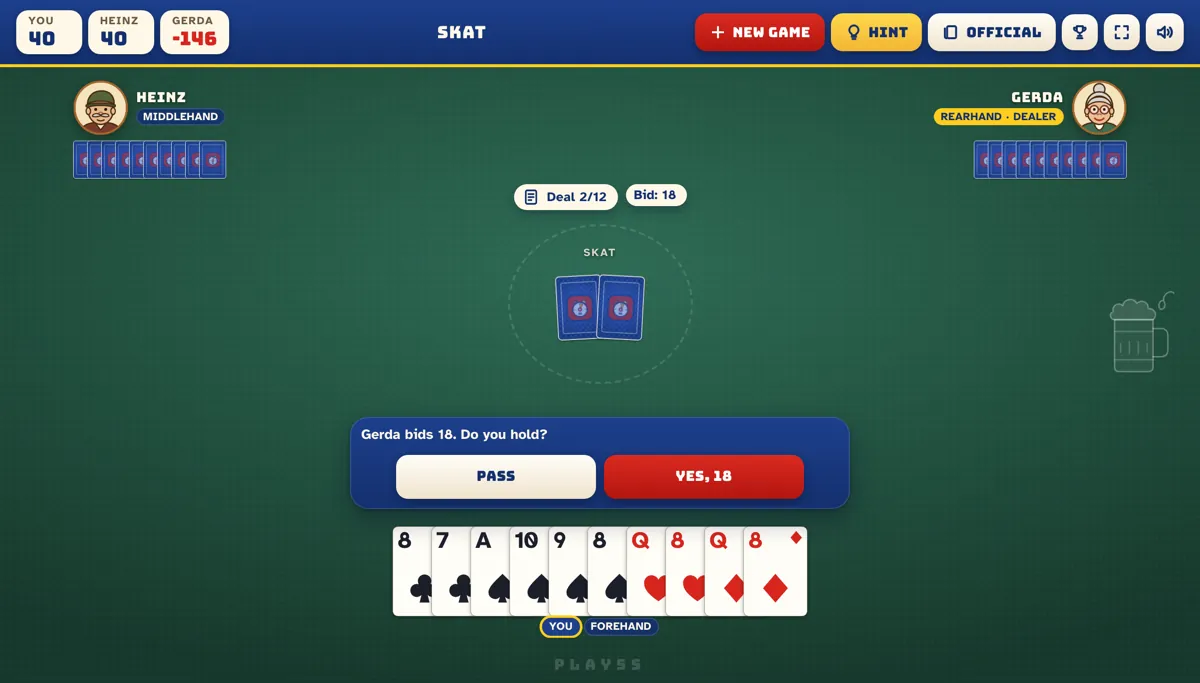
A bid is a number: the value, in game points, of a game you are ready to play. Only values a game can really have are legal, so the bids run 18, 20, 22, 23, 24, 27, 30, 33, 35, 36, 40, 44, 45, 46, 48, 50, 54, 55, 59, 60 and on up to 264. Middlehand speaks first to forehand: middlehand bids a number or passes, and forehand answers yes (the bid is held) or passes. The rules let a player jump to any legal number; Play5s offers only the next one, to keep the choice short. Whoever is left then faces rearhand, who must bid higher than any number said so far. The player who does not pass last becomes the declarer and plays alone against the other two, who form a team.
If middlehand and rearhand both pass, forehand may still play at 18 or throw the deal in. In Play5s the panel above your hand asks the question, shows the next bid and the Pass button, and the computer players speak in a bubble over the table.
 Zoom in
Picking up the skat and naming the game
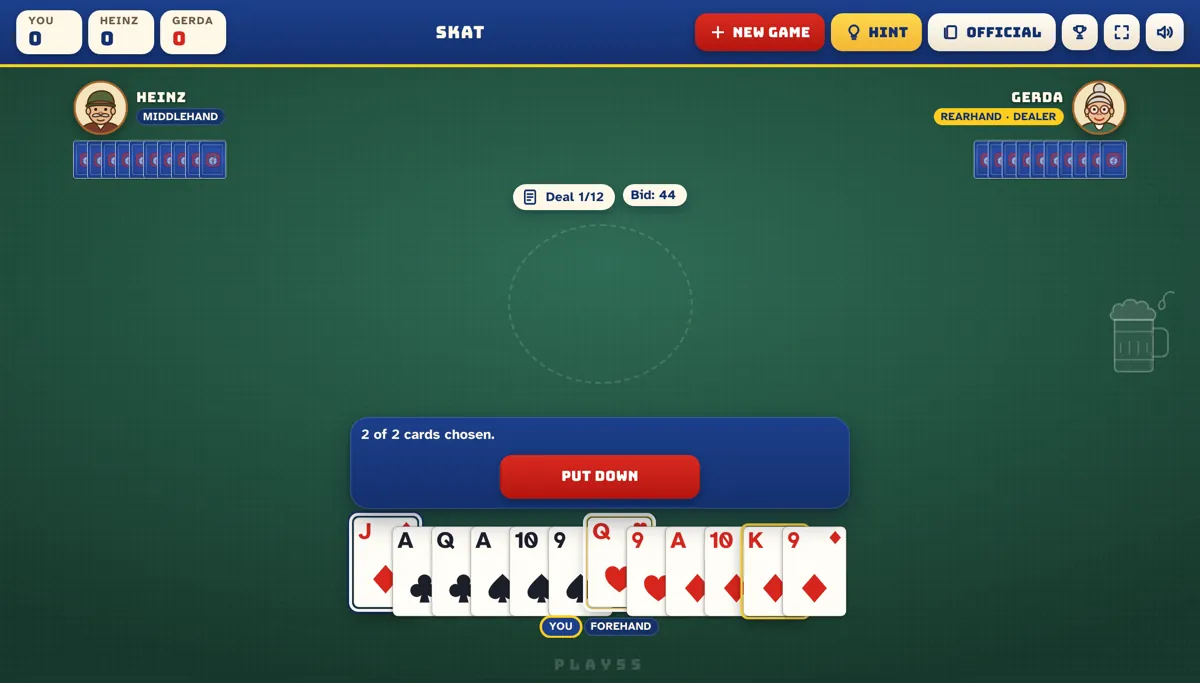
The declarer takes the two skat cards, looks at all twelve cards and puts two cards back face down. The cards put down count for the declarer at the end, so a ten or an ace can be put down on purpose; the two cards may also be the ones just picked up. Then the declarer names the game. The value of the game must be at least the bid, or the declarer has overbid and loses.
You can also decline the skat and play a Hand game straight from your ten cards. A Hand game is worth more, and in a suit or Grand game only a Hand game may announce Schneider, Schwarz or Ouvert (see the next section); Null Ouvert, which picks up the skat, is the one exception.
 Zoom in
Playing the ten tricks
Forehand leads to the first trick whoever the declarer is, and then the winner of each trick leads the next. Play goes clockwise and you must follow suit if you can; a player with no card of the suit led may play anything. A trick is won by the highest trump if there is one, otherwise by the highest card of the suit led. Remember that the jacks are trumps, so a jack is not a card of its printed suit and cannot be used to follow it.
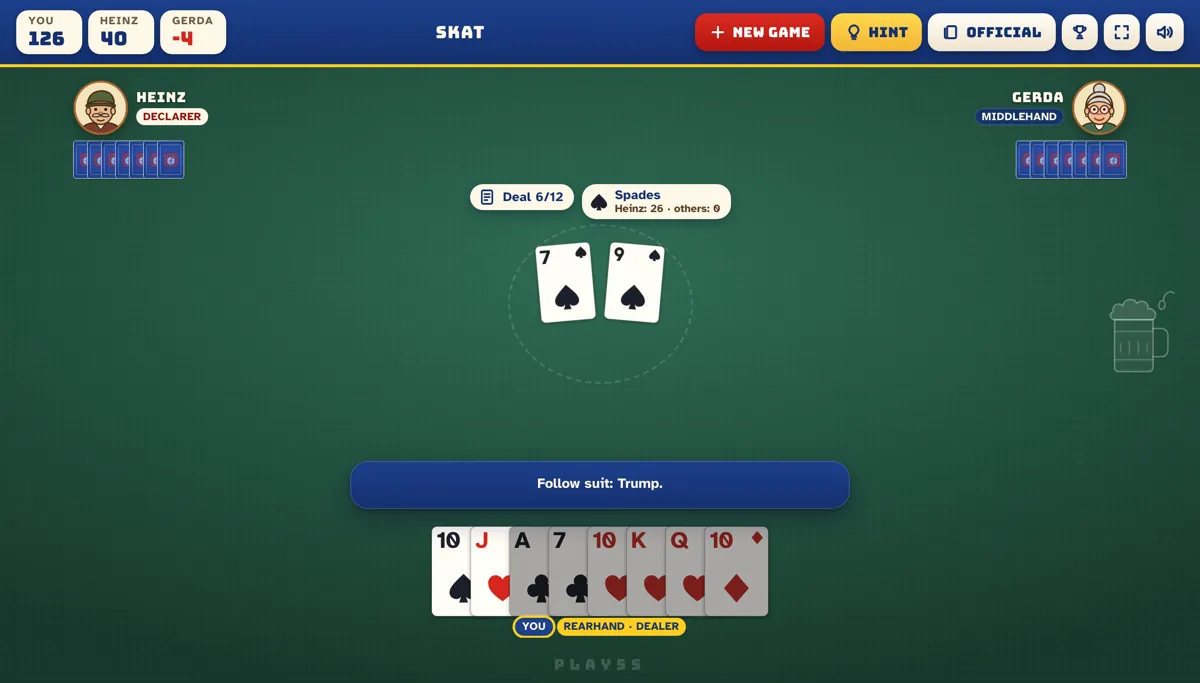
The Play5s table dims the cards you may not play, tells you which suit to follow, and shows the card points the declarer has taken so far and the points the other two have taken.
 Zoom in
The games: suit games, Grand and Null
There are three kinds of game: a suit game, where one suit is trump together with the jacks, Grand, where only the jacks are trump, and Null, where there are no trumps and the declarer must lose every trick.
Suit games and Grand
In a suit game the declarer names diamonds, hearts, spades or clubs as trump. In Grand only the four jacks are trump, which makes it the strongest game with a hand full of jacks and aces. In both, the declarer wins with at least 61 card points, counting the two cards put down, and the other two win with 60 or more. The fixed base value of a suit game is 9 for diamonds, 10 for hearts, 11 for spades and 12 for clubs, and Grand is worth 24.
Null
In Null there are no trumps and no card points: the declarer wins by taking no trick at all, and the deal stops as soon as the declarer takes one. The cards rank Ace, King, Queen, Jack, 10, 9, 8, 7 in every suit, so the jacks are ordinary cards. A Null has a fixed value: matadors and stages do not change it. Play5s does not offer a Null worth less than your bid: the rules would let you name it, but the deal would be lost at once.
| Game and value | What is different |
|---|---|
| Null · 23 | You pick up the skat and put two cards down. |
| Null Hand · 35 | You play from your ten cards, without the skat. |
| Null Ouvert · 46 | You pick up the skat, and you play with your cards face up for the opponents. |
| Null Ouvert Hand · 59 | Hand and Ouvert together. |
Hand games, Schneider, Schwarz and Ouvert
Playing a suit or Grand game from your ten cards is called Hand, and it adds a step to the value. Only a Hand game lets you announce more before the first card: Schneider (you promise to take at least 90 card points), Schwarz (you promise to take every trick) or Ouvert (you promise every trick with your cards lying face up). An announcement raises the value. Missing it loses the game even if you reach 61 points, and the loss is counted with the full value of what you announced; Schwarz and Ouvert games stop as soon as the opponents take a trick: the rules play every deal to the end, Play5s only skips the rest when the result can no longer change.
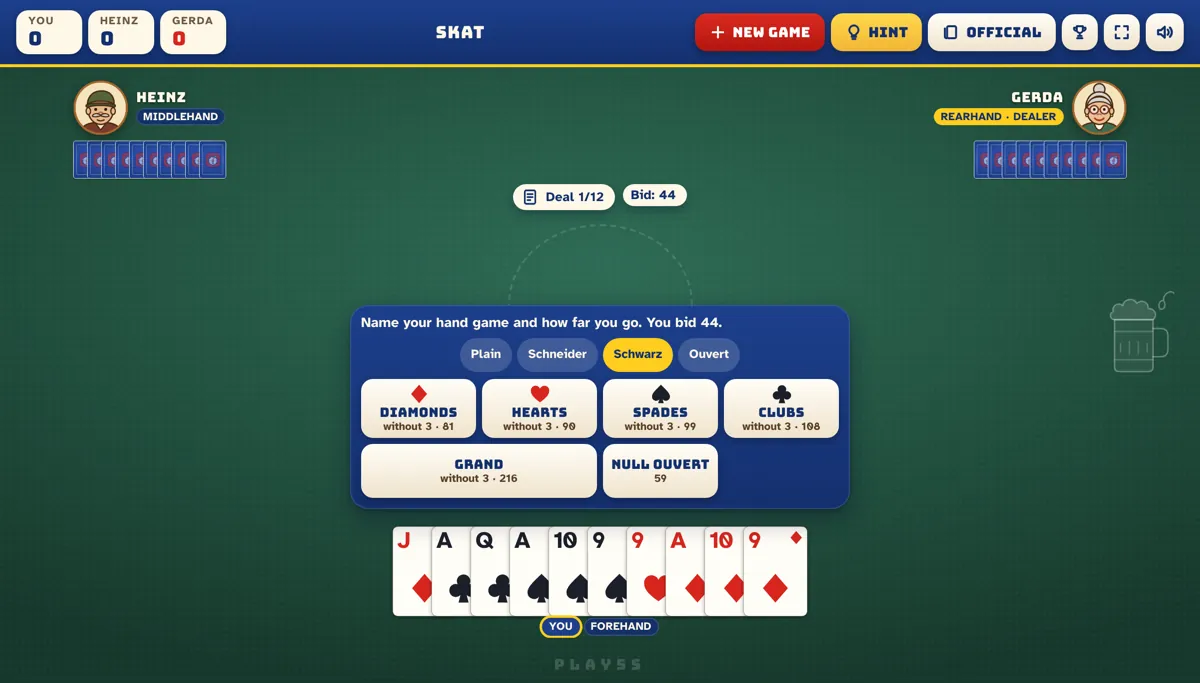
In Play5s, after you choose Play hand, a row of buttons above the games lets you pick Plain, Schneider, Schwarz or Ouvert, and every game button shows what it would be worth with that choice. A game too low for your bid is shown with a red value. In a Null Ouvert the computer players use your open cards when they lead; in a suit or Grand Ouvert they do not use them.
 Zoom in
How scoring works in Skat
A game’s value is its base value times a factor, the matadors plus the game stages; the declarer scores the value plus 50 for a won game, and loses twice the value plus 50 for a lost one, while each opponent gets 40.
The value of a game
The factor is the number of matadors plus the stages of the game. Matadors (the German word is Spitzen) count the top trumps in unbroken order from the jack of clubs: the declarer plays “with” as many as he holds among his ten cards and the two skat cards, or “without” as many as are missing from the top. The skat cards count even in a Hand game, where the declarer has not looked at them. A suit game has at most 11 matadors (four jacks and seven trumps) and Grand at most 4. “With 2” means the declarer has the jack of clubs and the jack of spades but not the jack of hearts.
The stages are counted one by one: the game itself (1), Hand (+1), Schneider (+1), Schneider announced (+1), Schwarz (+1), Schwarz announced (+1) and Ouvert (+1). Without Hand the possible stages are only game, Schneider and Schwarz. So clubs with 2 matadors and nothing else is worth (2 + 1) × 12 = 36, and Grand with 4 and Ouvert played from the Hand, the highest game there is, is worth (4 + 7) × 24 = 264, which is why the bids stop there.
| Game | Base | with or without 1 | 2 | 3 | 4 |
|---|---|---|---|---|---|
| Diamonds | 9 | 18 | 27 | 36 | 45 |
| Hearts | 10 | 20 | 30 | 40 | 50 |
| Spades | 11 | 22 | 33 | 44 | 55 |
| Clubs | 12 | 24 | 36 | 48 | 60 |
| Grand | 24 | 48 | 72 | 96 | 120 |
Winning, Schneider and overbidding
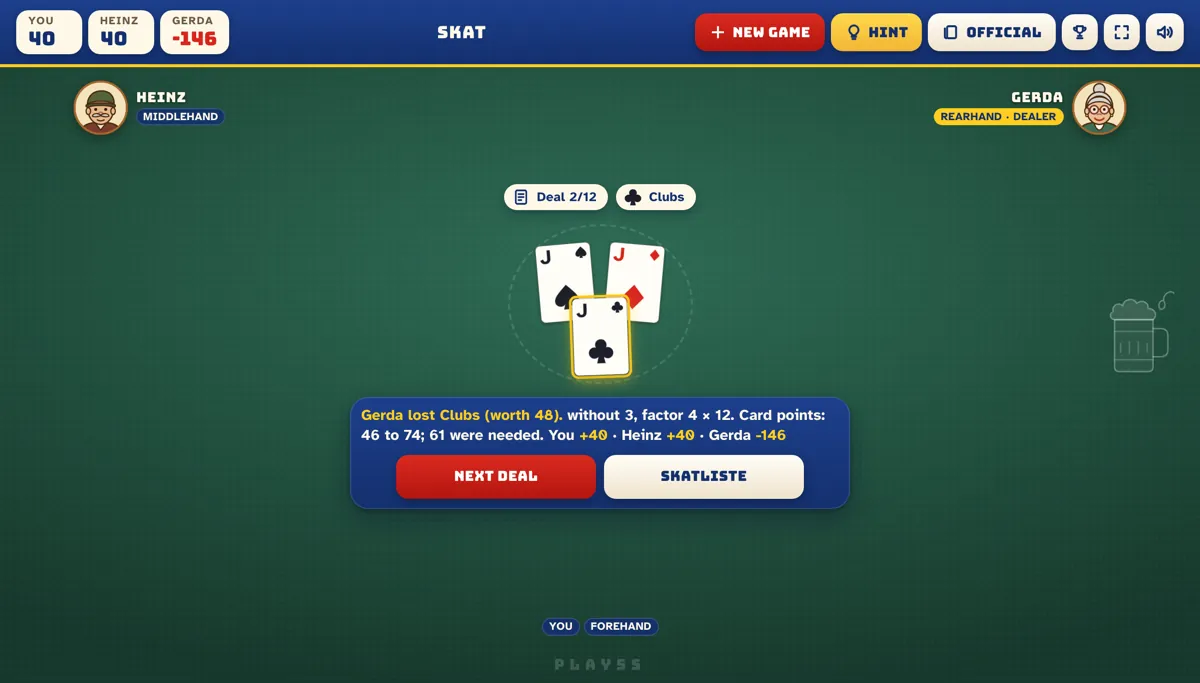
A declarer in a suit or Grand game wins with 61 or more card points. If the opponents take 30 or fewer they are Schneider, which adds a stage, and if they take no trick they are Schwarz, which adds another; the same words apply to a declarer who takes 30 or fewer, or no trick. The declarer must also keep every announcement made. A game whose value is lower than the bid is lost whatever the card points: it is “überreizt”, overbid, and the loss is counted with the lowest multiple of the base value that reaches the bid.
For example, a declarer who bids 46 and plays clubs worth only 36 loses even with 74 card points, and the game counts as lost at twice 48, the lowest multiple of 12 that meets 46, before the 50 of the series scoring is taken off as well. Play5s shows the value of each game before you choose it for that reason.
 Zoom in
Scoring a series: the Skatliste
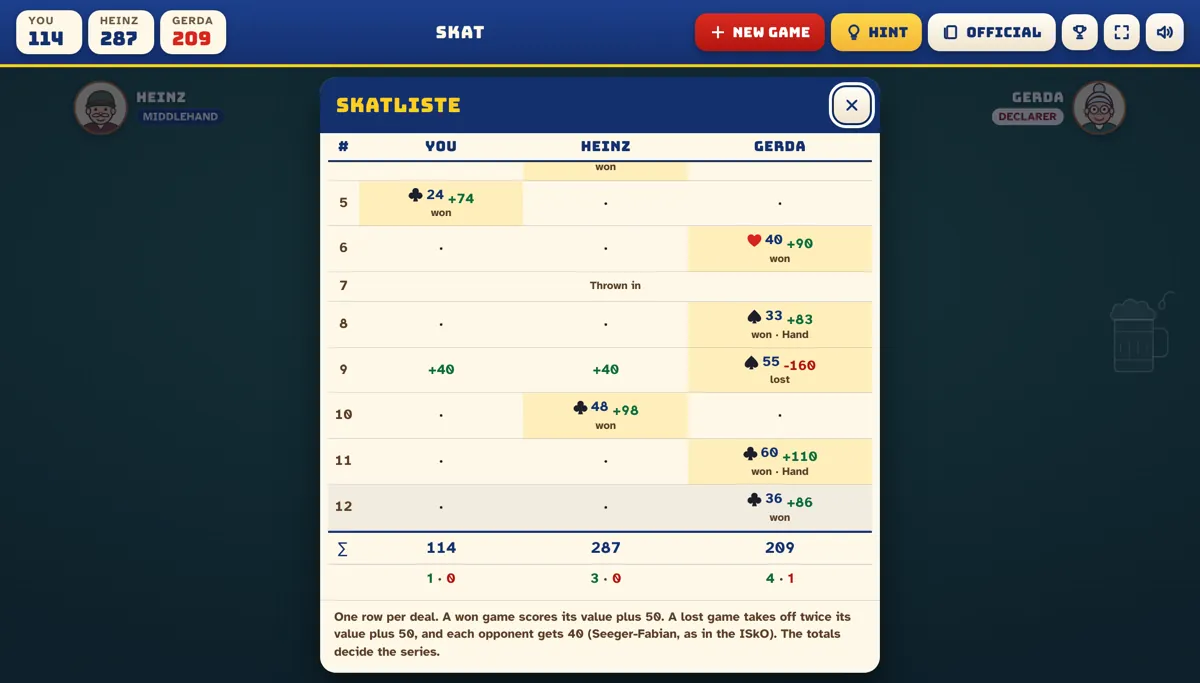
Play5s scores the series the way the International Skat Rules score a tournament at a table of three. The declarer of a won game is credited the value of the game plus 50; the declarer of a lost game loses twice the value plus 50, and each of the two opponents gets 40. A deal that nobody plays scores nothing. After 12 deals the highest total wins; if two totals are equal, more games won decides, then fewer games lost.
The Skatliste is the score sheet of the series, with one row per deal and the three players in columns. Tap the deal chip on the table, or press L, to open it. It shows who played what, the value and whether the game was won, lost or overbid, and the totals.
 Zoom in
Official rules or Ramsch?
Official and Ramsch differ in one situation: when all three players pass, Official throws the deal in and the next player deals, while Ramsch plays a game in which everyone tries to avoid card points.
The International Skat Rules do not know Ramsch; when nobody wants to play the deal is thrown in. In social games Ramsch is very common, and the German Wikipedia says that at leisure tables it is often played with the cards just dealt. Because the sources split, Play5s lets you choose. Official is the default and the mode of the Daily Deal. Ramsch is one tap away on the start screen or the mode button and has its own leaderboard. Everything else is the same.
The Ramsch of Play5s is the plain kind (Augenramsch): only the jacks are trump, as in Grand, and each player plays for himself. Forehand leads, each trick goes to the highest card, and the two skat cards go to the player who takes the last trick. The player with the most card points loses exactly that many points; a player who took no trick doubles the loss; two players level on the most both lose; 40 points each means nobody loses. A player who takes all ten tricks scores 120 instead of minus points. Schieberamsch, where the skat is passed on, and Kontra are not in this version.
Skat strategy and the odds of the deal
The best way to improve at Skat is to bid only on hands with jacks and long suits, count the trumps that have fallen, and remember that a lost game costs twice what a won one earns.
Bidding
In the beginners’ guides listed under Sources, a hand is worth a suit game when it has several jacks, especially the jack of clubs, and a long suit with the ace or ten in it; a hand with three or four jacks and a few aces often makes a good Grand. A hand with no ace or king that is hard to take a trick with is a candidate for Null. Count the value of the game you plan before you bid, and do not bid higher than that value. The skat changes the number of matadors, and it can lower the value, for example when it brings the jack of clubs to a declarer who had counted on playing “without”.
These are rules of thumb, not Play5s measurements. The scoring rewards care. A won game earns its value plus 50, but a lost one costs twice the value plus 50 and gives 40 to each opponent, so a game that wins about two times in three is only a little better than not playing it.
Playing the hand
As declarer in a suit game, lead your top trumps first to draw the opponents’ trumps out, then cash your aces. In Grand, cash the aces before the jacks. As an opponent, remember that you are a team although you may not talk: lead an ace of a suit you have more of, and put your tens and aces on a trick your partner is already winning. A ten that is not guarded by its ace is a danger, which is why declarers often put one down in the skat.
The odds of the deal
Counted from the 32-card pack (Play5s, 23 November 2026): there are 64,512,240 different ten-card hands and 2,753,294,408,504,640 different deals when you count which two cards go to the skat. You hold the jack of clubs in 31.25% of your hands. The number of jacks in your ten cards is 0 in 20.3% of deals, 1 in 42.8%, 2 in 28.9%, 3 in 7.3% and all four in 0.6%. The skat holds at least one jack in 23.8% of deals and two jacks in 1.2%.
How the computer players decide
The two computer players use only what a real player could see: their own cards, the bids and the cards played so far; they never look at a hidden hand, and they use no random numbers.
To bid, each computer player scores its ten cards for every game: the jacks count most, the jack of clubs the most, then the length and strength of the trump suit, plain-suit aces and tens guarded by their ace, and short suits that can be trumped. It bids up to the value of the best game that scores well enough, and it adds a little for what the skat is likely to bring. For Null it looks at how many high cards its hand has and how well the low ones cover them. After picking up the skat it tries every pair of cards to put down, names the best game that still meets the bid, and plays Hand games when the ten cards alone are clearly enough.
To play, the declarer draws trumps and cashes aces, an opponent attacks with an ace, smears points on a trick the partner is winning and takes a trick cheaply when it is worth points, and a Null declarer ducks under every card he can. In Ramsch each player dumps points on whoever takes the trick. The computer players never announce Schneider, Schwarz or Ouvert, and Null is rare: in 600 series that the computer played by itself (Play5s, 23 November 2026), about 8 deals in 100 were thrown in, 74% of the games that were played were won, about one game in eight was a Hand game, and 14 of 6,627 games were Null. The same deal and the same choices by you always lead to the same game, which is how the leaderboard server can replay a series from your moves alone. The Hint button shows what a computer player would do in your place.
Controls and saving
Tap or click a card to play it and use the buttons in the panel above your hand for everything else: bid, pass, pick up the skat, put cards down and name the game.
- Bidding: the panel asks the question and shows Pass and the next bid, or Yes to hold. The key P passes.
- Skat: choose Pick up the skat or Play hand. After picking up, tap the two cards to put down (tap again to take one back) and press Put down.
- Naming the game: the buttons show each game with its value. For a Hand game, pick Plain, Schneider, Schwarz or Ouvert first.
- Playing: cards you may not play are dimmed. On a touch screen the first tap lifts a card and the second plays it, so a finger on a narrow row of cards does not play the wrong one. On a keyboard the arrow keys move between your cards and Enter or Space plays one.
- Hint (H) shows what the computer would do. New game (N) starts again after a question, Full screen (F) gives the table the whole screen, L opens the Skatliste and M turns sound on or off.
- The start screen has a switch for the four-colour deck of German tournaments: spades green and diamonds orange, as on the cards of a Skat tournament.
- There is no Undo: the other hands are hidden, so a card cannot be taken back.
- Your series is saved in this browser as you play, with your best series total for each mode. Clearing your browser data removes them.
Daily Deal and leaderboards
The Daily Deal is one Official series that every player starts with the same shuffles on the same day; the day changes at midnight New York time, and the leaderboards rank series you finish first by your series points.
Every deal of a series is shuffled from a number the server hands out, so in the Daily Deal everyone gets the same cards and the same first dealer. Your bids and plays are your own, so the series soon go their own way. Play5s does not say the Daily Deal is easy or winnable: it is a series against the computer, and some days you do not finish first.
Only a series you finish first goes on a leaderboard. The ranking is your series total from the Skatliste, so a higher total is better. Ties go to the faster series, measured by our server from the deal, then to whoever posted first. There is one board for Official, one for Ramsch and one for the Daily Deal. Each connection gets one ranked Daily Deal result a day; after that, playing again is practice.
Your nickname has 2 to 12 characters and offensive names are refused. You do not need an account. Starting a ranked series asks our server for a deal and a ticket; your moves and your nickname are sent only when you submit a score, and the server plays the two computer seats itself to check the series. The Daily Deal needs a connection because the server picks the day’s shuffles. If it cannot be reached, a regular series still works without a ticket.
Skat terms
Skat has its own vocabulary, mostly German: the skat, matadors, forehand, Reizen and Ramsch are the words you will meet most.
- Skat: the two cards that lie face down in the middle; also the name of the game.
- Reizen: the bidding. A bid is the value of a game you are ready to play.
- Declarer (Alleinspieler): the player who wins the bidding and plays alone.
- Forehand, middlehand, rearhand: the seats. Forehand is left of the dealer and leads, rearhand is the dealer.
- Matadors (Spitzen): the top trumps in unbroken order from the jack of clubs. “With 2” or “without 3”.
- Grand: a game in which only the four jacks are trump.
- Null: a game in which the declarer must lose every trick.
- Hand (Handspiel): a game played without picking up the skat.
- Schneider: 30 card points or fewer for one side. Announced Schneider promises 90 or more.
- Schwarz: no trick for one side. Announced Schwarz promises every trick.
- Ouvert: played with the declarer’s cards face up. Needs every trick.
- Überreizt: overbid. The game is worth less than the bid and is lost.
- Ramsch: a game in which nobody wants to play and everybody avoids card points.
- Skatliste: the score sheet of the series.
- Einpassen: all three pass and the deal is thrown in.
Where Skat comes from
Skat was invented around 1810 in Altenburg, in what is now Thuringia, Germany, and it became the national card game of Germany.
English Wikipedia says that the game was developed by the members of a local Tarock club, the Brommesche Tarok-Gesellschaft, in Altenburg around 1810 to 1813. It grew out of the three-player Tarot game Grosstarock and the four-player Schafkopf, and its great new idea was the bidding. The earliest recorded rules date from 1835 and describe a game with German-suited cards and just two contracts. The International Skat Rules, which Play5s follows, say that the game appeared in the second decade of the 19th century and that the word skat comes from the Italian scartare and the French écarter, “to put aside”.
Today Skat is organised as a sport in Germany, with clubs, ranking lists and a national league; most clubs belong to the Deutscher Skatverband, whose rules apply in tournaments, and the International Skat Players Association runs the world and European championships. The rules of Germany and of the international association were unified on 1 January 1999.
Sources for the rules
The rules and figures on this page come from these pages, all read on 23 November 2026.
- Deutscher Skatverband, Internationale Skatordnung (ISkO), edition of November 2022 (PDF) (opens in a new tab): the cards, the games, the stages, the auction, the play and the scoring of a series.
- Wikipedia, “Skat (card game)” (opens in a new tab): the rules, variations such as Ramsch, history and distribution.
- pagat.com, “Skat” (opens in a new tab): the rules, the value of a game, tournament scoring, Kontra, Ramsch and other variations.
- Wikipedia (German), “Skat” (opens in a new tab): the bidding, the scoring methods and the variants played at leisure tables.
- Skat Palast, the online Skat lessons and overview: the beginner’s order of play and the usual special rules at pub tables.
- The odds of the deal and the computer players’ numbers were counted by Play5s, 23 November 2026.
Skat questions
What is Skat?
Skat is a three-player trick-taking card game from Germany, played with 32 cards. Players bid for the right to play alone against the other two, and the declarer needs 61 of the 120 card points to win.
How many cards are in a Skat deck?
A Skat pack has 32 cards: the 7, 8, 9, 10, Jack, Queen, King and Ace of each of the four suits. Each player gets ten cards and two cards, the skat, are put aside.
How many people play Skat?
Three people play each deal, one against two. At a table of four the dealer sits out, but the rules and Play5s are for three: you and two computer players.
What are the jacks in Skat?
The four jacks are the highest trumps in suit games and Grand, in the order clubs, spades, hearts, diamonds. A jack belongs to the trump group, so you cannot follow a plain suit with it.
Why does the lowest bid start at 18?
A bid is the value of a game you could play, and the lowest value any game can have is 18: diamonds, base 9, with or without one matador, which makes a factor of 2.
What is a Hand game?
A Hand game is played from your ten cards without picking up the skat. It is worth one stage more, and in a suit or Grand game only a Hand game can announce Schneider, Schwarz or Ouvert. Null Ouvert is the exception: it picks up the skat.
What is Null in Skat?
In Null there are no trumps and the declarer wins by taking no trick at all. It has fixed values: Null 23, Null Hand 35, Null Ouvert 46 and Null Ouvert Hand 59.
What happens when I overbid?
If the game turns out worth less than your bid, you lose it whatever the card points. The loss is counted with the lowest multiple of the game’s base value that reaches the bid.
What is Schneider, and what is Schwarz?
A side is Schneider with 30 card points or fewer and Schwarz with no trick at all. Winning against a side that is Schneider or Schwarz adds a stage to the value of the game.
What is Ramsch?
Ramsch is a game played when all three pass, in which only the jacks are trump and everyone tries to avoid card points; the player with the most points loses them. It is not part of the official rules; Play5s offers it as a mode.
Why can my score be negative?
A lost game takes off twice its value plus 50, which is more than a won game of the same value gives. After a few lost games the total can be below zero; the two opponents get 40 for each game you lose.
How long is a series?
A series is 12 deals, each of the three seats dealing four times. Your time is shown on the first tile and is the leaderboard tie-break.
Can I play Skat against other people on Play5s?
Not at the moment. Play5s Skat is a game against the computer: you play against two computer players, free in your browser, with no download and no account.
Do I need an account to put a score on the leaderboard?
No. Finish a series first, type a nickname of 2 to 12 characters and submit it. The server replays your series from your moves to check it before it goes on the board.
About this version
Play5s Skat is a game against the computer: you play two computer players, Heinz and Gerda, in a series of 12 deals with the 32-card pack, under the 2022 International Skat Rules.
There are two modes, Official (a deal nobody plays is thrown in) and Ramsch, and a Daily Deal in Official. You may play Hand games and announce Schneider, Schwarz or Ouvert; the computer players play Hand games but never announce. Kontra and Re, Bock rounds, Schieberamsch, Spitze and giving up a game are not in this version, and there is no Undo.
Starting a ranked series asks our server for a deal and a ticket; your moves and your nickname are sent only when you submit a score. Your series, your best totals and your nickname are kept in your browser on this device.
Play5s is an independent site and is not connected to any other Skat site or app.
Read more about Play5s, or see all of our free card games.