

On this page
How to play Belote
In Belote, two teams of two win tricks over eight rounds of cards, and the team that chooses the trump suit must score more points than the other team in the hand; the first team to reach 1,000 points wins the game.
The pack and the deal
Belote uses a 32-card pack: the 7, 8, 9, 10, Jack, Queen, King and Ace of each of the four suits. Four players sit in two teams, with partners across from each other. In Play5s you are at the bottom, your partner is at the top, and the opponents are East on your right and West on your left; the computer plays the other three seats. Play, bidding and dealing go anti-clockwise, the way the game is traditionally played in France (some tables play clockwise).
Each player first gets five cards, and the next card is turned face up. Whoever takes the trump receives that card, and the deal is completed to eight cards for everybody: the taker gets two more cards, the others three. The deal passes to the player on the right after every hand.
Choosing trump: take, or pass
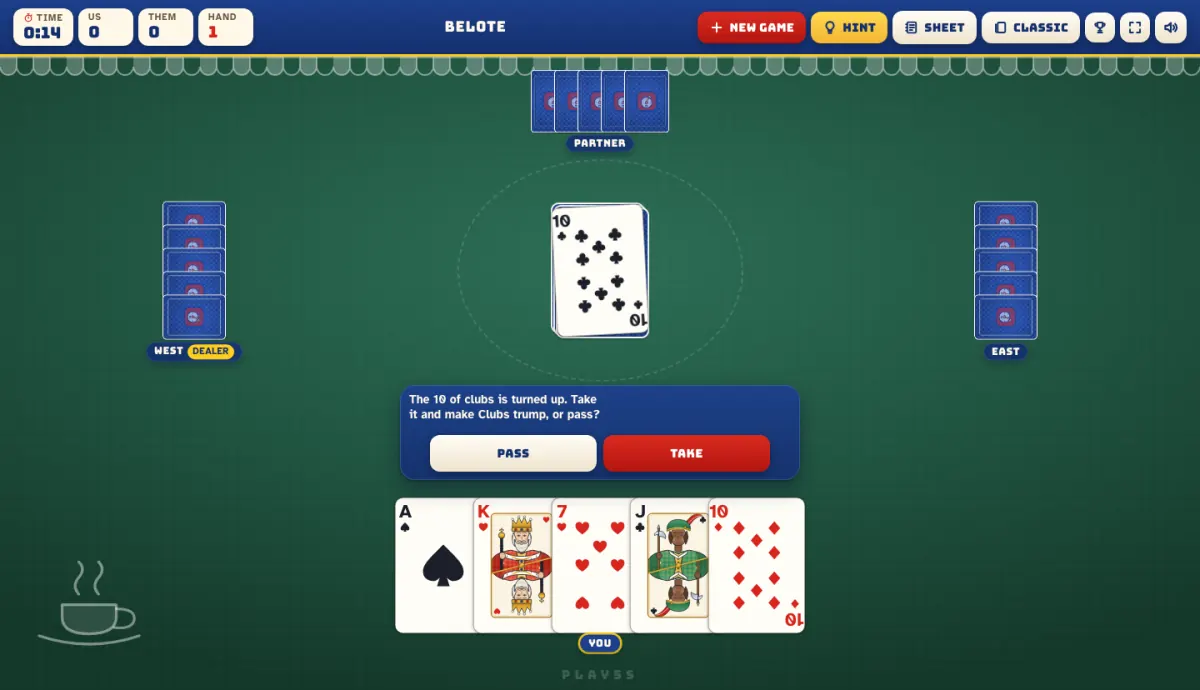
In the first round, each player in turn, starting on the dealer’s right, either takes the turned-up card, which makes its suit trump, or passes. The first player to take ends the bidding and receives the card. If all four pass, there is a second round in which each player in turn may name any other suit as trump, or pass again. If everyone passes twice, the cards are thrown in and the next player deals.
Because you only have five cards when you choose, the choice is a bet. Wikipedia’s French article notes that a jack turned up is a strong reason to take, because it is the highest card of the pack and it guards against a capot, and that the player after the dealer can hope that the cards still to come will help.
 Zoom in
The strong cards of trump
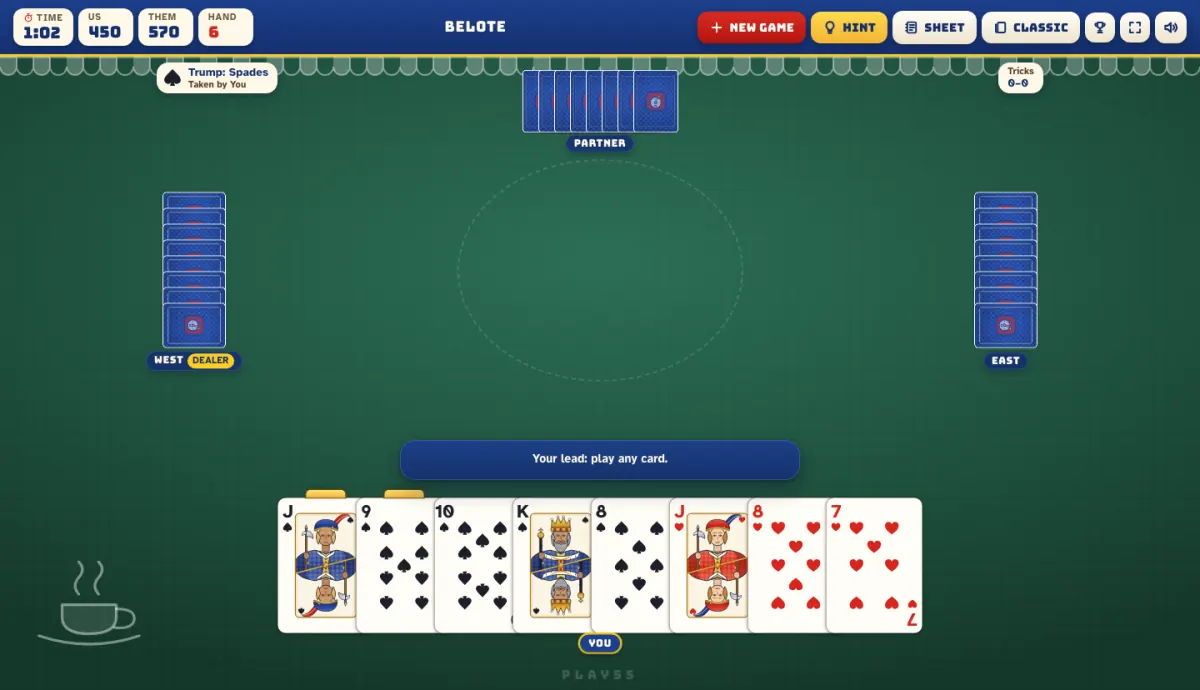
The trump suit has its own order. The jack is the highest card, then the nine, then the Ace, 10, King, Queen, 8 and 7. In the other suits the order is Ace, 10, King, Queen, Jack, 9, 8, 7. The Play5s table puts a small gold tab on your jack and nine of trump once trump is named.
 Zoom in
Playing the eight tricks
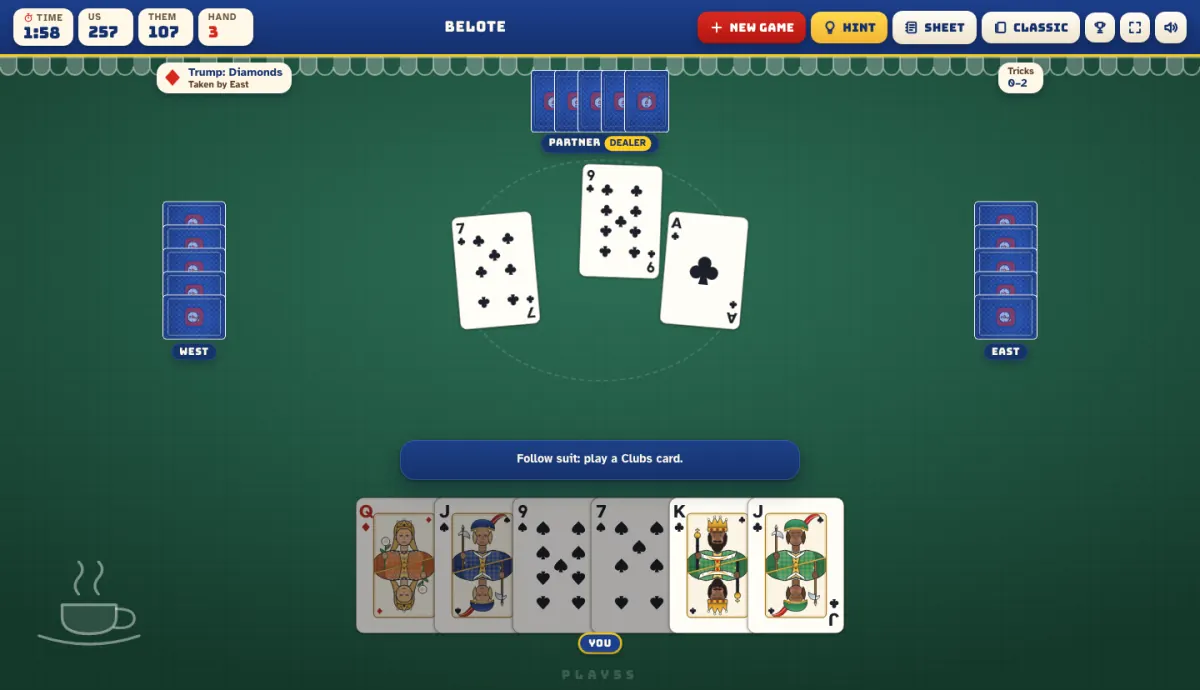
The player on the dealer’s right leads to the first trick. Each player in turn must follow suit with a card of the suit led. A player with no card of that suit must cut, playing a trump, unless their own partner is currently winning the trick, in which case they may discard another card or play a trump. A trump that is played must still go up when it can: it has to be higher than any already on the table, even over the partner’s trump, so a player holding a higher trump may discard or go over but may not play a lower trump. A player who cannot go up but holds trumps must still play one when an opponent is winning, which French players call “pisser”.
The highest trump wins the trick; with no trump, the highest card of the suit led wins. The winner leads the next trick, and the hand ends after eight tricks. The Play5s table dims the cards you may not play and tells you what the rule asks.
 Zoom in
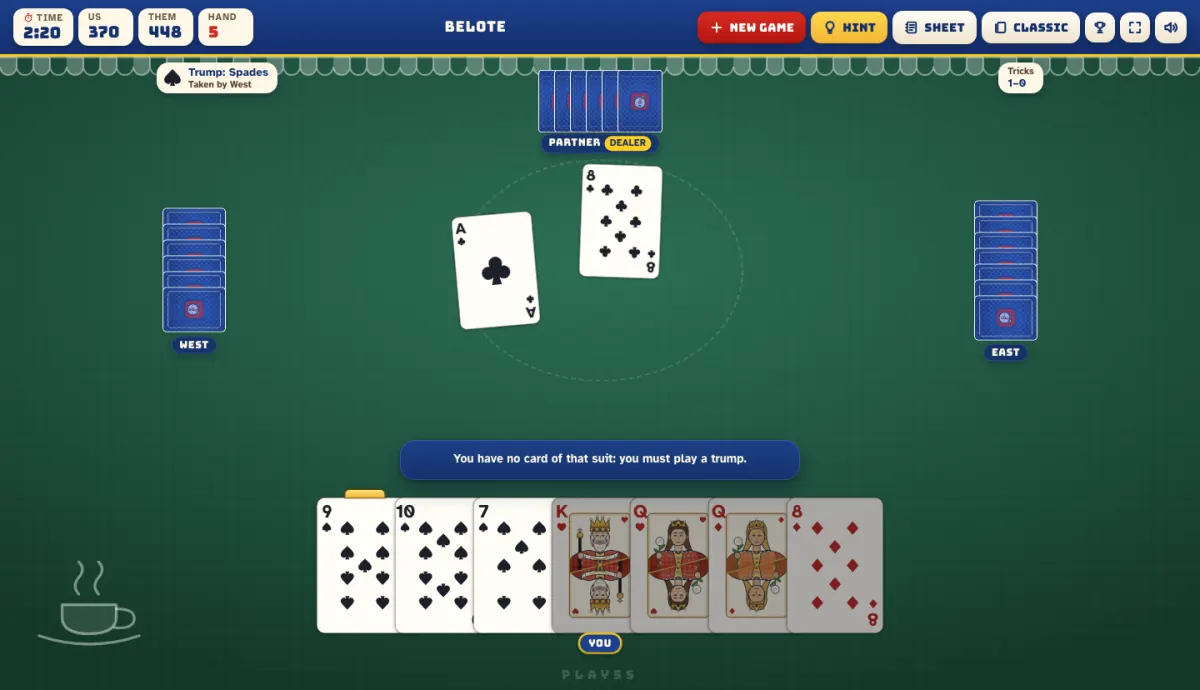
Cutting is where players are caught out. When an opponent is winning the trick and you hold no card of the suit led, you must play a trump, even if it cannot win.
 Zoom in
What are the card values in Belote?
The pack holds 152 card points, 62 in the trump suit and 30 in each of the other three suits, and the last trick adds 10, so a hand is worth 162 points.
The trump jack is worth 20 points and the trump nine 14, which is why a hand with both is so strong. The 7 and 8 are worth nothing in any suit.
| Rank | In the trump suit (high to low) | Points | In other suits (high to low) | Points |
|---|---|---|---|---|
| 1st | Jack | 20 | Ace | 11 |
| 2nd | 9 | 14 | 10 | 10 |
| 3rd | Ace | 11 | King | 4 |
| 4th | 10 | 10 | Queen | 3 |
| 5th | King | 4 | Jack | 2 |
| 6th | Queen | 3 | 9 | 0 |
| 7th | 8 | 0 | 8 | 0 |
| 8th | 7 | 0 | 7 | 0 |
How scoring works in Classic Belote
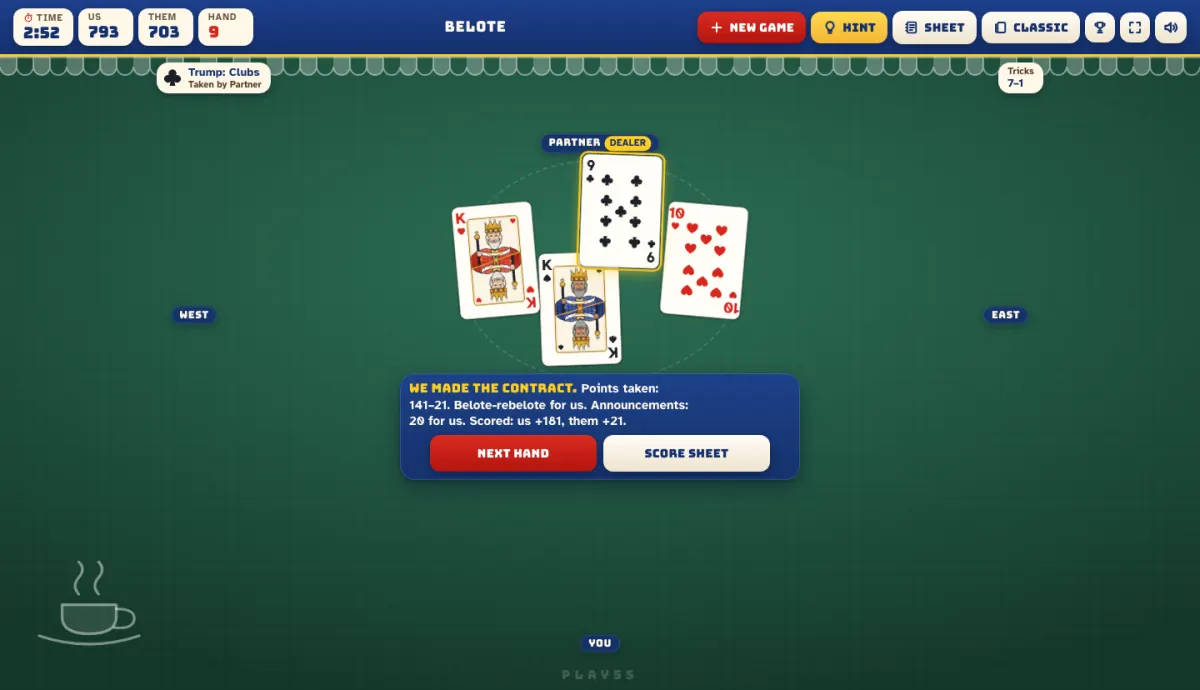
In Classic the team that took the trump scores what it won in the hand if it beats the other team; if it does not, it is “dedans” and the other team scores all 162 points; a tie is a “litige”.
Each team counts the card points in its tricks, 10 for the last trick (the “dix de der”) and 20 for belote-rebelote if one of its players held the king and queen of trump. A player who holds the king and queen of trump “declares” them by playing both cards, saying “Belote” and “Rebelote”; Play5s says it for you, and either card may be played first. In Classic, belote-rebelote is the only bonus that is always kept.
- The team that took beats the other team: both teams score what they won in the hand.
- The team that took scores less: it is dedans. The other team scores 162 points (plus its own belote), and the taker keeps only its belote.
- Both teams have the same total (81–81, or 91–91 with a belote): litige. The team that did not take scores its points at once; the taker’s points are held and go to whoever wins the next hand.
- One team wins all eight tricks: capot. It scores 252 points instead of 162, plus 20 for belote-rebelote, and the other team scores nothing (except its own belote).
- First team to 1,000 points wins. If both teams pass 1,000 on the same hand with the same score, another hand is played.
Play5s counts exact points, with no rounding. Some groups round to the nearest ten when they mark the score by hand, and the French article lists several ways of doing it; Coinche, below, rounds because the sources for that game do.
 Zoom in
The score sheet
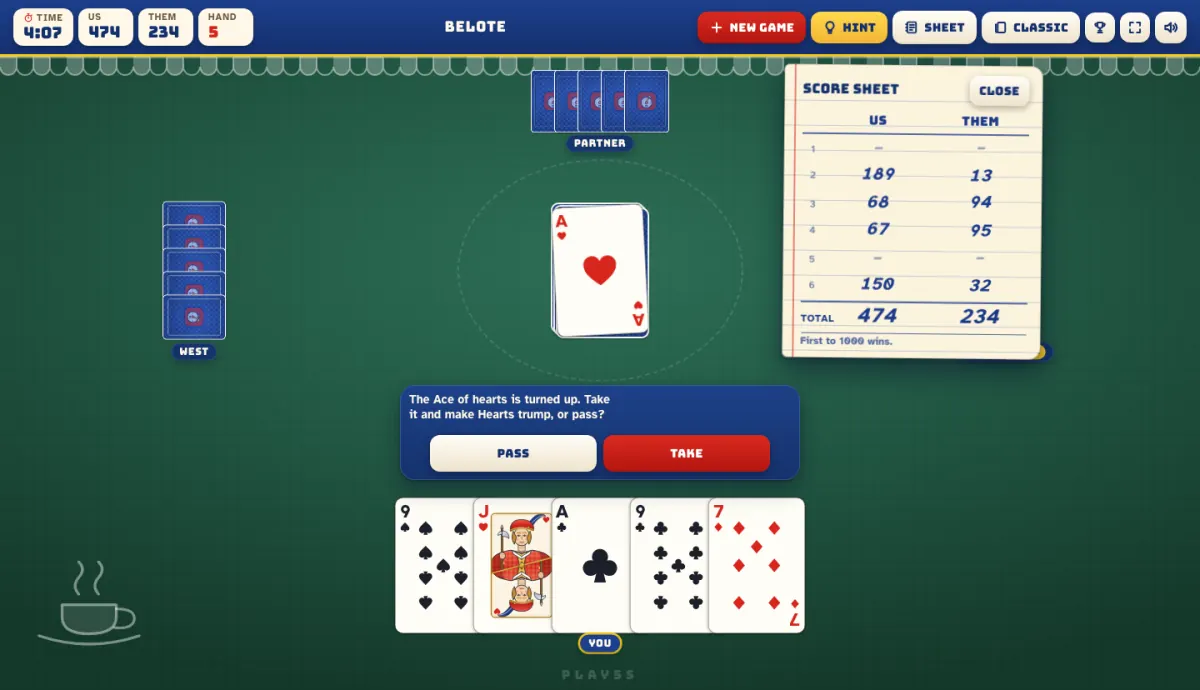
Press S or the Sheet button to open the score sheet, a notebook page with one line per hand for Us and Them and the total at the foot. A hand that was thrown in because nobody took shows a dash.
 Zoom in
Announcements: tierce, cinquante, cent and carré
Announcements are bonus combinations held in one hand (three or more cards in a row of one suit, or four of a kind), and only the team holding the best one scores for them.
Belote played with announcements is the traditional game described by Pagat and the French Wikipedia, and many groups still play it that way. Tournament play counts only belote-rebelote (Pagat), and Belote contrée is played without announcements (French Wikipedia), so Play5s lets you choose: the start screen has a Default / On / Off switch. Default means on in Classic and off in Coinche.
| Announcement | What it is | Points |
|---|---|---|
| Tierce | Three cards in a row of one suit, in the order A K Q J 10 9 8 7 | 20 |
| Cinquante | Four in a row | 50 |
| Cent | Five or more in a row (six or more count as five) | 100 |
| Carré of jacks | Four jacks | 200 |
| Carré of nines | Four nines | 150 |
| Carré of aces, tens, kings or queens | Four of the same rank | 100 |
Four 7s or four 8s are worth nothing, and a card can be part of only one announcement. Each player’s announcements are declared as they play the first trick, and settled when it is over. Only one team scores: the team whose best single announcement is highest. A carré beats any sequence; otherwise the higher value wins, then the higher cards, then a sequence in the trump suit, then whoever plays first. The winning team scores all its announcements, and they count when it is deciding whether the taker beat the others.
If the taker is dedans, the other team also collects the taker’s announcements. If one team takes all eight tricks, it gets the announcements of both teams. Play5s declares every announcement for you, so you never lose points by forgetting to say them. A game with the switch moved away from the default for its mode is not ranked.
Coinche: bidding, coinche and surcoinche
In Coinche all eight cards are dealt first and the players bid for the trump suit with a points contract from 80 to 160 or capot; the team that wins the bidding must score at least what it bid, and an opponent may “coinche” to double the stakes.
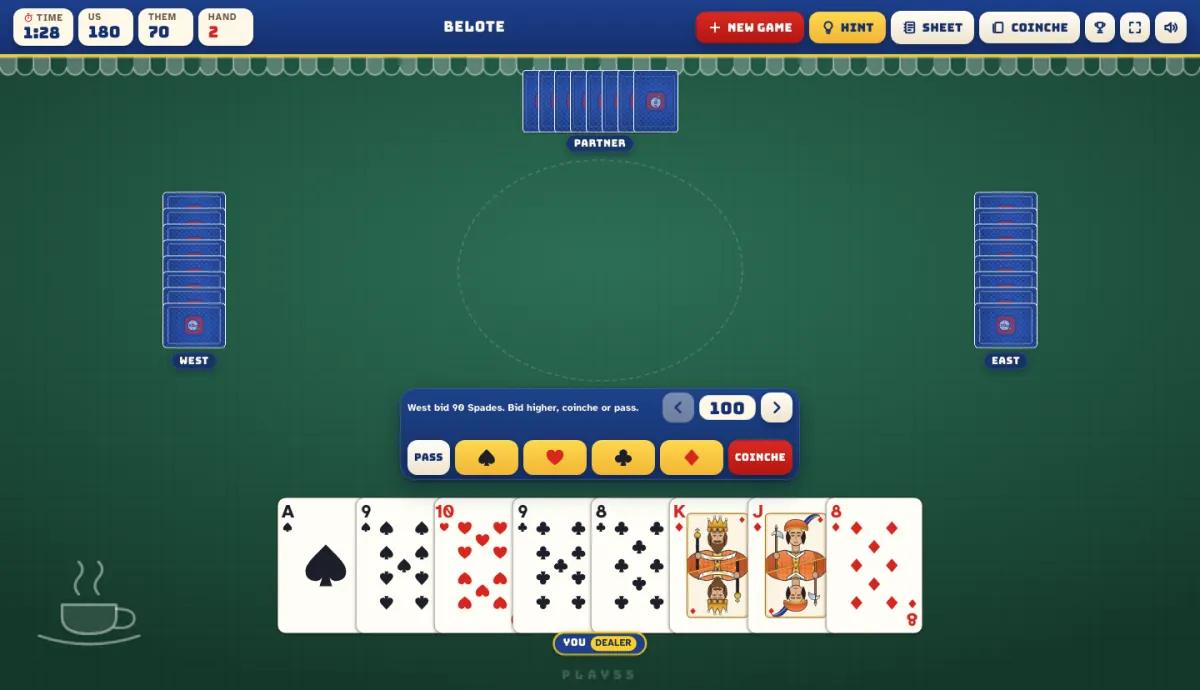
The bidding starts on the dealer’s right. Each player in turn passes, or bids a number of points (80, 90, 100 … 160) with a suit as trump, higher than the last bid, or bids capot, a promise to win all eight tricks, which nothing outranks. The bidding ends when three players pass after a bid; if all four pass, the hand is thrown in. In Play5s you choose the value with the arrows (or the Up and Down keys) and tap the suit to bid it.
An opponent of the last bidder may coinche when it is their turn, which ends the bidding: the contract is now doubled. Coinche is only allowed in turn; some tables let players call it out of turn. The bidder’s side may then answer with surcoinche, which doubles it again. The screenshot below shows a player facing a bid of 90 spades, with the choice of bidding higher, passing or coinching.
 Zoom in
How a Coinche hand is scored
The bidding team makes its contract if the points it won, with its belote counted (and its announcements, when they are on), reach what it bid; it does not have to beat the other team. Play5s follows the “points made” count in the French Wikipedia article on Belote contrée, which lists it as one of the two most played ways, and rounds scores to the nearest ten:
- Contract made: the bidding team scores its points taken, rounded to ten, plus the amount it bid. The contract is made with exactly the points bid, so an 80 needs 80 points (the basic version on Pagat asks for at least 82). The defenders score their own points, rounded to ten.
- Contract failed: the bidding team scores nothing, and the defenders score 160 plus the amount bid. The 20 points of a belote go to the defenders too, even if the bidders held it.
- Capot bid and made: 500 points, plus 20 for belote. Capot bid and failed: 410 points to the defenders (160 + 250). A capot that was not bid still earns the 250: the bidders score 250 plus the amount they bid, plus 20 for a belote (Pagat; the French Wikipedia says 250, or 270 with a belote). A capot can be coinched too, which doubles those points.
- Coinche doubles the points of the team that wins the hand, and surcoinche multiplies them by four.
- First team to 1,000 points wins; if both teams pass 1,000 on the same hand with the same score, another hand is played. A belote counts for whichever team holds it, not only for the bidders (Pagat’s basic version gives it only to the bidding side).
Pagat’s page on Coinche lists many regional versions that differ on exactly these points, for example doubling only the bid, or keeping the bidders’ belote when the contract fails. Play5s chose the French Wikipedia’s version of the points-made count and does not offer sans atout, tout atout or générale bids.
Classic or Coinche?
Classic and Coinche share the same cards and play and differ in how the trump is chosen: in Classic a turned-up card sets the first choice and you bet on five cards, while in Coinche you see all eight cards and bid a points contract.
Pagat explains that the Classic game, with a card turned up, is sometimes called “la tourne” to tell it apart from Coinche, where trumps are chosen by bidding, and that since the Second World War Coinche has taken over from it in many places. Classic is the default mode in Play5s and the mode of the Daily Deal. Coinche is one tap away from the mode button or the start screen, and it has its own leaderboard. The announcements switch applies to both.
Belote strategy and the odds of the deal
The best way to improve at Belote is to take the trump with a hand that is worth it, count the trumps as they fall, and lead trump when your team took.
Taking the trump and playing the hand
A hand is worth taking with when it holds the jack or the nine of the suit, a few more trumps, and an Ace in another suit; the computer players use the same idea (see below). In Coinche the French Wikipedia article describes common bidding conventions, such as 80 meaning the jack or the nine with another card in the suit, and 100 being possible with the jack, the nine and the Ace.
The French Wikipedia’s section on tactics says that the team that chose the trump usually has the strongest trumps and tries to make the opponents’ trumps fall, so that it can then play its Aces without being cut, while the defending team tries to keep its trumps and make the opponents cut. It also describes “appels”: when your partner is winning and you cannot follow suit, the card you discard can tell them which suit you are strong in, and it is worth agreeing the signals with your partner before playing. The computer partner in Play5s does not use signals.
The odds of the deal
Counted from the 32-card pack (Play5s, 23 November 2026): there are 10,518,300 different eight-card hands. You hold the jack of a given suit in 25.0% of hands, and the king and queen of a given suit together (a belote if it is trump) in 5.65%, the same as the jack and the nine of that suit. Four jacks come up in 0.195% of hands, about 1 in 514. You hold no card of a given suit in 7.0% of hands, and five or more of it in 1.2%. A hand holds at least one run of three or more cards in a suit (a tierce or better) in 22.6% of cases.
Played by the computer teams (20,000 Classic games with announcements, 181,769 scored hands, 23 November 2026), a game lasted 9.1 scored hands on average and never more than 12; the taking team made its contract in 81.5% of scored hands, was dedans in 17.7% and tied (litige) in 0.7%; a capot happened in 3.8% of scored hands and 11% of deals were thrown in.
How the computer players decide
The three computer players use only what a real player could see: their own cards, the turned-up card, the bids and the cards played so far; they never look at anyone’s hidden hand, and they use no random numbers.
To take or bid, each computer player adds up what its hand is worth with each possible trump: the jack and the nine of the trump count most, then the Ace, ten and king, length in the trump suit, a belote, and the Aces and tens of the other suits. They take or name a suit when the total is high enough, and in Coinche they bid the number of points that such a hand reached in about two thirds of the simulated hands played between computer teams. A computer player coinches only when its hand holds enough sure tricks against the bid.
To play, it follows the rules above, wins a trick with the cheapest card that does the job, gives points to its partner when the partner’s card is sure to win, leads the best trump when it took, and notes which suits an opponent has shown it has none of. The same deal and the same choices by you always lead to the same game, which is how the leaderboard server can replay a game from your moves alone. There is one level of computer player, so that every score on a leaderboard was made against the same opponents. The Hint button shows what the computer would do in your seat; it is a suggestion, not a rule.
Controls and saving
Tap or click a card to play it, use the panel above your hand to take, pass or bid, and use the keyboard if you prefer: the arrow keys move between your cards and Enter or Space plays one.
- Choosing trump: the panel above your hand asks the question. In Classic it shows Pass and Take, or the suits you may name; in Coinche it shows a value stepper, the four suits, Pass and Coinche. The keys P (pass) and, in the auction, Up and Down (the value) work too.
- Playing: cards you may not play are dimmed, and a tap on one says which rule applies.
- Hint (H) shows what the computer would do. Sheet (S) opens the score sheet. New game (N) starts again after a question, and Full screen (F) gives the table the whole screen. M turns sound on or off.
- There is no Undo: a hand has hidden cards, so a move cannot be taken back.
- Your game is saved in this browser as you play, with your best winning margin for each mode and your announcements setting. Clearing your browser data removes them.
Daily Deal and leaderboards
The Daily Deal is one Classic game that every player starts with the same shuffles on the same day; the day changes at midnight New York time, and the leaderboards rank won games by how many points you win by.
Every hand of a game is shuffled from a number the server hands out, so in the Daily Deal everyone gets the same cards and the same dealer for each hand. Your choices are your own, so the games soon go their own way. Play5s does not claim the Daily Deal is easy or winnable: it is a game against the computer, and some days you lose.
Only games you win go on a leaderboard. The ranking is your winning margin, your final points minus theirs, so a 1,040–720 win is +320. Ties go to the faster game, measured by our server from the deal, then to whoever posted first. There is one board for Classic, one for Coinche and one for the Daily Deal. Each connection gets one ranked Daily Deal result a day; after that, playing again is practice. A game played with the announcements switch away from its default has no ticket and is not ranked.
Your nickname has 2 to 12 characters and offensive names are refused. You do not need an account. Starting a ranked game asks our server for a deal and a ticket; your moves and your nickname are sent only when you submit a score, and the server plays the computer seats itself to check the game. The Daily Deal needs a connection because the server picks the day’s shuffles. If it cannot be reached, a regular game still plays but is not ranked.
What do the Belote terms mean?
Belote has its own French vocabulary: atout, pli, dedans, litige, capot and dix de der are the words you will meet most.
- Atout (trump): the suit that beats all the others for one hand. The jack and nine of it are the highest cards.
- Pli (trick): one round of play in which each player puts down one card.
- Prendre (take): to accept the suit of the turned-up card as trump, or to name a suit in the second round. The taker is the “preneur”.
- Dix de der: the 10 points for winning the last trick (“der” is short for “dernier”).
- Belote and rebelote: the king and queen of trump held together, worth 20 points; said as the two cards are played.
- Dedans: the team that took the trump scoring less than the other team. The other team gets 162.
- Litige: both teams scoring exactly the same in the hand. The taker’s points wait for the next hand.
- Capot: taking all eight tricks, worth 252 points in Classic.
- Annonces (announcements): tierce (three in a row, 20), cinquante (four, 50), cent (five, 100) and carré (four of a kind, 100 to 200).
- Coinche and surcoinche: the opponents’ challenge to a contract, doubling it, and the bidders’ reply, doubling it again.
- Monter (going up): playing a higher trump than the highest already on the table.
- Couper (cutting) and pisser: playing a trump when you cannot follow suit; “pisser” is playing a lower trump when you cannot go up.
Where Belote comes from
Belote came to France in the early 20th century, around 1914 according to the French Wikipedia, and it belongs to the Jass family of games that began in the Netherlands.
The French Wikipedia says the Larousse dictionary of 1928 to 1933 dates the game to 1914, and quotes a police commissioner’s book that says it spread through the cafés from 1915, though other writers describe a game called belotte played around 1906 in Montmartre. The origin of the name is unknown. It is a close relative of Klaverjassen, the Dutch game, and of Bela, played in many Jewish communities; Pagat notes that the king and queen of trump were called “belle” or “bela” in older Jass games, which is probably where “belote” comes from.
Coinche, with its auction, became popular after the Second World War and has taken the place of the original game in many regions, according to Pagat. A French Belote federation was founded in 2013, according to Pagat, and the French championship has been played since 2006, according to the French Wikipedia. The French Wikipedia lists France, Belgium, Algeria and Canada among the countries where it is played most, and related games under other names in Bulgaria (Bridge-Belote), Greece (Vida) and Cyprus (Pilotta).
Sources for the rules
The rules and figures on this page come from these pages, all read on 23 November 2026.
- Wikipedia (French), “Belote”: the French rules, the order and value of the cards, the deal, taking the trump, dedans, capot, litige, belote-rebelote, scoring, history.
- Wikipedia (French), “Belote contrée”: the auction, coinche and surcoinche, the “points made” count, capot bids.
- pagat.com, “Belote” and “La Coinche”: the rules of the four-player game, announcements and their ranking, the variations of play and scoring.
- regles-du-jeu.net, “Règles de la belote”: the rules explained with announcements as an optional variant.
- The open-source Coinche rules of the BGA Coinche project (MIT licence), compared for the order of play and the cut.
- The odds of the deal and the computer-play figures were counted by Play5s from the 32-card pack, 23 November 2026.
Belote questions
How many cards are in a Belote deck?
A Belote pack has 32 cards: the 7, 8, 9, 10, Jack, Queen, King and Ace of each suit. Each of the four players gets eight cards.
How many points do you play to in Belote?
Play5s plays to 1,000 points in both modes. Other groups play to 1,500, 2,000 or 3,000, especially with announcements or in Coinche (Pagat, French Wikipedia).
What are the strongest cards in Belote?
In the trump suit the jack is the highest card (20 points) and the nine comes next (14 points). In the other suits the Ace is the highest and the 10 is next.
What is belote-rebelote?
Holding the king and queen of trump together. The player says “Belote” when playing the first of them and “Rebelote” with the second, and the team scores 20 points. In Play5s the game says it for you.
What does dedans mean?
Dedans means “inside”: the team that took the trump scored less than the other team, so it loses its points and the other team scores 162.
What is a litige?
A litige is a tie: both teams scored exactly the same, for example 81–81. The team that did not take scores its points immediately, and the taker’s points are held for the winner of the next hand.
What is Coinche?
Coinche is Belote with an auction: players bid a points contract and a trump suit, and the opponents may “coinche” to double the stakes. Play5s has it as the second mode.
Must I play a trump when I cannot follow suit?
Yes, unless your partner is winning the trick, in which case you may discard another card or play a trump. When a trump is on the table you must play a higher one if you can, even over your partner’s trump; if you cannot go over and an opponent is winning, you still play a trump.
Do I have to declare announcements?
No. Play5s declares tierce, cinquante, cent and carré for you when they are on, and says belote-rebelote for you in every game.
Can I play Belote against the computer here?
Yes. You play with a computer partner against two computer opponents, free in your browser, with no download and no account. You can start a game from the start screen in one tap.
Can two people play Belote?
Belote is a four-player partnership game, so Play5s has you play with a computer partner. Pagat describes a two-player version, Belote Découverte, with exposed cards, but it uses different rules.
Do I need an account to put a score on the leaderboard?
No. You win a game, type a nickname of 2 to 12 characters and submit it. The server replays your game from your moves to check it before it goes on the board.
About this version
Play5s Belote is a game against the computer: you and a computer partner play two computer opponents, to 1,000 points, with the 32-card pack.
There are two modes, Classic (a card is turned up) and Coinche (an auction), and a Daily Deal in Classic. The announcements are on in Classic and off in Coinche unless you change the switch on the start screen, and a game with the switch changed is not ranked. The computer plays at one level, and there is no Undo.
Starting a ranked game asks our server for a deal and a ticket; your moves and your nickname are sent only when you submit a score. Your game, your best winning margin, your announcements setting and your nickname are kept in your browser on this device.
Play5s is an independent site and is not connected to any other Belote site or app.
Read more about Play5s, or see all of our free card games.