
On this page
How to play Nonogram
To solve a Nonogram, shade the exact groups of cells described by the row and column number clues until every line matches its numbers and the hidden pixel picture appears.
Reading the number clues
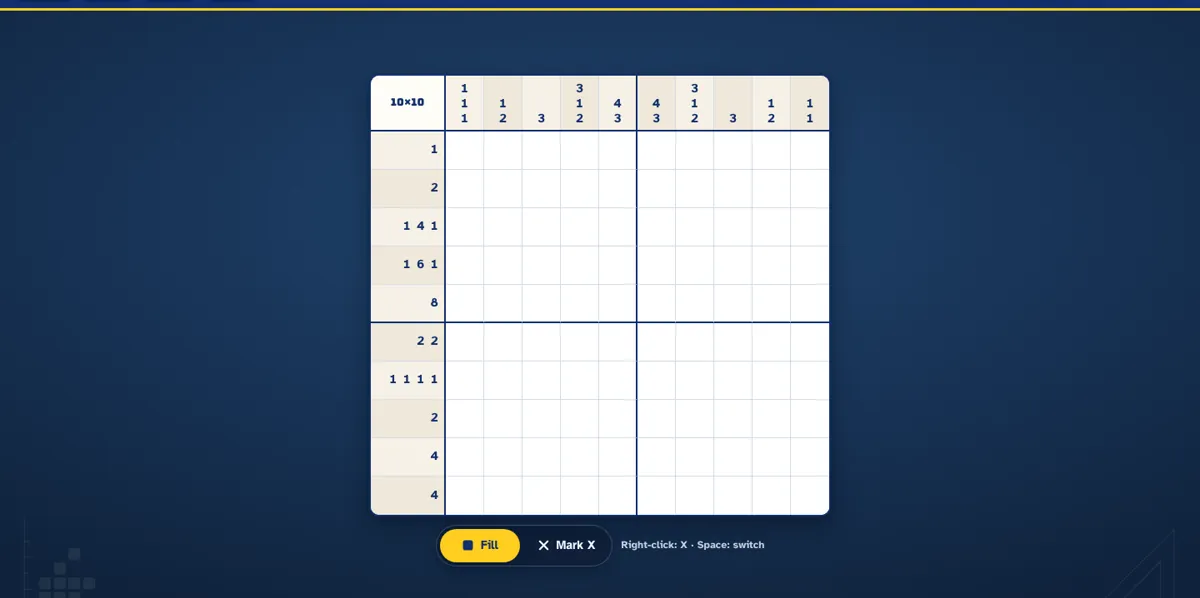
Every row has a sequence of numbers on the left, and every column has a sequence of numbers at the top. Each number tells you how many consecutive cells are filled in one unbroken block, read from left to right across a row or from top to bottom down a column.
For example, a clue of 3 2 on a 10-cell row means there is a block of 3 filled squares, followed by at least one empty square, followed by a block of 2 filled squares. Extra empty squares can appear before the first block, between blocks, or after the last block. A clue of 0 means no cells in that line are filled.
 Zoom in
Filling squares and X marks
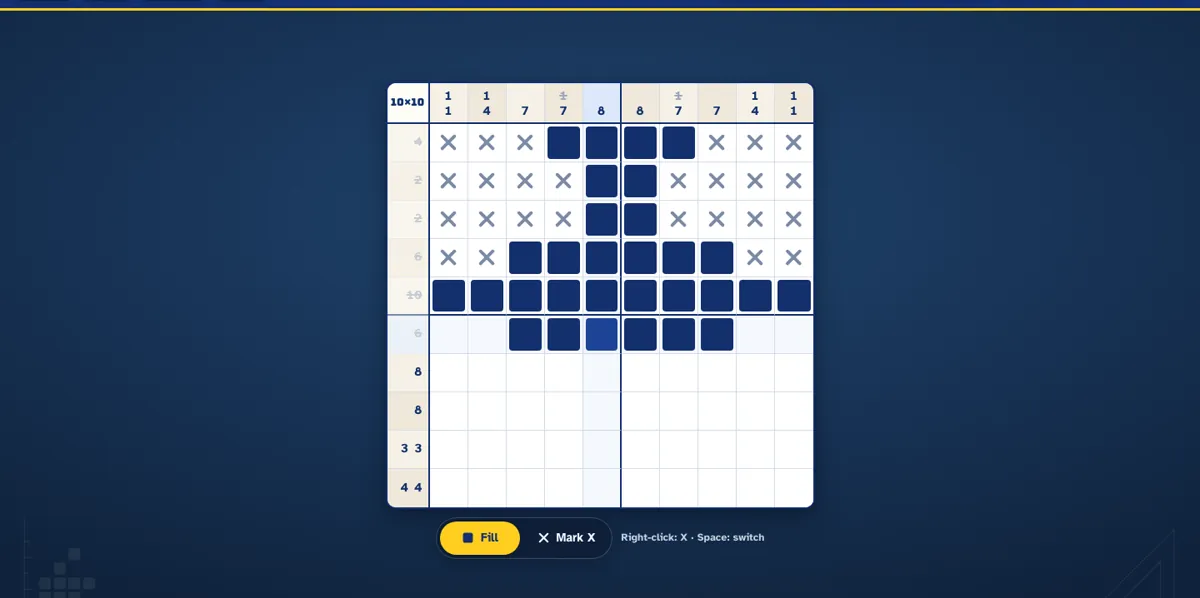
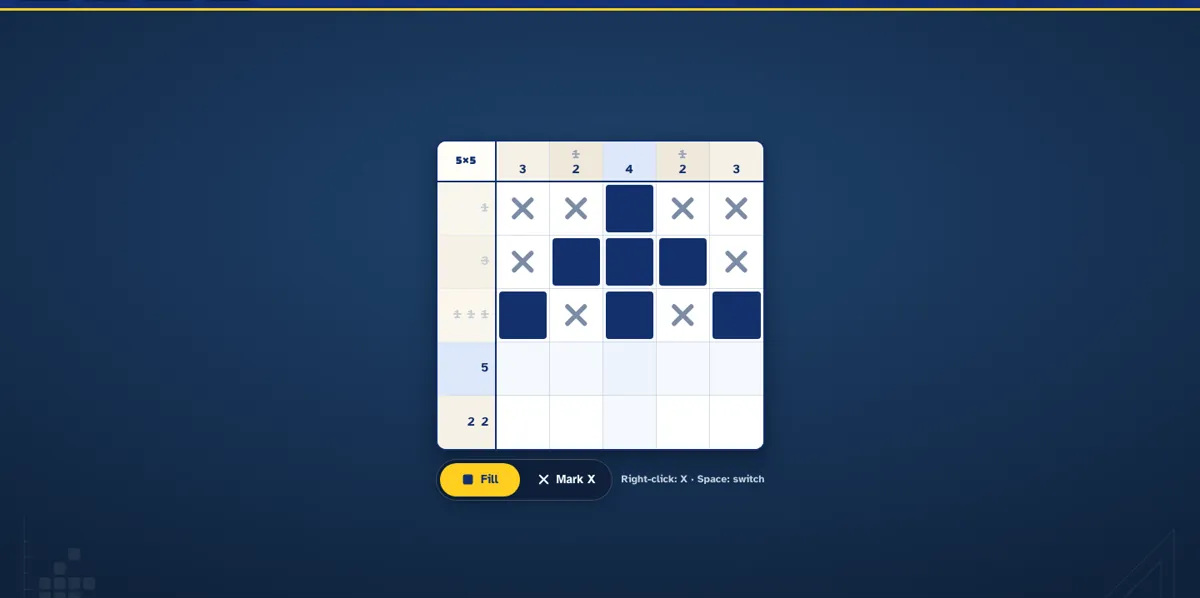
A Nonogram has two essential marks: a filled square for a cell that belongs to the picture, and an X for a cell you have proved must stay blank. Marking X cells is optional for winning, yet crossing out impossible squares is the fastest way to narrow down intersecting rows and columns.
As you complete bounded blocks from either end of a line, Play5s automatically crosses off the matching clue numbers so you can track what remains at a glance. If a line ever has too many filled squares or a block longer than its clues allow, that line’s clue box turns coral red as an immediate check.
 Zoom in
How a puzzle ends
You win as soon as the filled squares in every row and every column match all number clues. You do not have to put an X in every remaining empty square to finish. When the final square lands, the X marks fade away and the grid hairlines dissolve so you can see the completed pixel artwork clearly.
Grid sizes and unique logic
Play5s offers four monochrome grid sizes — 5×5, 10×10, 15×15 and 20×20 — and every generated puzzle is verified by a line-solver to have exactly one solution solvable without guessing.
Choosing a grid size
5×5 (Easiest): 25 cells, ideal for learning overlap logic or playing a 30-second warm-up.
10×10 (Medium & Daily Nonogram): 100 cells, the classic everyday Nonogram balance between quick sessions and layered row-column deduction.
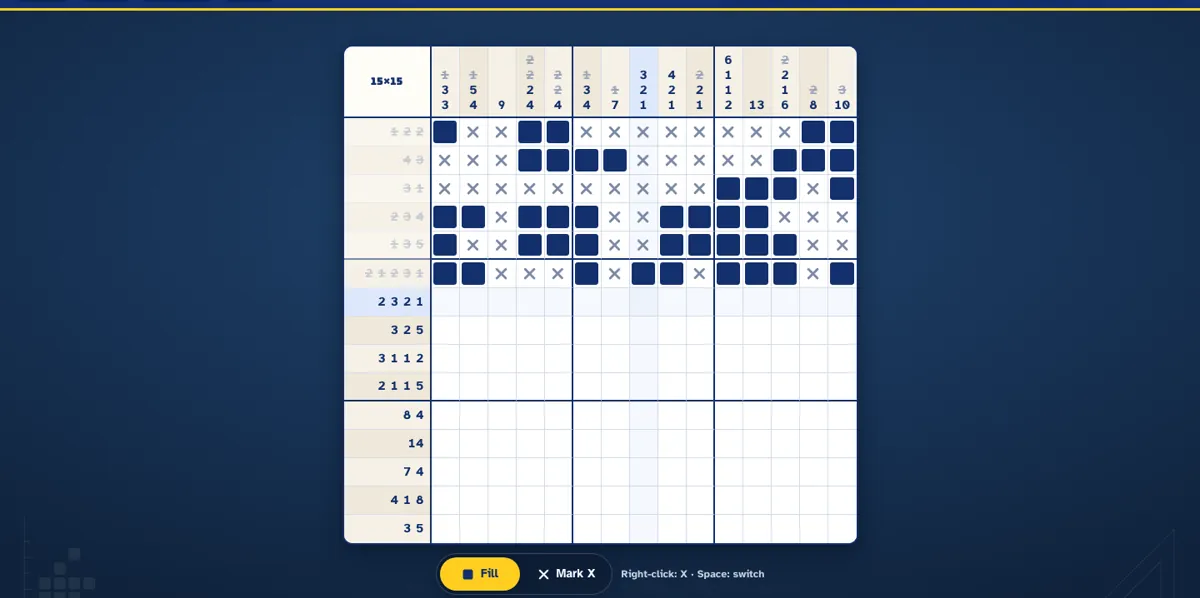
15×15 (Harder): 225 cells, where the 5×5 divider lines and counting in from the edges start to pay off.
20×20 (Hardest): 400 cells, a deep logic workout that rewards methodical X-marking and careful cross-checking.
 Zoom in
Why unique line-solvability matters
In general, solving an arbitrary Nonogram is an NP-complete problem (proved by Nobuhisa Ueda and Tadaaki Nagao in 1996), and poorly built grids can hide multiple valid pictures or force blind guessing. Jan Wolter’s survey of Paint-by-Number puzzle solvers (opens in a new tab) calls a puzzle line solvable when it “can be solved one line at a time”, and notes that a program that validates a puzzle has to look for a second solution, not stop at the first one.
Every Play5s Nonogram is generated purely from a numeric seed and checked through a dynamic-programming line solver before play begins. If a candidate pattern leaves even two ambiguous cells, the generator repairs or discards it, so every board you play has one unique picture and zero forced guesses.
 Zoom in
Daily Nonogram and fastest-time leaderboards
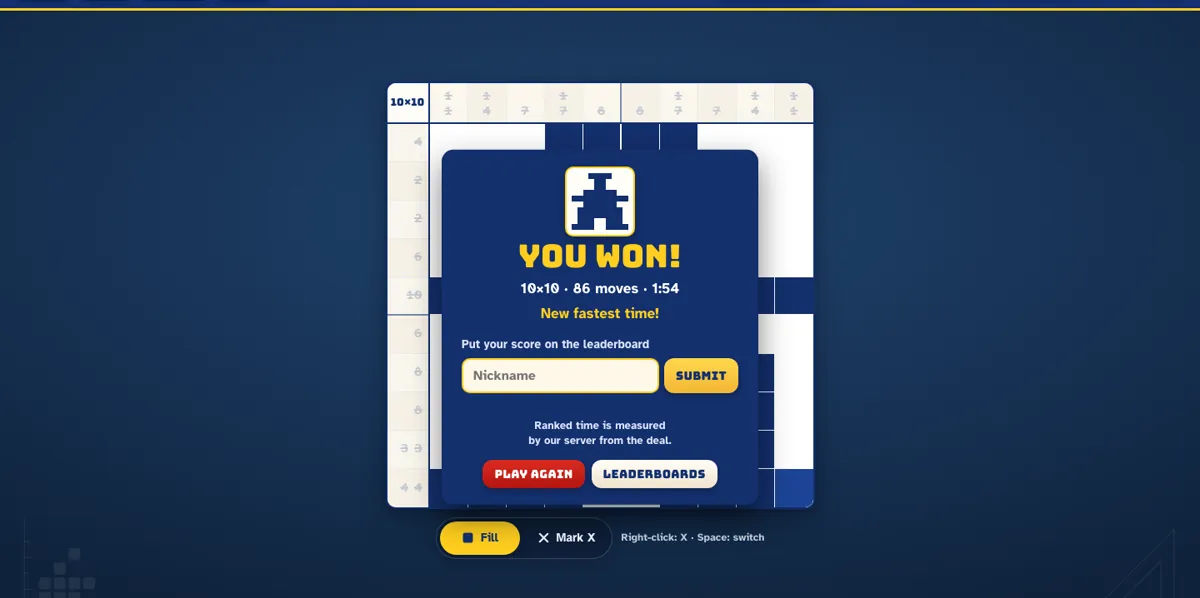
Nonogram leaderboards on Play5s rank winners by fastest solve time, measured by our server from the moment a puzzle is handed out, with separate boards for 5×5, 10×10, 15×15, 20×20 and the Daily Nonogram.
The Daily Nonogram is one 10×10 puzzle that every player gets on the same day, rotating at midnight New York time. Every Daily Nonogram seed is pre-verified to be uniquely line-solvable. Because our server issues the Daily seed and ticket, the Daily Nonogram requires an internet connection, and each connection gets one ranked Daily submission per day (replaying the same day afterwards is practice only).
When you solve a ranked puzzle, you can post your time with a nickname of 2–12 characters (no account required; offensive names are refused). The server replays your exact move log against the seed to verify every stroke leads to a valid win, records the time from its own clock, and rejects impossible speeds or altered logs. Ties in seconds go to the earlier submission; the Moves column is shown alongside your time, and each Undo counts as a move.
 Zoom in
Nonogram solving tips
Start with the overlap technique on the largest clues first: whenever a single number is larger than half the grid width, its middle squares are guaranteed to be filled.
- Simple overlap (boxes): On a 10×10 grid, a clue of 7 must cover the middle 4 cells (columns 4 to 7) no matter whether it starts at the left edge or the right edge. The same rule works for multi-number lines by comparing the leftmost and rightmost packed positions.
- Full lines and zero lines first: A clue of 10 on a 10×10 grid (or 4 5, since 4 + 1 + 5 = 10) fills the entire row immediately. Lock those in first to seed perpendicular columns.
- Glue to the edges: When a filled square touches the edge of the grid (or sits right beside an X), you know that block starts there and can extend it to its full clue length right away, then place an X immediately after it.
- Cross out unreachable spaces: If a small gap between two X marks is shorter than the smallest remaining clue in that line, fill the whole gap with X marks so your eyes stop checking it.
- Never guess — switch axes: Because every Play5s Nonogram is purely line-solvable, getting stuck on rows always means a column (or a newly placed X) just unlocked a fresh deduction.
- Use drag protection to go faster: Mark X boundaries first, then sweep across a whole row with the Fill tool — multi-cell Fill drags automatically skip over X cells so you can paint fast without mistakes.
Controls and shortcuts
Tap a square to toggle it, or press and drag along a row or column to paint multiple squares in one axis-locked stroke.
Use the Fill / Mark X switcher below the grid (or beside it on a sideways phone) to choose your active tool. On a computer with a mouse, left-click uses your active tool and right-click always marks or erases an X without switching tools. Dragging locks to either the row or the column you start moving along, preventing accidental diagonal slips on 15×15 and 20×20 boards.
Multi-cell Fill drags only paint empty squares and protect your existing X marks; multi-cell Mark X drags protect your existing filled squares. Tapping a single cell directly always switches it cleanly.
Buttons and smart Hint
Undo steps back one stroke at a time (even after reloading the page) and counts as a move on the HUD and leaderboard. Hint runs the same line-solver as the generator on your current board: if you have a conflicting square, it flags that mistake first; otherwise it highlights a square that is logically forced by a specific row or column. Mode cycles through 5×5, 10×10, 15×15 and 20×20 (asking first if a puzzle is in progress). Full screen expands the puzzle to the whole window, and the gear (Settings) button opens the switches for custom sound effects (on by default) and an optional background music loop (off until switched on).
- Arrow keys: move cell focus across the grid
- Enter or Space (on a cell): apply the active tool; Space (outside grid): switch Fill / Mark X
- X (on a cell): toggle an X mark directly
- Backspace or Delete: erase the focused cell
- U or Ctrl+Z: undo last stroke
- H: show a logical hint or flag a mistake
- N: start a new puzzle
- F: toggle full screen · M: mute or unmute sound effects
Nonogram terms and other names
Nonograms are known by dozens of regional names worldwide, all sharing the exact same row-and-column run-length clue rules.
- Nonogram: The name James Dalgety, a UK puzzle collector, made from “Non” (Non Ishida) and “gram” (from “diagram”); *The Sunday Telegraph* ran the puzzles weekly from 1990.
- Picross: Short for “picture crossword”, a name Nintendo claimed as a trademark for its own nonogram games, starting with *Mario’s Picross* on the Game Boy (Japan, 1995).
- Hanjie & Griddlers: Common English puzzle-book and web names for monochrome and color Nonograms.
- Oekaki Logic (お絵かきロジック) / Illust Logic: Japanese names meaning “drawing logic” or “illustration logic”.
- Japanese Crosswords (Японский кроссворд) / Logimage / Obrazki logiczne / Nemologic (네모로직): Standard regional names across Russia, France, Poland and South Korea.
- Line-solvable: A Nonogram whose unique solution can be found strictly by analyzing one row or column at a time, with zero guessing.
- Overlap (Simple Boxes): Cells that must be filled because the leftmost and rightmost legal placements of a clue block overlap on those squares.
History of Nonograms
Nonograms were invented independently in Japan in 1987–1988 by two creators: graphics editor Non Ishida and puzzle author Tetsuya Nishio.
In 1987, Non Ishida won a Tokyo design competition by creating pixel pictures on a skyscraper using lit and unlit office windows. Inspired by that grid of lights, she published three “Window Art Puzzles” in Japan in 1988. Around the same time, professional puzzle designer Tetsuya Nishio independently created an identical number-clue picture puzzle and published it in a Japanese puzzle magazine (Wikipedia, “Nonogram” (opens in a new tab)).
Ishida showed her puzzles to James Dalgety, a puzzle collector in the United Kingdom, who coined the name nonogram from “Non” and “diagram” and arranged for *The Sunday Telegraph* to publish them every week from 1990. By 1993 Non Ishida had published the first book of nonograms in Japan. Nintendo released *Mario’s Picross* for the Game Boy in Japan on 14 March 1995, using the trademarked name Picross (“picture crossword”).
Nonogram questions
What is a Nonogram puzzle?
A Nonogram is a picture logic puzzle where numbers beside each row and above each column tell you the lengths of consecutive filled-in square groups in that line. By cross-referencing row and column clues and marking blank squares with X, you reveal a hidden pixel picture.
Does every Play5s Nonogram have only one solution?
Yes. Every 5×5, 10×10, 15×15, 20×20 and Daily Nonogram puzzle on Play5s is checked by our dynamic-programming line solver before play begins, guaranteeing one unique solution that can be solved completely by logic with no guessing.
Do I need to put an X in every empty cell to win?
No. X marks are strictly a visual helper to rule out cells while you think. You win the instant your filled squares satisfy every row and column clue.
Are Nonogram, Picross, Hanjie and Griddlers the same game?
Yes. They are different names for the same classic Japanese logic puzzle ruleset, named differently by newspapers, magazines and video-game publishers in different countries.
Is Nonogram harder than Sudoku?
They test different habits rather than one being strictly harder. A 5×5 or 10×10 Nonogram is usually faster and easier to learn than a standard 9×9 Sudoku, while a 20×20 Nonogram can match or surpass hard Sudoku puzzles in concentration and visual scanning.
How do the Nonogram leaderboards and Daily Nonogram work?
Starting a ranked game asks our server for a seed and a signed ticket; your move log and nickname are sent only when you submit a winning solve. Leaderboards rank winners by fastest server-measured time for each grid size (5×5, 10×10, 15×15, 20×20) and for the 10×10 Daily Nonogram, which resets at midnight New York time.
How does Hint work if I get stuck?
Press Hint (or H) and the built-in line solver checks your board. If any square you filled or crossed conflicts with the unique solution, Hint highlights that mistake first; otherwise it highlights a square that can be deduced directly from its row or column clues.
About this version
Play5s Nonogram is built specifically for instant play in the browser: deterministic seeded puzzles checked for unique line-solvability, axis-locked drag-painting on phones and computers, right-click X marking, automatic clue crossing-off, full keyboard controls, custom Web Audio sound effects and optional background music.
Your game in progress and personal best times per grid size are saved locally on your device. Starting a ranked game or Daily Nonogram requests a seed and ticket from our server; your move log and nickname are transmitted only if you choose to post a winning time to the leaderboard.
Read more about Play5s, or see all of our free puzzle games.