

On this page
How to play Go Fish
Go Fish is a turn-based matching card game where players ask opponents for ranks they already hold in order to complete four-of-a-kind books before anyone else.
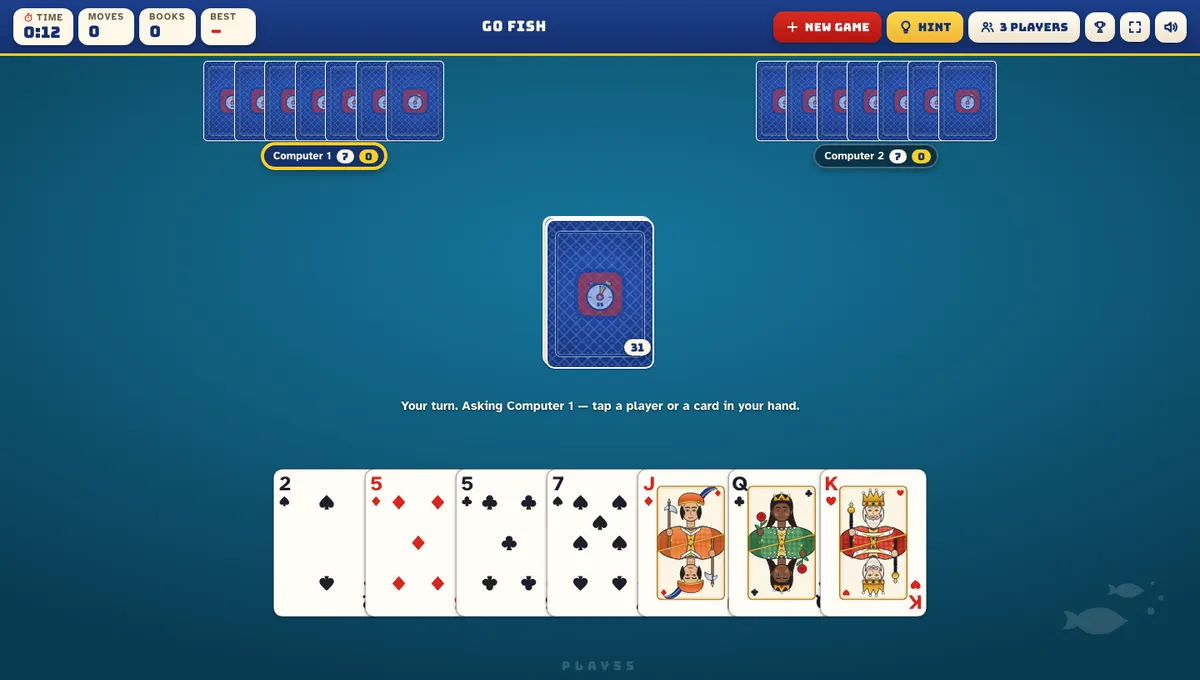
At the start of a hand, seven cards are dealt to each player in a 2- or 3-player game, or five cards each in a 4-player game, and the remaining cards are placed face down in the middle as the Fish Pond (stock pile). Cards in your hand are sorted automatically by rank so you can spot pairs and near-books at a glance.
On your turn, pick an opponent who still holds cards and ask for a rank you currently hold at least one copy of (for example, all of their Queens or 7s). If that opponent holds one or more cards of that rank, they must hand every matching card over to you, and you immediately take another turn.
 Zoom in
Fishing from the pond and the Wish Bonus
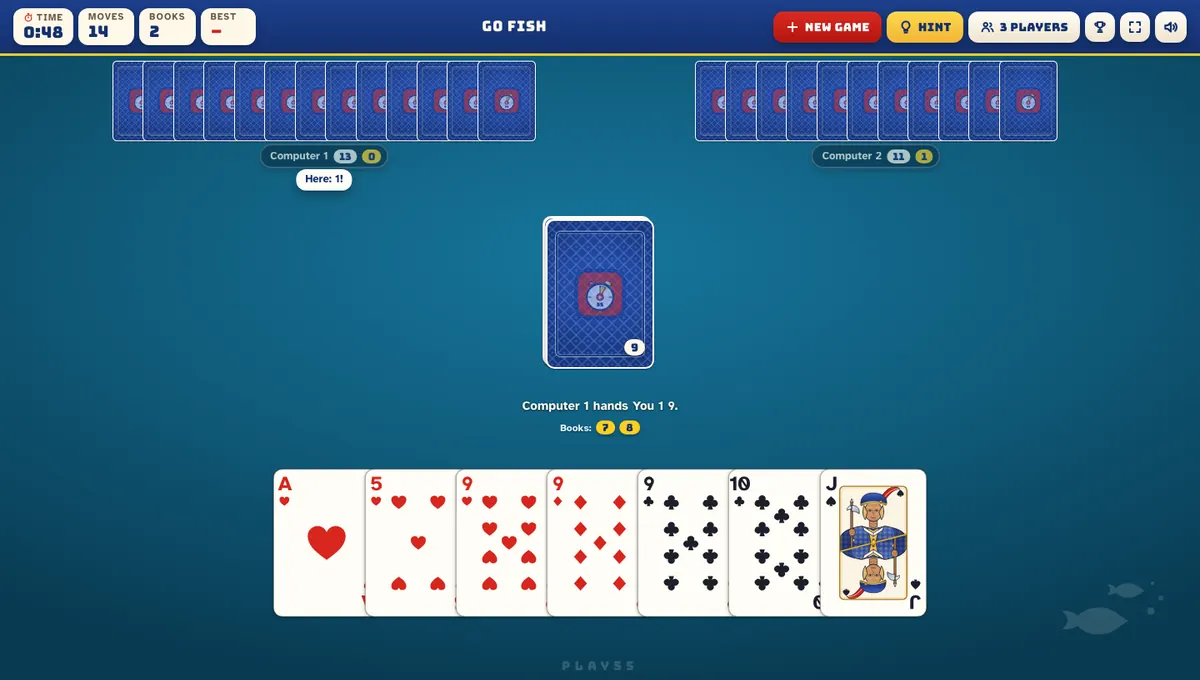
If the player you asked has no cards of the rank you named, they answer "Go fish!" and you draw one card from the top of the Fish Pond. Under Play5s's default Wish Bonus rule, which is the main rule on Pagat and a variation on Wikipedia, drawing the exact rank you asked for lets you show it and keep your turn; any other card passes the turn clockwise to the next player. A drawn card that completes a different book is laid down at once but does not keep your turn; Bicycle Cards, by contrast, says a player who gets the fourth card of a book "plays again".
Whenever any player holds all four cards of a single rank (Ace through King), that book of four is laid face up on their shelf right away and cannot be stolen later. An empty hand is refilled with one card from the Fish Pond right away, in clockwise order, so every seat stays in the game until the pond runs dry. Bicycle Cards has that player draw when their own turn comes, and Pagat ends the game as soon as someone runs out; refilling at once is a Play5s choice.
Rules, deal sizes, and game end
A standard Go Fish round ends as soon as all 13 four-card books have been laid down, and the player with the most books wins.
During the endgame, once the Fish Pond is empty, players keep taking turns with the cards still in their hands. Any player who lays down their last card without a stock card to draw steps aside while the remaining players with cards finish collecting the rest of the books. When multiple players tie for first place with the highest book count, the round ends in a draw.
| Attribute | Standard Play (Ranked) | Custom / Practice Options |
|---|---|---|
| Players at table | 2, 3 (Daily Deal), or 4 seats | 2, 3, or 4 seats |
| Opening hand size | 7 cards (2–3p) or 5 cards (4p) | 7 cards (2–3p) or 5 cards (4p) |
| Fish Pond stock | 38 cards (2p), 31 cards (3p), 32 cards (4p) | Remaining cards after opening deal |
| Scoring unit | Books of 4 (13 total books) | Pairs of 2 (26 total pairs) when Kids Pairs is on |
| Drawn requested rank | Wish Bonus On — extra turn kept | Wish Bonus Off — turn always passes on Go Fish |
| Computer players | Normal (remembers the last 6 asks) | Easy (last ask, 40% random) or Sharp (counts cards from every ask) |
| Leaderboard status | Eligible when won outright | Practice only (unranked) |
 Zoom in
How the computer players think
Each computer opponent tracks only public table information — its own hand, laid-down books, and earlier questions or catches — and never peeks at your cards or the Fish Pond.
Computer turns are deterministic, so a ranked game replays identically on the server. The three levels differ in how much public table history a seat uses when it chooses a rank and a target:
- Easy: remembers only the last ask, and 40% of the time picks a random rank from its hand and a random opponent.
- Normal (ranked default): remembers the last 6 asks. It asks a seat that is known to hold the rank (that seat asked for it), avoids a seat that just said "Go fish!" for it, and otherwise favors ranks it holds more of and opponents with bigger hands.
- Sharp: counts cards from every ask of the game. It tracks the fewest cards of each rank a seat must still hold and how many copies nobody has accounted for, then asks where the chance of a catch, weighted by the copies it already holds, is highest.
Every level reads only public information: Play5s tested that shuffling the hidden cards of the other seats and the pond never changes a Sharp pick (300 positions, 24 November 2026). In 600 test games per table against a player who always follows the Normal policy, that player won 30.3% of 3-player games against Normal computers and 25.0% against Sharp; at 4 players, 23.5% against Normal and 13.2% against Sharp. At a 2-player table the levels play almost alike (about 50% either way).
The Hint button follows the Normal policy, or the Sharp policy at a Sharp table, never the random asks of Easy. Against Normal computers, players who followed every Hint won 28.8% of 3-player games and 21.5% of 4-player games, against 6.5% and 1.3% for random legal asks (400 games each). At 2 players the Hint and random asks both win about half the time.
Tips for winning more books
The fastest way to win Go Fish is to listen to every question opponents ask, because a player can only ask for a rank they already hold.
- Track what others ask for: if Seat 2 asks Seat 1 for Aces, Seat 2 holds at least one Ace — ask Seat 2 for Aces on your next turn if you hold one too.
- Watch "Go fish!" answers: a seat that just said "Go fish!" to a request for 9s holds no 9s, so ask a different seat for 9s until that seat has drawn a few cards.
- Target players with fewer cards late in the game only when you know they hold a rank, otherwise target opponents holding more cards.
- Ask for ranks where you already hold two or three copies whenever possible so one catch completes the book immediately.
- Remember that every ask tells the table you hold that rank: when you hold three of a kind, ask for it soon, because opponents with a matching card will now target you for it.
Daily Deal and leaderboards
Every calendar day at midnight New York time, Play5s publishes one verified winnable 3-player Daily Deal for Go Fish alongside permanent leaderboards for 2, 3, and 4 players.
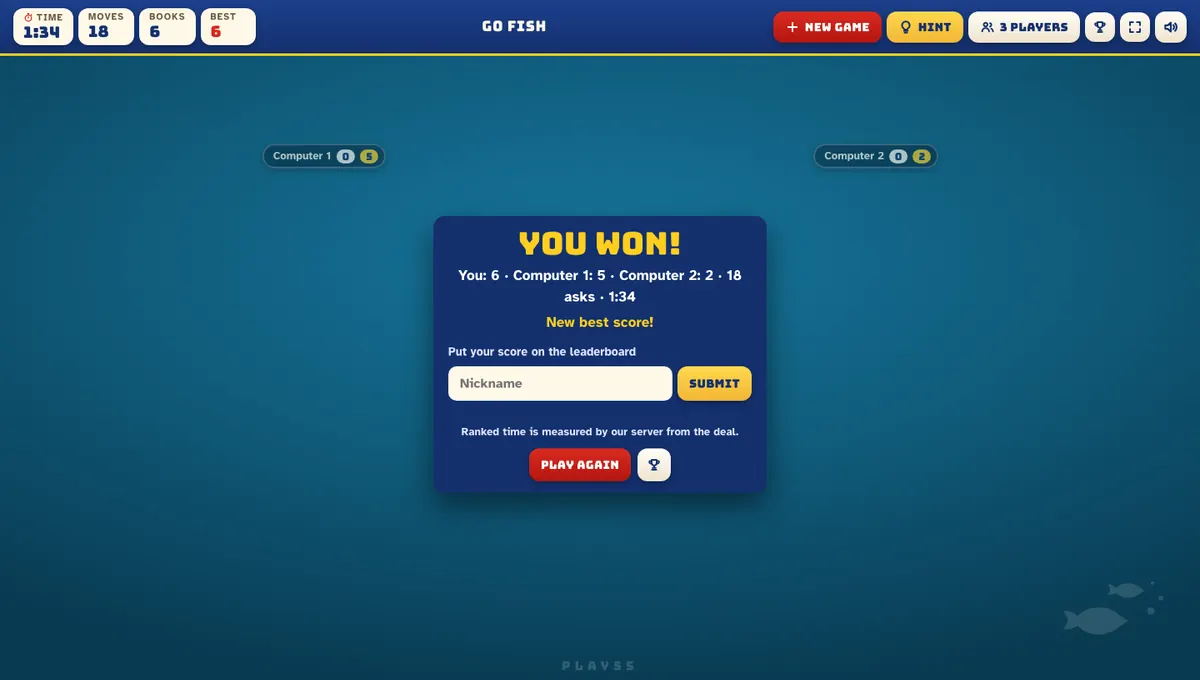
To keep leaderboards fair across devices, only outright wins using standard rules (Books of 4, Wish Bonus On, Normal AI) qualify for submission. Scores are ranked by most books collected first, and ties in book count are broken by fewer elapsed seconds measured on the server from deal to submission.
Daily Deals are pre-checked so every published 3-player seed has a verified winning line. Your first completed Daily Deal submission each day enters the Daily leaderboard with a 2–12 character nickname (no account required); extra runs remain unranked practice.
 Zoom in
Controls, keyboard shortcuts, and saving
You can play Go Fish entirely with taps/clicks or with the keyboard, and your active game automatically saves in your browser.
- Select opponent: Click or tap any opponent seat (`Seat 1`, `Seat 2`, `Seat 3`) in 3- or 4-player mode, or press keys `1`, `2`, or `3`. In 2-player mode the computer is selected automatically.
- Ask for a rank: Tap any card in your hand (or navigate with `Left`/`Right` arrow keys and press `Enter` or `Space`) to ask the targeted seat for that rank.
- Shortcuts: Press `H` for Hint (suggests an ask from public history only), `N` to start a New game, `F` for Fullscreen, and `M` to mute or unmute sound.
- Local storage: Progress, preferred player count, rule switches, AI level, and local best book counts are stored on your device only.
Where the rules come from
Play5s checked each Go Fish rule against Wikipedia, Pagat.com, and Bicycle Cards on 24 November 2026; each line below names the source for that rule.
- Wikipedia: Go Fish: 7 cards each for 2 or 3 players and 5 for more, all cards of the asked rank handed over, play passing to the left, keeping the turn on drawing the asked rank as a variation, and pairs instead of four-card books as a variation.
- Pagat.com (John McLeod, Go Fish): you must hold the rank you ask for, a catch earns another turn, drawing the asked rank shows it and earns another turn, and books of four are laid down at once.
- Bicycle Cards (Go Fish): for 2 or more players, 7 cards each for 2 or 3 players and 5 for 4 or 5, play continuing until all 13 books are made, a player who runs out drawing from the stock on their turn, and the most books winning.
- Play5s choices: Wish Bonus on by default with an Off switch for practice, Kids Pairs (pairs of 2) as a practice rule, empty hands refilled from the pond at once, a draw when two or more players share the most books, and up to 4 players.
Go Fish questions
How many cards do you deal in Go Fish?
Seven cards each when playing 2 or 3 players, and five cards each when playing 4 players, out of a standard 52-card deck.
Do you get another turn when you catch a card?
Yes. Whenever the player you asked hands over one or more matching cards, you immediately ask again. With Wish Bonus enabled (default), drawing the exact rank you asked for from the Fish Pond also grants another turn.
Can you ask for a rank you do not hold?
No. Classic Go Fish requires you to hold at least one card of any rank you ask for.
What happens if you run out of cards during the game?
On Play5s you draw one card from the Fish Pond straight away while the pond still has cards, so you stay in the game. Once the pond is empty, players without cards sit out while the others finish the last books. Bicycle Cards has you draw on your next turn instead, and Pagat ends the game when someone runs out.
What is the Kids Pairs option?
Kids Pairs lowers the target set from four-of-a-kind books (13 total) to two-of-a-kind pairs (26 total) for shorter, easier rounds with younger players. It is marked as a practice rule and does not post to leaderboards.
How does the Go Fish leaderboard rank scores?
Ranked wins (2p, 3p, 4p, and 3p Daily Deal under standard rules) rank first by the highest number of four-card books you collected, with ties broken by faster server-measured completion time.
About this version
Go Fish on Play5s runs directly in desktop and mobile browsers with custom card vectors, synthesized Web Audio pond/catch/book chimes, and accessible keyboard controls.
All ranked deals are replayed deterministically on the server from your action log alone so leaderboard results match the exact table rules shown here.
Read more about Play5s, or see all of our free card games.