

On this page
How to play Forty Thieves
To win Forty Thieves Solitaire, you move all 104 cards from two decks onto eight foundation piles, building each pile up in one suit from Ace to King.
The setup
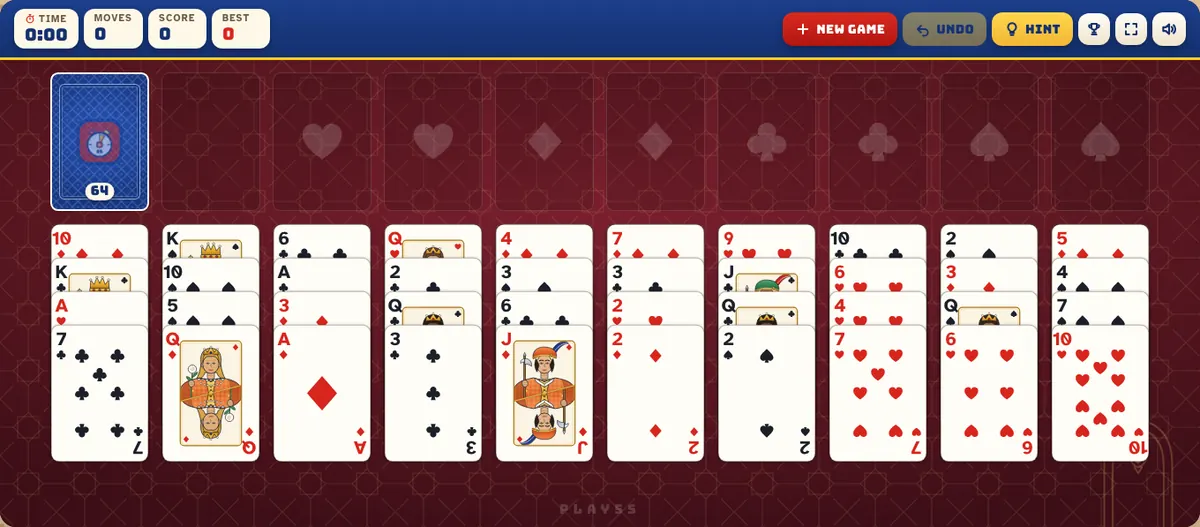
The game uses two 52-card decks. Forty cards are dealt face up into ten columns of four, called the tableau. The other 64 cards form the stock, face down in the top left corner. Above the columns, eight foundation spaces wait for the Aces, two for each suit.
Every card in the tableau is face up, so you can see and plan around all 40 of them from the first move.
 Zoom in
Building the columns
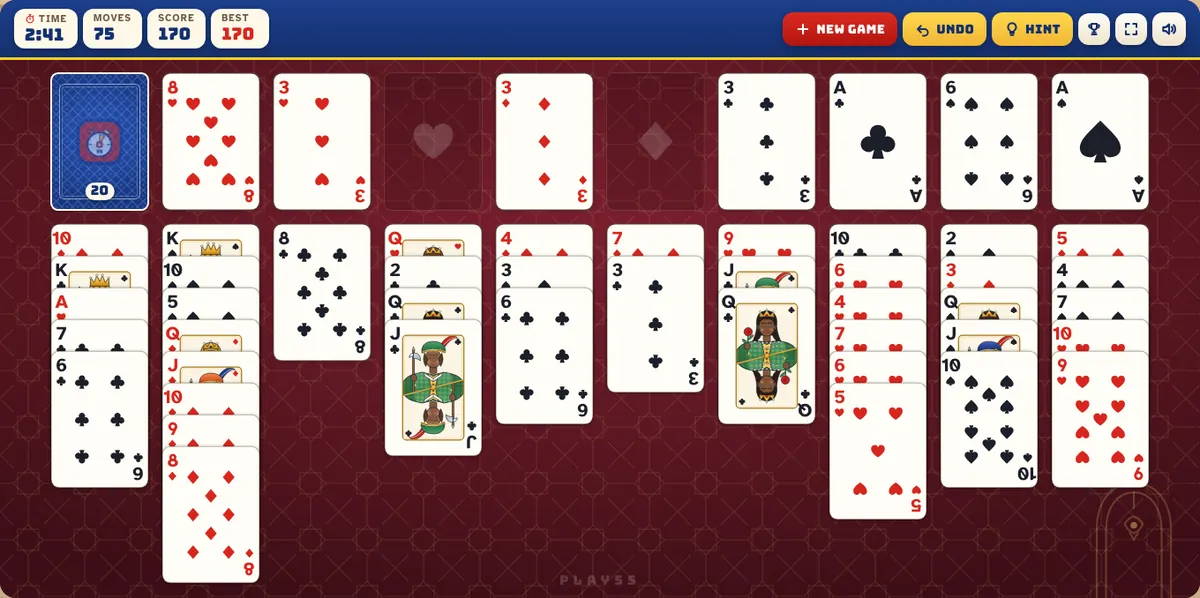
Columns are built down in the same suit: a 6 of hearts goes on a 7 of hearts, never on a 7 of diamonds. Only the top card of a column can move, and only one card at a time, even when several cards in a row are already in order. A card can move onto another column when that column’s top card is the same suit and one rank higher.
Any card can fill an empty column, which makes empty columns the most flexible space on the table.
 Zoom in
Using the stock
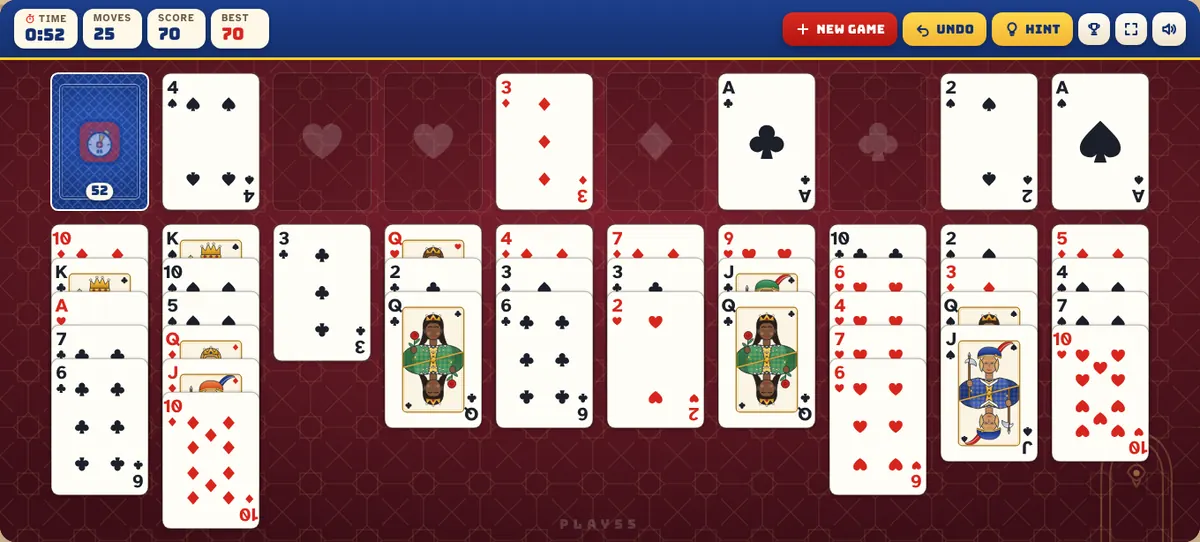
When you run out of moves, turn one card from the stock onto the waste pile. Only the top waste card can be played, onto a column or a foundation; once it is gone, the card beneath it becomes the new top card.
You can go through the stock only once. There is no redeal, so the number on the stock shows how many cards you still have to work with.
 Zoom in
Building the foundations
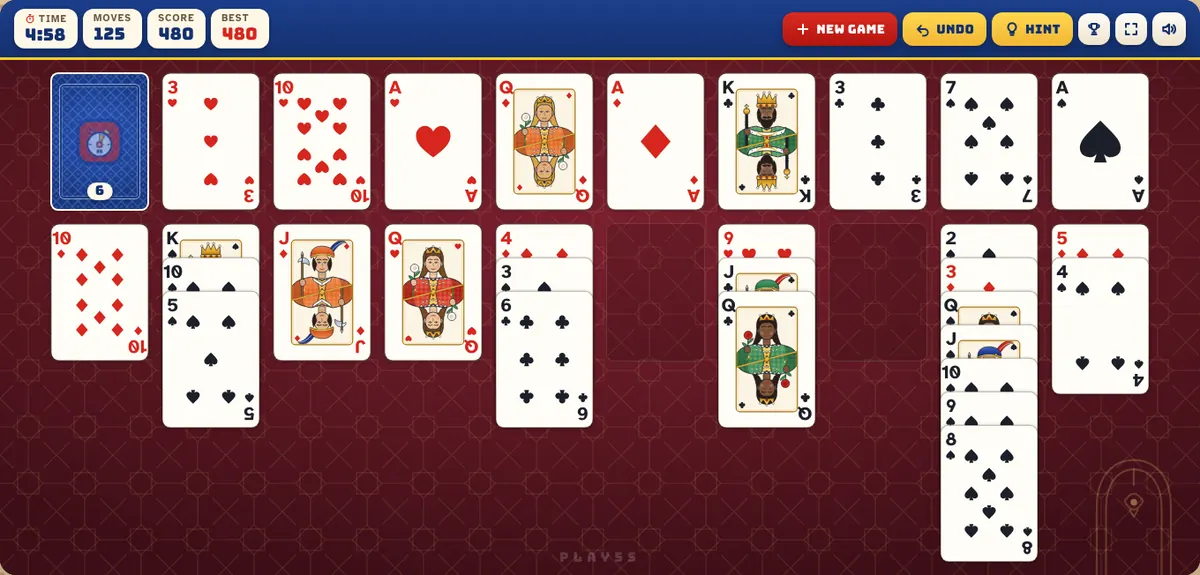
Each foundation starts with an Ace and grows by suit: Ace, 2, 3 and so on up to King. With two decks, every suit has two foundation piles, so you build each suit up twice. In the Play5s version the foundation spaces are marked with suit symbols, and a card that reaches a foundation stays there.
 Zoom in
How a game ends
You win when all eight foundations are complete, 104 cards in all. A game is stuck when the stock is empty and no move leads anywhere new; Play5s then shows a “No useful moves left” note, so you can press Undo or start a new game. When every remaining card can be played home, a Finish button appears and plays them to the foundations for you.
Forty Thieves rules in the Play5s version
The Play5s version follows the standard Forty Thieves rules: two decks, one pass through the stock, one card at a time and same-suit building.
- One card at a time: only the top card of a column moves. Wikipedia describes the variant Josephine, where cards of the same suit built down move as a unit, and the Easy mode of Arkadium’s online version lets you move a same-suit run too.
- One pass: the stock is turned a single time with no redeal. Solitaire.com’s version and the Easy mode of Arkadium’s version let you go through the stock again, which makes the game easier.
- Empty columns: any card can fill one. Arkadium’s online version accepts only a King.
- Foundations: a card on a foundation stays there. Some programs, PySolFC among them, let you move the top card of a foundation back to a column.
- Foundation piles: each suit has two, and Play5s marks every pile with its suit symbol.
- One rule set: there is no easy mode and no choice of draw count.
How hard is Forty Thieves to win?
Forty Thieves is hard: Wikipedia puts the winning chances at about 1 game in 10 under the standard rules.
SolSuite rates the chance of winning as low, about 1 in 15. Solitaire.com says the win rate is around 10 percent with careful play under the original rules and far lower for casual play. Solitaire Network reports that only 5% of the plays on its own site end in a win. These are estimates and reports from the sources named, not Play5s statistics, and they do not agree to the digit.
Wikipedia adds that luck of the draw is a significant factor and that success typically depends on the player’s ability to clear one or more columns.
Many variants exist to make the game easier. Wikipedia lists dealing the Aces to the foundations at the start, building down in alternating colors and moving sequences together as common changes, and it gives Indian, where a card goes on a card one rank higher of any other suit, odds of about 1 in 2. If Forty Thieves is too tough, Klondike Solitaire on Play5s is a gentler place to start.
How scoring works in Forty Thieves
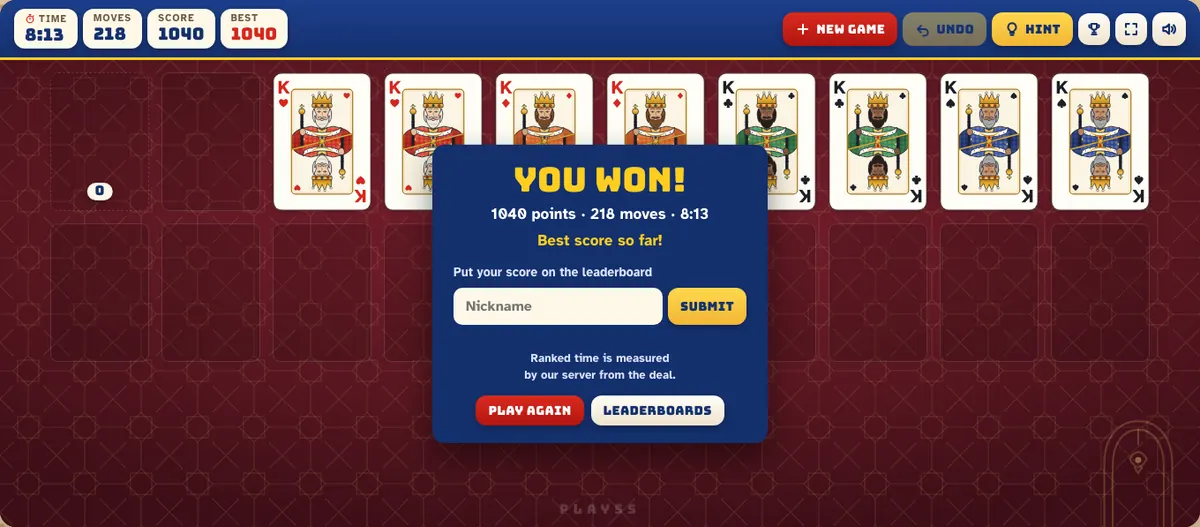
In Forty Thieves Solitaire on Play5s, every card you send to a foundation scores 10 points, so a won game scores 1,040 points.
This is Play5s scoring, our own simple scale. The rules pages we read for the original game, Wikipedia, PySolFC and SolSuite among them, describe no scoring, so there is no standard to copy.
Moves between columns and turns of the stock score nothing, and there is no time bonus. Undo takes back the points of the move it undoes. Best, in the bar above the cards, is the highest score you have reached in any game on this device, won or not.
A won game always scores 1,040 points, so the leaderboards rank wins by the fewest moves, and the shorter time breaks a tie. Every move counts, including the ones you take back, and so does each Undo.
 Zoom in
Daily Deal and leaderboards
The Daily Deal is one Forty Thieves game that every player gets on the same day, and a solver found a way to win it.
The solver knew the order of the stock, which you only learn as you turn cards, so that does not make every Daily Deal easy: not every player will win it. A new Daily Deal starts at midnight New York time. Our server hands it out, so it needs an internet connection, and each connection gets one ranked result per day: after that you can still replay the deal, but only as practice.
Wins go on a leaderboard ranked by the fewest moves, and the shorter time breaks a tie. There is a board for each Daily Deal and an all-time board for regular games, and only won games are listed. After a win you can add a nickname of 2 to 12 characters, no account needed; offensive nicknames are refused. For regular games the server picks the deal, so nobody can choose an easy one in advance.
The server replays every submitted game to check each move, counts the moves itself and measures the time from its own clock, from the moment the deal is handed out. Every action is in that log, the moves you take back and each Undo included, so they all count toward the move total, and an Undo cannot take back a card turned from the stock.
Tips to win more Forty Thieves games
The most useful habit in Forty Thieves is to free an empty column early, because any card can go there and it gives you room to rearrange the table.
- Play Aces and 2s to the foundations as soon as they appear.
- Empty a column early and, when you can, keep one open for single-card swaps.
- Keep same-suit runs short while you are still digging. A long run can trap the cards below it, because only one card moves at a time.
- Early in the game, play waste cards to the foundations rather than dropping them on columns, which only makes the columns longer.
- Look at all 40 face-up cards before each move. Nothing is hidden, so you can plan several moves ahead.
- Think before you turn a stock card. There is only one pass.
- Plan before you move. Undo takes a move back but counts as a move, so trying a move and undoing it costs you on the leaderboard.
Forty Thieves controls: tap, drag or keyboard
Tap a card to send it to the best place it can go, or drag it to the exact column or foundation you want.
A tap moves a card to a foundation when it fits there, otherwise onto a column whose top card is the next one up in the same suit, and otherwise into an empty column, unless the card is already alone in its column. If a card has nowhere to go it gives a small shake.
Dragging works with a mouse, a finger or a stylus. Drop the card near the column or foundation you want; if the move is not allowed, it slides back. Only the top card of each column and the top waste card can be picked up.
Buttons
Undo takes back your last move on the table, one at a time, but it counts as a move and it cannot go back past a card turned from the stock. Hint highlights a worthwhile move, or the stock when turning a card is what is left. New game deals a fresh game and asks first when a game is in progress. The cup button opens the leaderboards and full screen hides everything except the table. The bar above the cards shows time, moves, score and best score. The gear (Settings) button opens a panel with two switches: sound effects for dealing, moving and winning (on at first) and a quiet background music loop (off until you turn it on); both choices are remembered for every Play5s game. The same panel lets you pick the language of the game’s own words, and the M key mutes or unmutes the sound effects.
Saving
Your game, moves and time are saved in this browser on this device, so you can close the page and pick up where you left off. Clearing your browser data removes the saved game. The clock stops while the page is hidden or the start screen is open.
Keyboard shortcuts
On a computer you can play without the mouse. Tab takes you into the table and the arrow keys walk from the stock to the waste and along the columns. Enter or Space on a card picks it up and highlights where it would go; the arrow keys step through every legal place, Enter drops it and Escape puts it back. Pressing Enter twice does what a tap does.
- D: turn a card from the stock
- U or Ctrl+Z: undo
- H: show a hint
- N: start a new game
- F: full screen on or off
- Esc: leave full screen
- M: sound effects on or off
Forty Thieves terms
Forty Thieves uses a handful of words for the parts of the table, and they are the same in most solitaire games.
- Tableau: the ten columns where most of the game is played.
- Foundation: one of the eight piles, two per suit, that you build from Ace to King.
- Stock: the 64 face-down cards left after the deal.
- Waste: the face-up pile where cards from the stock land. Only its top card can be played.
- Pass: one trip through the stock. Forty Thieves gives you one.
- Run: cards of one suit in descending order. In Forty Thieves a run still moves one card at a time.
- Empty column: a column with no cards. It takes any card.
Where Forty Thieves comes from
Forty Thieves is also known as Napoleon at St Helena, a name Wikipedia records as early as 1870.
According to Wikipedia, Napoleon often played patience during his final exile on the island of St Helena, and this is said to be the version he probably played. The name Le Cadran, “The Dial”, appears in 1874, which Wikipedia notes reinforces a possible French origin. In the 1920s American sources began recording Big Forty and Forty Thieves as alternative names, and Roosevelt at San Juan is first recorded in 1939.
Wikipedia calls the game the progenitor of a large family of similar games, most of them designed to make it easier to win. Number Ten, Josephine, Indian and Emperor are among them.
Sources for the rules
The rules and figures on this page come from these pages, all read on 21 November 2026.
- Wikipedia, “Napoleon at St Helena”: rules, odds, history, variants.
- PySolFC rules, “Forty Thieves”: rules.
- PySolFC source code, “fortythieves.py”: moves from a foundation.
- SolSuite, “Forty Thieves”: rules, chance of winning.
- Solitaire.com, “Forty Thieves”
- Solitaire Network, “Forty Thieves Solitaire”
- Solitaire with Cards, “Forty Thieves Solitaire”
- Arkadium, “Forty Thieves Solitaire”
Forty Thieves questions
How do you play Forty Thieves Solitaire?
You build eight foundation piles, two per suit, from Ace to King. You move single cards between ten columns, building down in the same suit, and turn one card at a time from the stock.
How many cards does Forty Thieves use?
Two 52-card decks, 104 cards. Forty are dealt face up into ten columns of four, and the other 64 form the stock.
Can you move more than one card at a time?
Not in the standard game, and not in the Play5s version: only the top card of a column moves. Wikipedia’s variant Josephine and the Easy mode of Arkadium’s online version let you move a same-suit run together.
What can go into an empty column?
Any card, in the Play5s version and in the rules of Wikipedia, PySolFC, SolSuite and Solitaire.com. Arkadium’s online version accepts only a King.
Can you go through the stock more than once?
No. The standard game, and the Play5s version, allow a single pass with no redeal. Solitaire.com’s version and the Easy mode of Arkadium’s version add a second pass.
Why is Forty Thieves so hard to win?
Wikipedia says luck of the draw is a significant factor and puts the winning chances at about 1 game in 10; SolSuite says about 1 in 15. Same-suit building and moving one card at a time leave few options.
How does scoring work in Forty Thieves on Play5s?
Each card sent to a foundation scores 10 points, so a won game always scores 1,040. This is Play5s scoring: the rules sources we read describe no standard scoring for the game. The leaderboards rank wins by the fewest moves.
What is the Daily Deal?
One Forty Thieves game that is the same for every player on a given day, so you can compare your result with everyone else. A solver found a way to win each Daily Deal, but it knew the order of the stock and you do not, so not every player will. A new one starts at midnight New York time.
Is there a Forty Thieves leaderboard?
Yes: one for each Daily Deal and an all-time board for regular games. Wins are ranked by the fewest moves, and the shorter time breaks a tie. After a win, type a nickname and press Submit; no sign-up is needed.
Does the game save my progress?
Yes. Your current game, moves and time are saved in this browser on this device. Clearing your browser data removes the saved game.
Can I undo moves, and how far back?
Yes, one move at a time, back to the last card you turned from the stock: Undo cannot take that back, because it has already shown you a new card. Undo counts as a move, and so does the move it takes back, so the move count never goes down.
Is Forty Thieves the same as Napoleon at St Helena?
Yes. Wikipedia lists Forty Thieves, Big Forty, Le Cadran and Roosevelt at San Juan as alternative names for Napoleon at St Helena.
About this version
This Forty Thieves Solitaire was built by Play5s to run in any modern web browser. It uses the standard rules described above, with the choices listed under “Forty Thieves rules in the Play5s version”, and deals a new shuffled game every time, with a Daily Deal and leaderboards. The cards, including the Jacks, Queens and Kings, are drawn by Play5s.
There is nothing to install and no account to create. Your game in progress is kept in your browser’s local storage. Starting a ranked game asks our server for a deal and a ticket; your moves and nickname are sent only when you submit a score to a leaderboard. As on the rest of Play5s, Google Analytics counts when a game is started, won or left unfinished; the Privacy page has the details.
Read more about Play5s, or see all of our free solitaire games.