
On this page
How to play backgammon
To win backgammon, move all fifteen of your checkers around the board into your home board and then bear them off before your opponent does, using the numbers on two dice.
The board and the start
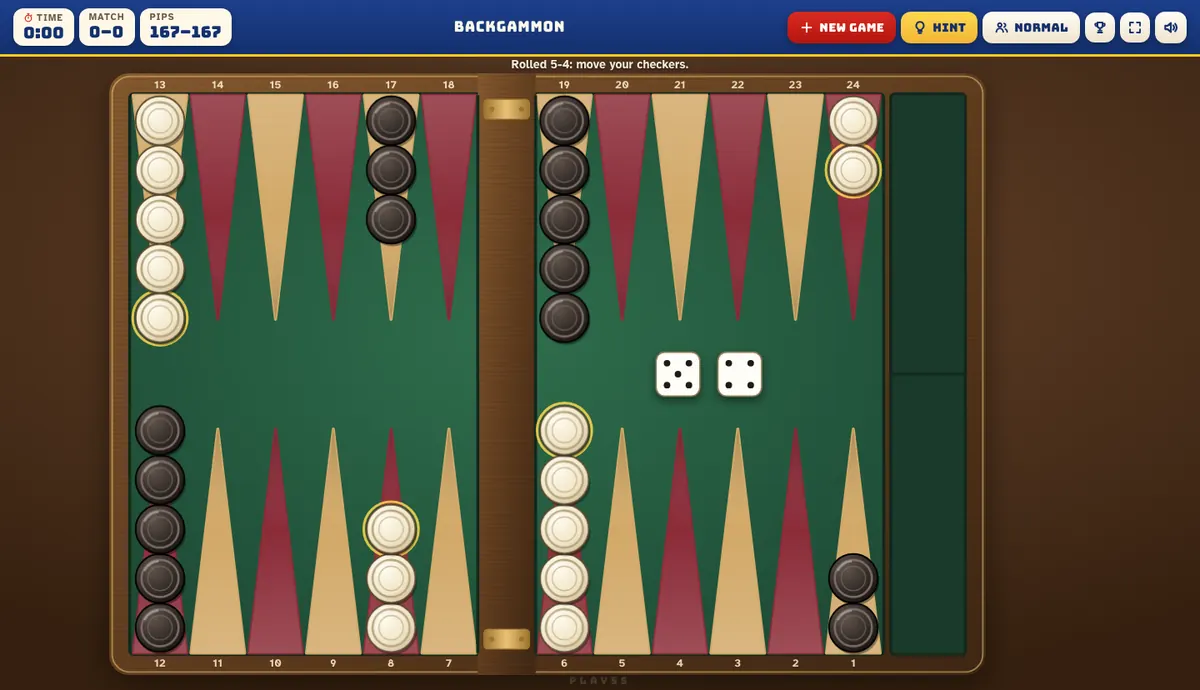
The board has twenty-four narrow triangles called points, split by the bar into four quadrants of six: your home board, your outer board, your opponent’s outer board and your opponent’s home board. Each side has fifteen checkers. At the start, each side has two on its 24 point, five on its 13 point, three on its 8 point and five on its 6 point, as the USBGF and bkgm.com describe it.
In Play5s you are the ivory checkers and move from the top right of the board, around the left, to your home board at the bottom right, so your numbers run down from 24 to 1. The numbers along the frame, which appear whenever the board is big enough to read them, are yours, and the pip count in the bar above the board adds up how many points each side still has to travel: 167 for each side at the start.
To decide who moves first, each side rolls one die. The higher number plays first, using both numbers just rolled, and a tie is rolled again. Play5s does this at the start of every game, so the first move of a game is always played with two different numbers.
 Zoom in
Rolling and moving
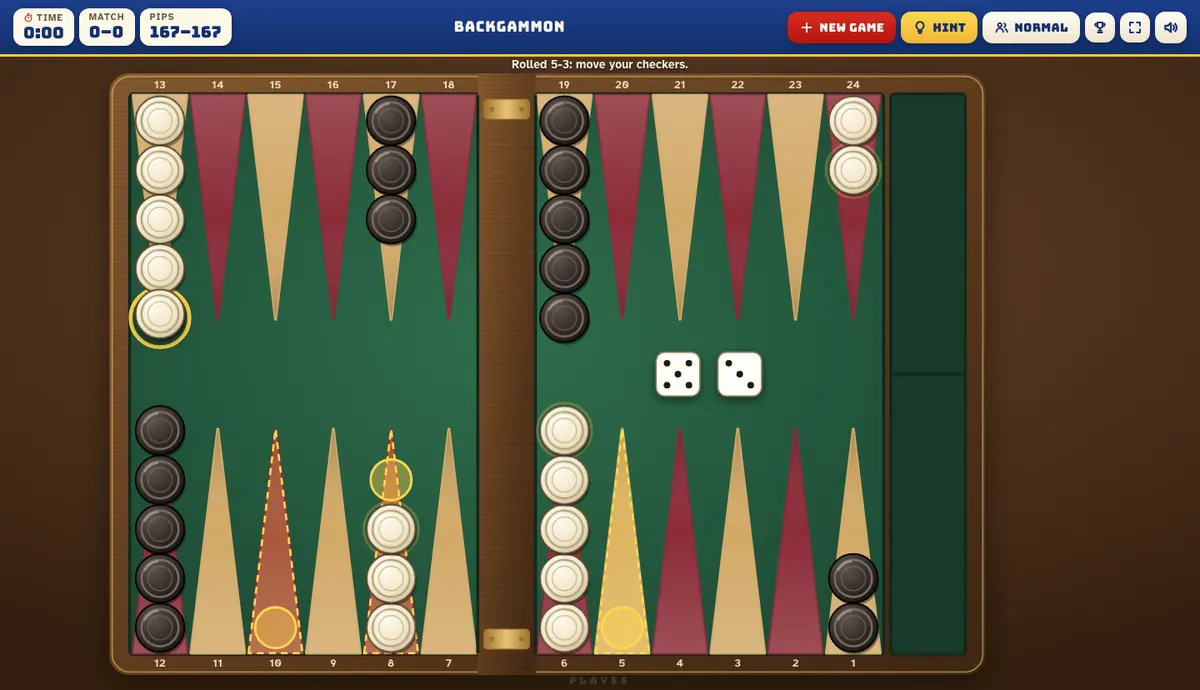
On your turn you roll two dice. Each number is a separate move: you may move one checker with one die and a different checker with the other, or the same checker with both, as long as the point it lands on in between is open. A point is open unless two or more opposing checkers stand on it. Checkers only move forward, toward lower numbers.
A double (the same number on both dice) is played four times. A roll of 3-3 gives you four moves of three points, with any checkers you like.
You must play both numbers if there is any legal way to do so. If only one of them can be played, you must play that one, and if either can be played but not both, you must play the larger one. If neither can be played, you lose the turn. Play5s enforces all of this: only the moves that follow these rules are highlighted.
 Zoom in
Hitting a blot and entering from the bar
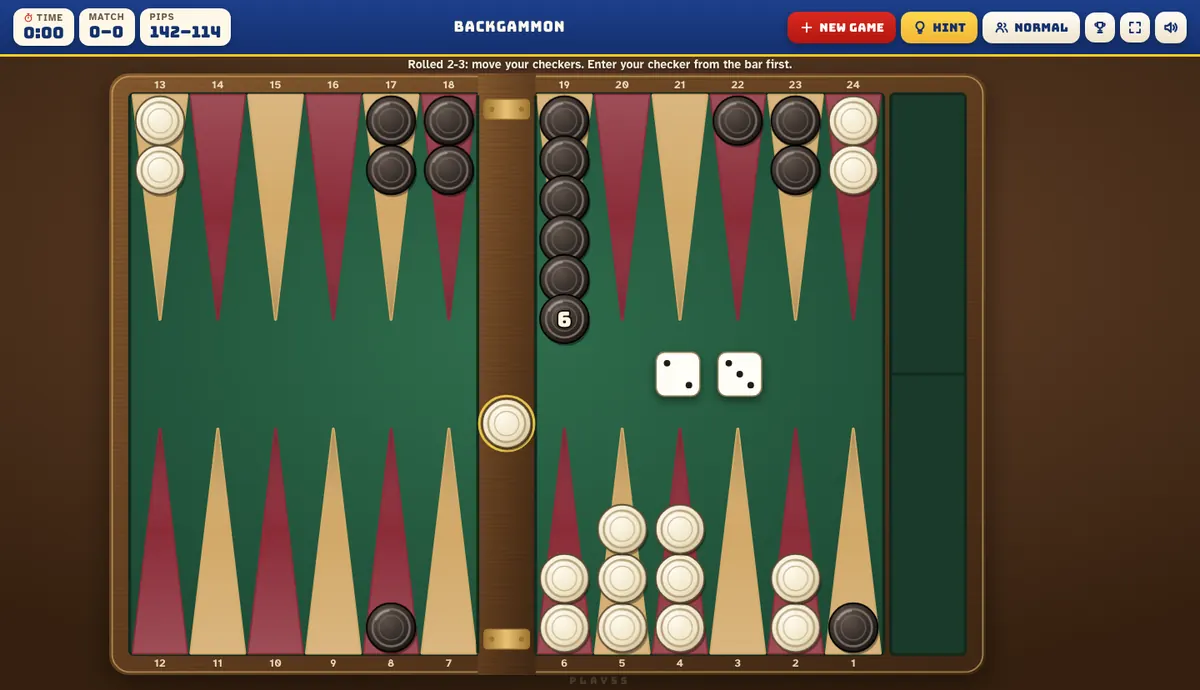
A point held by a single checker is a blot. If a checker of the other side lands on it, the blot is hit and goes to the bar in the middle of the board. A side with a checker on the bar must bring it back in before moving anything else: it enters on the opponent’s home board, on the point that matches one of the dice (a 6 enters on the opponent’s 6 point), as long as that point is open.
If neither number lets the checker in, the turn is lost. If a side has several checkers on the bar and can bring in only some of them, it enters those and forfeits the rest of the roll. Hitting and then moving the same checker on to safety is allowed.
 Zoom in
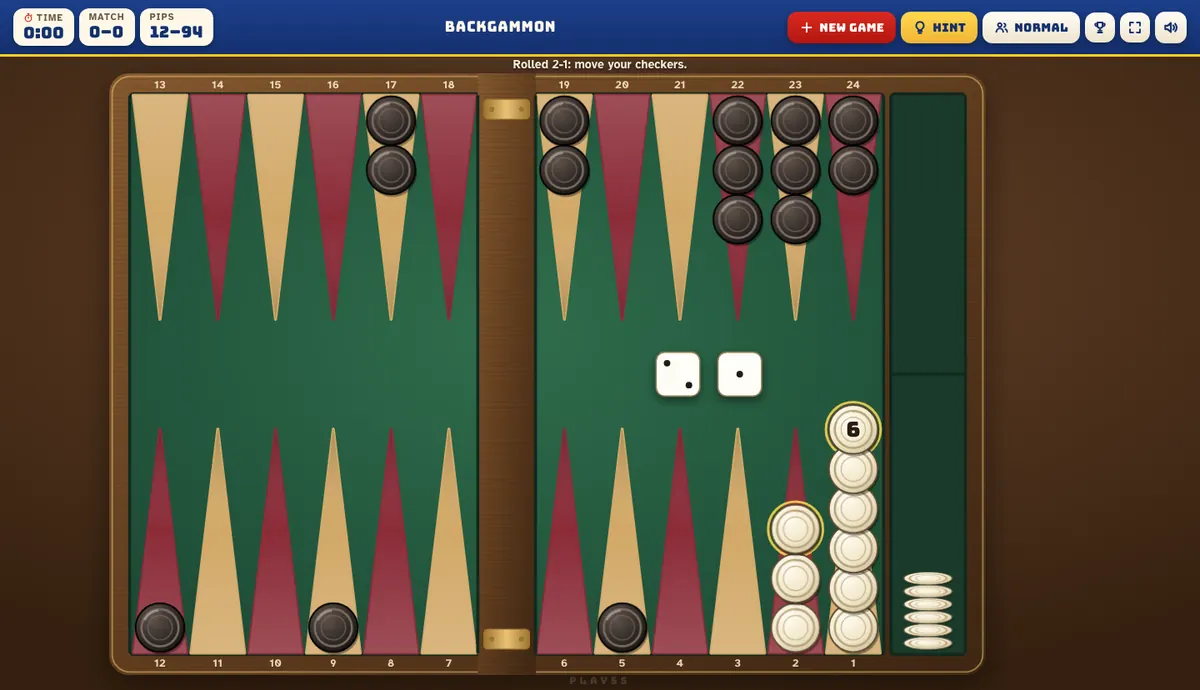
Bearing off
Once all fifteen of your checkers are in your home board (none on the bar, none outside the 6 point), you may start to bear them off. A number takes a checker off the point with the same number. If you have no checker on that point you must move a checker from a higher point instead, and if there is no checker on a higher point you bear off a checker from your highest point. You can always make an ordinary move instead of bearing off if you prefer.
If a checker is hit while you are bearing off, it has to come back round to your home board before you can bear off again. The first side to bear off all fifteen checkers wins the game.
 Zoom in
How is backgammon scored?
A game of backgammon is worth one point for a single win, two for a gammon and three for a backgammon, each multiplied by the value showing on the doubling cube.
If the loser has borne off at least one checker, the winner scores a single game: the cube value, which is 1 unless the cube was used. If the loser has not borne off a single checker it is a gammon and the winner scores twice the cube value. If the loser has not borne off any checker and still has a checker on the bar or in the winner’s home board, it is a backgammon, worth three times the cube value. The USBGF and bkgm.com give the same rule.
Some countries around the Mediterranean count a backgammon like a gammon (German Wikipedia mentions it). Play5s scores it three times, as the USBGF and English Wikipedia do. A single game is a match to one point, so gammons only matter in longer matches.
How does the doubling cube work?
The doubling cube lets a side that thinks it is ahead double the stakes, and the other side must either accept and play on for twice as much or give up the game.
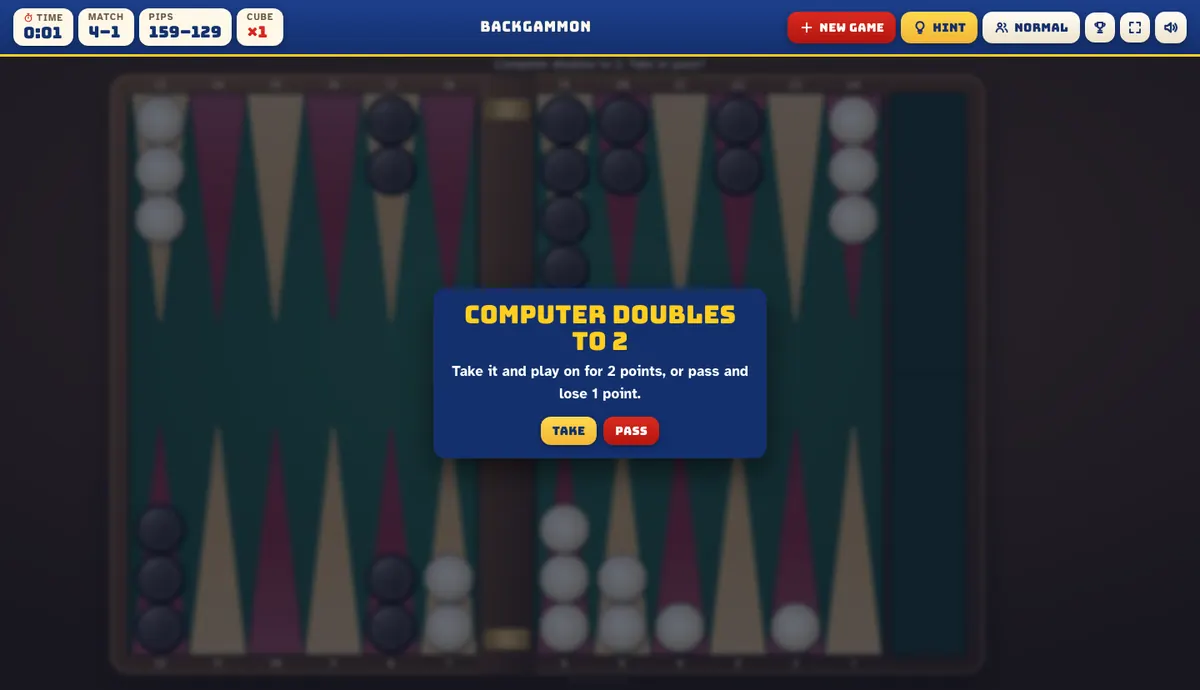
In Play5s the cube is an option you switch on at the start screen (it is off by default, and it needs a match of 3 points or more). The cube starts in the middle of the bar, so either side may make the first double. You may double only at the start of your own turn, before you roll. The other side can pass, which concedes the game and loses the stake from before the double (one point if there have been no doubles), or take, which doubles the stake and gives that side the cube: from then on only the owner of the cube can redouble. The cube goes up to 64 (a Play5s limit: the rules set none).
Two more rules apply to the cube in a match. A side that would win the whole match by winning the game at the current stake cannot double, because the cube is dead for it. And the Crawford rule: in the game right after one side first gets to one point from winning the match, nobody may double. After that Crawford game, the cube is back. Play5s does not use beavers, automatic doubles or the Jacoby rule (which belongs to money play, not match play).
When the computer doubles you, a box asks whether you take or pass and says what each costs. Take (T) or Pass (P) with the buttons or the keys; Hint tells you what the Sharp level would do.
 Zoom in
What is a match to 3, 5 or 7 points?
A match is a series of games played until one side has reached a set number of points, and Play5s offers matches to 1, 3, 5 or 7 points.
Every game of the match starts with a new opening roll and adds its points (single, gammon or backgammon, times the cube) to the winner’s score. The first side to reach the target wins the match, even if it goes past it with a gammon. The bar above the board shows the match score, the pip count and, when the cube is on, the cube value.
A match to 1 point is a single game. The default is a match to 3 points, which is the match that counts for the leaderboards.
How strong is the computer?
You play the computer at three levels, Easy, Normal and Sharp, and the Hint button shows what the Sharp level would play for you.
The computer is a hand-written player, not a learned network: it looks at the pip count, made points and blocks, anchors in your home board and the chance that you hit its lone checkers, and it chooses by that. Easy adds deliberate mistakes and never doubles. Normal takes the play its evaluation likes best and doubles when its position is strong. Sharp does the same and, for its best few plays, also looks at how you could reply.
Every move of the computer is a pure function of the dice, the position and the seed, so a ranked match can be checked by replaying it. The dice come from a seed, so the Daily Match gives everyone the same rolls.
You can also play two people on one screen: turn to the other side after each Done. A two-player match is practice and never ranked.
How do I play backgammon on my phone or keyboard?
You play by tapping or dragging a checker, and every action also has a key.
Tap Roll (or press R) to roll. Tap one of your checkers that has a gold ring to pick it, then tap one of the highlighted points to move it, or drag the checker there. On a phone the board turns to stand upright so the points are big enough to hit. A tap close to the edge of a point picks the legal point next to your finger.
When all your dice are played, tap Done (or press E or Enter) to hand the turn over. Until then, Undo (U) takes the last move back. Double (D) offers the cube before you roll, and Hint (H) shows with an arrow the play the Sharp level suggests; in a ranked match it asks first, because a match played with the Hint is practice. N starts a new game and asks first, F switches full screen, M turns sound on or off.
With the keyboard, Tab to the board, use the arrow keys to move between the checkers that can move and then between the places they can go, and press Enter to pick or place. Escape puts a picked checker down. The status line and screen readers announce each point and the places a checker can reach.
What are the Daily Match and the leaderboards?
The Daily Match is one match a day with the same dice for everyone, and the leaderboards rank matches won against the computer.
A ranked game is a match to 3 points against the computer at the level you choose, without the cube; anything else you set up is practice. A won ranked match goes on the board of its level, ranked by how many points you won it by, so 3–0 beats 3–2. A tie goes to the shorter time, then to whoever posted first. Only wins are listed. The Hint is a help, not a ranked move: using it in a ranked match or the Daily Match turns that match into practice (it asks first).
The Daily Match is a ranked match against the Normal level whose dice are the same for everyone that day. The day changes at midnight New York time. It needs a connection, because our server hands out the dice, and a connection gets one ranked Daily Match result per day: after that, playing it again is practice. The time is measured by our server from the moment it hands out the match.
Starting a ranked match asks the server for a start ticket with the dice seed; your moves and your nickname are sent only when you submit a score, and the server replays your match, including every turn of the computer, before it counts. A nickname has 2 to 12 characters and offensive names are refused. There are no accounts.
What are good backgammon tips for beginners?
Beginners improve fastest by building points, avoiding needless blots and counting the race.
- Make points: two or more checkers on a point block your opponent and keep your checkers safe. The 6 point, 5 point, 4 point and your 8 and bar (7) points are the most useful to make early.
- Do not leave lone checkers where the opponent can reach them with many numbers, especially near your own home board, where a hit costs you the most.
- Move your two back checkers out in time. If they stay on the 24 point too long they can be trapped behind a row of blocked points.
- Watch the pip count in the bar above the board. If you are ahead, play safe and race; if you are behind, look for a hit or a block.
- Use Hint after a roll to see a sensible play, and Undo to try an idea before you tap Done.
Where do the Play5s backgammon rules come from?
The rules follow the USBGF’s published rules for backgammon, checked against the bkgm.com rules text and Wikipedia, and the table below says where Play5s made its own choice.
The rules were read on 23 November 2026: the United States Backgammon Federation’s Backgammon Basics (opens in a new tab) and its tournament rules for the Crawford game and the dead cube (opens in a new tab), the rules text on bkgm.com, and Wikipedia’s article on backgammon (opens in a new tab) with its French, German, Italian and Spanish editions for the local words.
Backgammon is also the name of a family of older games on the same board. Long backgammon, nardy (the Russian *nardy*), and the Greek games Plakoto and Fevga (*tavli*) start from other positions and have different rules, for example no hitting in some of them. Play5s plays the international standard game.
| Rule | What the sources say | What Play5s does |
|---|---|---|
| Start position | Two on the 24 point, five on the 13, three on the 8, five on the 6 (USBGF, bkgm.com) | The same |
| Who starts | Each side rolls one die, the higher plays both numbers, a tie is rolled again | The same, at the start of every game |
| Both dice, doubles | Play both numbers if you can, the larger if only one; a double is played four times | The same |
| Bearing off | Exact number, else a higher point, else the highest checker; a hit checker comes home first | The same |
| Scoring | Single 1, gammon 2, backgammon 3 times the cube; a few countries count a backgammon as 2 | 1 / 2 / 3 |
| Doubling cube | Before your roll, only the owner, a pass loses the earlier stake; beavers and automatic doubles are optional extras; the rules set no top value | Optional (off by default), no beavers, no automatic doubles, up to 64 |
| Jacoby rule | Money play only, not used in match play | Not used |
| Crawford rule | No doubling in the game after a side first gets within one point of the match; a dead cube cannot be turned | Used when the cube is on |
Backgammon questions
Is backgammon free here?
Yes. Play5s backgammon is free to play in your browser, with no download and no account.
Who moves first?
Each side rolls one die at the start of a game and the higher number plays first, using both numbers just rolled. A tie is rolled again.
What is a pip?
A pip is one point of travel. The pip count adds up how many points all of a side’s checkers still have to move before they are off the board: 167 at the start.
What happens if I cannot move?
If neither number can be played, you lose the turn and the game passes the dice to the other side. If you can play only one number, you must play it, and the larger one if you could play either.
Is backgammon luck or skill?
Both. The dice decide what you can move, but choosing how to use each roll, when to hit and when to double decides who wins over a match.
Can I play against a friend?
Yes. Choose Two players on the start screen and take turns on the same screen. A two-player match is practice and is not ranked.
Does Play5s save my game?
Yes. Your game in progress is saved on this device and the start screen offers Continue when you come back.
About this version
This version plays standard international backgammon with fifteen checkers each, matches to 1, 3, 5 or 7 points, gammons and backgammons, and an optional doubling cube with the Crawford rule and dead cubes.
You play the computer at Easy, Normal or Sharp, or two people share one screen. You can tap, drag or use the keyboard, take a move back with Undo until you tap Done, and ask Hint for a suggested play.
Ranked matches are matches to 3 points against the computer without the cube; the Daily Match uses the Normal level and the same dice for everyone. The leaderboard stores your nickname, your result, the time your match took and the number of moves, and nothing else.
Your game in progress and your sound settings are kept in your browser only.
Read more about Play5s, or see all of our free online board games.