

On this page
How to play Pyramid Solitaire
To win Pyramid Solitaire, take all 28 cards off the pyramid by pairing cards that add up to 13 and by removing each King on its own.
The setup
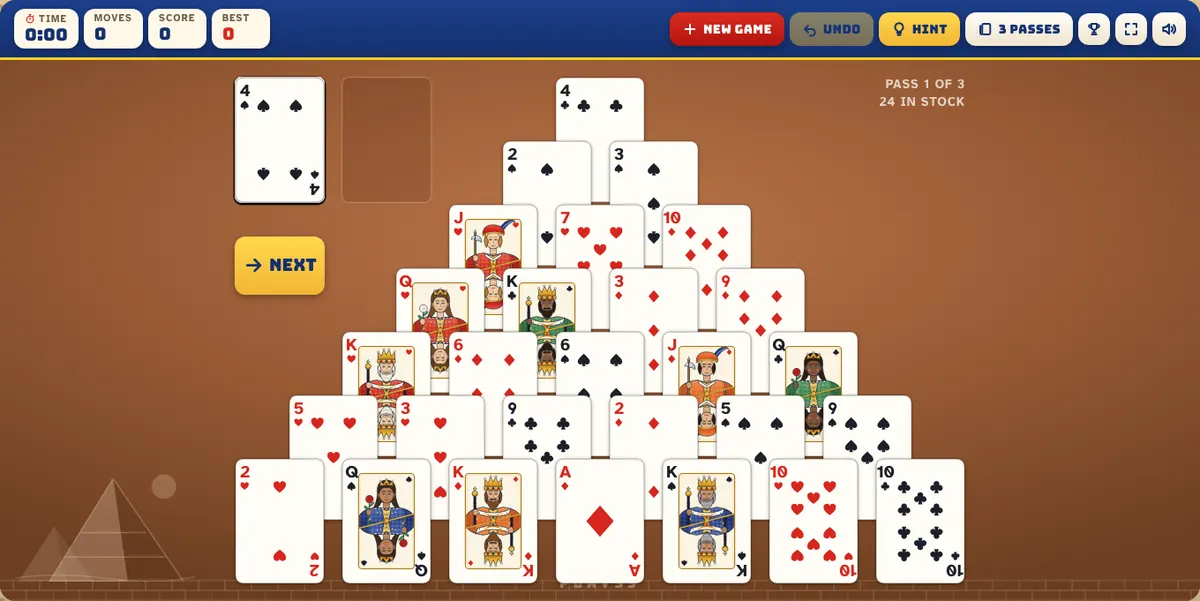
The game deals 28 cards face up into a pyramid of seven rows: one card in the top row, two in the next row, and so on down to seven in the bottom row. Every row overlaps the row above it, so a card is covered when a card from the row below lies over it.
The other 24 cards form the stock in the top left corner. Its top card is face up and can be played like any open card; the cards under it are face down. Next to the stock is the waste pile, which is empty at the start.
 Zoom in
Free cards
A card is free when no card overlaps it, and only free cards can be played. At the start the seven cards in the bottom row are free. A card higher up becomes free as soon as both cards that cover it have been taken off. In the Play5s version a card cannot pair with the card that covers it; Wikipedia notes variants that allow that.
Pairs that add up to 13
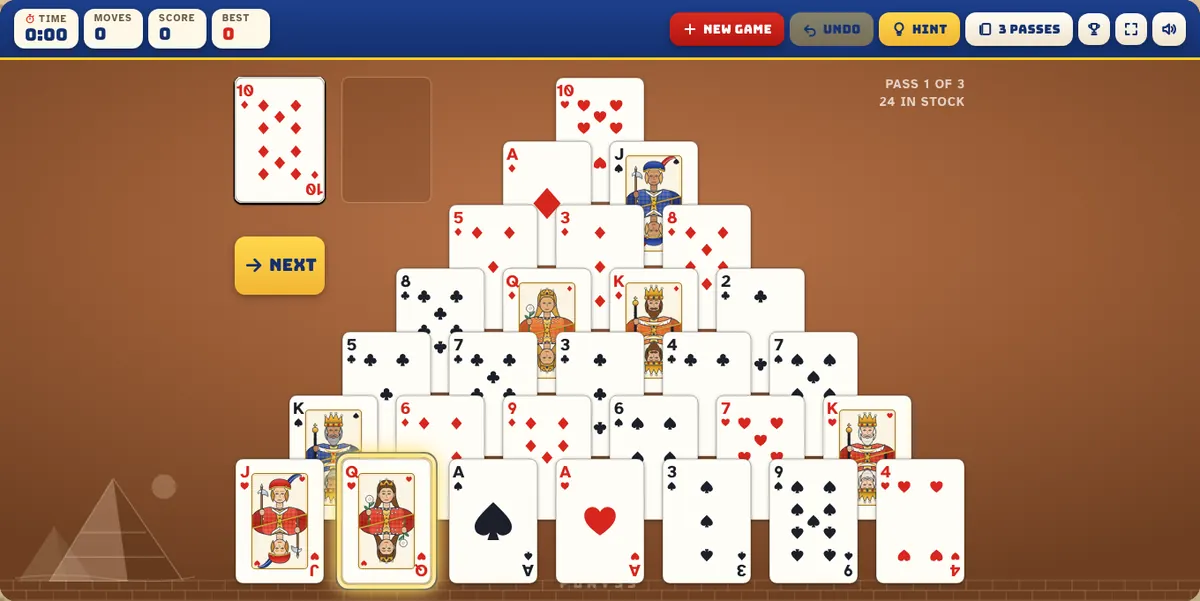
An Ace counts 1, number cards count their number, a Jack is 11, a Queen is 12 and a King is 13. So the pairs are Ace and Queen, 2 and Jack, 3 and 10, 4 and 9, 5 and 8, and 6 and 7. Suits and colors do not matter.
A King is already 13, so it needs no partner: take it off on its own. The rules on semicolon.com say that both the top card of the stock and the top card of the waste pile are available for play, and BVS Solitaire says that only uncovered cards in the pyramid and the top cards of the stock and the waste pile are available. The Play5s version follows them: you can pair two free pyramid cards, a free pyramid card with the top card of the stock or of the waste, or the top card of the stock with the top card of the waste. A King can go off alone from any of those places.
 Zoom in
Using the stock and waste
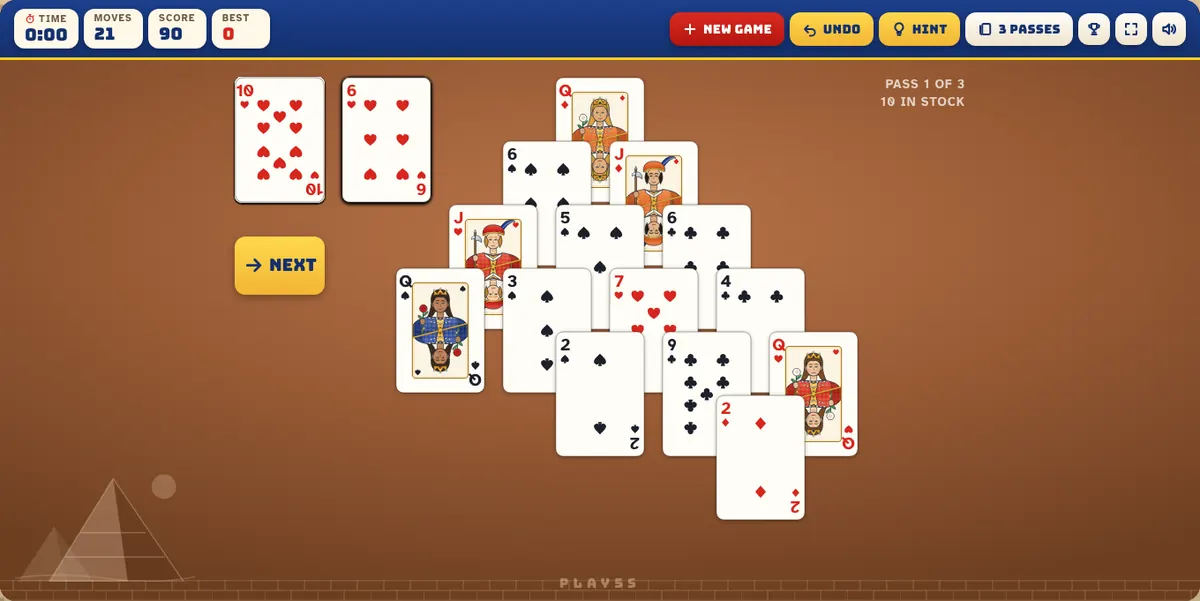
Before you turn anything, check the top stock card: it is face up and may pair with the top waste card or a free pyramid card. When nothing pairs, tap Next under the stock to move its top card onto the waste. Only the top card of the waste can be played; the cards under it stay out of reach until it leaves. When the stock is empty, the same button reads Flip and turns the waste over for another pass, if the mode you chose allows one.
How a game ends
In the Play5s version you win when the last card leaves the pyramid, in both modes, and cards still left in the stock or the waste do not matter. The basic rules in Wikipedia's article are stricter: every card, including the stock and the waste, has to be moved off. Wikipedia lists a looser variant, Relaxed Pyramid, in which only the pyramid has to be cleared, and that is the goal used here for both modes.
A game is lost when no pair, no King and no stock card is left to play; a "No moves left" box then offers Undo or a new game.
 Zoom in
Three passes or one pass?
Three passes lets you go through the stock three times and one pass only once, so three passes is the easier mode and one pass is the harder one.
Pyramid rule sets disagree on how many times the stock may be used. The basic rules in Wikipedia's article on Pyramid use a single pass, while the rules on semicolon.com and BVS Solitaire allow two redeals, which makes three passes in all. In the Play5s version you choose: three passes is the usual pick, and one pass is the stricter game. The pick is yours on the start screen, and the button in the bar above the cards switches mode and deals a new game. Both modes use the same goal and the same scoring.
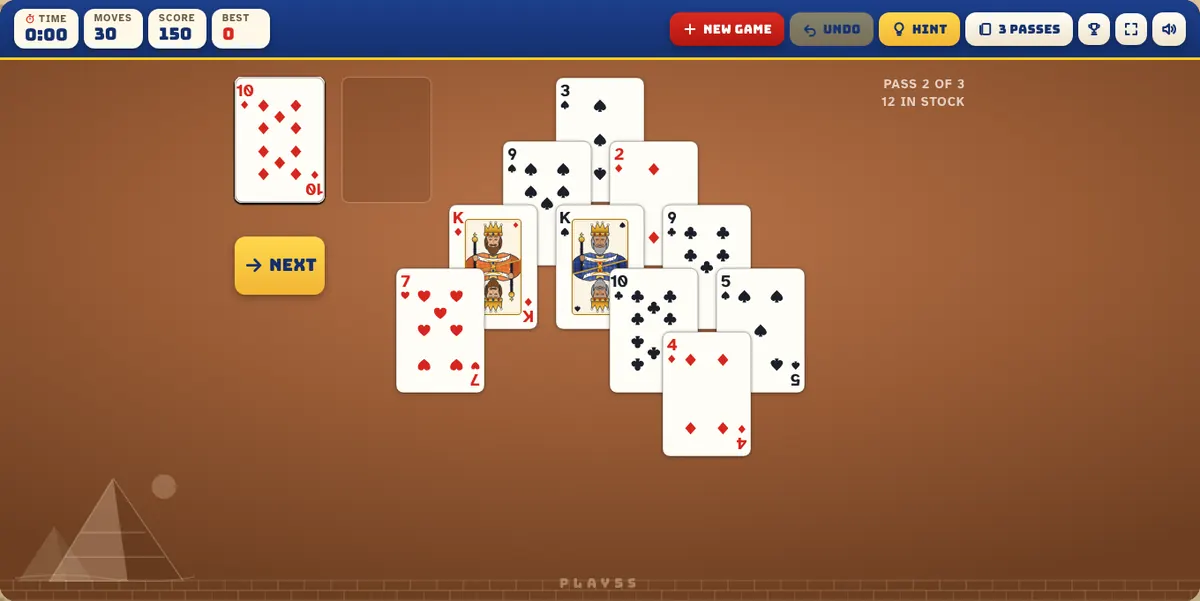
In the Play5s version, when the stock runs out in the three-pass mode you tap Flip and the waste is turned over, with the cards in the same order as before. The table shows which pass you are on, for example "Pass 2 of 3". After the third pass the stock is finished.
 Zoom in
Which one should you pick?
If you are new to Pyramid, start with three passes: the extra passes give you more chances to find the card you are missing. Switch to one pass when you want every turn of the stock to count.
How scoring works in Pyramid Solitaire
Play5s scoring gives 10 points for every pair you remove and 5 for every King taken off alone, and clearing the pyramid adds a bonus of 50, 35 or 20 points for finishing on the first, second or third pass.
Sources score Pyramid in different ways. Wikipedia's article counts the cards left in the pyramid, so zero is a perfect result. The rules on semicolon.com use a par system that starts from 50, 35 or 20 points depending on the pass on which the pyramid is cleared, minus the cards left over. Play5s scoring is our own simple scale: only the 50, 35 and 20 bonus values echo that par system, and the rest is ours. A score here can therefore only be compared with other games on Play5s.
Points are only taken away when you take back the move that earned them with Undo, and there is no time bonus. Turning cards from the stock or turning the waste over scores nothing, but each of those actions counts as a move, and so does every Undo. When you win, your score becomes the best score for that mode if it beats the old one, and the best score is saved on your device. The scores of won games differ very little, because every win takes the same 28 pyramid cards, so the leaderboards rank wins by the fewest moves instead, and by the shortest time when the moves are equal.
 Zoom in
Daily Deal and leaderboards
The Daily Deal is one Three passes game that every player gets on the same day, and a solver found a way to win every one of them.
The solver knew the order of the stock cards, which you only see one at a time, so not every player will win a Daily Deal even though it can be won. A new Daily Deal starts at midnight New York time. Because everyone plays the same cards, the Daily Deal leaderboard compares every player on one deal. Our server hands out the Daily Deal, so it needs an internet connection, and each connection gets one ranked result per day: after that you can still replay the deal, but only as practice.
Leaderboards rank wins by the fewest moves, and when moves are equal the shorter time comes first. Moves count every action, including each Undo and the move it took back, so taking moves back costs you on the board. Only games that clear the pyramid go on a board, and there is one all-time board for each mode, Three passes and One pass, next to the Daily Deal board. After a win you can put your result on a leaderboard with a nickname of 2 to 12 characters, no account needed; offensive names are refused. The server replays every submitted game to check that each move is legal, works out the moves and the score itself and measures the time from its own clock, from the moment the deal is handed out. For regular games the server also picks the deal, so nobody can choose an easy one in advance.
Tips to clear the pyramid
The most useful habit in Pyramid is to look at every free card, the top of the stock and the top of the waste before you pair anything, because each card has only four possible partners.
- Count partners before you pair. There are four cards of every rank, so a 6 has exactly four 7s as partners. If three of those 7s are already gone, the last one is precious: do not spend it on another 6 without a reason.
- Take a King off as soon as it is free. It needs no partner, and it frees the cards that lie above it.
- Work the lower rows first. A pair taken from the bottom of the pyramid uncovers more cards than a pair from the top, and the Hint button in this version follows the same idea.
- When two cards could take the same partner, pick the one that uncovers more. For a 6 with two free 7s, take the 7 that frees a card higher up.
- Look at the stock top before you turn it. It is face up, so you can pair it with the top waste card or a free pyramid card instead of burying it on the waste.
- Check the waste before you tap Next. Turning a card buries the old waste card, so use it first if it has a partner on the pyramid or the stock.
- Remember what has gone through the stock. In the Play5s version the cards left in the stock come back in the same order on every pass, so on pass 2 you already know what is coming.
- Think before you pair. Undo can take back a pair or a King, but every take-back counts as a move, and a card you turned from the stock cannot be taken back at all.
Pyramid controls: tap, drag or keyboard
Tap a free card to pick it, then tap the card that adds up to 13 with it; tap a King to take it off at once.
The picked card glows. Tap it again to put it down, or tap a different card that does not pair with it and that card becomes the pick. A card that is still covered gives a small shake and cannot be picked. The top stock card and the top waste card are picked and paired the same way as pyramid cards.
Dragging works with a mouse, a finger or a stylus. Drag a free pyramid card, the top stock card or the top waste card onto its partner; if the two do not add up to 13, the card slides back.
Buttons
Undo takes back your last pair or King, and you can press it again to go back further, but only as far as the last card you turned from the stock: a turned stock card, or turning the waste over, cannot be taken back, so Undo shows a short note and changes nothing. Taking a move back counts as a move, so the Moves counter never goes down and both the move and its Undo stay counted. Undo also works after you close the page and come back. Hint highlights a pair or a King, or the Next button when turning a card is the best option; it only uses cards that are face up. Next moves the top stock card onto the waste, and when the stock is empty it becomes Flip and turns the waste over. New game and the passes button ask before they end a game in progress, so one stray tap does not lose it. The cup button opens the leaderboards. The full screen button hides everything except the table; press it again, or Esc, to come back. The bar above the cards shows your time, moves, score and best score. The gear (Settings) button opens a panel with two switches: sound effects for dealing, pairing and winning (on at first) and a quiet background music loop (off until you turn it on); both choices are remembered for every Play5s game. The same panel lets you pick the language of the game’s own words, and the M key mutes or unmutes the sound effects.
Keyboard shortcuts
On a computer you can play without the mouse. Press Tab to reach the table, then Tab or the arrow keys to move between playable cards in reading order: the pyramid from the top row to the bottom row and from left to right, then the stock and the waste. Press Enter or Space to pick a card.
- D: Next (move the top stock card onto the waste) or Flip (turn the waste over)
- U or Ctrl+Z: undo (takes back a pair or King, never a turned card)
- H: show a hint
- N: start a new game (asks first when a game is in progress)
- F: full screen on or off
- M: sound effects on or off
- Esc: put the picked card down, keep the current game, or leave full screen
Pyramid terms
Pyramid uses a few words for the parts of the table, and they are the same in most solitaire games, such as Klondike.
- Pyramid: the 28 face-up cards in seven overlapping rows.
- Free card: a card that no other card overlaps, so it can be played.
- Pair: two cards whose ranks add up to 13.
- Stock: the pile of 24 cards left after the deal. Its top card is face up and can be played.
- Waste: the face-up pile where cards from the stock land; only its top card can be played.
- Pass: one trip through the stock from top to bottom.
Where Pyramid Solitaire comes from
Pyramid is a one-player card game with several named variants, and according to Wikipedia one of them, Tut's Tomb, was released on Microsoft Entertainment Pack 2 in 1991.
Wikipedia's article on Pyramid also lists Relaxed Pyramid, where only the pyramid has to be cleared, which is the goal used here, and other variants such as Par Pyramid, Apophis, Giza and Triangle that change the stock, the waste or the layout.
Sources for the rules
The rules on this page follow these pages, read on 21 November 2026; where Play5s makes its own choice, the text says "In the Play5s version".
- Wikipedia: Pyramid (solitaire)
- Semicolon Software: Rules for Pyramid
- BVS Solitaire: Pyramid rules
Pyramid questions
What is Pyramid Solitaire?
A one-player card game in which you take cards off a pyramid of 28 by pairing cards whose ranks add up to 13, counting Jack as 11 and Queen as 12. Ace and Queen, 2 and Jack, 3 and 10, 4 and 9, 5 and 8, and 6 and 7 are the pairs, and Kings go on their own.
Can I take a King off by itself?
Yes. A King counts as 13, so it needs no partner. Tap a free King, or a King on top of the stock or the waste, and it goes off at once.
How many times can I go through the stock?
In the Play5s version, the three-pass mode lets you go through the stock three times, which means turning the waste over twice, and the one-pass mode gives you one pass. Other rule sets differ: Wikipedia's basic rules use one pass. Switch with the passes button above the cards; it asks first and then starts a new game.
Why can I not tap some cards?
Those cards are covered. A card can only be played when no card overlaps it, so take off the cards that lie over it first. The card shakes a little to tell you.
Can every game of Pyramid be won?
No. Some deals cannot be cleared however you play, so losing does not always mean you made a mistake. A game with only one pass gives you fewer chances than one with three.
Can I undo a move?
Yes, with limits. Undo takes back your last pair or King, as many times in a row as you like, but only as far as the last card you turned from the stock: a turned stock card and a flipped waste cannot be taken back. Every Undo counts as a move, and so does the move it took back. Press the Undo button, U, or Ctrl+Z.
Does the game save my progress?
Yes. Your current game, moves and time are saved in this browser on this device, so you can close the page and pick up where you left off. Clearing your browser data removes the saved game.
Can I play Pyramid on my phone?
Yes. The pyramid fits phone screens in portrait and in landscape. Tap a card to pick it and tap its partner, or drag one card onto the other.
What is the Daily Deal?
A Three passes game that is the same for every player on a given day, so you can compare your result with everyone else. A solver found a way to win every Daily Deal, although you cannot see the stock cards ahead the way it could. A new one starts at midnight New York time. It needs an internet connection, and each connection gets one ranked result per day.
Is there a Pyramid leaderboard?
Yes. There is a leaderboard for each Daily Deal and all-time leaderboards for Three passes and One pass. Wins are ranked by the fewest moves, then by the shorter time. After a win, type a nickname and press Submit; no sign-up is needed. The time on the leaderboard is measured by our server from the moment the deal is handed out.
How does scoring work in Pyramid?
Play5s scoring: a pair scores 10 points and a King taken off alone scores 5. Clearing the pyramid adds 50 points on the first pass, 35 on the second and 20 on the third. Points are only taken away when you take back the move that earned them, and there is no time bonus. Other versions of the game score differently. Because the scores of won games are so close, the leaderboards rank wins by the fewest moves, not by points.
Is Pyramid Solitaire free on Play5s?
Yes. It is free to play in your browser, with no download and no account.
About this version
This Pyramid Solitaire was built by Play5s to run in any modern web browser. It follows the rules above, deals a new shuffled hand every game, and lets you choose three passes, one pass or the Daily Deal. The cards, including the Jacks, Queens and Kings, are drawn by Play5s.
There is nothing to install and no account to create. Your game in progress and your best scores are kept in your browser on this device. Starting a ranked game asks our server for a deal and a ticket; your moves and nickname are sent only when you submit a score.
Read more about Play5s, or see all of our free solitaire games.