

On this page
How do you play Mus?
Each hand starts with an optional discard (“Mus”), then four lances are bet and compared; the partnership that wins them collects piedras until one side reaches 40.
What are Mus, No hay mus and the four lances?
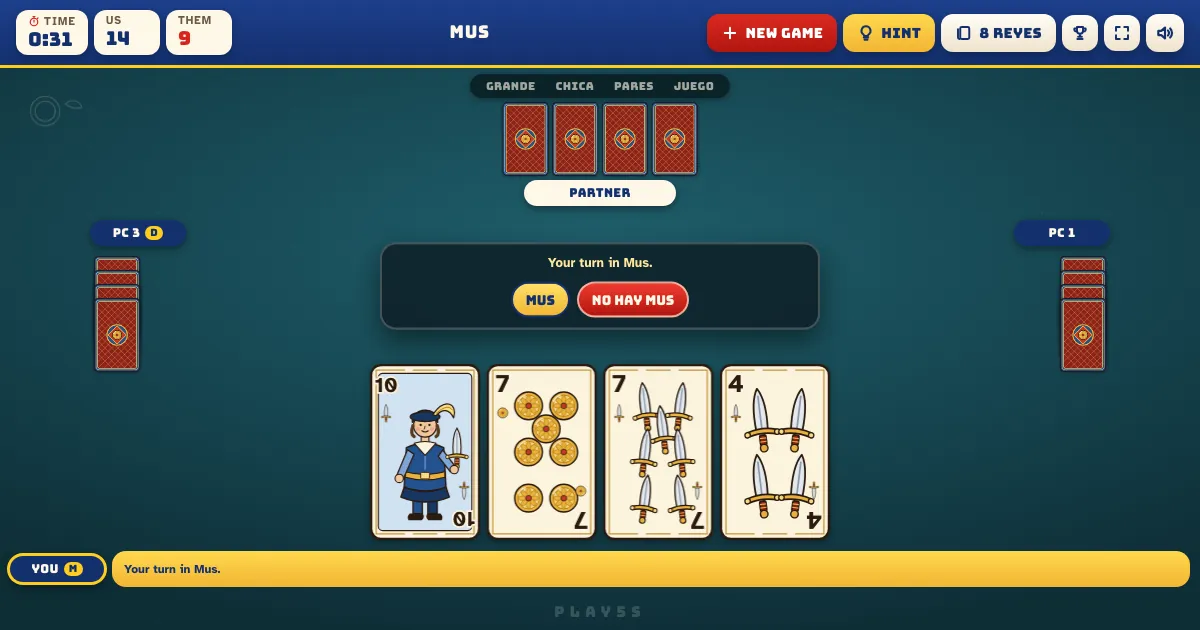
Starting with Mano (the player after the dealer), each seat either says Mus or cuts it with No hay mus. Only if all four say Mus does everyone discard 1 to 4 cards and draw replacements. Once anyone cuts, betting runs through Grande, Chica, Pares and Juego (or Punto when nobody has 31 or more).
In 8 Reyes (default and Daily Deal) every 3 counts as a Rey and every 2 as an As, which makes pairs and 31s far more common. In 4 Reyes the cards keep their natural ranks.
 Zoom in
How do Envido, Quiero, No quiero and ¡Órdago! work?
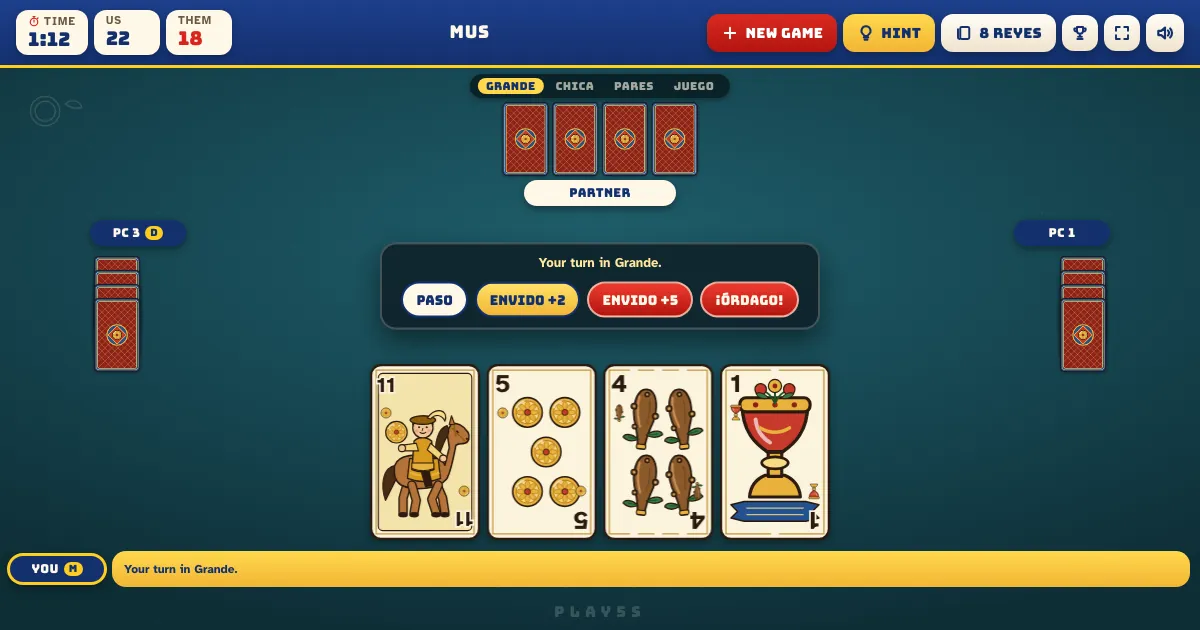
A side that bets Envido +2 or +5 forces the others to answer: Quiero keeps the bet until the showdown, a raise pushes it up, No quiero gives the bettors the previous accepted stake at once (1 piedra if it was the opening bet). In Play5s one opponent answers for the whole pair.
When a bet in Pares, Juego or Punto is refused, the bettors still score the Pares, Juego or Punto value of their own hands at the showdown. ¡Órdago! bets the whole 40-piedra game on that lance: if the others call, the hands are shown and the match ends there.
 Zoom in
How is each lance scored in Mus?
Grande and Chica give 1 piedra when nobody bets, and Pares and Juego add fixed piedras for the winning side’s hands on top of any accepted bet.
Court figures count 10 toward Juego (and so do the 3s in 8 Reyes). 31 is the best Juego, then 32, 40, 37, 36, 35, 34 and 33. When no one has Juego the fourth lance becomes Punto: the highest sum up to 30 wins 1 piedra.
| Lance | Winner / bonus | 8 Reyes note |
|---|---|---|
| Grande | Highest cards; 1 piedra if nobody bets | 3s rank as Reyes |
| Chica | Lowest cards; 1 piedra if nobody bets | 2s rank as Ases |
| Pares: Par / Medias / Duples | +1 / +2 / +3 piedras per player holding them | Four of a kind counts as Duples |
| Juego: 31 | +3 piedras; order 31 > 32 > 40 > 37 … 33; other Juego +2 | Rey + Rey + Rey + As or three 3s + a 2 make 31 |
| Punto (nobody has Juego) | Closest to 30 wins, +1 piedra | Played automatically |
What are señas, levels and ranked rules?
Practice games can show partner signals (señas), while ranked and Daily games play without them or Hint.
- Señas are optional signals between partners; turn them on in Practice if you want to learn to read them.
- Casual, Standard and Expert are different opponents: Expert estimates its chances from its own cards and what has been announced in Pares and Juego, and calls bets by odds.
- Only 40-piedra games at Standard level, señas off and no Hint go on the all-time and Daily leaderboards.
- References: Pagat – Mus and Mus on Wikipedia ES; also try Play5s Tute.
Mus questions
What is the difference between 8 Reyes and 4 Reyes in Mus?
In 8 Reyes all four 3s act as Kings and all four 2s as Aces, so there are eight Kings and eight Aces. In 4 Reyes the cards keep their natural ranks.
What happens if nobody holds Juego (31 or more)?
The fourth lance becomes Punto: the highest sum up to 30 wins 1 piedra plus any accepted bet.
How are ties broken in Mus?
Every tie goes to the tied player closest to Mano (the first seat after the dealer).
Can I play Mus online free without signing up?
Yes. You play against three computer seats in your browser; nothing to download and no account, and your game is saved on your device.
Are señas allowed on ranked boards?
No. Señas can be turned on in Practice only; ranked 40-piedra and Daily Deal games play without them.
About this version
Play5s Mus covers the four lances, discard-pile reshuffling, tie-breaking by Mano and the instant órdago, all in plain deterministic code.
The game runs in your browser and saves automatically; ranked games are replayed on the server before a score is accepted.
Read more about Play5s, or see all of our free card games.